Categories
Health

See Felicity Jones as Ruth Bader Ginsburg in the First Trailer for *On the Basis of Sex*


Last year, Felicity Jones signed on to portray Supreme Court Justice Ruth Bader Ginsburg in an upcoming biopic called On the Basis of Sex—and now the first trailer for the movie is here.

If these two-plus minutes are any indication, On the Basis of Sex will focus solely on Bader Ginsburg as a young lawyer battling sexism in both her career and the culture at large. The first scene shows her literally walking up the stairs of Capitol Hill amid a sea of dudes in suits—and that image permeates the entire trailer.

It seems Bader Ginsburg faced sexism everywhere she turned. She lived under the shadow of her husband, Martin (played by Armie Hammer), was called a “ball-buster” for gradating at the top of her class, and was rejected from jobs all because she was a woman. “If the law differentiates on the basis of sex, then how will women and men ever become equals,” Bader Ginsburg asks at the top of the trailer.

But attempts to change this by taking on a case that could potentially overturn decades of gender discrimination. Felicity Jones and Armie Hammer star alongside Justin Theroux, Sam Waterston, Jack Reynor, and Kathy Bates. Mimi Leder, known for films like Deep Impact and The Peacemaker, is directing.

“The word ‘woman’ does not appear even once in the U.S. Constitution,” a judge says to Bader Ginsburg at one point in the trailer, to which she replies, “Nor does the word ‘freedom,’ your honor.”

Check out the trailer, below:

On the Basis of Sex hits theaters on December 25.

Related Stories:

Felicity Jones Reveals Star Wars Characters’ Senior Superlatives

“You Know Her as the Notorious RBG, but She’s Bubbie to Me”

What You Should Know About the Supreme Court Arbitration Ruling That Ruth Bader Ginsburg Called “Egregiously Wrong”


Source link

Categories
Health

Twitter Users Promise to Protect Justice Ruth Bader Ginsburg at All Costs After SCOTUS Shakeup


After Supreme Court Justice Anthony Kennedy announced his retirement from the bench this week, questions quickly surfaced about what his exit means for the future of women, people of color and the LGBTQ community, whose rights are often on the line in high-profile cases that come before the justices.

But there was one other person the internet immediately focused their attention on: Ruth Bader Ginsburg.

Kennedy’s retirement sent Twitter into a full panic spiral, as people worried that perhaps RBG, who is 85, might also be planning her exit. Ginsburg is the oldest Supreme Court Justice, and she’s already five years past the average age at which most Justices have retired.

“Protect RBG at all cost!” tweets flying across social media read, with many users promising to send her vitamins, prayers, and even 24/7 security detail. “I’m buying Ruth Bader Ginsburg an Anytime Fitness membership, 10 years of Vitamins, and a lifetime of Smoothies…” one Twitter user wrote. “I’m becoming an organ donor but only if my organs are going to Ruth Bader Ginsburg,” someone else said.

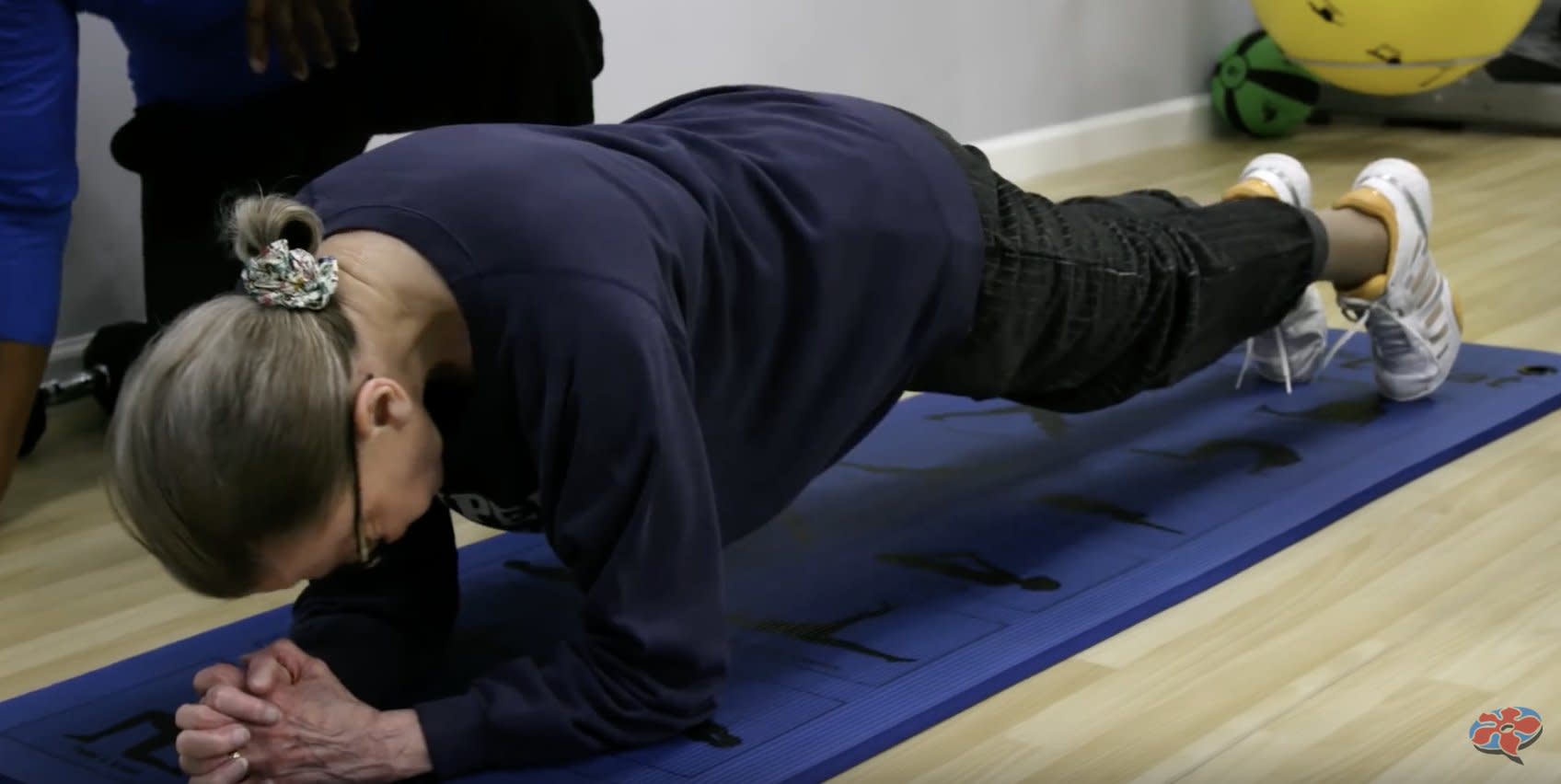
The good news for nervous RBG fans is that she’s still going strong. While many predicted she might call it quits during the Obama administration, the planking heroine of an octogenarian has kept on. She even hinted earlier this year that she hoped to follow the path of former Supreme Court Justice John Paul Stevens, who retired at the age of 90. According to the Los Angeles Times, she also said that she’s in “very good” health and that “as long as I can do the job full steam, I will be here.”

Plus, there’s recorded proof of her fitness level here, which means Twitter users can rest easy.

While the world went full-blown Liam Neeson in Taken over the Notorious RBG, she was busy reacting to Kennedy’s news like the boss she is. Kennedy, who was considered the Supreme Court’s key swing vote, could throw off the conservative-liberal balance of the bench with his retirement, but there was no trace of anxiety in Ginsburg’s sweet tribute to him.

“I will miss the pleasure of his company at our Conference, his helpful suggestions on circulating opinions, his recommendations of art exhibitions to visit with my chambers staff, and much more,” she said in a statement. “For the good he has done during the 43 years he has served as a member of the federal judiciary, he has earned a rousing Bravo.” She also called Kennedy a “true gentleman, a caring jurist and a grand colleague in all respects.”

What a class act. (But also, please never retire.)

Related Stories:

A Reminder That We Won’t Need a Full Repeal of Roe v. Wade for Abortion to Be Restricted

How Justice Anthony Kennedy’s Retirement From the Supreme Court Could Erode Women’s Rights


Source link

Categories
Health

What You Should Know About the Supreme Court Arbitration Ruling that Ruth Bader Ginsburg Called 'Egregiously Wrong'


Ruth Bader Ginsburg has always been a fierce warrior for equal rights—so much, in fact, that her tenacity and determination has earned her the nickname of the “Notorious RBG.” On Monday, she lived up to her name and reminded everyone of her champion litigator skills by standing up to the Supreme Court’s majority opinion on allowing employers using arbitration agreements to block workers from coming together to file class-action suits, calling the decision “egregiously wrong.”

In a rare move, RBG read her written dissent from the bench, CNN reports, saying, “The court today holds enforceable these arm-twisted, take-it-or-leave-it contracts—including the provisions requiring employees to litigate wage and hours claims only one-by-one. Federal labor law does not countenance such isolation of employees.”

But what was this case really all about? Here are four things you should know about the ruling.

1. The Epic Systems Corp. v. Lewis Case looked at how federal laws relate to workplace lawsuits.

RBG was all fired up over Epic Systems Corp. v. Lewis, which consolidated three cases where employees wanted to file group claims against their employers, despite signing contracts that contained arbitration clauses. Arbitration clauses are legal methods used to resolve disputes in private settings through a third-party, instead of in public court or through a collective claim in court. To the disappointment of many, including RBG, the Supreme Court ruled that a federal law gives employers the right to enforce these kinds of legal agreements and that they can use arbitration clauses in contracts to keep workers from banding together as a collective.

According to the New York Times, the Supreme Court issued a 5-4 ruling, which is estimated to affect some 25 million employment contracts.

2. Arbitration agreements have come under fire in the wake of #MeToo.

You may have been hearing a lot about arbitration agreements lately—they’ve inspired a lot of controversy in the wake of the #MeToo movement. Critics have pointed out that in cases of sexual harassment, arbitration agreements can force victims into silence by limiting the ways they can pursue and talk about their claims.

The latest headlines about arbitration agreements involved Uber. Several women who accused Uber drivers of sexual misconduct wrote a public letter urging the company’s board to release them of a mandatory arbitration provision found in the Uber app’s user agreement, partially so that they could join a collective claim against the company together. Uber revealed in a post that it would reverse the policy as it pertains to sexual harassment.

3. Critics think the Supreme Court ruling will affect survivors of sexual harassment and assault.

Although Epic Systems Corp. v. Lewis was not specifically about sexual harassment, the Supreme Court signaled through their ruling that it would side with employers. The Cut writes that the ruling is a potential blow to the #MeToo movement—women and victims of sexual misconduct who sign arbitration agreements may not be able to fight sexual harassment together in the workplace. If their employer puts one of these clauses in the contract they sign as an employee, they’ll have to file individual claims and challenge their place of work on a one-on-one basis.

Additionally, they might also have to deal with non-disclosure agreements, which could prevent them from speaking publicly about disputes and corralling public support.

4. RBG says the decision has other implications on employee issues.

Justice Neil M. Gorsuch said the court came to their decision through a federal law that favors arbitration and the court’s precedents. But in her dissent, RBG was quick to point out specific employment issues that the majority opinion could lead to, suggesting that individual arbitrations may not offer results that are as impactful as class-action suits.

“By joining hands in litigation, workers can spread the costs of litigation and reduce the risk of employer retaliation,” she wrote.


Source link

Categories
Health

This Is Justice Ruth Bader Ginsburg's Actual Workout


In 1999 Justice Ruth Bader Ginsburg was recovering from cancer. Her late husband urged her to find a personal trainer, and she found me. She was determined as all get-out, and we started building a regimen. After several months of our twice-weekly workouts, her bone density began to increase. Her doctor told me: “I’m not sure what you’re doing, but keep doing it.”
Keep doing it we have. We work out twice a week, usually in the gym at the Supreme Court. Sometimes we chat, but mostly we just get to it. We listen to PBS NewsHour, and she gives it her all. For example, she’s graduated from doing push-ups against a wall, to doing them on her knees, to full-on standard push-ups. Justice Ginsberg is T.A.N. (tough as nails). Try our routine yourself: All you need is a resistance band. Warm up by jogging or marching in place for five minutes.
Adapted from The RBG Workout: How She Stays Strong and You Can Too, by Bryant Johnson, illustrated by Patrick Welsh, out October 17


Source link