Categories
TV & Movies

#398 January 19, 2021


Matt writes: On January 7th, the movie world lost one of its brightest lights, filmmaker Michael Apted (1941-2021), who died at age 79. Renowned for his groundbreaking “Up” series of documentaries, which followed the lives of British children every seven years as they became adults, Apted also helmed various sublime narrative features, including 1980’s Loretta Lynn biopic, “Coal Miner's Daughter,” that earned Sissy Spacek a Best Actress Oscar. You can read Matt Zoller Seitz’s obituary here and Roger Ebert’s Great Movies essay on the “Up” series here, as well as watch Apted’s 2019 interview about “63 Up” as part of the BUILD series in the video embedded below.

Trailers

In & Of Itself (2021). Directed by Frank Oz. Written by Derek DelGaudio. Starring Derek DelGaudio. Synopsis: Storyteller and Conceptual Magician Derek DelGaudio attempts to understand the illusory nature of identity and answer the deceptively simple question ‘Who am I?’ Debuts on Hulu on January 22nd, 2021.

I Care a Lot (2021). Written and directed by J Blakeson. Starring Rosamund PikeEiza GonzálezDianne Wiest. Synopsis: A crooked legal guardian who drains the savings of her elderly wards meets her match when a woman she tries to swindle turns out to be more than she first appears. Debuts on Netflix on February 19th, 2021.

Dear Comrades! (2021). Directed by Andrey Konchalovskiy. Written by Andrey Konchalovskiy and Elena Kiseleva. Starring Yuliya VysotskayaVladislav KomarovAndrey Gusev. Synopsis: When the communist government raises food prices in 1962, the rebellious workers from the small industrial town of Novocherkassk go on strike. The massacre which then ensues is seen through the eyes of a devout party activist. US release date is TBA.

Breaking News in Yuba County (2021). Directed by Tate Taylor. Written by Amanda Idoko. Starring Mila KunisAllison JanneyJuliette Lewis. Synopsis: After her husband goes missing, Sue Buttons, an under-appreciated suburban wife, gets a taste of being a local celebrity as she embarks on a city-wide search in Yuba County to find him. Debuts in the US on February 12th, 2021.

The United States vs. Billie Holiday (2021). Directed by Lee Daniels. Written by Suzan-Lori Parks (based on the novel by Johann Hari). Starring Andra DayTrevante RhodesGarrett Hedlund. Synopsis: Follows Holiday during her career as she is targeted by the Federal Department of Narcotics with an undercover sting operation led by black Federal Agent Jimmy Fletcher, with whom she had a tumultuous affair. Debuts on Hulu on February 26th, 2021.

True Mothers (2021). Directed by Naomi Kawase. Written by Naomi Kawase and Izumi Takahashi (based on the novel by Mizuki Tsujimura). Starring Hiromi NagasakuArata IuraAju Makita. Synopsis: A woman with an adopted child is contacted unexpectedly by the child’s birth mother. US release date is TBA.

Cherry (2021). Directed by Anthony Russo and Joe Russo. Written by Angela Russo-Otstot and Jessica Goldberg (based on the novel by Nico Walker). Starring Tom HollandCiara BravoJack Reynor. Synopsis: An Army medic suffering from post-traumatic stress disorder becomes a serial bank robber after an addiction to drugs puts him in debt. Debuts on Apple TV+ on February 26th, 2021.

Bliss (2021). Written and directed by Mike Cahill. Starring Salma HayekMadeline ZimaOwen Wilson. Synopsis: A mind-bending love story following Greg who, after recently being divorced and then fired, meets the mysterious Isabel, a woman living on the streets and convinced that the polluted, broken world around them is a computer simulation. Debuts on Prime Video on February 5th, 2021.

Clapboard Jungle (2021). Directed by Justin McConnell. Synopsis: Following five years in the life and career of an independent filmmaker, supported by dozens of interviews, posing one question: how does an indie filmmaker survive in the current film business? US release date is TBA.

The World to Come (2021). Directed by Mona Fastvold. Written by Ron Hansen and Jim Shepard. Starring Katherine WaterstonVanessa KirbyChristopher Abbott. Synopsis: Somewhere along the mid-19th century American East Coast frontier, two neighboring couples battle hardship and isolation, witnessed by a splendid yet testing landscape, challenging them both physically and psychologically. Debuts in the US on February 12th, 2021.

The Map of Tiny Perfect Things (2021). Directed by Ian Samuels. Written by Lev Grossman. Starring Kathryn NewtonJosh HamiltonKyle Allen. Synopsis: Two teens who live the same day repeatedly, enabling them to create the titular map. Debuts in the US on February 12th, 2021.

Horizon Line (2021). Directed by Mikael Marcimain. Written by Josh Campbell and Matthew Stuecken. Starring Allison WilliamsAlexander DreymonKeith David. Synopsis: A couple flying on a small plane to attend a tropical island wedding must fight for their lives after their pilot suffers a heart attack. Now available in the US.

Willy’s Wonderland (2021). Directed by Kevin Lewis. Written by G.O. Parsons. Starring Nicolas CageBeth GrantTerayle Hill. Synopsis: A quiet drifter is tricked into a janitorial job at the now condemned Wally’s Wonderland. The mundane tasks suddenly become an all-out fight for survival against wave after wave of demonic animatronics. Fists fly, kicks land, titans clash — and only one side will make it out alive. US release date is TBA.

To All the Boys: Always and Forever (2021). Directed by Michael Fimognari. Written by Katie Lovejoy (based on the novel by Jenny Han). Starring Noah CentineoLana CondorJanel Parrish. Synopsis: Continuing the romantic life of the teenage girl and facing her good and hard times with her friends and family. Debuts on Netflix on February 12th, 2021.

Barb & Star Go To Vista Del Mar (2021). Directed by Josh Greenbaum. Written by Kristen Wiig and Annie Mumolo. Starring Kristen WiigAnnie MumoloJamie Dornan. Synopsis: A pair of best friends find themselves in over their heads. Debuts in the US on February 12th, 2021.

Music (2021). Directed by Sia. Written by Sia and Dallas Clayton. Starring Maddie Ziegler, Leslie Odom Jr., Juliette Lewis. Synopsis: Zu is newly sober when she receives news that she is to become the sole guardian of her half-sister named Music, a young girl on the autism spectrum. US release date is TBA.

Falling (2021). Written and directed by Viggo Mortensen. Starring Viggo MortensenLance HenriksenSverrir Gudnason. Synopsis: John Peterson lives with his partner Eric and their adopted daughter in Southern California. When he is visited by his aging father Willis from Los Angeles who is searching for a place to retire, their two very different worlds collide. Debuts in the US on February 5th, 2021.

Malcolm & Marie (2021). Written and directed by Sam Levinson. Starring ZendayaJohn David Washington. Synopsis: A director and his girlfriend’s relationship is tested after they return home from his movie premiere and await critics’ responses. Debuts in the US on February 5th, 2021.

Sam Pollard on “MLK/FBI

Matt writes: Director Sam Pollard recently spoke with our contributor Donald Liebenson about his enormously timely documentary, “MLK/FBI,” which was praised by our critic Odie Henderson. Read the full conversation here.

Charlie Chaplin’s “The Kid

Matt writes: In honor of the 100th anniversary of Charlie Chaplin’s masterpiece, “The Kid,” our contributor Audrey Fox wrote about the film’s enduring legacy, which can even be evidenced in the popular “Star Wars” series, “The Mandalorian.” Read the full essay here

Free Movies

How to Go Out on a Date in Queens (2006). Directed by Michelle Danner. Written by Richard Vetere. Starring Jason AlexanderRuth BarrieCarlos M. Castillón. Synopsis: A self-proclaimed dating expert tries to get his best friend, who lost his wife two years earlier, back into the dating scene, with disastrous results.

Watch “How to Go Out on a Date in Queens”

Uncle Bob (2010). Directed by Robert Oppel. Synopsis: Robert Oppel’s documentary about the life and murder of his uncle & namesake, Robert Opel; the man who streaked the Academy Awards in 1974.

Watch “Uncle Bob”

The Casserole Club (2011). Directed by Steve Balderson. Written by Frankie Krainz. Starring Susan TraylorKevin Scott RichardsonDaniela Sea. Synopsis: A group of mod 1960’s era suburban housewives, close-knit and neighborly, are all bent on one-upping each other, trying to prove that each is “the hostess with the mostess.”
Watch “The Casserole Club”


Source link

Categories
TV & Movies

Leslie Odom Jr., Aldis Hodge, Eli Goree, and Kingsley Ben-Adir on the Brotherhood of One Night in Miami


If you don’t believe these four men are the best of friends, you won’t believe the movie. That’s the primary challenge, among many others, for the four leads in Regina King’s feature directorial debut “One Night in Miami.” It’s a surprisingly humorous film—predicated on the revealing conversations these men instigate—about friendship, life-altering transitions, and the shared hope for Black liberation.        

Adapted by Kemp Powers’ from his play of the same name, “One Night in Miami” follows four of the biggest Black megastars of the 1960s: Cassius Clay (Eli Goree), Malcolm X (Kingsley Ben-Adir), Jim Brown (Aldis Hodge) and Sam Cooke (Leslie Odom Jr), as they celebrate Clay’s 1964 victory over Sonny Liston for boxing’s heavyweight title. Each man arrives at the Miami hotel room at a crossroad in their life. Clay is on the verge of converting to the Nation of Islam while Malcolm is on his way out. Brown must decide between either a movie or football career. Cooke considers the price of mainstream, or white-decided, chart success. 

The film’s main setting, a motel room, is a metaphorical barbershop. Jokes run freely, and Powers’ script is filled with the type of one-liners you’d never let a stranger get away with. The topics that come to bear hit with less ease. Flared tempers warm verbal blades to a heat that cuts so deep, with such precision, it would only be tenable if the men were the closest of friends. King sidesteps biopic artifice and thoughtfully guides her actors, with the quartet of Odom Jr., Ben-Adir, Hodge, and Goree achieving a level of comfort that makes us wonder aloud if they weren’t long-lost brothers. Their solidarity is not only tangible off the screen, it’s unbreakable as well.        

In a loose yet spirited discussion, RogerEbert.com spoke to the four leads of “One Night in Miami,” about the power of having Regina King as their director, the importance of playing these historical figures, and the bonds each actor shares with one another. 

“One Night in Miami” is heavily dependent upon camaraderie the four character share. How did you translate that closeness in the script on-set?

ALDIS HODGE: I appreciate you noting that. We didn’t have a lot of prep time. It was simply: get to work. What you saw were a lot of artists who are dedicating themselves to their roles and we really tried to bring that out. So it was a mad dash. We stayed in a constant mode of hustle and doing the research and making sure that we were really dialing into these characters because we know how important this movie really is. 

KINGSLEY BEN-ADIR: I was just going to say, I like this free flowing conversation. What’s the truthful answer for that? Leslie. Cause we get asked that a lot. People ask, “How’d you not play a caricature?” Well, I don’t know. Was it just fluke? 

LESLIE ODOM JR.: I mean, sure. You can’t take credit for all of it. Some things do come together and it’s a miracle whenever that happens. But I think there was great care taken in vetting. It wasn’t just about can you act. It was about a certain kind of approach, a certain kind of humanity and humility. Because it wasn’t an accident. Regina and quite frankly, you [Kingsley], because early on you had so much material, we were just sitting in that hotel room, and you were so collaborative. You guys set the tone. Your process, the way you were working, and also your openness to have conversations about what was working, and what wasn’t working; it set the tone. I’ve been in situations on movies, and on projects, that were not as lovely as this set.

ELI GOREE: It’s funny we all have different opinions. Cause I really felt like it was Regina and you, Leslie. I’m not even joking. You’ve already been part of a huge franchise yet your humility and coolness, and your ferocity to fight for the things you needed to fight for. There was never a feeling of “I’m sitting next to Tony award-winner” or “I’m sitting next to Oscar winner, Regina King.” When you guys came in as serious, humble, and willing to listen and willing to take things in, it set a tone. For me it was like, “Okay, this is the tone. This is the vibe. This is how the team is. This is how the team is running. Let me get up to speed.”

Regina King with Eli Goree on the set of “One Night in Miami”

It’s still rare not only to have a Black director, but also a Black director who’s as accomplished of an actor as Regina King. This is such a uniquely Black story, how helpful was it to have Regina as a director to turn to?

LO: Just to know that whenever she took that short walk from behind the camera to whisper something in my ear, she was going to offer me something that was a value to me. She was going to make me better. She would put me on a more honest path, a more entertaining path. She would offer me something that would not have occurred to me. That was the benefit of having, amongst the quadrumvirate, the fifth-drumvirate [laughs] she really was the other member of the crew. In a little band of brothers we had a sister. 

[silence]

By the way, everyone can chime in.

LO: Y’all better speak on Regina!

[laughs]

AH: It was so instrumentally helpful in every way possible. Here’s something that people don’t understand about the value of her being Black. She understands the meaning and the value of what we’re going through and how we’re going through it. You don’t have to go to her and say, “Hey, we wouldn’t do this because of X, Y, and Z. Or this is not normal in our culture.” You don’t have to explain that to her. With other directors, I find myself having to explain that quite often. And I’m down for the challenge, but for something like this, where it’s about the culture, and it’s for the culture—you need someone who’s going to understand the culture.

Then you also have Kemp Powers, this brother is brilliant beyond measure—shout out to Kemp for writing “Soul“—who gets it. He knows the tone of the conversation and how the conversation has to go in order for us to reach the potential of efficacy for the message. So it really does help so much when you have Black people telling a Black story.

KBA: I haven’t had the experience of working with someone who is as tuned into process [as Regina]. The calm she had, and how she knew when to come over and how much to say. I never felt bombarded. Sometimes you’ll have really good directors but they don’t really understand acting. There’s a certain language you need, otherwise the rest of the time you’re translating. With Regina, I never had to translate. She gives you a little push and a steer, and then you’re off. She got the best out of me. I’ve never felt so free on set.

AH: Kingsley did the research to present a different side of Malcolm. And Regina really focused on the vulnerability of these men. We get to show that here, and it just gives you a brand new respect for who they were and what they accomplished.

EG: I just want to reiterate everything these brothers are saying. For me, I had already dug into the Cassius role, which can be good and bad because this is a different story. She had a real clear vision of the story and the moment she was trying to tell. A lot of the direction that I got from her was, “Who am I in this story? Where am I right now?” Making sure you’re in the right movie. When you’ve got four different entities that could be their own film on their own, that ability to make sure everyone’s in the same movie is essential. 

LO: Film is such a collaborative thing. Coming from the theater, I knew when somebody I admired was in the theater, I had some control over their experience that evening. With film I’ve learned, with the little over a handful of films that I’ve made, you really let that control go. Regina took care of us on the day. She took care of us in the editing room. What she’s given us back is so gorgeous. And in many ways better than I could have even imagined.

Regina King with Kingsley Ben-Adir on the set of “One Night in Miami”

In “One Night in Miami” there are so many fly-on-the-wall conversations that we, as Black people, are used to having. The film is almost like a barbershop in a hotel room. How much weight did you feel trying to translate these frank conversations?

EG: I didn’t feel weight. Because weight to me is like a burden. I felt excitement. That’s the thing I loved so much about the script: It wasn’t the same old biopic. It didn’t start off as he was a child, somewhere, in some hard circumstance, and then he started to grow. In “Ali,” this night [February 25, 1964] happens in that film. But it’s here, and then it’s gone. That’s what you miss when you try to put someone’s life—like Malcolm X or Cassius Clay—into two hours. The beautiful thing about this is you can go on a deep dive and unpack a charged moment and see just how much life is in one conversation. For example, you could make a movie about the day Nelson Mandela gets out of prison. You can make a movie about his whole life, or you can make a movie about that one day because that’s enough for a movie. I reveled in the opportunity to be able to tell this story, which I think was necessary and beautiful.

AH: I didn’t really feel any weight. I felt elation. Part of my charge as an artist is to exhibit the things that people may not understand. Or to show the things that people do go through so they know they’re being recognized. For these kinds of conversations, I was happy because we get to show people what we be talking about. This is what goes on. And you cannot deny us. 

You have a super-megastar singer, a super-megastar football player, and the heavyweight champion of the world. You have all of these men you would think are removed from any effects that the rest of us go through—but no; they go through the exact same thing. Their position in life, their money, and their influence means nothing when you stack that up against them being Black in America. People look at me speaking on issues and they say, “But you’re a successful actor.” First of all, we’re not even talking about that. We’re talking about the value my life has versus yours. It’s not the same. So stop denying it, especially when you don’t experience it. 

KBA: As a working actor, so much of this job is just about treading water and trying to get the next gig. Other actors are probably interviewing all the time and analyzing the work. They’re in a very luxurious position at the top; where they get to decide what type of character they want to play. They’re shaping their careers. But for the rest of us, we’re just out here. So when this opportunity came, it was a very serious situation. It’s an opportunity to show Regina King your acting. 

Sometimes casting directors, they look at your tapes first, and then they decide whether they’re good enough. But I was like, “I think Regina is actually going to watch these” because they’re really trying to find a Malcolm. That was a joy in itself. The weight of it was, yes, playing Malcolm, but also showing the work to Regina, and just getting to do what you’ve always dreamed about.

EG: I want to just second that. I get that question all the time. “What made you choose to take on this role?” It’s just so funny to me because that’s not the position I was in as an actor. To say, “Oh, I’m going to choose to pass on this Cassius Clay role …” No, no. You’re grateful to have the opportunity to audition for something like this.

Leslie Odom Jr. in “One Night in Miami”

It feels like every single day the importance of this movie is growing, especially as we’ve seen what’s happened over the last year. How has making this movie stuck with you on a personal and spiritual level?

LO: It was a clarifying experience. I didn’t know if the movie was going to do anything, if anybody was going to see it. This was before Amazon came on to support it. I just made a little independent movie. It was a similar experience to working on “Hamilton.” There was something that I suspected about myself. I know I’m not the only one. These brothers probably had similar experiences. It’s that thing when you’re growing up and you feel like, “I don’t know. I could do something special, if I was given the opportunity.” You’re watching your white brothers and sisters really tear it up and climb the ladder and you’re like, “Maybe I could be a contender?” 

What Lin-Manuel gave a room full of Black and Brown people was the evidence. It wasn’t about proving it to the world, or to the audience, which I’m grateful we got the chance to do too, but we got to prove it to ourselves. Leaving “Hamilton,” I never had to question again what I was capable of. That’s a powerful thing to give somebody. That’s what Kemp gave us with this script. He laid down the gauntlet. Kingsley and I would talk about how this was our “Glengarry Glen Ross.” Kemp and Regina, they allowed us to prove something to ourselves. Before I knew anybody who was going to see it, I was like,” I think we did something special back there.” 

AH: For me, there was professional growth. I studied Regina and her directing. Because at the time, I had acquired a short film that I was producing, and was set to direct, but then we got hit with quarantine. Still going to do it, but it was really just studying Regina. 

On a personal level, I’ve been fortunate enough to be part of some projects that have influenced culture in magnificent ways. I feel it with this film yet again. I see how it’s been received thus far. The resounding response has been synonymous and consistent with people understanding that this is not a film that’s going to badger you over the head or tell you you’re wrong. This is a film about love, about empathy, about unity, and about building something. It’s about Black people. And it’s about these brothers. 

KBA: I love what Kemp was saying yesterday about how he’s frustrated by so many people calling the film ‘timely.’ It was timely in 2013. It was timely in 2015. It was timely when this happened in London. It felt timely when I read it in the summer of 2019. Coming into this before the pandemic, before George Floyd, as a Black man, I understood how important the conversation in this film was.

I was so excited by the idea of being a part of something that I hadn’t seen before. That feeling can be kind of scary. But you’ve got to be smart and think outside the box and go, “No—that’s actually a good thing.” It’s like what Leslie said to me before, “They don’t make ‘em like this.” It was a really one-off opportunity. And … that does not answer your question at all.

LO: No, no. It’s really about the flow. The flow. [laughs]

EG: I’m enjoying what everyone’s saying. I forgot the question both times. These brothers are inspiring me, right now.

Aldis Hodge in “One Night in Miami”

It was just about what you’ve taken away from making this film.

EG: Man, so many things. Personally, I have so much admiration for these guys. What they put up there, what they accomplished, the honor they gave to their characters, it’s amazing. Every day I wake up and there’s some new person who’s been touched by this film. I’ve never been a part of anything that resonates like that. People are watching this, and they’re messaging me saying that they cried, or they’re glad they got to see this.

KBA: It’s kind of overwhelming.

EG: Exactly. I’m still processing it. I started to get an inkling of that when I first started playing Cassius. I was staying in character down in New Orleans, and I saw the way people were responding to me. 

People would give me things for free. “No—don’t worry about it champ. Can you sign this?” And I’d sign it, but they’d be like, “No, no—sign it as Cassius. Not as Eli.” Even if you’re just portraying him, it touches people in a special way. I know it’s true for all of these men. They had an impact in the world and they used their life to mean something for others. To be part of that legacy, to have some small attachment to that story, it’s something that I’m so proud of. And then to have the connection I have with Regina and with these guys on a personal level. These people are really important to me. 

I saw a thing on the very last episode of “Seinfeld.” Seinfield said, before they went out to shoot, “From now on whenever anyone mentions one of us, they’ll always think of all four of us.” That couldn’t be more true than with this group of four. That’s a special connection that almost never happens.

“One Night in Miami” is now playing on Amazon. To read Odie Henderson’s review of the film, click here.


Source link

Categories
TV & Movies

10 Upcoming Films That Could Shake Up Oscar Season


Because of Covid-19 quarantine restrictions, the eligibility period for Oscar contenders has been stretched from the standard December 31 deadline to February 28, 2021. While a considerable number of lauded films have either have had short runs in theaters before landing on streaming platforms or a VOD format already, the extended period into 2021 has led to a flock of possible dark-horse titles that could upset the awards races this year.

Here are 10 spoilers that might bump some of the early favorites off the track. The films are listed by their opening dates during this extra window of time.

1. “The Dig” (Netflix, January 15): If “Promising Young Woman” wasn’t enough to get Carey Mulligan on the ballot, this truth-based tale set right before World War II directed by Simon Stone will likely at least get her an extra boost. She plays Edith Pretty, an English widow in Suffolk who hires a self-made archaeologist the reveal what is inside the multiple mounds of dirt on her property. The self-described local excavator Basil Brown (Ralph Fiennes) unearths a burial ground of sorts. But factors like the upcoming war, bad weather, and an interloping, stuffy archaeologist tread on Brown’s discovery. It turns out that archaeology is more about the living than the dead.

2. “Penguin Bloom” (Netflix, January 27): This Australian tear-jerker based on a fact-based best-seller stars Naomi Watts as Sam Bloom, a mother who was left paralyzed after a near-fatal accident. Her husband (Andrew Lincoln), her mother (Jacki Weaver), and her three young sons struggle to deal with Sam’s situation. But matters take a turn for the better when an injured baby magpie they call Penguin enters the movie, and causes Sam to piece her life together again. 

3. “The Little Things” (In theaters on January 29, while simultaneously having a month-long run on HBO Max): Any movie with a trio of Oscar winning actors in the form of Denzel Washington, Rami Malek, and Jared Leto sounds like a must-see to me. This dark crime yarn set in 1990 about a suspected serial killer pits Washington’s Kern County deputy sheriff against Malek’s strait-laced L.A. detective, with Leto as a possible suspect who forms a strange relationship with Malek’s law enforcer.

4. “Cinderella” (In theaters on February 5): This musical romantic-comedy is directed by Kay Cannon, who is best known for writing and producing the three “Pitch Perfect” films. It stars Cuban-American singer Camila Cabello in the title role and Idina Menzel as Cinderella’s mean stepmother. Meanwhile, Billy Porter plays Fab G., a genderless fairy godparent. The cast also features Pierce Brosnan as a king, Minnie Driver as his queen, and Missy Elliott as the Town Cryer, while both James Corden and John Mulaney play footmen and mice. The best news is that “Frozen” belter Menzel and Cabello will sing original songs.

5. “Malcolm & Marie” (In theaters in January before being released on Netflix on February 5): Written and directed by Sam Levinson, the creator of HBO’s teen drama “Euphoria.” The Emmy–winning star of that show, Zendaya, co-stars in the black-and-white film with John David Washington. The shoot took place in a private home in Carmel, California. Covid-19 safety protocol was followed with cast and crew quarantined before filming and after. The premise? Washington plays Malcolm, a filmmaker who returns home after celebrating a movie premiere, hoping it becomes a critical and financial success. But the evening becomes more about the state of his relationship with Marie (Zendaya). 

6. “Judas and the Black Messiah” (In theaters on February 12 as well as on HBO Max): This biopic drama, directed and co-written by Shaka King, is based on the life of Fred Hampton, chairman of the Black Panther Party in late 1960s Illinois. Daniel Kaluuya, Best Actor Oscar nominee for 2017’s “Get Out,” stars while Lakeith Stanfield plays a petty criminal who agrees to work with the FBI and take down Hampton. The cast also includes Jesse Plemons, and Martin Sheen as J. Edgar Hoover. It will have its world premiere at the Sundance Film Festival on February 1.

7. “French Exit” (In theaters on February 12): The surreal comedy directed by Azazel Jacobs stars Michelle Pfeiffer as a Manhattan heiress and widow who moves to Paris with her son with the few funds they have left. They also have a black cat, who she believes is actually her deceased husband. Pfeiffer, who is incredibly overdue for Oscar recognition, earned a great deal of praise for her performance when the film premiered at the New York Film Festival in October.

8. “The Courier” (U.S. release date is February 19): British director Dominic Cooke’s historical drama’s ace in the hole is Benedict Cumberbatch, who plays an amiable British salesman Greville Wynne. This unlikely hero recruited by M16 helped the CIA penetrate the Soviet nuclear program during the Cold War. He and his cagey Russian sidekick (Merab Ninidze) would also provide crucial intelligence that ended the 1962 Cuban missile crisis. The slow-building plot is somewhat by the numbers but the true-life spy gets a lift from its cast, including Rachel Brosnahan as a CIA agent and Jessie Buckley as Wynne’s wife, who thinks his testy outbursts means he is cheating on her, an act he has committed before.

9. “Cherry” (In theaters on February 26 and on Apple TV+ on March 12): Brotherly co-directors Anthony and Joseph Russo, veterans of Marvel Cinematic Universe, turn to the crime genre. In “Cherry,” their Spider-Man Tom Holland plays a scary Army medic suffering with PTSD who becomes addicted to opioids and starts robbing banks to feed his addiction. His cast mates include rapper Pooch Hall, Damon Wayans Jr., and Michael Gandolfini. Joe Russo has already declared Holland’s performance as Oscar-worthy. As he told Collider, “He is shredding himself, physically and emotionally.”

10. “The United States vs. Billie Holiday” (Hulu, February 26): Lee Daniels directs and Andra Day stars as the legendary jazz and blues singer. The film focuses on a period when her career was upended after she was targeted by the Federal Department of Narcotics. She was the subject of an undercover sting operation led by an agent who had a torrid affair with the performer. Day shares the screen with Trevante Rhodes, Garrett Hedlund, Natasha Lyonne, and Da’Vine Joy Randolph.


Source link

Categories
TV & Movies

Film About A Father Who


Every father is a bundle of contradictions. But in Ira Sachs, Sr.’s case, the contradictions are more extreme than most. Filmmaker Lynne Sachs tries to make sense of them—up to a point—in “A Film About a Father Who,” an unraveling of her family’s complicated history, drawn from footage that she’s been gathering between 1984 and the present day. 

Known as “the Hugh Hefner of Park City,” the Utah ski town where Robert Redford founded the Sundance Film Festival, Sachs at his life-force peak was a hotel developer, a devoted skier, a prodigious pot smoker, and a womanizer whose affairs ultimately produced nine children by five women. He emerges here as an infuriating but charismatic figure whose life holds many secrets, and who treats his children and ex-wife (and various girlfriends) with a mix of genuine warmth and shocking selfishness and manipulation. 

The filmmaker has been directing movies for a long time, building an archive of experimental features and shorts. Some were offered, at the time this review was written, in a virtual film festival online at the Museum of the Moving Image in Queens, New York. Sachs is the sister of Ira Sachs (“Keep the Lights On,” “Love is Strange”), and based on the interviews collected here, the whole extended family has an artistic and/or literary mindset even when they make a living some other way. We hear a lot about how playful, adventurous and bold the father was, back in the day, but also how emotionally remote (one child says that he seemed to exist in a detached-seeming middleground, rarely manifesting extremes of euphoria/happiness or anger/sadness. 

There’s a lot of sardonic quipping about his sex life, which impacted the children (and his eventual ex-wife) in ways that troubled everyone but him. The ostensible trigger for this film was the 2016 revelation that there were two other children by yet another woman, beyond the ones that were already known about, their names blacked-out in an insurance document. The movie never gets into why this particular bit of information would shock the family into taking stock of things when the list of prior outrages and scandals was so prodigiously long. It’s not a failing, exactly, but it does momentarily cause the viewer to ask questions that fall beyond the scope of the film itself. One of the director’s siblings weeps as she talks of learning in youth that she had other siblings out there, but being made to wait to meet them, because her father was adamant that they not be connected until his own mother had passed on. Why? She wants to know. Why place such a restriction on truth? Who was being protected?

Kaleidoscopic in both its assortment of materials and its assemblage, this feature doesn’t so much sort out and organize all the different aspects of the father’s life as sift through them in a fixated, somewhat discombobulated way— like a detective poring over contents of a thick file that have spilled out all over the floor, properly impressed by how much work has to be done to even start to understand all the complexities; or, to be more mundane, like a child who has learned a new, unpleasant truth about a parent, in addition to the other unpleasant truths she already knew, and is reeling in shock even as she tries to reframe the picture in a calm and rational way.

The array of formats displayed is so texturally diverse—encompassing Super 8mm and 16mm film, VHS and other low-resolution video formats, and more crisp, high-definition digital video in recent scenes—that the movie is always fascinating, even when it seems to lose or drop the threads of therapeutic/psychological understanding woven throughout the project. 

It’s sometimes hard to tell if the fragmentation in the story and the more atmospheric and/or dislocating touches (such as sound dropouts, and dialogue-as-narration by witnesses who are heard speaking over silent footage of people in earlier time periods, sometimes with their own lips moving) are urgently necessary to aid our understanding and feeling, or if they are vestigial outgrowths of the way an experimental filmmaker typically works (intuitively and viscerally, without obsessing over linear clarity). But there’s no denying that these sometimes alienating touches add to our sense of the father as a towering presence in the lives of his children, not always for noble reasons. 

One of the most striking things about the movie is how it reveals the way in which all adult children feel forever small when contemplating the life experience of their parents: the brave or reckless choices, the beneficial and destructive outcomes, the redactions and blank spots, and the mysteries that will never be solved.


Source link

Categories
TV & Movies

Acasa, My Home


If it weren’t for the high-rise buildings within eyeshot, you could swear that the opening sequence of the acutely compassionate and probing “Acasa, My Home” was filmed in deep wilderness. During that initial scene, our gaze floats over the sun-dappled surface of a muddy marsh, following a teenaged boy as he swims in murky waters that somehow seem idyllic and catches fish with his bare hands, away from the metropolitan area he seems to be right outside of. Soon enough, he is joined by a number of young boys, whose cheery sounds we hear in a cacophony before their faces appear on camera and watch the older brother dexterously catch a wild water bird. When the poor terrified winged creature manages to escape and run for dear life, the boys go straight back to their carefree afternoon, rolling around in mud, giggling away and wresting amid tall reeds.

The drone camera then poignantly peels away from this joyous tableau to slowly reveal Bucharest from atop, juxtaposing the bustling capital against the habitat of the youngsters. They are all a part of the Romanian Enache family, an off-the-grid clan that has been residing on a deserted reservoir by the outskirts of Bucharest (named the Bucharest Delta) for nearly two decades. Considering it’s a tribe of eleven—the parents Gica and Niculina and their nine children—it’s appropriate to think of the Enaches as a small village that operates as a single unit in the earlier moments of filmmaker and investigative journalist Radu Ciorniciuc’s impressive debut documentary. It’s a patriarchal band by all accounts where Gica authoritatively calls the shots. Still, all of its members serve a clear purpose in their shared unconventional life. Living in extreme poverty in a self-made shack alongside all sorts of animals—pigs, chickens and dogs among them—every action is a matter of survival for the Enache family in the absence of access to the basics of urban conveniences.

In a way, “Acasa, My Home” is a real-world “Leave No Trace,” Debra Granik’s recent American drama about an off-the-grid father and daughter rejecting the conformities of a traditional society. Like in that film, Ciorniciuc opens a non-didactic and non-judgmental window for audiences into an alternative world where parents both nurture their babies within the rules of nature and also deprive them of their vital rights, like safety and education. The kids all seem well-adjusted to the ins and outs of their pastoral way of life however—when the concerned authorities and child services make an appearance, there is routine talk amongst them about hiding in their usual spots.

While those of us equipped with everyday necessities might be inclined to judge the family’s treatment of the wildlife around them, the clan’s actions and existence make sense within the bounds of the reality Ciorniciuc (also one of the cinematographers) rigorously portrays with his elegant, eye-level camera. (It mostly stays put and respectfully detached as the subjects walk in and out of it in an effortless fashion.) But the organic order of things come to an abrupt, almost cruel end for the Enaches when the Romanian government takes a long-planned step to convert the land of their home into a so-called nature preserve. Officials arrive with their orders soon after. And for a brief while, the Enache patriarch receives an artificial sort of respect from them as the land’s former groundskeeper. Somewhere amid the press circus, even Prince Charles makes a short appearance to promote the project that apparently carries some international significance. But the tables turn when social services relocate the family into a crammed home where they’d have to adjust to the rules of a regular community; something Gica had decided to avoid like the plague a long time ago.

Guess who embraces and adopts the charms of the modern world the fastest? Illiterate and isolated until then, the Enache kids (at least most of them) prove to be quick studies. And with his unprecedented, trust-based access to the family for nearly four years, Ciorniciuc captures their transition with such devoted precision. There are blissful haircuts, good old-fashioned school work and much smartphone scrolling in the lives of the Enache kids now; all of which Ciorniciuc films with a keen yet unobtrusive eye while the children replace their parents as key subjects on the foreground.

And yet, this isn’t a rosy story of urban transformation. As the kids—especially the oldest, Vali—reconcile their old lives with the new, grudges rise up to the surface and heartbreaking generational confrontations take place, with some of the young ones admitting to missing the Delta’s sense of freedom and the rest, resenting their parents for not as much as teaching them how to read and write. While the filmmaker tries to neatly bring the complex tale to a close in its final minutes, it feels like a different story takes off at the conclusion of Ciorniciuc’s compact 80-something minutes; one that would encompass new jobs, a newborn, distressingly uncertain prospects, and even higher-than-before stakes in the midst of an unforgiving urban jungle.

Now playing in theaters and in virtual cinemas. 


Source link

Categories
TV & Movies

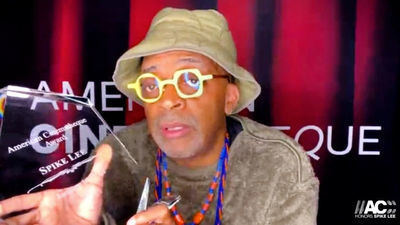
Spike Lee Recieves American Cinematheque Award


Oscar-winning filmmaker Spike Lee became the 34th recipient of the American Cinematheque Award during a two-hour virtual ceremony held yesterday, January 14th, and I couldn’t agree more with their choice of recipient. Lee was a filmmaker greatly admired and championed by my late husband, Roger Ebert, and I shared his admiration of Lee. I have watched Spike’s career from the beginning, and watching a “Spike Lee” film is always interesting and enjoyable, irrespective of whether you agree with some of his choices. He is quite simply a talented auteur and watching some of his films in a shot-by-shot format is like going to film school. Off the screen, Spike also deserves kudos for leading the charge to admit more diverse filmmakers to the unions. And I admire his courage and passion in speaking truth to power when it comes to issues affecting African-Americans, and America as a whole. His continued efforts for equality in Hollywood have been noted around the world and make him an ideal elder statesman. But fortunately he is not resting on his laurels, he has many more films to direct.

Hosted by Jodie Foster, who co-starred in Lee’s 2006 thriller, “Inside Man,” the ceremony featured heartfelt tributes from many of the filmmaker’s cherished collaborators, who conversed in pairs to reveal the particulars of his genius. Guests included “Chi-Raq” star Angela Bassett, “Malcolm X” editor Barry Alexander Brown, “Bamboozled” costume designer Ruth E. Carter, “BlacKkKlansman” casting director Kim Coleman, “Black Panther” director Ryan Coogler (one of Lee’s former students at NYU), “Mo' Better Blues” cinematographer Ernest Dickerson, “Do the Right Thing” producer Jon Kilik, “4 Little Girls” cinematographer Ellen Kuras, “Do the Right Thing” star Rosie Perez, “Jungle Fever” editor Sam Pollard, “Clockers” casting director Robi Reed, “Do the Right Thing” producer Monty Ross and “She’s Gotta Have It” production designer Wynn Thomas.

“You have to work on your craft no matter what it is — you have to work, you have to work, you have to work,” Lee said in conversation with Foster. “If you love what you are doing you can delay Father Time, so I have some more joints to make. At the very beginning I wanted to build a body of work because I noticed the artists I admired kept building their body of work. It wasn’t just a one-and-done thing. Over the years they kept working on their craft. For me that was the model.”

The director also paid tribute to the late star of his latest acclaimed narrative feature, “Da 5 Bloods,” Chadwick Boseman (who played a heroic platoon leader), saying, “The character in ‘Da 5 Bloods’ is so enormous — you just can’t cast anybody. He is described as mythic. You are talking about a guy who played Jackie Robinson, James Brown, Thurgood Marshall, Black Panther.” Boseman’s “Da 5 Bloods” co-stars—Norm Lewis, Delroy Lindo, Jonathan Majors, Clarke Peters and Isiah Whitlock Jr.—appeared together to virtually give Lee his award.

“There are filmmakers who create entertainment for the world. and there are those who create commentaries for our world,” said Jonathan Majors. “Personally I don’t know another person that so naturally and so honestly creates both time and time again. Hopefully all artistic artists grow in their craft, Spike, but you started with compassion and guts and truth. Vision ferocious before anyone knew who you were, and passion before anyone knew that you are. I know that from courtside at the Knicks game and hanging out with you, and having a beer with you in Thailand, you don’t speak through your art, you speak through your humanity.”

Two of Lee’s movies cracked the top five of RogerEbert.com’s combined list ranking the best films of 2020: “David Byrne's American Utopia” (#3) and “Da 5 Bloods” (#5). And Roger famously vowed to boycott the Cannes Film Festival when “Do The Right Thing” did not win an award there. He said that film was one of the few movies that ever made him shed a tear. He wrote in his four-star review of “Do the Right Thing,” “I believe that any good-hearted person, white or black, will come out of this movie with sympathy for all of the characters. Lee does not ask us to forgive them, or even to understand everything they do, but he wants us to identify with their fears and frustrations.” 

You can find links to all of Roger’s writing on the career of Lee here

Also be sure to watch Lee’s virtual conversation with “Moonlight” director Barry Jenkins held last year by the American Cinematheque in the video embedded below.


Source link