Categories
TV & Movies

Sundance 2021: Try Harder!, Homeroom, At the Ready


There are multiple documentaries at Sundance this year that focus on the teenagers of America, from Oakland to El Paso. In fact, this dispatch of three loosely connected films doesn’t even include some teen-centered non-fiction flicks that will be covered later like “Cusp”. Why this trend in 2021? Why are the children on our mind as we head into a new decade and leave one of the worst years in world history behind? Maybe it’s a question that answers itself.

The best of the three is a personality-driven piece called “Try Harder!,” which profiles five students of the prestigious Lowell High School in San Francisco, revealing the varied stories to be told from a learning institute that might appear from the outside to be filled with the same personality type. Director Debbie Lum carefully deconstructs the life of over-achievers going through the brutal and rigorous process of college applications, one that can often seem random and unfair. Even the smartest and hardest working kids can’t be guaranteed they’ll get into the colleges they choose. But Lum’s approach is far from depressing (even if aspects of this film play like a horror movie for parents with kids under high school age like yours truly), choosing instead to really take a character-driven look at these people, finding their differences and allowing their personalities to shine through, revealing how much a process that often turns kids into numbers and demographics can miss the true stories underneath.

Take the arc of Shea, a junior who puts up with an addicted father who is gone all night feeding his demons when he’s not getting the pair evicted. Shea puts up with it in large part because he can’t go live with his mother or he wouldn’t be able to attend Lowell. His home life is impacted by his choice of education and he’s not even in college yet. Or Alvan, a sweet young man whose mother is what some might call intrusive into his life and decisions about his future. These kids are facing constant stress, and yet Lum is careful to present their playful, joyous sides too. All of them are likable and open with Lum, a testament to her skill as a filmmaker and interviewer.

The truth is that college is everything to kids who go to a school like Lowell…but it’s also not. They need to be teenagers and they need to understand the unknown challenges of the real world like not getting into a school even when all you’ve done all the right things. I would love to revisit these kids Michael Apted style in four to five years and see what all of this meant for their futures. I expect their stories would be even more diverse, unique, and fascinating as they are now.

Across the bay in Oakland, a different kind of document of teen life unfolds in Peter Nicks“Homeroom,” the story of a very unusual year for education around the world. Nicks has made three films now about life in Oakland, including the excellent “The Force” from 2017. Here, he turns his eye to the education system and captures how many of the issues that would come to the surface in 2020 via the pandemic and the protests were there before. Most of all, he’s made a film that’s really encouraging about the youth of this nation, finding a passionate, fascinating group of teenagers at Oakland High School and following them through the entire 2019-2020 school year, one that unfolded like no other.

Nicks takes a verité approach to his subject, following students through the ups and downs of their final year in high school at a distance, letting them tell their own stories. The focus of the first half falls on a debate that would echo “Defund the Police” months later as students and community members fight the board about removing police officers from Oakland High School. Like a bit too much of “Homeroom,” I could have watched these board meetings for hours, Wiseman style. The debate over adults who think that officers keep their kids safe opposite students telling them that uniforms don’t equal safety for a lot of young people is fascinating. And it’s wonderful to hear these young people discuss their concerns so openly, even if a lot of them seem to often fall on deaf ears.

If there’s a flaw in “Homeroom,” it’s that there’s so much story to tell about 2019-20 in a 90-minute movie. It’s not until over halfway through that Nicks gets to the impact of COVID—I did love hearing a teenager convinced that if you had the flu shot then you were fine in the early days—and then he races through the protests of May 2020 and graduation. There have been so many docuseries lately that could have been better movies. “Homeroom” is the opposite, often zipping through moments and highlights that would have been stronger with more dissection and discussion. Then again, time flies when you’re a teenager.

Finally, there’s the complex “At the Ready,” which shifts the Sundance documentary focus to Horizon High School in El Paso, Texas, ten miles from the border. Director Maisie Crow introduces viewers to an incredibly unusual thing in the criminal justice club, wherein teenagers are trained in how to run raids, stop illegal immigrants, and battle active shooters in a way that even ends with a competition with fake guns and obstacles. Most of the participants are Mexican Americans who are interested in a legal border and law enforcement in general, but these choices often lead to problems at home, and inner conflict as teenagers learn more about the real world. At first, “At the Ready” feels a bit repetitive and even thin, but Crow’s deep empathy allows her subjects to open up, and we come to care about someone like Kassy, a kid really coming to terms with so many things about the world while playing fake games of border warfare.

“At the Ready” feels like a reflection of the complexities of the part of the world in which it takes place. It first seems like a land of contradictions, but Crow is careful in the way she structures her story as so as not to judge the young people at its center. I’m not so sure the same is true of the adults. One of the best pieces of editing by Crow and her team comes late in the film when a teacher of students enrolled in the border patrol and enforcement program speaks openly about how he softens the true horrors of the job to the young people who look up to him. He goes on to say he has PTSD from his time as an officer, even mentioning that it led to his divorce, and he gets emotional. He’s arguably softening the real world for kids who are about to get thrown in it, but one can sense his conflict about that. In the very next scene, a young man is speaking to his teacher about pulling out of the program to mend a rift with his father, who now lives in Juarez, and she encourages him to stick with it. Her intention to make sure a young man doesn’t give up on a dream is admirable, but it’s impossible not to think of the previous interview with a traumatized man who lost his family and wonder why a kid is being encouraged to take that path.

“At the Ready” develops strength and empathy as the students profiled do the same. They’re there for the controversy about kids in cages on the border, leading some to question why they’re even peripherally involved in a profession that would allow that, and the campaign of Beto O’Rourke becomes a prominent event in the life of these kids, as it did for a lot of young people in El Paso. If anything, these three films offer a portrait of passionate, engaged, smart, fascinating young people, a generation that understands the complexity of where we are in 2021 in a different way from their parents. I can’t wait to see what they do next.


Source link

Categories
TV & Movies

Sundance 2021: Passing, Eight for Silver, Mass


Three very different films premiered on Saturday, the biggest day for the 2021 Sundance Film Festival. Set in different time periods in different parts of the world, these movies are a snapshot of the diversity of stories being told virtually out of Park City.

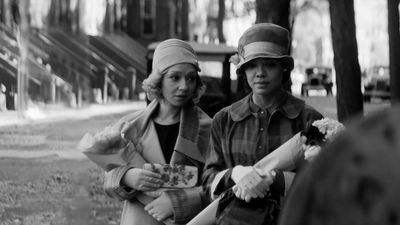
The best of the three is “Passing,” Rebecca Hall’s adaptation of the 1929 Harlem Renaissance novel of the same name by Nella Larsen. The acclaimed actress proves to be an ambitious filmmaker, tackling a challenging story of race, sexuality, class, and culture in the 1920s. She also proves to be a deft director of performance, bringing out the best of her notable cast, particularly her incredibly talented leads. There are aspects of “Passing” that feel a bit too preciously rendered—it’s very refined in terms of craft, almost to a fault—but this is a drama that will have people talking when it’s released. It’s a conversation piece in every way, and those are always the films that matter most.

The wonderful Tessa Thompson plays Irene Redfield, an upper-class 1920s woman who takes refuge from the heat in the tearoom at the Drayton Hotel in New York City. She’s passing, pretending to be white to access a place that Black people weren’t allowed at the time, and that’s where she runs into Clare Kendry (Ruth Negga), an old high school classmate doing the same. However, Clare isn’t just passing for the day, she’s doing so in every aspect of her life, including in her marriage to a grotesquely racist man played by Alexander Skarsgard, the king of sketchy husbands. Irene returns to her home in Harlem with her two children and her husband Brian (André Holland), but Clare finds her way to that side of the color line, going to parties with the Redfields. It leads to a subtle and nuanced examination of racial boundaries and definitions, amplified by issues of sexuality that would have been equally daring at the time this book was published.

Hall takes a very lyrical, poetic approach to her storytelling, boxing her characters into a 4:3 aspect ratio and shooting in luscious black & white with long silences. She often places boxes within boxes, shooting people through doorways that further shrink the tight frame. It’s all so carefully considered from the detailed costume work to the haunting piano score that it can feel a bit cold in terms of character. Luckily, Thompson and Negga make up for that, finding emotional notes that keep the piece relatable. Thompson can do anything as an actress, finding ways to reflect multiple layers of Irene’s inner monologue on her expressive face. While looking like she could easily have been a major star in silent cinema, the captivating Negga matches Thompson in her own register, conveying subtly how much her reunion with someone from a different life has reshaped her foundation.

“Passing” has the kind of complex filmmaking that I wish could be discussed at bars and parties in Park City this year. It’s a film that grows when one rolls it around their brain, and I imagine will produce some of the best writing of 2021, both pro and con. We need more of those movies. (Editor’s Note: Chaz Ebert, Publisher of this site, is an Executive Producer on this film but had no impact over this review.)

There was a bit of tonal whiplash for this viewer going from Harlem in the 1920s to the French countryside horror movie of Sean Ellis“Eight for Silver,” but that can sometimes be the fun of the film festival experience. Monster movies fans should take heed that there’s a gruesome, ambitious one coming their way, one that runs a bit too long and might want to go back and polish up some of its VFX, but still an impressive thrill ride of unflinching horror.

Seamus Laurent (Alistair Petrie) is a vicious land baron, someone who owns a giant manor with his wife (Kelly Reilly) and children and will do whatever it takes to hold onto his property, including slaughtering a clan of gypsies who have staked a claim to it. The sequence in which Laurent and his men massacre, burn, and mutilate the people on the land is startling, shot mostly at a distance but still powerful. And then Laurent learns that doing something that horrible has consequences. Laurent’s son Edward (Max Mackintosh) starts having dreams that draw him to the field where all of this happened, and then goes missing. A visiting pathologist named John McBride (Boyd Holbrook) knows there’s something vicious in the woods, and it wants its vengeance.

“Eight for Silver” will be too much of a slow burn for action horror fans, but it definitely gets to the gruesome stuff and pulls no punches when it does. Some of the imagery here, especially in a horrifying scene that recalls John Carpenter’s “The Thing,” will be enough on its own for fans of the genre, but there’s more going on here than mere jump scares. “Eight for Silver” really gets under your skin, and it feels dangerous and dirty. It legitimately feels threatening, like anyone could be disemboweled at any given moment. That tension is hard to maintain for two hours, and some of the climax here suffers from the budget, but there’s still enough to like, including another game performance from Holbrook, who could make a career as a cinematic monster hunter and I’d be pretty happy. He feels like an old-fashioned lead in a Hammer movie, totally understanding what’s needed of him here in terms of charisma and urgency.

Finally, two couples meet for an emotional, unimaginable conversation in the writing and directorial debut of “Cabin in the Woods” and “Dollhouse” star Fran Kranz, “Mass.” Both are parents facing the enduring pain of losing a child, but their common grief comes in different colors because one pair are the parents of a school shooting victim and the other the parents of the shooter, who then took his own life. Formally reserved to the extreme, almost the entirety of Kranz’s film takes place in a church meeting room, giving the entire production the feeling of a one-act play, but it lacks the intensity it would have in that format, where the emotions of the characters could feel more tangible than they do here. It’s an experiment in real-time drama that dissipates in its intensity and power just as it’s getting through its emotional climaxes.

Kranz sets his deliberate tone early in his 110-minute film by providing a long prologue in which the people who work at the film’s only setting get ready for what’s about to happen there. After that, the heart of the production kicks in with the introduction of two sets of unnamed parents—Richard (Reed Birney) & Linda (Ann Dowd) and Jay (Jason Isaacs) & Gail (Martha Plimpton). The latter couple has decided they need to talk a few things through with Richard & Linda if they’re ever going to move into the next phase of grieving the loss of their son. Gail brings a righteous anger early in the meeting, wondering how the other parents could have missed warning signs. Richard & Linda insist it’s not as clear-cut as the press made it out to be. It never is.

The complex emotional issues that circle through “Mass” like nature vs. nurture and blaming parents for their children’s actions give it some emotional heft, but Kranz’s dialogue too often sounds scripted, increasingly so as the film reaches its boiling point. Isaacs steals the movie, allowed to perform in an emotional register he doesn’t often get to tap, and Dowd can do just about anything. But this really does feel through and through like a theatre writing project, an actor’s showcase that plays somewhere Off Broadway, earns rave reviews for its cast, and then gets adapted into a movie that opens it up a bit more than “Mass” is willing to do. 


Source link

Categories
TV & Movies

Sundance 2021: Knocking, Coming Home in the Dark


The Midnight section of the Sundance Film Festival has produced some notable hits in the last few years, including “The Babadook,” “Relic,” and “Hereditary.” Looking over the schedule for the virtual edition of the 2021 Sundance Film Festival, I was concerned that the Midnight section this year felt the thinnest, unlikely to produce such a smash hit. There will be great horror movies in 2021, but it doesn’t feel like we’ll get one out of Sundance. (The most acclaimed is probably “Censor,” a film I liked a little less than Nick Allen but would probably agree is the best of this year’s program.)

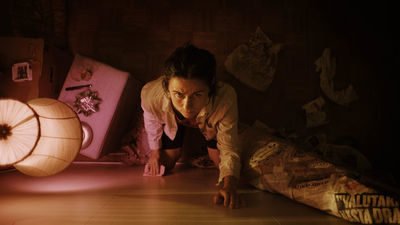
The better of the two marginally successful genre flicks I caught late at night on my couch this year comes in the form of Frida Kempff’s somewhat effective “Knocking,” a film that recalls great apartment horror films like Roman Polanski’s “Repulsion” in its examination of fractured sanity.

Cecilia Milocco stars in what is essentially a one-woman show as Molly, a woman who is suffering the trauma of a horrible loss when she moves into a new apartment. Alone all the time with her grief, she starts to fracture further when she hears a knocking sound from the apartment above. She investigates and asks her neighbors, who all look at her like she’s crazy (and, of course, they’re all men), but the knocking intensifies and is joined by other unsettling sounds. Is someone trapped? Or is Molly going crazy?

It’s hard not to feel like “Knocking” is an effective short film stretched past its breaking point even at only 78 minutes despite a strong central performance and sweaty sense of existential dread. Who hasn’t felt like there was something knocking at the back of their emotions at one point or another, probably more than ever in the last year? Milocco and Kempf smartly focus their storytelling on doubt as Molly herself starts to wonder if she’s going crazy or being gaslit. After all, the neighbors who claim not to hear the knocking are all men. And then a woman seems to be fleeing the building one night and is brought back in? What is going on? 

I wanted “Knocking” to get more formally ambitious and reflect Molly’s tension and possible mental state in its visual language too, but there’s a sweaty claustrophobia to this film that’s effective, especially for those who haven’t left their apartment in a year.

A much different kind of horror unfolds in James Ashcroft’s brutal “Coming Home in the Dark,” a film that recalls other Sundance waking nightmares like 2017’s “Killing Ground.” It’s one of those horror films that seeks to investigate not the supernatural or unknowable but the true evil in the hearts of men, even those who have convinced themselves they’re good.

A schoolteacher nicknamed Hoagie (Erik Thomson) is on a day trip with his family when they run into two drifters named Mandrake (Daniel Gillies) and Tubs (Matthias Luafutu). After a few very effective scenes in which the threat presented by this pair isn’t completely clear, the men send the family into the most violent day of their lives, and it’s not long after that Hoagie realizes that their arrival may not have been coincidental, and he’s forced to come to terms with some of his actions from the past.

Some of “Coming Home in the Dark” plays like stylish, hollow brutality, but the film’s biggest problem is one it shares with “Knocking” in that it can’t sustain for its running time, getting less interesting as it should be building to its climax. Ashcroft fills the space between major events and character revelations with monologues by the evil Mandrake, who is effectively menacing as played by Gillies but also a bit cartoonish in the way he’s used here. And Ashcroft can’t land the more serious themes about past sins and vengeance, unsure of what he’s saying about either. By the end, “Coming Home in the Dark” feels empty, a genre exercise with some impressive bursts of filmmaking and performance that bode well for whatever Ashcroft does next, but an all-night joy ride from Hell that doesn’t really feel like it ended up at an interesting destination.


Source link

Categories
TV & Movies

Sundance 2021: Faya Dayi, Sabaya, Writing With Fire


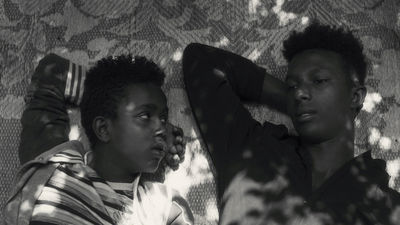
One of the happy byproducts of Sundance’s digital incarnation is time. Space to first consider, more space to reconsider. On first blush, Jessica Beshir’s abstract anthropological directorial feature debut, “Faya Dayi,” left me underwhelmed. Bewildered. In a normal festival setting, short on time, and with other movies to see, I would have bitten the bullet and filed a quick review of my first assessment. But in a digital setting, with ample time to revisit, I experienced the rare pleasure of watching a festival selection for a second time during the festival itself. On my second watch, Beshir’s gorgeous freeform black and white picture revealed itself as a poetic study of a country intoxicated into listlessness.

Set in Ethiopia, “Faya Dayi” concerns the populace’s dependence on the region’s biggest cash crop—a leafy green vegetation known as the khat plant. More than an added line to the country’s GDP, the khat plant is a powerfully addictive drug wielded by the user to induce excitement or euphoria. While composing lyrical vignettes of the customers either lulled into ennui or roiled to violence, Beshir tracks the plant from harvest to marketplace, from field to dealer. And in the pirouetting hookah smoke, the sprinkles atop smushed food, and the slender branches fit to chew, she demonstrates how the drug is an all-encompassing fixation to her subjects’ daily lives. The adults, from mothers to fathers, warn their children against entering the khat’s gloomy cloud, even while they tap the leaves for their own consumption. For the younger clean generation, whom Beshir contrasts from their fantasizing stoned elders, the plant’s presence means less opportunities for school and love, and more reasons to leave Ethiopia.

Beshir eloquently maps Ethiopia’s realities, which includes a violent government further repressing its people, onto an ancient religious parable of the khat plant’s origin. Though “Faya Dayi” captures a tapestry of subjects, including the 14-year-old Mohammed, an errand boy with dreams of reuniting with his mother in Saudia Arabia, leaving his hot headed khat-addicted father behind, the film mystically weaves in and around several nameless individuals. Such an approach could easily leave one feeling cold, disconnected from the people onscreen. But the wet lo-fi soundscape over Beshir’s evocative monochromatic compositions, slow-motion sequences, and curious tactile framing of laced curtains and narrow stone pathways mirror the hazy high of a country left rudderless. It strikes us at our core. Beshir’s assured debut is a spellbinding documentation of a self-destructive walking dream with few signs of an ending.   

Controlled by the US-backed Syrian Democratic forces, the Al-Hol refugee camp straddles the Syria-Iraq border. While the camp is purportedly filled with only Daesh (ISIS) women and children, intel says the population also includes kidnapped Yazidi women (a kurdish ethnic minority), forced by Daesh men into becoming a sabaya (sex slave). By way of infiltrators—free Yazidi women who have volunteered to pose as Daesh by adorning black niqabs—implanting themselves in the fenced-in city of white tents, the Yazidi Home Center receives crucial information needed to recover these women and deliver them back to their families. Hogir Hirori’s harrowing “Sabaya” is a riveting, though often meandering story, about a select few working to reunite the families torn apart by an endless civil war. 

The risk that Mahmud and his volunteer comrades take, filing into a van to Al-Hol Camp with nothing but their sidearms and a couple of rifles, is obviously immense. Mahmud routinely receives cryptic voicemails and texts from his infiltrators updating him with new intel on the scattered sabaya who’ve watched their names, ages, and places of birth changed by their captors. Retaliatory force by Daesh against the Yazidi Home Center’s volunteers also constitutes a persistent danger for Mahmud. And in some instances, even while Hirori’s film crew rides along, they try to.    

While Hirori’s documentation can be immersive, with one captivating shot finds the lens behind a niqab’s veil, viewers are occasionally trapped frustratingly at a distance. For the safety of the infiltrators, obviously, Hirori must exercise caution when illuminating their embedding process. But there’s also less of the survivors’ journey through PTSD symptoms in lieu of narrowing the scope to Mahmud’s emotional burden than one might expect. The day-to-day events are equally as elusive to track, giving the documentary a winding repetitive quality. 

Nevertheless, each rescue that Mahmud and the Yazidi Home Center achieve, with the women varying in ages as young as seven, is a successive gut punch that renders the viewer distressed. And in the beguiling photography—a brushland horizon of fire and plumes—the image that’s captured is as seemingly endless as the Yazidi Home Center’s task. Hirori’s “Sabaya” is a harrowing portrait of courage under fire that will shake audiences into awareness solely based on its subject matter, yet the film’s overriding thesis, the trauma these women have experienced, feels far too elusive.  

In India is another group of dauntless women. In the country’s restrictive caste system—divided into priests, warriors, traders, and labourers—Dalits (untouchables), especially Dalits women, constitute the lowest rung. Nevertheless, in 2002, in Uttar Pradesh, a small band of Dalits women founded Khabar Lahariya (meaning ‘Waves of News’)—the only Indian newspaper run solely by women. To adapt to the changing media landscape, these reporters, already doubted by their male peers and family members, are now switching from print journalism to digital. In “Writing With Fire,” co-directors Sushmit Ghosh and Rintu Thomas follow four Khabar Lahariya reporters—Meera, Kavita, Suneeta, and Shyamkali—in their journey as women journalists to deliver impactful stories while navigating India’s corrupt political system, its misogyny, and the nation’s stringent caste system. 

Each of the four subjects, all Dalits, and part of a much larger newsroom, come from varying backgrounds. Meera, a persistent incisive reporter who holds a master’s in political science and a degree in teaching, juggles her family life while her and her childhood best friend Kavita document the fervent general election. Because Suneeta hails from a mining village she takes a special interest in the hazardous working conditions implemented by the mafia in their illegal mines. While Shyamkali greatly struggles with the transition from print to digital due to her less educated background, her spirit, nonetheless, is just as strong. All of these women, in their wit and determination to represent the powerless, are an ebullient tonic in the face of a cynical chauvinistic male power structure. 

These crack journalists stand up to dismissive regressive politicians of the BJP party, turn down their husbands and fathers who ask them to stay home, and resist the pressures of marriage in a bid to reveal the inequities of a system that ignores their basic right to safety from rape and death. They’re easy to root for. Especially when Ghosh and Rintu’s montages show how the paper’s Youtube channel, with each report, grows in subscribers and views—even in the face of a vitriolic comments section. The admittedly abrupt and unsatisfying finish to “Writing With Fire” doesn’t tarnish these women’s efforts. Rather the resounding message that manages to boil to the surface, “nevertheless, she persisted,” hits with a pen point’s force. 


Source link

Categories
TV & Movies

Sundance 2021: How It Ends, Mother Schmuckers


For Sundance’s long history of fostering hip films that are distinctly of-the-moment, premiere title “How It Ends” is its first official ensemble pandemic comedy. Written and directed by Zoe Lister-Jones and Daryl Wein, the film wears that designation of “First!” like a badge of honor, and it tries to frame 2020’s lockdown as a moment of self-reflection. Its construction is unmistakably Sundance-ready, presenting a low-key story of a woman’s arrested development with a revolving door of funny faces that includes Nick Kroll, Whitney Cummings, Glenn Howerton, Fred Armisen, Bobby Lee, Lamorne Morris, Paul Scheer and many others. And because the movie is explicitly not about a pandemic—no, it’s about something unavoidable and less stupid, an asteroid careening toward earth—it doesn’t have the cringing forcefulness of recent comedies that have tried to relate to us with Zoom call-filmmaking.

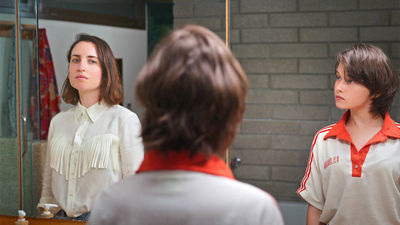
Instead, the movie banks on and benefits from the catharsis of seeing our absurd reality played as a dark joke. Lister-Jones stars in the movie as Liza, a lonely woman with a list of regrets regarding the people she’s known in her life. She initially intends to just do a lot of drugs and go out of this world alone, but then she warms up to the idea of sealing her emotional wounds on this very special day, a beautiful and final day in Los Angeles. Liza has a friend who joins her as she ventures to visit some old friends, lovers, and family members, and it’s her younger self, literally, played by Cailee Spaeny, an idea that fits with the movie’s apocalyptic, outwardly “f**k it” attitude. 

Getting some of its energy from ‘90s slacker movies and “Dude, Where’s My Car?”, the movie follows Liza and her younger self as they amble throughout a sunny and silent Los Angeles, the ease of their pace off-setting the context that the production was indeed made when everyone was indoors. There are no extras or non-cast bodies to be seen in the background, but instead a revolving door of funny people you’re thrilled to see if even just for a couple minutes, making for hit-and-miss comedy based on whether the score is overplaying its quirky comedic cues, or whether the duo’s interactions with strangers and friends are charming enough. Sometimes the 85-minute movie benefits by just sitting with its moments, like a calming, five-minute scene where Jones and Spaeny listen to a musician sitting in the middle of the road, playing a song she wrote on guitar.  

Even more so than a lockdown comedy, the script is more specifically a slightly under-baked, existential, walk-and-talk, with Liza interacting with Young Liza. One can even imagine watching “How It Ends” that this must have been the original script, before the lockdown forced Jones and Wein to update their locations. This is where the script gets a bit more ambitious, especially as it creates an emotional arc with Liza symbolically coming to terms with her past, but it’s also where the script gets weirdly overcomplicated. “How It Ends” never really hits the dramatic heights that it hopes it can balance with its broad comedy, and that’s even in spite of the formidable emotional work from Lister-Jones, who can be gleefully goofy in some sequences and then compellingly vulnerable in the next. It’s a great vehicle for her, even if the movie is mostly struggling with giving her enough to do. 

“How It Ends” has no grand scheme when it comes to being funny—there’s nothing particularly special about its sense of humor, especially when it abandons Liza’s originally exhilarating “OK I guess I’ll just get f**ked up” abandon for a narrative that primarily wants to be healing and then sporadically silly. But it does have a whole lot of cameos, and you can’t underestimate how much that helps a movie go from one modestly amusing scene to the next. I also wouldn’t dare give away more famous peoples names than what I did above, but “How It Ends” takes full advantage of how seeing funny people in a relatable, traumatic situation is a comfort itself. The laughs may be fleeting in “How It Ends,” but they can be mighty cathartic. 

You can’t accuse “Mother Schmuckers” of false advertising, especially if you know that Sundance’s Midnight section is the go-to place for comedies that will reveal your breaking point. As part of its tone, and of stating that it doesn’t want to charm everyone in the audience, the Belgian comedy begins with its two leads, brothers Isaachar and Zabulon (played by writer/directors Harpo Guit and Lenny Guit) making a joke about eating fecal matter out of a frying pan. The sequence is total chaos, with their mother Cashmere yelling at them as they joke around and try to put it in each other’s faces, made all the more hectic by handheld camera work and frantic cutting. The scene climaxes with the mother puking, revealing the film’s title. It’s all downhill from there. 

Is this what some people felt in the ’90s watching “Dumb and Dumber“? I am not sure, and I am frustrated as someone who loves the silliest things, and as someone always in search of new goofs. When a comedy like this is your bag, the 70 minutes can be exhilarating. But for this viewer, the one-note screech of this film was endless. Like a five-minute web series sketch that’s been dragged out, “Mother Schmuckers” goes from one frantic situation to the next, with only its unpredictable plotting giving it any edge: at first it’s about their dog January Jack going missing, and then it’s their mother going missing. The two characters bound around Brussels like how Harpo and Chico Marx were clueless to anyone outside of their own fun. In one joke, the brothers here fall into possession of a gun and run through the city, with onlookers scurrying away. 

“Mother Schmuckers” is more of an experiment with its high-energy comedy, and despite being so blissfully stupid and obnoxious, it never reaches an interesting level of absurdity. With its sketch show-ready filmmaking style (on-the-fly filmmaking and sporadic goofy cuts), the movie throws in different characters who also have the same problem of simply being too cartoonish. It is trying so very hard to be silly and outrageous, but there is so little dimension to it all. Take away the admirable kinetics, and it’s an even more tedious, obvious attempt at lowering the bar. 


Source link

Categories
TV & Movies

Sundance 2021: On the Count of Three


Jerrod Carmichael makes his directorial debut at Sundance this weekend with a true marvel of pitch-black comedy, “On the Count of Three.” Given that its main plot-point is suicide, the movie contains a whole set of obstacles a lot of filmmakers spend their careers avoiding. But Carmichael quickly establishes himself as a director you can trust on a wild emotional ride, and a creator of expanding talents with an invigorating approach to entertainment. “On the Count of Three” is the type of risky project that when done right proves a great, fearless storyteller.

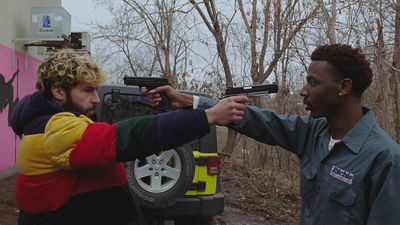
The film’s airtight script, by Ari Katcher and Ryan Welch, starts with the central hook of two friends ready to shoot each other—their shared goal is to die by the end of the day. “I think about it all the time,” confesses Val (Carmichael) after Kevin (Christopher Abbott) sees the guns. “It brings me relief.” He’s just broken Kevin out of a psych ward, after Kevin tried to commit suicide with pills days earlier, and Val feels like that means Kevin will do him a solid and die with him. This is the type of darkness that the movie is filled with from start to finish, and Carmichael knows that the audience will always be able to squint and see a heartwarming of two buddies who love each other. He doesn’t overplay either the immense heaviness, or the select bits of light that shine through and give “On the Count of Three” its vital dynamic. Carmichael mastered the opposite balance of heavy and light material with his underrated, thoughtful sitcom “The Jerrod Carmichael Show,” and with his feature debut he shows just how capable he is with tone over 90 minutes. 

“On the Count of Three” is propelled by its focused, cause-and-effect plotting—we don’t know what they are going to do with their time, especially after Kevin balks at shooting Val (he just needs a few more hours). Kevin has the idea to kill a doctor who wronged him as a young boy, and Val, being the supportive friend that he is, walks with him right up to the person’s reception desk. Carmichael films the moment in one shot, starting from Val’s Jeep, into the building, up the elevator, and into an office. The shot is more showy for its length than it is its athleticism, but it’s a sharp way to slowly build tension and give us more of their incredible banter, two components that this movie flourishes with all the way to its intense climax. It’s then revealed that Kevin’s target will only be coming in later in the day, giving Kevin and Val a more established timeframe. First they’ll live a little more, then they’ll shoot the doctor, and then they’ll die. Simple as that. 

There’s so much to adore about this movie, starting with the chemistry between Abbott and Carmichael. They blend their on-screen energy to create an instantly watchable, hilarious duo, their deep friendship established by the opening images of them amping themselves up to shoot each other in the face. Of the two, Abbott’s highly sensitive Kevin brings more intensity than Carmichael’s muted Val, the duo ebbing and flowing between who wants to die the most but also who is the more irritated. And with Carmichael’s brilliant sense for tone as a director, the story sprints to the darkest places of its ideas on mental health and depression—key subjects that are hardly discussed in the movie, because the guys have hardly verbalized it themselves. And then boom—Carmichael or Abbott hit with some perfectly timed piece of dialogue, based in their characters’ neuroses, and the big laughs give us a time to catch our breath.  

Abbott and Carmichael are just two pieces of a uniformly strong cast, although you want more from the supporting people who are brought into the mix. JB Smoove is a scene-stealer in his one sequence as Val’s estranged father, a visit that Val has in mind as part of what to do with his day. Smoove is tough and scary like we’ve never seen before, especially as he hints at an abusive rage toward his son that’s underneath his initial counter of turning their unexpected reunion into a jokey affair. And Tiffany Haddish is excellent as Tasha, Val’s girlfriend, but the limit of her presence is a major flaw in the story’s mechanics. She imparts wisdom into the story in her own way, but her character verges on being one-dimensional, despite being played by a talent like Haddish. 

Carmichael nails the larger ambitions for this concept, and keeps the dialogue especially prickly, uncomfortable, but always sincere. Some of the best jokes involve Val’s preoccupation with what’s cheesy or not on his death day, especially as the high-energy events also have him priming himself for his death (Papa Roach’s suicide jingle “Last Resort” gets two hilarious, emotionally meaningful needle-drops). But in the sly, sophisticated tact of Carmichael’s subversive nihilism, here’s a heroically non-cheesy story of a suicide pact, that’s actually about maybe giving life another shot; a death wish saga that is bursting with life, because it dares to reckon with how much darkness and sadness is a part of being alive. 


Source link