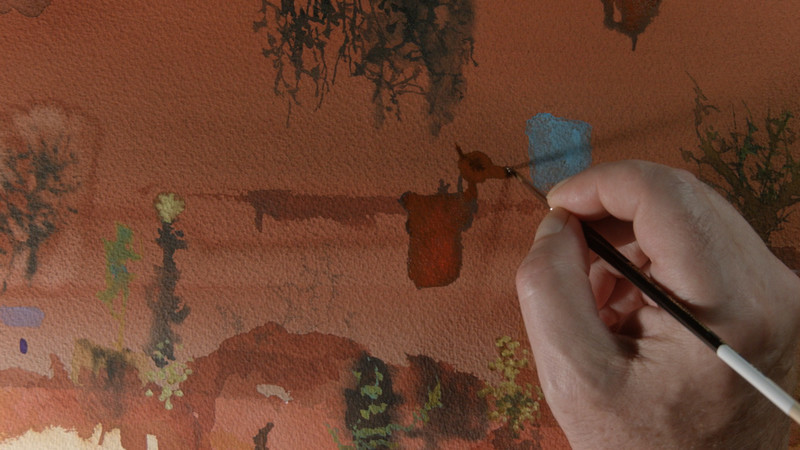
“Bob Ross was wrong,” John Lurie says. “Everybody can’t paint. It’s not true. So.” In his hand he’s got a delicate paintbrush and a pair of glasses, the better to paint and to see you with. That’s because John Lurie can paint. He can also make television. In “Painting With John,” HBO’s magnetic new series from the multidisciplinary artist, there’s plenty of painting, and no small amount of instruction—at least of a sort. Lurie’s series isn’t about learning to paint happy little trees. It’s about living, seeing, and rolling a tire down a hill; yes, it’s also about painting, but this ain’t school. It’s something much less easily classified. And besides, as Lurie tells us, “My trees are miserable.”
It’s tempting to think of the six-episode series, which premieres Friday, as a sequel of sorts to “Fishing With John,” Lurie’s cult favorite 1991 series which saw the artist and a famous-friend-of-the-week head out in pursuit of one sort of catch or another in various far-flung locales. “Painting” and “Fishing” certainly share some DNA—given that each brief six-episode series is entirely written and directed by Lurie, it would be strange if they didn’t—but while “Fishing” has the kind of gonzo energy you’d expect from a show in which Jim Jarmusch tries to tempt a shark with cheese and Tom Waits puts a fish down his pants, the surreality of “Painting” is far more meditative. (That said, “Fishing” is a fascinating companion to this series; it’s currently streaming on The Criterion Channel and is well worth your time.) Symptoms of advanced Lyme disease, Lurie tells the camera, have forced the artist to give up music and many other creative pursuits. Now living on an island equally beautiful and remote, he’s turned to watercolors. Before a canvas, he’s contemplative and at ease, a stark contrast to his relationship to the camera, which is alternately and sometimes simultaneously playful, intimate, and adversarial. “Fishing” is a bonzer adventure in style and form as well as reality; “Painting” is a hand reaching straight through the solar plexus to squeeze.
And squeeze, it does. It’s a rare thing to encounter a work of art you can describe as both daffy and mournful, yet “Painting” is certainly such a creature. It might be more at home on the shelf next to something like Kirsten Johnson’s “Dick Johnson Is Dead” than its predecessor, but here we are. Rarer still is the television show that’s confrontational yet gentle as it prods you toward something profound, leaving it to the viewer to decide if the point-blank direction to look at a beautiful sunset and then write a poem is a statement on the way we view the creation of art, a suggestion that we often pass up such opportunities, or something else entirely. Will Lurie’s head popping up in the corner of the frame to have a quick chat with the moon about the perverse nature of loneliness—one of several breathtaking shots courtesy of cinematographer/editor Erik Mockus—make you want to laugh or cry? Maybe both. Maybe neither. Maybe on Tuesday it’ll make you angry, while on a Wednesday it brings something like peace. For a series without much in the way of shape, there’s not a frame wasted, and it never deigns to tell you what your reaction ought to be. You’ll have one, though. Of that there’s almost no doubt.
Forgive the intrusion of the personal, but this is that kind of show, so here we go: Once, years ago, I was sitting on the floor of a massive black box theatre, one of many students there to learn from a storied avant-garde theatre company. We were directed, one at a time, to get up and make our fellow students see the room differently using only our bodies. One by one, we contorted our figures to echo the drape of a curtain, a diagonal beam of light, the vastness of a fire door. All interesting, all the same. (Write a poem about a sunset, they might have said.) Then my friend Ghafir stood up and quietly but rapidly left the room. The door clanged shut, and moments later, another opened. He appeared on the ringed second level of the space, and on quick but silent feet, walked to the opposite end of the vast space. There, in the middle of a wall, he stopped and suddenly pointed directly upward. At the tip of his finger was a bright red tack. I would never have seen it. None of us would. But there it was, and it was suddenly all any of us could see.
Everybody can’t paint, but some of us can. And every so often, someone who can will open the door for the rest of us.
To John Lurie’s way of thinking, Bob Ross was wrong. Yet in a way, “Painting With John” contradicts Lurie’s assertion. Whether joyful or absurd, melancholic or cranky, lonely or communal, it is always a celebration of art and artists, of the process of creation. A branch becomes an elephant’s trunk, and the imagined elephant becomes a painting as water meets paint and a blossom of color grows and swirls. A man remembers a brother’s triumphant echoing of a jazz classic through wounded lips, bloody stitches flying, because it’s what the music demands. (And speaking of music, the soundtrack—Lurie’s, of course—is marvelous.) Lurie’s trees may be miserable, but they’re also alive, and so are we, and while breathing, we can paint. And that, no matter what he might say, is what Lurie wants us to do while we can.
While U.S. audiences were complaining about the frustrating plotting of HBO’s disappointing “The Undoing” back in October, their British counterparts had a similar experience with ITV’s “The Sister,” now premiering in its entirety on Hulu this Thursday, January 21st. It too is based on a mystery novel, this one by Neil Cross (“Luther”), who adapts his Burial into a four-part mystery that has about one episode of interesting story to tell and less than that in terms of character development. “The Sister” starts with an intriguing premise, but if it’s not spinning its wheels, it’s digging into its own grave with unrealistic choices, twists, and a frustrating flashback structure. There’s a welcome supernatural tinge to the project, but even that feels half-hearted by its end. Its frustrating, crazy end.
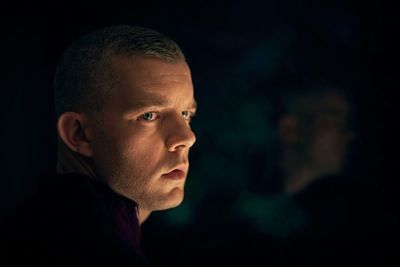
Nathan Redman (Russell Tovey) is first seen about to commit suicide in 2013. He pours the pills out on the table, gets himself something to wash them down, and starts to throw them in his mouth. All of a sudden, he freezes. Someone on TV has caught his attention. It’s Holly Fox (the very good Amrita Acharia), the sister of a missing girl. Nathan looks like he knows her. And he stops his suicide attempt.
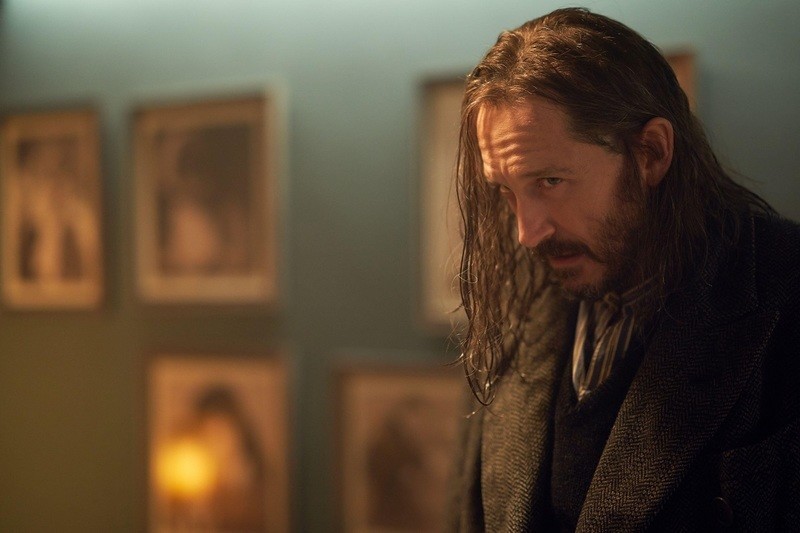
Cut to years later on a rainy night as Nathan sits and reads. A knock on the door reveals the unkempt and unnerving Bob Morrow (Bertie Carvel), and Nathan looks like he’s literally seen a ghost (and Carvel appears to be going for the same demonic tenor as his namesake from “Twin Peaks”). He tells Nathan that a construction project means they have to move the body. You see, Nathan knows exactly where Holly’s missing sister is because he and Bob put her there in the cold ground. And then guess what Nathan did? He wooed and married the sister of the missing girl. Yes, “The Sister” is not only a tale of horrific death but the inexplicable behavior that follows it, forcing the criminal to live an even greater lie than normal, one that’s about to unravel with the return of his accomplice.
“The Sister” jumps back and forth—as all murder mystery mini-series seem to do lately—slowly revealing the details of what happened in the early hours of New Years Day back in 2010, how Nathan and Holly got together in 2013, and then the current dilemma this conflicted criminal faces. One of the more intriguing aspects of “The Sister” is a supernatural element in that Bob turns out to be a paranormal expert, and he’s convinced that Emily has quite literally returned to their lives. The sense that Nathan is not only haunted by his actions that night but could literally be haunted as well distinguishes “The Sister” from some of its peers, but, like most things here, it’s underdeveloped.
From its opening scenes, “The Sister” has to navigate a moral tightrope. We can’t root for Nathan to have a happy, normal life with the sister of the woman he murdered and buried, right? And yet the first couple episodes feel motivated by him trying to keep his façade in place, creating a unique tension in the viewer that comes with a downfall drama. In a sense, we want him to get caught, especially given the lie he’s living with Holly, but we’re also smart enough to know there’s more to this story than meets the eye.
The problem is that Cross and his team can’t find a way to make what might have worked on the page into something that works on TV. “The Sister” circles its themes and twists without really digging into them. It meanders when it needs to pulse, and it gives Tovey too little to play other than the panic he has the minute Bob knocks on his door. He’s in a constant state of cover-up, trying to keep his potential family (he’s trying to have a baby with Holly) from coming apart. And Bob ends up being more than just a face from the past. He’s an aggressor and obvious villain, pushing Nathan to come to terms with what happened that night but also somewhat gleefully watching him collapse.
Of course, there’s a twist or two along the way, including a few biggies in the final episode, but most of them aren’t satisfying. On the page, this story probably felt like a tale of regret and paranoia in a way that recalls countless other mysteries about men whose darkest secrets came back to shatter to their domesticity. In mini-series form, it just doesn’t connect the same dots. The characters are too thin, the good ideas remain unexplored, and the suspension of disbelief shatters in a few places. It turns out that mediocre TV mysteries are not exclusively an American phenomenon.
For a show so consumed with the idea that boredom is dangerous, “Losing Alice” certainly does take its time. Director and writer Sigal Avin so belabors the point that an idle mind can stray into self-destruction that “Losing Alice” paradoxically has the same effect on its viewers. Many times during the eight episodes of “Losing Alice,” as the series recalls other, more visceral and engaging art-imitating-life works like “Black Swan,” “Nocturnal Animals,” and “Mulholland Drive,” you might wonder what “Losing Alice” is saying about the shackles of marriage, the expectation of professional success, and the fear of aging and irrelevance that is particularly unique to these characters or these situations. Unfortunately, the answer isn’t much.
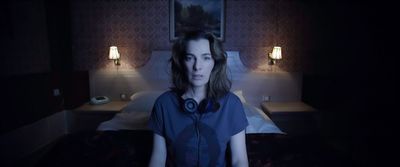
“Losing Alice” follows 48-year-old Alice Ginor (Ayelet Zurer), a once-promising director whose seminal film “Three-Quarter Moon” was provocative, sexually charged, and singular. But that was years ago. Alice now is a mother of three daughters who every so often does commercial work; Alice’s look when one of her daughters recognizes a yogurt ad she directed is a grimace of professional frustration. While she mostly stays at home, bumping heads against her always-guilt-tripping mother-in-law Tami (Chelli Goldenberg), her actor husband David (Gal Toren) travels around on the world working on various films. Both of them have slid into the kind of mid-career mainstream that is creatively unrewarding: They’re doing jobs that pay for their very large house and the cost of raising their three kids rather than for artistic fulfillment, and the strain on their marriage is beginning to show.
An opportunity for something different appears after a chance encounter on a train, when Alice is recognized by a fan, 24-year-old Sophie (Lihi Kornowski), who is endlessly praising of “Three-Quarter Moon.” Alice keeps trying to end the conversation, but Sophie is passionate, exuberant, and tenacious, and she won’t stop talking. How much of “Three-Quarter Moon” was made up, Sophie wonders, and how much of it was real? “Everything begins with a kernel of truth” is the explanation given, and Sophie seems to begrudgingly accept it. And then Sophie reveals a surprising admission of her own: She’s written a script, she’s sent it to David, and he’s agreed to star in her movie. He said the script “blew his mind”—didn’t he tell Alice?
That meeting between Sophie and Alice sparks a relationship between the pair that will sprawl outward and affect nearly every facet of their lives: personally, professionally, romantically. Between Alice and David, whose already tenuous marriage is tested even more when the attractive Sophie starts appearing unexpectedly at their house and when Alice considers directing the film, which David had pinpointed as his own comeback. Why won’t Alice let him have this? Between Alice and Tami, who is convinced that Alice’s increasing interest in returning to movie directing will have a negative impact on her grandchildren; she would prefer Alice and David break up altogether. Between Alice and Sophie, as Alice becomes obsessed with the very question Sophie had asked her on the train: How much of Sophie’s film “Room 209” is pulled from real life? Sophie has a decades-older boyfriend, just like the script’s protagonist, Eleanor. Sophie’s Instagram showed that she had a best friend who mysteriously stopped appearing in posts, just like Eleanor’s split from her closest confidante in “Room 209.” There’s a lot of sexualization and taboo-breaking in “Room 209,” just like the buttons Sophie likes to push. Showing up to meet David braless. Slathering Alice’s daughter with makeup, cutting her bangs, and making her into a miniature Sophie lookalike—all without asking. Flirting with Sophie’s neighbor Tamir (Yossi Marshek), who previously had looked at Alice with the same playful longing that he now aims at Sophie. Is Sophie trying to copy Alice’s life? Take over her life? “Room 209” ends in bloodshed, with its myriad characters saddled with the effects of their own debased decisions. Is art imitating life here, or vice versa?
That instance of one character knowing something that the other doesn’t and using the reveal of that information to tweak, to poke, and to prod at the dynamic between them is the recurring methodology of “Losing Alice,” and it’s the only way these characters communicate. Is that a genre convention of the neo-noir-meets-thriller space that “Losing Alice” is assuming for itself? Sure. But it also makes for repetitious storytelling with increasingly diminishing returns. Everyone in “Losing Alice” is lying a little to themselves and a little to everyone else, too, but the script doesn’t take the time to analyze deeper motivations for all this betrayal. Alice is bored, David is bored, Tamir is bored—but that’s about all the depth they receive, and how Sophie moves them around like pieces on a chessboard without having any real backstory of her own is the most recurringly unfulfilling element of “Losing Alice.”
Sophie is clearly meant to be an homage to the classic femme fatale figure, and to Kornowski’s credit, she nails the character’s grand emotional swings, her pettiness and her recklessness, and how glowing the impact of her attention can be. It’s easy to understand why so many characters in “Losing Alice,” male and female, young and old, are swept up in her charms—at first. But as each episode reveals yet another terrible thing Sophie has done, or yet another lie she has told, or yet another life she might have destroyed, you wonder why so many would continue putting up with it. Sophie is only superficially imagined, the most detailed elements of her conception being her uninhibited physicality (an omnipresent smirk, an aversion to bras, a thong tan line), and Kornowski’s dynamic performance can’t alleviate that shallowness.
Avin is trying to send a message here about what people will give up for continued fame, and she wants us to understand how Alice’s morality takes a hit from her continued affiliation with Sophie, and how her acceptance of Sophie’s wildness sparks her own spontaneity. A speech in which Alice describes “being asleep” before meeting Sophie feeds into the film’s ideas on dream worlds and dual identities, while the film’s attempts at inexplicable strangeness are somewhat Lynchian: a woman spotted across a balcony, frantically and unceasingly shaking her head; a skulking figure who appears out of the darkness of a parking garage to spit on Alice’s face. Those moments would resonate more, though, if Zurer’s Alice were anything other than inscrutable or agitated. Alice is written neither with a baseline personality from which we understand her to be deviating, nor with an indication of what all this complicity is costing her. A scene in finale episode “The End” in which we finally see some of the toll of “Room 209” on Alice is handled well by Zurer, who drops the protective wall surrounding the character and bares her most fragile parts. But in the preceding episodes, certain moments meant to celebrate Alice (a slow-motion tracking shot of her leading her all-male crew to the production office, set to Run the Jewels’ “Nobody Speak”) or interrogate her (her lack of reaction when she learns about an alleged sexual assault committed by one of the film’s crew members) seem unintentionally subdued.
The greatest misstep of “Losing Alice” is its fear of letting this story unfurl linearly, and its reliance on disturbing or confusing moments (the premiere opens with a suicide) that are sometimes flashbacks, sometimes flashforwards, sometimes scenes from “Room 209,” and sometimes Alice’s fantasies or imaginings. How these moments serve as echoes, overlaps, and contrasts to demonstrate what is fact vs. what is fiction is only intermittently satisfying. A lengthy, one-take sex scene in seventh episode “The Scene” is technically well-done and admittedly titillating, but “Losing Alice” needed similar moments of emotional intensity earlier in the series, too. At a certain point, “Losing Alice” tips over into puzzle to be solved rather than narrative to be experienced, and that choice does the series a disservice. “I’m interested in shocking,” Sophie spits to Alice during one of their fights, but “Losing Alice” should have strived for more than just cheap thrills.
Speaking as someone who loves modern comedy and crafty filmmaking but rarely expects them to be in the same movie, Michael Angelo Covino‘s “The Climb” is a gift. The script is sharp enough that even without its batch of engrossing, one-take sequences, it could have been a memorable buddy epic, focusing on Mike (Michael Angelo Covino) and his life-long friend Kyle (Kyle Marvin) through various highs and lows of their elastic relationship.
But it only just starts with Michael telling Kyle, while biking up a massive hill in France, that he slept with Kyle’s fiancee. That hill is a very funny setting for such a reveal, and then the camera keeps going as Kyle tries to catch up with Mike. Suddenly, you’re watching both an expertly written scene of dialogue and precise character development, and you’re sucked into the characters’ life-changing moment because an edit hasn’t changed your perspective. And when you do notice that the camera hasn’t cut, it makes you all the more invested in the scene and its athletic execution. The film mixes raw, relatable emotions with high-wire filmmaking, and the results are exhilarating.
Written by Marvin and Covino, and based on the short of the same name, “The Climb” examines the complicated DNA of a friendship, while observing two men who suffer from an easily diagnosable case of arrested development. Time passes by through major life events—Thanksgiving, Christmas, a wedding and more—and creates a portrait of their complicated bond, with some scenes climaxing to an embrace, or a betrayal. A third person, Marissa (Gayle Rankin), enters the picture as Kyle’s new fiancee, and she has her own feelings about this friendship that can be as fulfilling as it is destructive. The tension and release from this dysfunctional love triangle is matched by Zach Kuperstein’s framing and pacing with camera movement, along with the movie’s tendency to bookend its long sequences with a lo-fi musical number. Jokes are select in their appearances, but they always hit big because of how often they catch you off-guard.
When Covino and Marvin talk about the film, silent film comedians like Buster Keaton and Charlie Chaplin come up. Not because it’s an immediate comparison, but because that’s who “The Climb” has more in common with than the buddy indies of similar constructs, or the studio projects that try to sell funny people on a massive scale. “The Climb” is comedy filmmaking that remembers how funny a movie can be when its select humor is mixed with a clear sense of risk. And considering that this is Covino’s directorial debut, it shows the immense promise for a vision that thinks outside of standard visual storytelling.
RogerEbert.com spoke to Covino and Marvin about the inspiration behind their buddy epic, the philosophy behind their visual approach to comedy, the stunt gag that probably gave Covino a concussion and more.
How does making a movie like this affect a friendship? Does it bring you closer together? Or make you more communicative, or conscious of your friendship?
KYLE MARVIN: Certainly more conscious. The way that you’re speaking about these characters, reflects your opinions and visions of friendship. I think it can be like more revealing and you kind of have to open yourself up to scrutiny, or your own self-scrutiny. I think in that sense it certainly made us, and made me, explore the ideas for friendship and those bonds a little bit more.
MICHAEL ANGELO COVINO: I remember there was a time when we would take a break from each other, and just not see each other for a couple weeks, or a month, or something. We’d talk on the phone. We were intensely living together and writing together and shooting together. And then traveling to festivals together. But I think it’s a testament to our friendship and how we complement each other, and I think we have this shared work ethic. And desire to make films and write together, that sort of above all else, even if we’re annoyed with each other, it’s like, “Alright, we’ve gotta get these pages done. Let’s just sit down and be annoyed with each other but also figure out what happens in this scene.” That became the status quo.
Especially when the characters are annoyed with each other, it’s striking that Michael has always been the more annoying one, the asshole. I was struck by that watching the short, and realizing that the roles never switched. Michael, why are you the asshole?
KM: Believe it or not, we talked about that before the short.
MAC: We actually rehearsed it a bunch where we would play opposite roles in scenes, and put it up in an acting class and explore what that felt like. It was fun. I probably would have been more interested in playing Kyle’s role, [but] I just think it’s a lot more natural to be the asshole. [laughs] I think we just wrote to some of our simple strengths, or the strengths we felt like we could lean into. It was fun to play these characters in the way that we played them, I think. I don’t not regret switching roles, although I do regret it in some ways because people constantly think I’m an asshole now.
KM: [laughs]
MAC: They don’t give me a chance. I’m like, “I swear I’m not that person!” And then Kyle says something and I’m like, “Shut the f**k up!”
KM: And I say, “It’s OK, he’s great. He’s a great guy.”
Are the major life experiences from this movie based on things you have figured out together?
MAC: There’s some loose factual stuff that it’s based on, but nothing with each other. I think it’s like, oh yeah, a friend sleeps with your ex-girlfriend, and you’re trying to figure out how to process that. And that was maybe the impetus for the original idea for me. But out of that, it was just loosely based on a friendship Kyle had with someone, or a friendship that I had with someone, and interactions that we had or a dynamic that developed. There’s this interesting dynamic of, a person who takes more from a relationship, and a person who gives more. And at what point do you just cut it off, or at what point do you just hold onto it for the rest of your life?
KM: Strangely, those relationships weren’t just our relationships with other men, I think we pulled from our female relationships and our romantic relationships, and I think there’s some pretty universal themes and friendship sort of fits. It doesn’t sort of matter what the relationship is, it’s a sort of universal experience that people can relate to.
I was struck watching it again about the sense of family, and how it challenges the idea of what a “family” is.
MAC: I think that’s the thing—we have our biological families, or lack thereof. And then, we kind of over time accumulate an extended family that in some ways we’re closer with the people in the extended family because we can speak more freely with them. Or, we have a different relationship that maybe is fulfilled differently than the relationship you have with your sister or your mom.
KM: Also, I think there’s strangely a catharsis in the film with the sense that, people go through their whole lives without having their own best friend being like, “She’s bad for you.” That’s kind of what everyone wanted to say, and never said it. And it’s kind of fun to watch it play out in real time, because you fantasize about it and you never go through it.
MAC: I go through with it.
KM: Yeah, Mike goes through with it, but I never go through with it. Or nor does any sane person.
MAC: I told one person who was supposed to be married not to marry someone.
Was that moment dramatic? Could it have been “Climb”-worthy?
MAC: Those last longer, those conversations in real life, than like a five-minute scene. In a movie it’s like, “We gotta be out of this scene in five minutes, let’s be efficient.” Whereas in life, it’s like, “This conversation has been going on for an hour and 45 minutes.”
KM: And half the time it’s the same words, over and over again!
Speaking of timeframe, there’s a sense in this movie of life unfolding one extended take at a time. Does it get any easier organizing and executing extended takes happen? Or by each sequence, does it seem like starting at the bottom?
MAC: It gets much easier … and it’s still just as hard depending on the scene. It gets a lot easier in that everyone knows the game. Everyone on set, by Day 12, is like, “Alright, we get it. This is how this thing works.” There’s not as much pressure in the beginning, and then the pressure gets dialed up more and more as we get into the late hours of the shoot day, and we’ve got two hours left and we know we need to nail the take. And someone keeps making the same mistakes, and we keep not getting this one part. But it works itself out, because you get into a rhythm when you’re shooting any film. Every time you shoot a film, people forget that you block, then you light, and then you shoot. In that order. And with this type of film, it’s just a lot of blocking, and a lot of rehearsing, and a lot of figuring it out for a day-plus before you’re finally shooting and trying to figure it out.
I have a few lightning round questions, because I know we could talk about this part all day. But how many takes it did you do for … the Christmas scene?
MAC: 13, I think we would have shot more but I kind of concussed myself. I didn’t go to a hospital to see if I had a concussion, so I don’t know if I concussed myself, but I definitely split my chin open.
KM: And was bleeding.
From falling on the table?
MAC: We did a bunch of takes without the table so we had it clean, you didn’t see me fall but I was already laying down. And then when we had that, we were like, “Alright, let’s start doing the stunt takes.” And I just kept falling and I think I got three or four falls in, and by the fourth one I was like, a little out of it. [laughs]
How many takes for the ice fishing sequence?
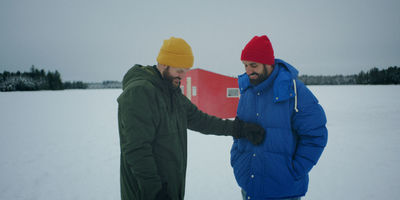
MAC: That’s a confusing one, because we shot three takes on the original day, and then we went back and got a couple more. So probably all-in, like seven takes. Kyle went underwater seven times.
KM: That was the one where probably did the least number of takes because it was so intense, and there were scuba divers under there. There was a lot to that one where the pressure was high, and it was like, “OK, we got it. Let’s not keep torturing ourselves.” Whereas with other takes, with the scene going up the hill it was just us, and we like, “Let’s keep torturing ourselves.”
How many takes on the church scene?
MAC: I want to say 28, or 29 times.
KM: That whole thing, inside and outside, car coming in. That was one sequence.
Michael, you enter that scene with the car coming into frame right on the dot. Was that luck? That’s such a specific blocking detail but the film is filled with them.
MAC: There were a lot of times when I didn’t hit the mark. It’s muscle memory! You just get it down to a science. You’re like, “OK, I need to hit the sign with the car at this speed in order to land at the exact mark.” But there were times when I would overshoot it and the camera would miss, and I would call “cut,” because I knew I over-shot it. Or we would just run out the rest of the scene and then we would dial it in.
But that was the challenge of this film, there were times when I missed that mark and it was like, “Do I use this take where I’m a little off here, or do I use one where the blocking in this section is better?”
When you were dreaming up this movie, were you intentionally thinking about how to use danger? Or using that a question of, “Are they going to pull it off?”, as part of the comedy?
KM: Not from a camera-technique viewpoint. But certainly from a … “Oh, OK, what are the hardest things to do? A baby. A dog. A big sign. Underwater.” And it’s like, “Great, let’s put a baby at the end of this scene that depends on a baby in a car and hopefully that baby is laughing at the right moment.” Or, “Oh, let’s put a crazy stunt seven minutes into a scene.”
MAC: Or the Thanksgiving scene was my dog, and it had to hit a mark. And at a certain point, it didn’t want to. “Come on, Grandpa, you can do this.” And she was like, “No, I’m good.”
KM: The thing is that the dog was so well-trained that when she was yelling “No, no, no,” the dog was like, “OK, I’m not gonna do it.”
MAC: So she wouldn’t eat the turkey!
KM: We were like, “This would make it exciting.” And maybe naively at first from a writing standpoint, it would be like, “Oh, this would be so much fun to go under a frozen lake and really do it,” and we really fought for it during all of pre-production, and when we got to it it was like, “Oh, this is a really f**king crazy choice, but here we are. Let’s do it.”
MAC: It had less to do with, “How hard will this be in production?” because as fun as that is as a challenge, it’s like, “Why make things hard to make things hard?” It was more about, “What physical elements can we insert into a scene where something is being revealed?” To compound the situation, or to influence the way that the characters react to the situation. As we were writing each scene, we like, “OK, cool. This is what’s happening, this is what’s being revealed in the scene. Is there some physical outside force that can kind of interject here, the way that things interject in life, to liven up the way that characters have to respond to this, or create an additional dynamic to overcome?” The most obvious being, I reveal that I’m sleeping with his fiancee, but we’re going up a hill so he still has to surmount the challenge of getting to the top of this hill while also processing the information.
So how do you not lose the comedic flow when you’re doing something so planned out? Especially when you talk about the importance of reactions, and getting beats.
KM: That was the joy of it. I think from a performance standpoint, that was really the joy. It gave us a sort of improvisational feeling to it, but it was so well rehearsed, the lines and what we were saying was sort of set in stone, because everyone was basing their actions on the dialogue. But what we got to improvise is this sense that that you have to be in the moment every time, and responding to real things happening in front of you that aren’t consistent. In having to just be that present in a scene, where it’s like, “Oh, the camera hasn’t made it around the corner, and I’m here and I need to be here with her, and just live with those decisions.”
Did that storytelling decision come from you guys being actors? This idea to have something so present, and constant? Would you say it comes from your history of acting?
MAC: I mean, it certainly comes from what we didn’t want the film to feel like, which is very cut-ty, very jokey. Very slice of life, fly-on-the-wall. There’s films that we love that have that aesthetic, but I think that knowing the subject matter, knowing how we were writing it, knowing what we wanted to do, we wanted to have the immediacy, these long continuous takes. But we wanted to have them be a bit more choreographed so that they felt cinematic and theatrical, and a bit elaborate. The types of films that we love, they’re not showy for the sake of being showy, but they’re showy because …
KM: It’s entertainment.
MAC: Because it’s entertainment, and that’s what cameras can do. That’s what film can do, you can live in a moment. But truly it was camera and really focusing on perspective, and what is the perspective of the camera and how it is serving the story? I think often times, comedies remove camera from the equation too much, and how they tell the stories. And we were like, “This is probably the biggest tool.” Like, if you go back to the origins of comedy and cinema, you’re looking at Buster Keaton and Charlie Chaplin and they’re putting a static camera on a blank frame, and they’re doing everything.
KM: And using the frame!
MAC: And it’s more entertaining than anything that you see today, and yet that’s because of the constraints and the limitations, and then working within those constraints. I think by giving clearly defined constraints and rules for ourselves, we push the boundaries for ourselves with what the intention of the camera is, what the motivation of the camera is at any given point, and how that perspective could reveal comedy and could hide information, reveal story, and guide the way that we experience this film.
Did it make you wonder why more people don’t do comedy like this?
MAC: Yeah, but if you watch a movie like “Carnal Knowledge,” there’s this amazing scene where they’re playing tennis in the background, and it’s just the two of them sitting on a bench talking. And it’s just like, you don’t see Art Garfunkel and the woman break up, you just know it’s going to happen. That’s the plot point, that’s the reveal. And so I think there’s definitely a tradition of cinema where this was the norm, and it was like, “No, we’re going to be a bit more bold with our choices here, because audiences can handle it.” I think maybe the pressures of box office, or the pressures of just attention span have led to these very choppy, cut-ty, joke-joke-joke-joke films. But what we found is, the more jokes you pack into something, the more you just get overwhelmed by that. You almost need a breath, you need to lull people into, “Wait, I’m not laughing.” And then you hit them with something that they don’t expect.
KM: That also hearkens back to the older comedies where they would set up a joke, pay it off 15 minutes later after you forgot about it. Chaplin was the king of that. He’d like, set a bench down at the beginning of a scene, and at the end of the scene after everything has fallen apart, he trips over the bench. And to me, that’s the absolute genius of comedy—that level of craft. And not to compare us to that in that way …
MAC: Too late.
KM: Yeah, I did it, sorry. [laughs] That kind of humor really is at your core entertaining, it’s not just laughing at joke-joke-joke-joke.
Moving forward do you think you guys will try to continue that kind of approach to comedic storytelling? Or do you think you’ll try to work with more cuts, and more set-ups?
MAC: I definitely don’t think my next film will be long single takes. It’ll have a couple, but I think that was specific to this story. But I think we learned a lot from shooting a particular film this way, and the fact that there’s something about really letting characters get into a rhythm and find things and explore and open it up, I would much prefer to make a film where I had all the tools of cinema at my disposal, and editing. I can cut away to things.
KM: Use different takes!
MAC: I can use great takes that I don’t have to leave on the cutting room floor. But there’s something about finding simplicity in your approach to things, and certainly always understanding that you need to have a plan for how the camera lenses the story and tells the story, and how you choreograph this whole story in front of the camera, even if it’s very limited. That is one of the biggest contributing factors to how people experience comedy, and so for us, we are very interested in pushing the boundaries of that, and finding new ways to present comedy visually.
“The Climb” is now available on digital, Blu-ray, and DVD courtesy of Sony Pictures Home Entertainment
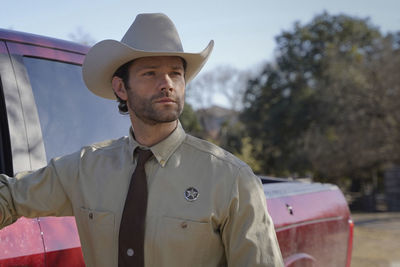
When CBS created “Walker, Texas Ranger” in the ‘90s, it had a very simple, effective purpose—an action show for conservative America. Most episodes were showcases for star Chuck Norris to show off his martial arts skills, and it had a very black-and-white view of the world in terms of good and evil. It was a show thick with moral messages about the dangers of crime and drug use. Most of all, it was comfort food for millions, landing in the top 25 shows on TV for four years in a row. And the reboot craze of the current era that led to updated versions of shows like “Hawaii Five-0” and “MacGyver” meant a “Walker” update was basically inevitable, but the CW version, launching this Thursday, struggles to find its identity in the premiere. There’s only one brief scene that could be described as action and most of “Walker” plays like thin family melodrama, the story of a man trying to balance his important job as a Texas Ranger with his role as a parent, brother, and son. There are two charismatic leads in “Walker” and they could make it simple comfort food TV in a time when people seem like they need that more than ever, but it’s startling to say that this version feels like it’s even shallower and more simplistic than the one with the star of “Delta Force 2: The Colombian Connection.”
Cordell Walker is described in the season premiere as “The edge of the coin,” someone who is neither heads nor tails—someone who does things his own way. I wish this were true. As played by the charismatic Jared Padalecki, looking for another CW hit after the end of “Supernatural,” Walker is very much one side of the coin, and that’s one of the main problems with a show that wants to be a little progressive but can’t leave behind its black-and-white origins. He’s introduced driving a truck with that classic Stetson hat, the perfect amount of stubble, and a slight Texas twang. One thing he does often share with the Norris version is he’s more of the strong, silent type than the people around him. He’s there to get the job done. And that job has been interfering with his personal life.
After a violent prologue featuring the death of his wife (played by Genevieve Padalecki), “Walker” jumps forward almost a year. It turns out that Cordell fled reality by diving into his job, going undercover for ten months after the death, leaving behind his kids August (Kale Culley) and Stella (Violet Brinson). His son has been forced to grow up too soon and his daughter is in complete rebel mode, angry at her father for leaving them behind. Can Walker solve the case of the week and be a good dad at the same time? Walker’s father Bonham (Mitch Pileggi, who also did a memorable arc on “Supernatural”) and mother Abeline (Molly Hagan) fall into typical family drama roles as disapproving dad and supportive mom. There’s also a brother (Keegan Allen), who has been made the new ADA after basically taking care of his niece and nephew for a year, and then there are work colleagues, including a smart new partner in Micki Ramirez (Lindsey Morgan) and a former colleague turned boss in Larry James (Coby Bell).
Introducing audiences to this many characters and tossing in a mystery of the week so viewers know that’s what they’re in for makes the series premiere of “Walker” a little crowded, but it’s also surprisingly flat and slow in terms of pacing. None of these characters make much of an impact outside of Walker and Ramirez, which would be fine for an intro episode if the case wasn’t also very thinly conceived and executed. There’s just nothing here to hold onto, which can be fine for comfort food procedurals if that’s what fans are looking for but the best CW shows like “Supernatural” and “Riverdale” push back against conformity and the best shows like this elevate it. “Walker” isn’t the edge of the coin as much as one of those quarters that’s been through the system for so long that it’s lost all of its luster.
Hungarian director Kornél Mundruczó and writer Kata Wéber adapted their own experience of loss, and the pressure it put on their relationship, into “Pieces of a Woman,” the story of a couple who face unspeakable tragedy. Vanessa Kirby plays Martha and Shia LaBeouf plays Sean in the Netflix film, and in an extended, seemingly one-shot scene of wrenching intimacy, we experience with them witness the birth and then the sudden death of their child. In an interview, Mundruczó and Wéber talked about how they spoke to the actors to create that scene, how Martin Scorsese became involved as a producer, and what they learned from making the movie that helped them understand and find some healing what they had gone through.
I want to begin by asking you about the color red, which is very important in the movie. When we first see Martha after her loss, she’s wearing a bright red coat. Tell me about the color red in the middle of all those wintery tones.
KORNEL MUNDRUCZÓ: For me, red is something which is really electrolyzing. And if you want to force yourself to be still part of life and society, and also you just want to express that feeling, you really need colors, and so we really go against black color, we go against the real mourning color. So, red is on one hand important for her to energize herself. But at the same time, it’s kind of a provocation as well to everyone else and expresses somehow, in a way her happiness. Happiness in that sense that she’s still connected to the lost one. And that was the idea and that was really important for me to show with the color red. Because we talked a lot about it because we have a color palette with lots of pale pastel colors all over the movie, except the red which we use just very specific moments.
Like the apple.
KM: Yeah, exactly. And the apple. I am a fan of the Russian avant-garde paintings, like Kandinsky. And when they’re using the red it is always very spiritual and very electrolyzing. And that’s why I find it that it would be really great to use that color.
A couple can feel that they know each other very well and that they understand each other very well and yet still be surprised that they mourn in different ways, as we see in the film.
KATA WÉBER: Yeah, very much so. I agree on that. These are the moments which define us in many ways, and really in a relationship when you’re different. And with togetherness and happy moments, the different things may appear appealing, and it’s something that adds to the relationship. But once there is something like a tragedy, the differences may make you question if you can still stay together. And I think Martha’s choice to be with Sean in the first place is already a protest. She chooses to be kind of a misfit of the family with a relationship. And then we see if they could survive within these circumstances.
As we see, too, it is natural to look for someone to blame when things go wrong.
KW: Yeah, you’re absolutely right. But here Martha feels the legacy of her child must be something good and must be something in the direction of peace and understanding. I did a lot of research and what was so surprising talking to women who lost their babies is that they tend to really not talk about the tragedy and the loss, but about the grace and the light, and the togetherness and the feeling of the biggest love they ever experienced and also understanding what could be the legacy of their child. And therefore, I think it’s really important to point out that this is, in the story, quite a heroic act that she does not take revenge. But it comes from the place of loving her baby and wanting the legacy of the baby for good reason. I felt this is someone who could be a real hero.
KM: And also we see the conflict between generations. For Martha’s mother Elizabeth, from her past, it was very helpful to find the reason and get revenge. And this kind of thinking just doesn’t work for Martha. And especially these days when blaming and revenge is all around. It’s crazy, you know? And in that sense such a person like Martha who can change that way of responding, it’s pretty heroic.
There are long stretches in the film without a score. And then there are stretches where the music takes over more than the dialogue. So, tell me about those choices.
KM: First of all, we decided that at the beginning we don’t really have music, and later on the music is also born somehow as she goes through her process. Music is started to surround the character, and finally we ended up with the form of concerto and that was very important for us. So, we have a solo instrument and we have the orchestra and the solo instruments sometimes piano, sometimes an oboe, sometimes a flute but the orchestra is always separated. I find that very clever because this is also representing somehow the isolation and we have a classical form already to represent that isolation, which is the concerto itself. So, the music became a more and more and more significant element in the movie.
That very intense childbirth scene is unforgettable. What did you say to Vanessa and Shia to prepare them?
KM: Without a good childbirth scene, you have no movie, basically. So, from the point zero that was a very important issue that you have to create something as extraordinary as birth itself, extraordinary for your life even if you are born or if you give birth. So, there is a special film-within-in-a-film kind of entity.
When we started to talk about it, I was clear that I would like to do it as one take. I really wanted to expand somehow film time, just as much as you start to lose your connection to time in intense moments. So basically creating a space where it is more like no time, or really compressed real-time which is like a birth itself.
What I told the actors was that we need all of the chapters, what is inside the birth, the highs and lows through all of the stages. We talked through it with Vanessa and Shia very carefully, especially with Vanessa. I said, “What the audience has to get from the scene is to feel you. Feel you and not understand you, feel you and feel your love to the one who is not here yet, and that’s the major thing. So, give me the most physical performance you can and give me the most emotional performance you can.” Because that’s the ultimate choice, to be connected. In any way as a filmmaker, I really believe your emotional intelligence is above your intellectual intelligence. And if you can activate your emotional intelligence, then the movie is landing on a more honest place. I love the films from Ophüls and Fassbender and was inspired by them. And that’s why I needed Vanessa to give an emotional performance. But it really resonated with her as well.
How did Martin Scorsese got involved?
KM: He came through [score composer] Howard Shore. He asked me that, as they worked together quite a few times that I’d be happy if he’s sharing the movie with Martin Scorsese. And I was like, “Of course! Don’t even ask me! I would appreciate it a lot if he’s watching.”
And a couple of weeks later Marty Scorsese called me and said that the movie is amazing and “How can I help?” And I was like, “Excuse me, who’s talking?” You know, like crazy. And of course, I was beyond happy. And he used this sentence, which was very important to me: “This is more of an experience than a movie.” That’s an amazing compliment to me as far as I really would like to give that kind of experience-like feeling from the movie. The team decided that the best help from Martin would be if he became part of the team, and we are very, very proud that he get that and then he spent his time in post-production with us.
The filmmaking must have been very emotional for both of you. Was it cathartic as well? Did you feel that you made progress emotionally in making it?
KW: Yeah, for us, it was kind of like breaking the silence over something that we couldn’t really talk about. But it was not obvious from the very first moment. So, we as a couple share an experience of a miscarriage, which is very far from what you see in the movie, but at the same time, we also experienced certain kind of isolation within our relationship. So, I think that’s one of the reasons why I didn’t want to write about this topic because I felt it would be a very dark place to go where I didn’t necessarily want to be. But during the writing process, and then really with the shooting, sharing this thing and this topic with others really somehow helped. And that’s also something to understand that once you break the silence over a taboo, you can get new connections, and together with other people you kind of go through a healing process, which you would not necessarily be able to do on your own. So, I think for us that was kind of an experience. I did not realize until the end how helpful it was.
KM: Absolutely. Especially since we had the Netflix premiere. A crazy amount of letters coming. Unbelievable how much mail or Facebook posts from all over the world. And that’s very surprising and very encouraging in the same time when you feel like, wow, it’s so important for them, but not as a movie, but as an experience. And that’s unbelievable power.
“Pieces of a Woman” is now on Netflix. To read Monica Castillo’s review of the film, click here.