With a muscular 6’ 3” frame, gentleman thief Assane Diop (Omar Sy) shouldn’t fade into the background. But as a Senegalese immigrant living in Paris, he does. Ever since his father’s incarceration—accused of stealing a priceless necklace belonging to Marie Antoinette from his employer Mr. Pelligrini (Hervé Pierre)—and his father’s later death, Assane has known how often Black immigrants are overlooked. He uses white folks’ racial blind spots as cover to carry out his brazen robberies. And finds inspiration for his heists in the mysteries of the fictional gentleman thief penned by the French novelist Maurice Leblanc, Arsène Lupin.
Created by George Kay (“Killing Eve”) in collaboration with François Uzan (“Family Business”), “Lupin” is an addictive, clever puzzle that combines elements from “Luther,” Sherlock Holmes,” and “Inside Man” for an engrossing experience.
For every answer Kay and Uzan offer in this ten-episode French crime drama, more questions arise. Take the premiere, wherein Assane concocts a plan to steal Marie Antoinette’s aforementioned necklace from an auction at the Louvre. To furnish his scheme, he enlists a trio of loan sharks he owes serious money to as a way to cancel his debt. He’s also behind in his alimony payments to his ex-wife Claire (Ludivine Sagnier), and missing his visitations with his teenage son Raoul (Etan Simon). Through flashbacks, Kay and Uzan further reveal Assane’s once close relationship to Mr. Pelligrini’s daughter Juliette (Clotilde Hesme) and her mother Anne (Nicole Garcia). We wonder how Assane, who’s working as a simple janitor, can now craft a near-foolproof ploy to rob the former Queen’s crown jewels. Where did he find the means to bankroll this job? Why does he trust these abhorrent loan sharks?
“Lupin” is as patient as it is smart, and its plot twists like melted railroad tracks. And yet the narrative train, through some tight savvy editing, always exits on the other side of the tunnel. But we’re left wondering how it didn’t skip its twisted tracks.
See, Assane is as wily as the show’s writing. He’s a silver tongue snake charmer who relies on convincing acting, disguises, quick-thinking, and his race. When so often questioned by white law enforcement, he implies his accusers’ racism to his advantage.
Kay and Uzan are also intrigued by other people often ignored. In later episodes, a trio of detectives work to solve the Louvre heist. And though Youssef (Soufiane Guerrab)—who we’re led to believe is of Middle Eastern descent—could crack the case, his white colleagues on the police force ignore his sound theories. There’s also a French journalist (Anne Benoit, a vivid lightning bolt), long dismissed for her age and sex, who plays a pivotal role, too. All of these characters are shadows in an alley blotched by white street lights. Christophe Nuyens and Martial Schmeltz’s photography, which uses lens flares and foregrounded shadows to obscure Assane’s identity, furthers the series’ enigmatic quality.
Within the Assane character, Kay and Uzan pile in references to other detective greats. Assane’s rough and tumble fighting style, along with his frame, is reminiscent of “Luther.” The reliance on disguises, and the adrenaline rush from fooling unsuspecting victims, is reminiscent of Sherlock Holmes. And Assane’s skillful rouses, acted out through the show’s adroit staging, to steal sinful diamonds, recalls “Inside Man.” But it’s telling how these detective narratives are often carried out by cynical protagonists—not so the case with Omar Sy’s performance, which avoids such characteristics with a sincere, soft touch. Sy’s Assane is so damn lovable, even when he’s clearly wrong, and especially when he ingeniously gets the better of his opponent.
Some components whither: Through the first five episodes, Assane’s Watson-inspired sidekick Benjamin (Antoine Gouy), is an afterthought who barely progresses. Likewise, an unreliable police commissioner (Vincent Garanger) overstays his welcome. Nevertheless, in a series this patient, it’s difficult to draw any final conclusions until the finale’s closing minutes. And when Kay and Uzan excavate Assane’s failed marriage and his suspenseful heists, we’re given a well-staged, fast-paced crime thriller that often leaves one awestruck. “Lupin” is not only totally addictive, it’s the first great television show of 2021.
Phillip Thomas’ “Cake Day” is a universal story that’s not rooted in any specific time or place, but I imagine it’s happening in real-life now more than ever. As many people know, sobriety is its own struggle. Pile on any one of the contributing factors from our world today and the struggle doubles, if not more. We can be optimistic about the coming year (I’m very, very cautiously optimistic myself). But for many, time is not marked by the changing of the calendar, but by when you get your next sobriety chip. And when a relapse happens, time starts over.
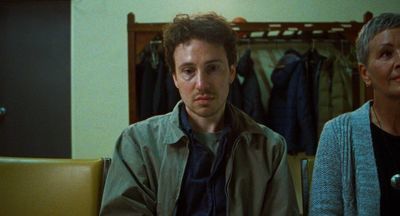
“Cake Day” tells the story of Cameron (Cameron Crosby), who is about to get his five-years-of-sobriety celebratory cake and chip at his Narcotics Anonymous meeting. When we first see him, he looks severely hungover and drained of any life force. He somehow is able to drive himself to his meeting where his sponsor, mother, and several other NA addicts await his arrival. As his moment approaches, we hear others give their stories of addiction and struggle. During this time, Cameron has to make a choice about whether or not to tell the truth about his relapse the night before.
This short film is a snapshot of an addict’s life, beautifully shot in 16mm by Liam Mitchell and given a haunting score by Jeremy Wallace Maclean. It’s the kind of short that could also work as a feature, but writer/director Thomas knows all the key moments to depict to help it work at only 15 minutes. Cameron’s struggle is internal, as he puts on a positive front to everyone around him. His sponsor doesn’t show signs of suspicion, but one gets the feeling he has seen the struggle many, many times throughout his time with NA. These performances are strong enough to convey what an addict’s state of mind is like and Thomas, who also edited the movie, puts it in sharp focus during a key sequence that quickly cuts back and forth between Cameron’s brave front and the isolation he feels, physically and internally.
It may not be the most uplifting subject matter, but if you have someone like Cameron in your life, “Cake Day” serves as an important reminder to keep that person in your prayers and check in on them. Yes, it’s finally 2021, but some people need more than a new year right now.
Q&A with writer/director Phillip Thomas
How did this come about?
Originally, the idea of developing a film set in the addiction and recovery world was brought to me by an acquaintance. It’s material that has been tread and retread for years, but his perspective was unique and very authentic. So we tackled the feature script over several months, but when it was finished and I was working through development my co-writer and I had some creative differences that put the project on ice for a year or so.
In hindsight, this ended up being a gift in strange wrapping, because it allowed me time to really process what I had learned about addiction and recovery and how to best execute putting it all on screen. After some consideration, I felt it was a good idea to do a short film about a singular moment. But the challenge of putting recovery on screen is that the drama is predominantly internal, which can be difficult to translate, especially if the viewer has no experience personally with the subject matter.
I really wanted to challenge myself with giving the audience that first-person experience—a moment where they could feel the psychological stress and pressure of recovery. To bridge the gap, it had to be based on a universal moral dilemma like honesty. Everyone, at some point, has struggled with being honest, so that felt like the perfect bridge. To heighten the stakes I felt it was best to set it at a cake day celebration which carries a natural pressure. Everyone is celebrating and praising you for an amazing achievement, but what if that was directly after a relapse? The inner torment and shame translated to screen is practically a horror film.
I brought the loose concept to my friend Cameron Crosby, who is an extremely talented actor. He loved the concept and wanted to do it, but was soon taking off to New York for a six-month stint … which actually served as great motivation for me to get it going; it lit a very hot fire under my ass. I had to hustle to write it, but once things were in motion it really came together quite quickly.
What went into the choice of shooting it on film? It looks great, by the way.
Thank you! It was a fairly quick choice. My instinct was to capture it on 16mm because it brought a real-life, gritty aesthetic almost like a documentary, which I felt added to the authenticity of the story. A timeless issue deserved to be shared on a timeless medium.
When writing it, was there ever a question as to how it would end? Did you have other ideas about what Cameron would do?
I never wavered on how to end the film. It had to be this way!
Have other addicts seen the film? What has the response been like?
I’m actually not an addict or in recovery myself, but a lot of people now believe I am, which I wear as a badge of pride. I set out to relay an experience that does not belong to me, so for anyone to believe it was authentic to the point that I had to have personal experience … I mean, that’s the greatest feedback I could ever receive. My biggest fear was to inaccurately portray such sensitive material. So I’m really happy that it’s getting such a warm reception from those in the community.
What were some of the production challenges you faced?
Oh man, we had a three-day shoot and our first day was a doozy. The location where we shot the NA meeting and bathroom scene was only available for one day because it’s used for actual NA meetings.
We had 46 set-ups scheduled for the day which was daunting to the point that it was actually funny. It felt like such a bad idea because we had to keep an insane pace. We had 15 minutes to set-up, shoot, and move to the next set-up … all day. I had to edit the movie before we shot it because there was zero wiggle room for error.
Plus, I could only afford my 35 background actors to be on set for like 3 hours. So we had to strategically place the paid background actors in the furthest seats and design all the shots to slowly move to the front of the room as the day progressed. So I sat all the friends and family in the front few rows of the meeting because they generously donated their time for the entire day.
I feel like we all lived a few days in 16 hours. I have to give a massive thank you and shout out to Cameron and my entire cast and crew for being so incredibly precise and sharp all day. It would not have been possible without their expertise and professionalism.
It’s funny though, I don’t think the movie would be better if we had more time. Having those boundaries really forces you to think deeply about what each moment means and the best way to deliver it to the audience. That day taught me what it really means to be a director so I remember it quite fondly. I’ve never had more fun or been more in the zone.
What’s next for you?
First and foremost we are going full steam ahead on an Oscar campaign for “Cake Day,” trying to get as many eyes on it as possible. So we’ll see how this whole adventure shakes out; it’s been really cool so far. You really never know how these things will go, but I’m just happy people are watching and enjoying the film.
As far as projects … I’ve got my heart set on shooting a feature film next. With several scripts ready to go, and more in development, I’m happy to see what pulls into the lead as things develop further.
The films of Ramin Bahrani invite us to trespass into liminal space, and his sympathies are with the outsiders threatened to be left behind by those transitions. For the majority of his career, the first-generation Iranian American has extended unfussy empathy to people struggling to make sense of the ever-changing world and their place within it. In “Man Push Cart,” a Pakistani immigrant sells bagels and coffee out of a heavy cart he drags around Manhattan; in “Chop Shop,” a 12-year-old orphan tries to find enough work in Queens to support himself and his sister; in the bigger-budgeted “At Any Price” and “99 Homes,” Bahrani cast up-and-comers Zac Efron and Andrew Garfield, respectively, as young men whose hope in the American Dream is shattered by familial betrayal and economic devastation. Even in less-heralded work like his adaptation of the sci-fi classic “Fahrenheit 451,” Bahrani’s loyalty to the outcasts and underdogs—to those who can step back from the status quo and imagine how much effort it would take to destroy it—shines through.
In “The White Tiger,” Bahrani’s first cinematic excursion set outside of the capitalist voraciousness of the United States, the filmmaker—who both directed and wrote the screenplay for this adaptation of Indian author Aravind Adiga’s 2008 Booker Prize-winning novel—affixes his analytical eye upon the global underclass. Although less imaginative in his world-building style here than in his 24-hour-news-cycle approach to Ray Bradbury’s seminal text, Bahrani has maintained the darkly comedic, progressively resentful energy of Adiga’s debut. Like the work of Pakistani author Mohsin Hamid (in particular his 2008 novel The Reluctant Fundamentalist, which Mira Nair adapted into a 2012 film starring Riz Ahmed), Adiga’s “The White Tiger” is primarily concerned with the divide between the haves and have-nots, the injustice weathered by the latter from the former, and the inciting incident that could finally spark an uprising. Bahrani sticks close to the source material, trusting lead actor Adarsh Gourav to take us through the lifetime of poverty that could inspire a moment of radicalization, and that faith is warranted. Gourav hardens before our eyes in a performance that flits back and forth between immature recklessness, calcifying fury, and justified braggadocio, and that multifaceted quality is key to the intentionally uncomfortable rags-to-riches nature of “The White Tiger.”
Bouncing between the early 2000s, 2007, and 2010, “The White Tiger” follows protagonist Balram Halwai (Gourav, and played as a child by Harshit Mahawar), who narrates his life story as part of a letter written to the (now-former) Chinese Premier Wen Jiabao, who is visiting India. (A storytelling tactic lifted straight from the novel, that narration does get clunky here as an intrusion of international politics into an otherwise intimate story.) Balram is an entrepreneur, he boasts, but he came from nothing: He grew up in the rural town Laxmangarh, where his grandmother dictated every move. Although Balram was a strong student, his grandmother pulled him out of school to work at the family tea shop, hammering chunks of coal. His father died of tuberculosis. His brother was forced into an arranged marriage. The only way out of that lower-caste life was up, so when Balram overhears that the village’s Godfather-style landlord, nicknamed the Stork (Mahesh Manjrekar), is looking for a second driver for his returned-from-America son Ashok (Rajkummar Rao), Balram decides that person will be him.
The decision sets Balram on a path that he describes, in his narration, with a mangled combination of triumph and shame. He convinces his recalcitrant grandmother to give him the money for driving lessons in exchange for the majority of his future earnings. When he’s hired and moves into the Stork’s family compound in Delhi, he’s overly deferential and thoroughly obedient, taking on more tasks and continuously belittling himself to secure the family’s approval. Balram cleans rugs, sleeps on the floor, rubs oil into the Stork’s calves, and argues that he deserves a fraction of the already-small salary they offer. Much of this inferiority is inbred, Balram says, the result of thousands of years of a rigid caste system (“men with big bellies and men with small bellies”), magnified by hundreds of millions of people fighting for the same low-paying jobs, amplified even further by the gap between India’s poor, both rural and urban, and the increasingly out-of-reach wealth horded by a few. Balram has been angry for a long time, and the charged attitude of his present narration bleeds into the past, coloring his interactions with the Stork and his family as we sense that something awful, some violence that no amount of money can fix, is coming.
What “The White Tiger” wonders—as do Bong Joon-ho’s “Parasite” and Ken Loach’s “Sorry We Missed You,” films that would pair nicely thematically with this one—is whether wealth can ever be divorced from the inherent privilege it provides. Ashok and his wife Pinky (Priyanka Chopra Jonas) seem different from the rest of the family (Ashok broke caste custom to marry Pinky; Pinky asks Balram what he wants to do with his life), but how much of that compassion is meant to make themselves feel better? When they treat Balram like he’s from a different world, when they praise him for knowing the “real India,” when they take at face value his farcical stories about rural religious customs, aren’t they just as condescending as the rest of Ashok’s family? When they ask Balram to dress up like the stereotypical image of a British maharaja for Pinky’s birthday, aren’t they essentially mocking him for being willing to take their mockery?
Rao and Chopra Jonas work well together as individuals who occupy two spaces at once: As much as they try to distance themselves from the familial wealth that protects them from the surrounding world, as much as they argue with the Stork for the insults that he hurls toward Balram, as much as they ask Balram about himself and encourage him to set higher standards of behavior, they still consider themselves better. They are, like the Park family in “Parasite,” unable to understand how offensive their very existence is to someone like Balram, and how much worse their moments of kindness make that disparity. When Balram sees Ashok for the first time, Bahrani gives the moment a sort of romantic veneer: Ashok in slow motion, an upswell of music, Balram saying dreamily, “This was the master for me.” But scene by scene, “The White Tiger” punctures the fantasy that a rich man could also be a nice man, and although the comedy here is pitch-black, it strums with a particularly focused anger.
Some of the text from Adiga’s novel doesn’t have the same lyricism said out loud as it did on the written page, most noticeably the book’s central theme of poor Indians being stuck in a “rooster coop”. Toward the end of the film, there are a few endings too many, and that extra time dampens the impact of a certain shocking act. Elsewhere, however, Bahrani’s script emphasizes certain dialogue that captures Balram’s sense of unity with who Noam Chomsky would call the world’s “unpeople” (“I think we can agree that America is so yesterday … The future of the world lies with the yellow man and the brown man,” Balram writes in his letter), and as he did with Michael B. Jordan’s Guy Montag in “Fahrenheit 451,” Bahrani uses mirror images and duplicates to communicate Balram’s fractured sense of self. He finds contrast between the Balram who retreats into the gilded elevator in Ashok’s apartment building to pinch his hand to keep from crying, and the Balram who loses his mind at a beggar woman on the streets far below the apartment—but which reaction is genuine? What kind of person is Balram becoming?
“Straight and crooked, mocking and believing, sly and sincere, all at the same time,” Balram says of the formula for success at the beginning of “The White Tiger,” Bahrani’s fish-eye lens giving us a warped sense of perspective. When Bahrani visually breaks the fourth wall again in the film’s final moments, evoking the grander themes of disruption he’s mined during the preceding two hours, the deliberate provocation he offers is as successfully acidic as the rest of “The White Tiger.”
“The White Tiger“will be available on Netflix on January 22nd.
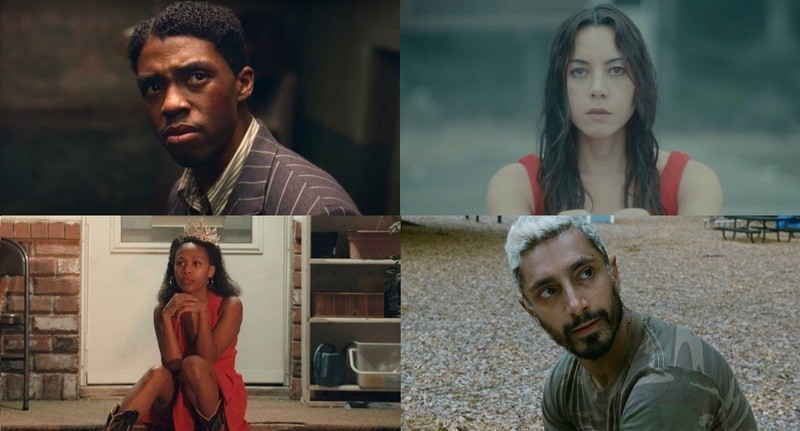
Matt writes: To all of our Ebert Club members, I join my fellow writers at RogerEbert.com in wishing you a safe and rejuvenating 2021! We’re kicking off this new year by taking a look back at many of the great performances that lit up 2020 and will likely prove to be major contenders during this most uncertain of awards seasons. Click here to read the essays penned by our writers about the essential work delivered by such towering talents as the late Chadwick Boseman (“Ma Rainey's Black Bottom“), Aubrey Plaza (“Black Bear“), Nicole Beharie (“Miss Juneteenth“) and Riz Ahmed (“Sound of Metal“).
Trailers
Coming 2 America (2021). Directed by Craig Brewer. Written by Barry W. Blaustein, David Sheffield and Kenya Barris. Starring Eddie Murphy, Arsenio Hall, Jermaine Fowler. Synopsis: The African monarch Akeem learns he has a long-lost son in the United States and must return to America to meet this unexpected heir and build a relationship with his son. Debuts on March 5th, 2021 on Prime Video.
The White Tiger (2021). Written and directed by Ramin Bahrani (based on the book by Aravind Adiga). Starring Priyanka Chopra, Rajkummar Rao, Adarsh Gourav. Synopsis: The epic journey of a poor Indian driver who must use his wit and cunning to break free from servitude to his rich masters and rise to the top of the heap. Debuts on Netflix on January 22nd, 2021.
Sing Me a Song (2021). Directed by Thomas Balmès. Synopsis: As the Internet finally arrives in tiny Bhutan, documentarian Thomas Balmès is there to witness its transformative impact on a young Buddhist monk whose initial trepidation gives way to profound engagement with the technology. Now available in the US.
Atlantis (2021). Written and directed by Valentyn Vasyanovych. Starring Andriy Rymaruk, Liudmyla Bileka, Vasyl Antoniak. Synopsis: A soldier suffering from PTSD befriends a young volunteer hoping to restore peaceful energy to a war-torn society. Debuts in the US on January 22nd, 2021.
Pretend It’s a City (2021). Directed by Martin Scorsese. Synopsis: Wander the New York City streets and fascinating mind of wry writer, humorist and raconteur Fran Lebowitz as she sits down with Martin Scorsese. Debuts on Netflix on January 8th, 2021.
WandaVision (2021). Directed by Matt Shakman. Starring Paul Bettany, Kat Dennings, Kathryn Hahn. Synopsis: Blends the style of classic sitcoms with the MCU in which Wanda Maximoff and Vision -two super-powered beings living their ideal suburban lives-begin to suspect that everything is not as it seems. Debuts on Disney+ on January 15th, 2021.
The Serpent (2021). Directed by Hans Herbots and Tom Shankland. Starring Ellie Bamber, Jenna Coleman, Tahar Rahim. Synopsis: The twisting, real-life story of Charles Sobhraj, a murderer, thief and seductive master of disguise, who was a hidden darkness in the mid-70’s on Asia’s hippie trail. Now streaming on Netflix.
Night Stalker: The Hunt for a Serial Killer (2021). Synopsis: The limited docu-series tells the true story of how one of the most notorious serial killers in American history was hunted down and brought to justice. Debuts on Netflix on January 13th, 2021.
Search Party (2021). Created by Sarah-Violet Bliss, Charles Rogers and Michael Showalter. Starring Alia Shawkat, John Reynolds, John Early. Synopsis: A dark comedy about four self-absorbed twenty-somethings who become entangled in an ominous mystery when a former college acquaintance suddenly disappears. Season 4 debuts on HBO Max on January 14th, 2021.
Bridgerton (2020). Created by Chris Van Dusen. Starring Jonathan Bailey, Ruby Barker, Harriet Cains. Synopsis: Wealth, lust, and betrayal set in the backdrop of Regency era England, seen through the eyes of the powerful Bridgerton family. Now streaming on Netflix.
Servant (2021). Created by Tony Basgallop. Starring Lauren Ambrose, Toby Kebbell, Rupert Grint. Synopsis: A Philadelphia couple is in mourning after an unspeakable tragedy creates a rift in their marriage and opens the door for a mysterious force to enter their home. Season 2 debuts on Apple TV+ on January 15th, 2021.
The Human Voice (2021). Written and directed by Pedro Almodóvar (based on the play by Jean Cocteau). Starring Tilda Swinton, Agustín Almodóvar, Pablo Almodóvar. Synopsis: A woman watches time passing next to the suitcases of her ex-lover (who is supposed to come pick them up, but never arrives) and a restless dog who doesn’t understand that his master has abandoned him. Two living beings facing abandonment. Debuts in the US on March 5th, 2021.
Matt writes: Oscar-winner Viola Davis recently joined acclaimed director George C. Wolfe in speaking with our correspondent Katherine Tulich for an exclusive video interview about their experience of making the jaw-dropping Netflix drama, “Ma Rainey’s Black Bottom.” Watch their full conversation above, and read about it here (also be sure to check out Odie Henderson’s review of the film here).
Matt writes: Oscar-winning director Pete Docter joined producer Dana Murray in speaking with Nell Minow about their latest Pixar feature, “Soul,” which premiered on Disney+ as a Christmas gift to cinephiles of all ages. You can read their full conversation here.
Free Movies
Angel (1982). Written and directed by Giorgos Katakouzinos. Starring Michalis Maniatis, Dionysis Xanthos, Katerina Helmy. Synopsis: A young gay man in Athens, Angelo, keeps his sexual identity a secret from his family. He falls hard for a rough sailor, Mikhalis, and moves in with him. Mikhalis convinces Angelo to dress in drag and work a corner with other transvestites.
Strip Jack Naked: Nighthawks II (1991). Directed by Ron Peck. Synopsis: Ron Peck talks about his experiences of growing up as a gay man, the attitudes to homosexuality in Britain, and his journey towards making his 1978 film, “Nighthawks.”
My Name is Alan, and I Paint Pictures (2007). Directed by Johnny Boston. Synopsis: While many academic categories of art exist, not every artist easily fits into prescribed meanings. Alan Russell-Cowan is one such artist. Afflicted with paranoid schizophrenia, we watch Cowan struggle with the desire to be a great painter, while battling delusions and auditory hallucinations.
The bad news about this upcoming award season is that the pandemic has kept several major studio titles out of the running. The good news is that this might be the most diverse list of possible contenders in some time. History could be made in many ways, especially when it comes to female directors. Using insight from the nearly 4,000 readers of the showbiz awards site Gold Derby who have posted their Oscar 2021 predictions, this list below will likely reflect the field of filmmakers who will compete in the Best Director category.
As for Asian auteurs, Taiwan native Ang Lee won the prize for 2005’s “Brokeback Mountain” and 2012’s “Life of Pi”—becoming the first person of color to do so—while South Korea’s Bong Joon-ho became the second Asian to win the prize, thanks to 2019’s “Parasite.” Here is the rundown of this year’s front-runners for Best Director:
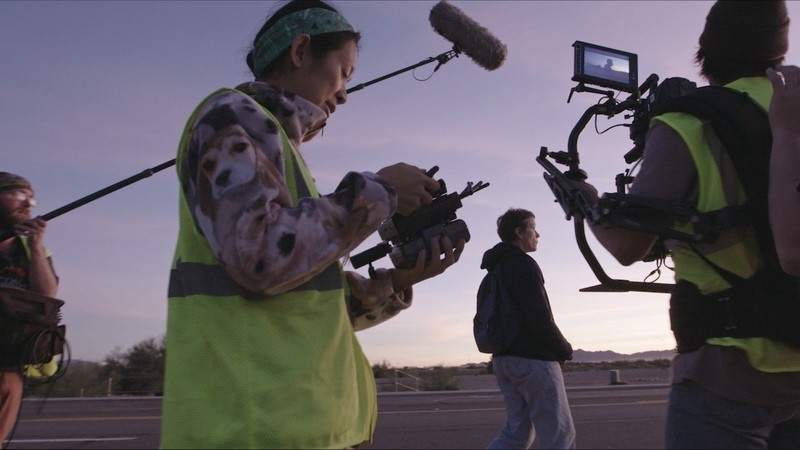
Chloé Zhao(“Nomadland”): This Chinese filmmaker was previously praised for her debut feature, 2016’s “Songs My Brothers Taught Me,” which focused on the bond between a Lakota Sioux brother, his younger sister and their extended family who live on the Pine Ridge Indian Reservation in South Dakota. Her second film, “The Rider” (2018), starred a real-life rodeo rider who suffers an accident and no longer competes. Her latest film “Nomadland” won the Golden Lion at the Venice Film Festival and the People’s Choice Award at the TIFF, becoming the first movie to claim both prizes. The movie’s greatest asset by far is its star Frances McDormand, who plays a feisty 60-something former plant worker who decides to sell most of her belongings and buy an RV to live in as she looks for job opportunities while connecting with her fellow vagabonds. Watching McDormand genuinely bond with her real-life nomad co-stars is an emotional road trip indeed, along with soul-stirring backdrops courtesy of Mother Nature and terrific cinematography.
David Fincher(“Mank”): Fincher, who was previously was nominated in this category for 2008’s “The Curious Case of Benjamin Button” and 2010’s “The Social Network,” ambitiously dips into the truths and myths about the making of Orson Welles’ “Citizen Kane” (1941), which is considered one of best movies ever made. Instead of focusing on Welles, Fincher’s first feature since 2014’s “Gone Girl” zeros in on alcoholic screenwriter Herman J. Mankiewicz (Gary Oldman), whose main character is inspired by media mogul William Randolph Hearst (Charles Dance). Fincher, who usually has visual panache to spare, insisted on shooting “Mank” in black and white as an homage to the subject at hand. We will see if his nostalgic time-machine to Hollywood’s golden era finally snags him a win.
Aaron Sorkin(“The Trial of the Chicago 7”): In an awards season rife with top-notch ensemble casts, Sorkin has gathered quite an interesting mix of characters based on the real-life Vietnam War protestors who were accused of inciting riots during the 1968 Democratic Convention in the Windy City. Sorkin, directing for the second time, mostly stages the action in a courtroom with a motley crew of opinionated males, most notably Yippies Abbie Hoffman (Sacha Baron Cohen) and Jerry Rubin (Jeremy Strong) along with Tom Hayden (Eddie Redmayne). Meanwhile, Mark Rylance takes on the chore of being their lawyer William Kunstler, opposite Frank Langella as the hissable Judge Julius Hoffman who mistreats Black Panther party co-founder Bobby Seale (Yahya Abdul-Mateen II) in one of the film’s most dramatic scenes. Snappy dialogue is one thing. But given all the anti-racism protests that continue to take place in the streets of our country and Trump’s previous use of military force to stage to a creepy photo op, there might not be a more relatable film at this moment.
Regina King(“One Night in Miami”): King seems to have the Midas touch whenever awards season comes around. She has amassed quite a load of gold in her career, in the form of an Oscar, four Emmys, a Golden Globe and a SAG ensemble honor. But this time, she might just win with her film debut behind the camera. The actress has been in training for a while, thanks to helming TV episodes of “This Is Us,” “Insecure,” and “Scandal.” Based on a Kemp Powers play, this what-if drama imagines what might have happened during a 1964 meeting at a Miami hotel between Muhammad Ali (Eli Goree), Malcolm X (Kingsley Ben-Adir), Sam Cooke (Leslie Odom Jr.) and Jim Brown (Aldis Hodge). What transpires is a black male all-night gab fest, where adult beverages are served, vanilla ice cream is shared, and opinions are the main course. King’s best move was casting such charismatic actors, who are talented enough to play four black icons from the past and make them seem current again.
Paul Greengrass(“News of the World”): This British director is best known for directing three of the “Jason Bourne” sequels. His lone Oscar nomination was for his 2006 9/11-inspired drama “United 93,” which recreates what entailed on that fateful hijacked flight as passengers would crash the plane and save countless lives. Greengrass’ latest effort reunites him with Tom Hanks after 2013’s sea-faring true-life thriller, “Captain Phillips.” This time, they take on a Western drama about a Civil War veteran, Jefferson Kyle Kidd, who makes his living by traveling from town to town and charging attendees 10 cents to hear him read newspaper articles aloud. In his travels, he happens upon Johanna (Helena Zengel), a stranded young white German lass who was taken from her family by Native Americans. He reluctantly agrees to return her to her surviving family even though they have trouble communicating. The film has echoes of “True Grit” as well as “The Miracle Worker,” but ultimately it’s about a nation divided struggling to recover from the emotional wounds of a horrible war and the death of loved ones, while embracing a new way of life. Without being too blunt about it, isn’t this a reflection of the current state of our nation right now?
Lee Isaac Chung (“Minari”): Chung based this heartfelt, often amusing film about a South Korean immigrant family with a curious six-year-old son David (Alan S. Kim) and an older grounded daughter Anne (Noel Kate Cho) on his own upbringing. Husband Jacob (Steven Yeun), who puts on a macho façade under his gimme cap, is determined to grow and sell Korean vegetables grown on his 50-acre plot in Arkansas, while wife Monica (Yeri Han) is less than pleased to be living in a mobile home. To keep the peace as the family searches for their own American dream, the couple recruits Jacob’s grandmother to join them, and it’s a good thing she did since actress Yuh-Jung Youn’s arrival not only binds the family, she also enlivens the whole movie with her passion for profanity, wrestling, and Mountain Dew. She also eventually charms her great-grandson, who initially isn’t that excited to share his bedroom with someone that he says “smells like Korea.” The film won both the U.S. Dramatic Competition Grand Jury Prize and U.S. Competition Audience Award at the 2020 Sundance Film Festival—a good omen for eventual trophies to come.
Spike Lee(“Da 5 Bloods”): You would think that this highly influential and ground-breaking filmmaker would have multiple Oscars by now. But you’d be wrong. Lee received an honorary Academy Award in 2016 but had to wait until 2019 to bring home his first competitive Oscar for his adapted screenplay of “BlacKkKlansman,” a movie that also earned him his first-ever bids for Best Director and Best Picture. His latest, “Da 5 Bloods,” is a tale of four aging black Vietnam vets who return to the country to find the remains of their fallen squad leader and dig up a treasure that they left behind while serving. There is action and intrigue galore as well as welcome catharsis, with the under-appreciated Delroy Lindo as a standout along with the late Chadwick Boseman who is seen in flashbacks as their leader, Stormin’ Norman. Lee’s film digs deep, exposing the racism inherent in warfare while adding some grindhouse-movie escapism to the landscape.
Florian Zeller (“The Father”): The insidious disease that is dementia showed up in numerous 2020 films, ranging from the horror film “Relic” to the documentary “Dick Johnson is Dead.” But this heartbreaking title based on French writer and first-time director Zeller’s play has earned the most critical plaudits as it unites two Oscar-winning actors. Anthony Hopkins plays an elderly Englishman whose pride causes him to deny his condition while he continues to lose grip on what is real and what is an illusion, sometimes being forced into silence. Olivia Colman plays the man’s daughter, who can’t make daily visits any more, and grieves the loss of her father although he is still alive. The last time a first-time director took the prize in this category was when Sam Mendes won for 1999’s “American Beauty.” And the last time a French-born director won an Oscar was Michel Hazanavicius for 2011’s “The Artist.”
George C. Wolfe(“Ma Rainey’s Black Bottom”): This stage veteran has won two Tonys for directing plays, one for 1993’s Angels in America: Millennium Approaches and another for the 1996 musical Bring in ‘da Noise, Bring on ‘da Funk. As for his film work, Wolfe directed 2008’s Nicholas Sparks adaptation “Night in Rodanthe” and also 2005’s “Lackawanna Blues,” which aired on HBO. One could surmise that Wolfe’s stage background came in handy as he and his crew adapted August Wilson’s play “Ma Rainey’s Black Bottom” for the big screen. There are a few outdoor scenes, including the opening that introduces the title character played by a stellar Viola Davis in all her bluesy glory, as well as her cocky trumpet player Levee Green, who takes a solo as they perform in a tent in the woods. Played by Chadwick Boseman in his final role before he died in August last year, Levee brings down the house as an ambitious musician who writes catchy tunes and is itching to be discovered. Given that most of the action takes place in a cramped rehearsal room and a recording studio in 1927 Chicago, Wolfe focuses on the hot-headed whippersnapper Levee, who is driven by anger and ambition, and on the three elder musicians who talk amongst themselves while waiting for Ma to show up. But it’s the crackling dialogue and sometimes testy interactions as the Mother of the Blues tries to manipulate her white manager and producer to do her bidding, which includes bringing her three ice-cold Cokes before she sings a note. Yes, these men are exploiting highly talented artists for their own gain—a situation that isn’t that unusual even now.
Emerald Fennell(“Promising Young Woman”): The show-runner for the second season of TV’s “Killing Eve,” who also plays Camilla Parker Bowles on Netflix’s “The Crown,” Fennell has quite an eye for details in her big-screen directing debut, “Promising Young Woman.” The film is a lethal revenge thriller starring fellow Brit Carey Mulligan as Cassie—short for Cassandra, the Trojan priestess who told true prophecies that were never believed. The devil, however, is in the details. Cassie is a 30-year-old med-school dropout who dons girly pastel sweaters and rose-adorned dresses to her day job as a barista, but at night she wears revealing outfits, sexy hairdos, and piles of make-up in order to pretend to be wasted at clubs, waiting for a “nice guy” to take her home. When they do, she suddenly reveals she is stone-cold sober and shames them for taking advantage of her. Not since Gerwig’s “Lady Bird” has there been such a marvelous spot-on debut of a new female director.
I wouldn’t go as far as to call “Greenland” a masterpiece but it’s certainly one of the biggest cinematic surprises in a while. It spent three weeks in theaters without much fanfare here in Mexico until they shut down again this weekend. This makes sense, after all, not many people were going to risk a trip to the cinema during a pandemic for another seemingly unremarkable Gerard Butler action movie. Thankfully, word of mouth spread in time for me to watch it before it was too late. This is the type of feature where several of the scares come from the sound mix and great visuals. It demands to be seen with the right sound system and on the big screen.
Whatever its flaws and limitations, I see “Greenland” as the poster boy for Ebert’s rule of “It’s not what the movie is about, but how it is about it.” The film shares more than a few elements with the two members of the “gigantic earth busting comet movie” genre (“Deep Impact” and “Armageddon,” both from 1998), and on the surface it seems even closer to Roland Emmerich’s “2012.” But “Greenland” is set apart from all of them with its very different attitude.
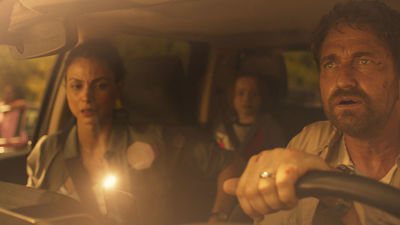
Directed by Ric Roman Waugh, the film deals with the events leading to the appearance of Comet Clarke, a spectacular moment that appears harmless enough until several clues make it clear that something bigger is on the way. Skyscraper builder (and thus essential worker) John Garrity (Gerard Butler) is recruited along with his estranged wife Allison (Morena Baccarin) and son Nathan (Roger Dale Floyd) for a flight to Greenland where shelters were built years ago for just such an occasion; they spend a good deal of the movie facing one believable setback after another. They’re a family unit in crisis, reminiscent of the one Spielberg created in “War of the Worlds” (2005).
Few things have been as frustrating to me as Hollywood’s recent inability to make a good disaster film, despite coming up with truly groundbreaking SFX technology. “2012” is a good example of the philosophy that the more realistic visual effects have become, the less believable that disaster films have turned out to be. Other predecessors of “Greenland” have all made the same mistake: they never take themselves even remotely seriously, and their makers see them as mere roller coaster rides designed to sell popcorn. In that regard some may have succeeded, but I will never understand the point of making a movie about the end of the world if the audience never really gets the feel what it would be like to live through such an event.
Most of Emmerich’s recent disaster entries have shared the same tendency to create over-the-top characters whose attitudes have nothing to do with what’s going on around them, and who have relationships that make it too easy to determine who lives and who dies (case in point: Amanda Peet’s doomed boyfriend in “2012”). Even the supposedly frightening characters in these movies have turned out to be complete duds, unlike what we get here in “Greenland.” Just compare Woody Harrelson’s mad prophet form “2012” to the bearded, overweight everyman in “Greenland” whose unpredictable, and terrifying nature is only revealed as we slowly come to realize that his best interest may not necessarily align with those of the leads. When it comes to its character’s attitudes “Greenland” is much more reminiscent to the disaster films of the 1970s than to the rest of the movies mentioned above. The characters here are much more believable as well. They panic to the point of doing things they would have never guessed, like leaving behind their beloved neighbor’s children to their sad fates, and they make the normal mistakes that regular people would make in a situation like this (ex.: one suitcase allowed” actually means one suitcase per family).
Director Waugh makes Clarke the comet a truly frightening menace not unlike what Spielberg achieved with Bruce the shark decades before, and wisely takes the same approach in introducing its full dimension little by little. Every death in this movie is deeply felt, and is not just put aside a couple of scenes later. The characters in “Greenland” don’t act as if they were on a roller coaster ride but rather as if in a situation where they’re fighting for their lives every step of the way. Take for instance a sequence when the leading man can’t avoid facing a couple of crazies, and we then see his stunned reaction at realizing he’s capable of the unimaginable. In these most difficult times, a movie like “Greenland” can actually help you put your personal problems in perspective if only for a couple of hours. That is the best compliment I can imagine for an entry of this nature.
All of the above is not to say that the movie doesn’t include its share of apocalyptic film clichés. After all, what would a disaster entry be without a leading couple living through a marital crisis that will inevitably be solved, much as in “The Abyss,” “Twister,” “2012,” and so on? And how could “Greenland” possibly convey immediate doom without the usual sky full of ominously flying birds? And what would a film like this be without all the crisis associated with the typical ill child in dire need of medication, just as in in “World War Z,” “Signs,” and what have you? At least the filmmakers made this last dilemma integral to the plot.
Still, I’m also a bit skeptical about the plausibility of building all these shelters in the remote lands of Greenland since logic dictates nothing would stop a comet from colliding directly with Earth precisely in that region. We also have to look past all these incredible coincidences that need to take place for the characters to remain together and crash land just a couple of miles from their destination (much as it happened in “2012”). But “Greenland” is so convincing, we don’t really care too much about these weaknesses.
Waugh’s film will likely be remembered as a special effects movie, but they wouldn’t achieve the same result without actors and a director to sell them to the audience, such as in the ending sequence which features scenes from destroyed cities around the world. When my hometown’s presidential palace in ruins turned up, I have to admit that it received cheers from all four audience members. It was for all the wrong reasons, but also for all the right ones.
After watching “Greenland” I was especially surprised to see how well Butler comes off by adding some vulnerability to his character. Maybe Butler has found his true niche in this genre, much like Liam Neeson did with the “special set of skills” character from “Taken” over a decade ago. After all these years of complaining and writing on this site about half a dozen pieces on the problem with the recent disaster films, one viewing of “Greenland” has left me with nothing more to say about the subject. It shows the exact way to make a really good one.