Categories
Health

Miss Michigan Called Out the Flint Water Crisis During the Miss America Pageant


Last night, Nia Franklin of New York was crowned the latest Miss America, but it is Miss Michigan, Emily Sioma, who is making headlines thanks to her short introduction during the broadcast.

Instead of using the moment to highlight her achievements or qualifications—she graduated with a degree in women’s studies and works to support survivors of sexual violence—Sioma instead chose to call attention to the continuing water crisis in Flint, MI. “From the state with 84% of the United States’ fresh water but none for its residents to drink, I am Miss Michigan Emily Sioma,” she said.

The city’s water problems have been ongoing since 2014 when it was found that the water in the city’s pipes was contaminated with high levels of lead and other toxins.

Social media users were quick to praise Sioma for her bold move with one writing this was “clearly not your mother’s Miss America pageant.”

Another said, “Been rolling my eyes all weekend that Miss America is still a thing but MISS MICHIGAN FOR PRESIDENT.”

This is surely the type of positive attention that the Miss America organization is looking for as it continues to rebrand and attempts to focus more on the intellect of its contestants. Back in June, board of trustees chairwoman Gretchen Carlson announced that the pageant would no longer include its famous swimsuit competition. “We are no longer a pageant,” Carlson told Good Morning America at the time. “We are a competition. We will no longer judge our candidates on their outward physical appearance. That’s huge.”

“Who doesn’t want to be empowered, learn leadership skills, and pay for college and be able to show the world who you are as a person from the inside of your soul,” she continued. “That’s what we’re judging them on now.”

While Sioma didn’t even make the final 15 in the competition, her message was most definitely heard.


Source link

Categories
Health

The Best Sleep Water to Help You Fall Asleep Naturally


I have a distinct memory from five years ago, when I was fresh out of college and happy to work until 2 a.m. on a deadline, of humble-bragging to my boss that I could get by on merely four hours of sleep. (“I just drink a Red Bull and I’m fine!”) She groaned an ominous warning: “Just wait.”

Now, at 29, I realize my youthful naïveté. Along with a newfound inability to handle the hangover I’ll get after two rosés, I’m now unable to function with any less than seven hours of sleep. As I’ve gotten older and more curmudgeonly about going to bed early, this hasn’t been too much of an issue. But a few months ago, on top of an already chaotic news cycle that’s wreaked havoc on normally sound sleepers, I found myself suffering from insomnia.

Not one to really ever prioritize my health (see: taking pride in sleep deprivation), I didn’t do much to seek out treatment. I caffeinated, I upped my under-eye concealer, and slogged through the day like a yawning zombie. That didn’t quite cut it. (Weird, right?)

But I had tried sleeping pills in the past and felt foggy in the morning, so I didn’t want to go down that road again. I’d heard about melatonin tablets and adaptogens—options normally lauded as solid natural sleep-aids—but already over-tired, the thought of having to road-test these and titrate the right amounts before landing on something that would work for me just exacerbated my agita. So my ill-advised solution was to pop an Ativan (which I’m prescribed, as-needed, for anxiety attacks), hoping it would knock me out. As you can imagine, this went horribly, as going off-label or against doctor’s instructions often does. Not only was this misuse of anxiety meds making me groggy, it was screwing with my mood.

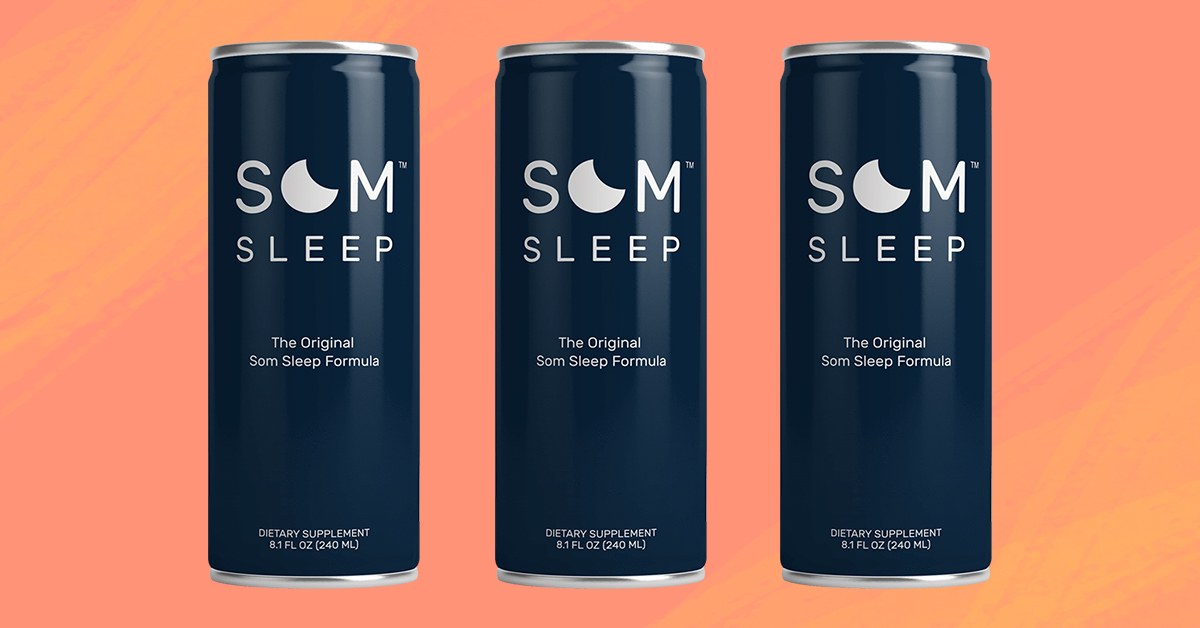
I’d recently attended Goop Fest, Gwyneth Paltrow’s bougie wellness summit, to share an outsider’s view on the convention. For my participation, I walked away with a literal suitcase full of health swag including everything from mushroom matcha mix to collagen protein bars to paleo supplements. I ended up giving away most of it with one intriguing exception: four bottles of Som Sleep’s “Sleep Formula.” A drink that promises to help you doze off, which I promptly placed in my fridge and forgot about for the foreseeable future.

I never heard of a sleep water before, but it wasn’t that hard to figure out. You put it in the fridge, and then drink it 30 minutes before you want to go to bed. From there, magnesium and melatonin (among other ingredients said to promote relaxation) go to work to naturally tell your body that it’s time to turn in. It’s essentially the anti-Red Bull. So, one night when I was having a particularly difficult time winding down, I remembered I had a case of this stuff stashed in my fridge and cracked one open. Fifteen minutes into the show I was watching, I started to yawn. By the time the credits were rolling, I was ready for bed.

I awoke the next the morning surprisingly refreshed. Getting up to my alarm felt a little easier, and come 4 p.m. that day, I wasn’t dragging and in need of another coffee. Since Som claims its formula is non-habit forming, I chugged one again the next night to the same delightful result.

An occupational hazard of working as a beauty editor is that I get access to, and then sample, all kinds of supplements. And something I’ve noticed among them, whether it’s “beauty water” or collagen drinks, is that many have a funky taste. This berry-flavored formula is a little more polite on the palate. There’s a slight aftertaste, but overall it’s actually quite refreshing (the original slightly moreso than the sugar-free version). And like most things that are Goop-approved, it comes with a lot of no‘s: no gluten, no dairy, no preservatives, and no artificial flavors.

As for a different no: By no means am I saying a sleepy-time supplement is a cure for anxiety or insomnia. It’s not. Eventually, I did make the call to loop in my doctor, who helped me land on a better anxiety-med dosage. That, I’m pretty sure, is what has ultimately helped me get better sleep. But at least once or twice a week when I still have trouble unwinding—these days, likely from a too-intense episode of The Handmaid’s Tale—I reach for one of these cans and feel the blissful effects of the sleep water at work. Whether it’s the placebo affect or the real deal, me and my full eight hours are not complaining.

Plus, it’s nice to be able to brag about my sleeping habits again.

Som Sleep The Original Som Sleep Formula, $30 for 12, amazon.com

Related Stories:
Even If You Aren’t Expecting, You Should Try Sleeping With This Pregnancy Pillow
16 Sleep Masks That’ll Help You Clock Those 8 Hours
9 Ways to Bounce Back the Day After a Crappy Night’s Sleep


Source link

Categories
Health

Taylor Swift Is in Hot Water With the ACLU After Allegedly Attempting to Silence a Critic


Taylor Swift has a history of pushing back against her critics—see: the lyrics to “Shake It Off”—but her latest dispute has the singer in hot water with the ACLU.

On Monday the ACLU sent Swift a strongly worded letter telling her to back off a critic she reportedly tried to silence. According to the ACLU, the website PopFront published a story in September entitled, “Swiftly to the alt-right: Taylor subtly gets the lower case kkk in formation.” In the post, editor Meghan Herning, in a mix of “political speech and critical commentary,” argues that some white supremacists have embraced Swift’s work. Because of this, Herning asks the singer to denounce white supremacy. Then, in October, Herning received a cease-and-desist letter from Swift and her lawyer threatening a defamation lawsuit and demanding a retraction for the story.

“Among other things, the story propagates such hideous falsehoods as: 1) ‘Taylor’s lyrics play to [a] subtle, quiet white support of a racial hierarchy;’ 2) that there are similarities between Ms. Swift and Adolf Hitler; 3) that the ‘lyrics [of ‘Look What You Made Me Do’] are the most
explicit in speaking to white anger and affirming white supremacy;’ and 4) that Ms. Swift’s purported silence regarding white supremacy means she supports Donald Trump and identifies with the white supremacist/al-right movement,” the letter from Swift’s lawyer read.

After receiving it, Herning contacted the ACLU, who sent Swift a letter stating that the editor and PopFront would not “in any way accede to your attempt to suppress their constitutionally protected speech.” As for the aforementioned “hideous falsehoods,” the ACLU responded, “Not even in your wildest dreams can they constitute defamation.” The references to Swift’s work continued later in the letter with, “Criticism is never pleasant, but a celebrity has to shake it off, even if the critique may damage her reputation.”

Related: How Taylor Swift is Counting on Fashion to Change Her ‘Reputation’


Source link

Categories
Health

Help! I Can Only Orgasm With Running Water


PHOTO: deepblue4you/Getty Images

Hi, Emily!

I’m just gonna dive right in. When I was 17 years old, I had never orgasmed, despite having had one or two sexual partners. So I did some research. I read that placing your clit right underneath running water is a way to reach orgasm! So, I tried it. And to this day, it is the only way I can climax.

I have a serious boyfriend now, who I have amazing sex with, but I don’t think I’m orgasming with him. What do I do? Am I doomed to only come in the presence of running water?? Sex with my partner feels amazing, and I truly think I am orgasming in some way, just not as intensely. I just don’t know what will help!

May, age 19

May,

Running water is one of the most common ways women experience their very first orgasm—and a pretty effective one at that. You get brownie points in my book for taking charge of your pleasure and figuring this out.

On the flip side, your body becomes trained to respond to a particular touch, and when you’re only relying on one method to orgasm (running water), you aren’t giving your body much to work with in terms of learning how to reach climax with other types of stimulation.

Masturbation is the best place to start. You need to teach your body how to respond to new stimuli, so experimentation is a must! Plus, when you’re by yourself, there’s less distraction, and you’ll have all the time in the world to figure out what sensations you like. Use your fingers and hands, add a little lube, change up your speed, intensity, and rhythm; explore all parts in and around your vagina.

You can even try out a toy during this learning curve, like the Mystic Wand by Vibratex. It has six different intensities and vibration patterns to play around with, to really experiment with yourself.

Once you’re comfortable on your own, then you can bring that newfound information to your partner. After all, as much as we wish they were, men aren’t mind readers! Show him the different kinds of touch that your body responds to as well as the positions that work best for you. And, most importantly, remember that this is something that is going to take time. It’s like learning how to play a sport: you aren’t going to wake up with Mia Hamm soccer skills after one practice.

So, if at first you don’t succeed in finding different ways to orgasm, try, try again. You have so much time to explore and learn the many beautiful ways in which you can experience pleasure.

XX
Emily

Emily Morse is a doctor of human sexuality and host of the top-rated iTunes podcast Sex With Emily. As an expert, author, and star of television and radio programs, she has inspired millions of listeners and followers to make sex a priority, enhance communication, and strengthen their relationships. To learn more or to subscribe to her podcast, visit sexwithemily.com.


Source link