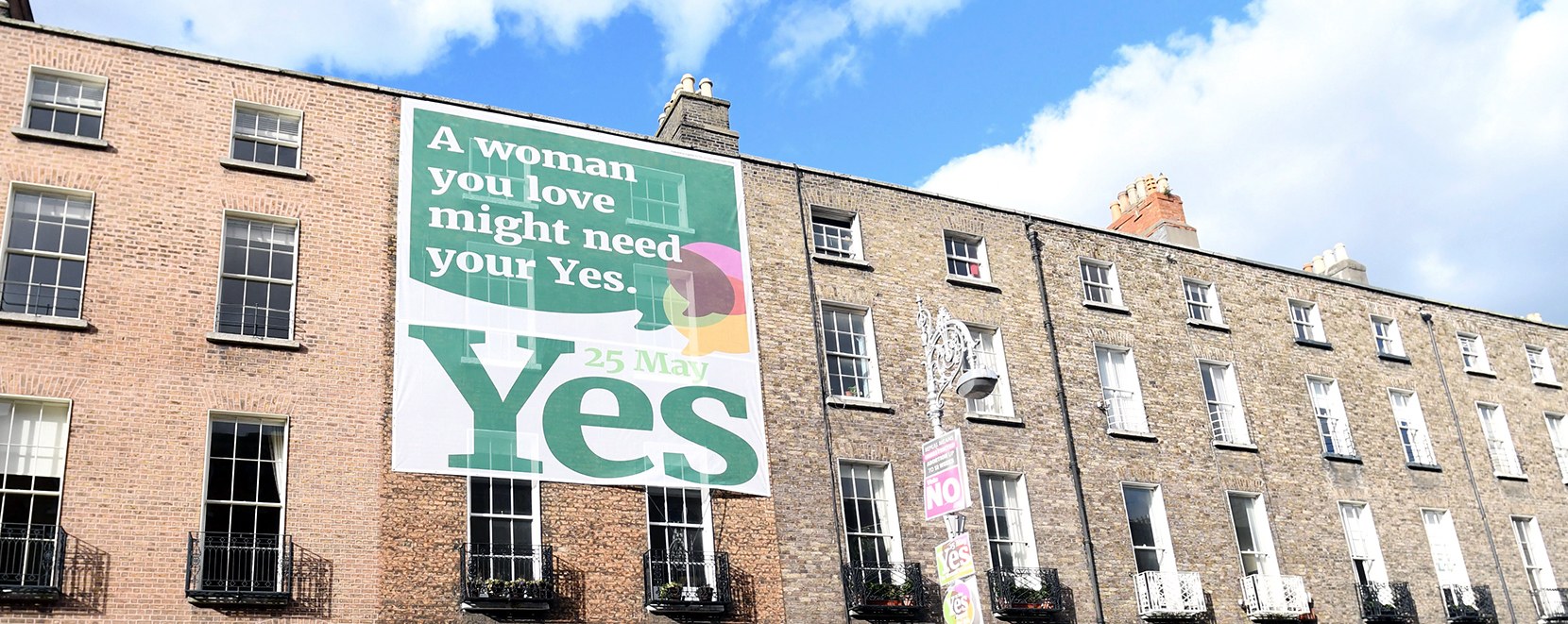
Three years ago this week, I cried with joy as I sat in my New York apartment and watched the country I grew up in make joyous, beautiful, progressive history with a national referendum that ultimately allowed us to become the first country in the world to grant into law gay marriage.
On Friday, May 25, I will again be frantically refreshing news pages as I await the result of another historic referendum—which means a country’s entire electorate are invited to vote—this time on whether to repeal the Eighth Amendment. Or for those of you unaccustomed to the Irish constitution, whether abortion will be legalized.
Abortion has been illegal in Ireland since 1861 but, in 1983, the Eighth Amendment was voted into the Irish Constitution, stating that the life of a pregnant woman is equal to that of an unborn child, and outlaws abortion for every woman.
Indeed, Ireland has had a troubling history of oppressing women, insofar as the country has had to reckon with the fact that up until as recent as the mid 1990s thousands of unmarried pregnant women were placed into servitude in what was known as the Magdelene Laundries—essentially confinement asylums run by Roman Catholic nuns for girls or young women who had become pregnant outside marriage or whose families could not or would not support them and had to be hidden away.
In many other ways, though, Ireland has changed a lot since 1983. In just a few decades, it’s gone from an often-insular society with institutions controlled by the Catholic Church to a multicultural society of socially progressives. To Americans, it might sound like we’re slow to adopt cultural norms you’re accustomed to, but progress has been made: In 1985 the Irish government approved the sale of contraceptives, divorce became legal in 1995 following another referendum, and Ireland is now the European hub of some of the largest and most innovative tech companies in the world, including Google an Facebook. Our current political leader, Prime Minister Leo Varadkar, is the gay son of Indian immigrants!
I want to stress that you don’t have to agree with abortion to hope for an affirmative outcome. You just have to agree that Irish women should be afforded a legal—and safe—choice.
On Friday, if the vote gets a majority Yes, Ireland will likely enact legislation that will allow for legal abortions up to 12 weeks into a pregnancy (for context, most states in the US allows abortion up to the 20th week). After that time period, abortions will only be carried out on the grounds of a serious mental or physical health risk to the mother, or a fatal fetal condition. A No vote means that Ireland’s abortion laws, which are some of the most restrictive in the developed world, would remain in place.
This referendum is deeply divisive in Ireland and for the Irish diaspora around the world, many of which are traveling long distances to be able to cast their vote. And, right now, the polls are too close to call.
Having lived outside Ireland for the past eight years, I’m not eligible to vote but given the opportunity I would certainly vote a resounding YES to repeal the 8th.
Because abortion is illegal—full stop—thousands of women have had to seek them out in unsafe and illegal ways. According to the UK Department of Health data, nine women make the journey from Ireland to the UK to have an abortion every day. They bleed on the way home on Ryanair flights from London where they’ve had to travel to get legal terminations; they wait in anxious hope for the illegal “abortion pills” they’ve surreptitiously ordered online to make it through the postal system without getting caught because if they do, they can face up to 14 years in jail; they cry in airports with their husbands and partners when they’ve been told they have a terminal pregnancy but under Irish law they have to carry the baby to term. In Ireland, a sexual assault survivor could potentially face more jail time for terminating a pregnancy than her rapist.
As I explain this referendum to curious friends and colleagues here in the US, I want to stress that you don’t have to agree with abortion to hope for an affirmative outcome, you just have to agree that Irish women should be afforded a legal—and safe—choice.
I urge Glamour readers to pay attention to the outcome of tomorrow’s vote. While women’s reproductive rights—an area Glamour has long been committed to covering—are in a precarious place in the US right now, the fact is, for many women in many states, access to safe and legal abortions exist. I hope you’ll join me in agreeing that right should be afforded to the women across the Atlantic, too.
Samantha Barry is Glamour’s Editor-in-Chief
Source link