Categories
Health

Self Isolation Has Truly Changed My Relationship With Makeup


As much as the beauty industry claims that makeup is a tool for empowerment, for me, it’s more of a crutch. Sure, there’s something “empowering” about the fact that covering my acne makes it easier to focus on my work. A red lipstick gets me in the headspace to have a fun night out, and thick winged liner makes me feel like the ’60s It-girl I want to be. But when it gets down to it, I use it to feel prettier and to cover what society has drilled into my head are my flaws.

I’m not ashamed to say that. I don’t think wanting to look a certain way makes me any less intelligent, or less of a feminist, but it is exhausting. Every day, I wake up and spend at least 30 minutes getting myself ready for the day ahead. I layer on a full-coverage foundation, along with concealer, blush, highlighter, brow gel, liner, and mascara, and slowly sculpt myself into the face I recognize. I started wearing makeup when I was 12—my mom generously let me wear neon Urban Decay eyeshadow to middle school—but it wasn’t until high school, when my acne began and my self-esteem plummeted, that it became something I couldn’t live without.

I’ve struggled with cystic acne for a decade now. I had a brief stint of clear skin thanks to Accutane in 2018, but it returned with a vengeance last year. And after a particularly brutal breakout this winter left me covered in red scars, it hurt to look in the mirror. This sounds dramatic, I know, but if you’ve ever experienced it, you’ll understand. I’ve long depended on makeup to make myself feel like myself, and not like I’m stuck in a bad dream or a teenager’s body.

I refuse to run to the corner store without at least a light layer of tinted moisturizer and mascara. Even when I have nowhere to go I’ll pile on some foundation and liner so my heart doesn’t sink every time I catch a glance in a reflective surface. On the off chance I do pop out for an errand without makeup on, I find it hard to make eye contact with anyone I pass.

Cut then to a few weeks ago. In early March, I woke up as usual and put on my regular face, paying extra attention to my cat eye since I hadn’t slept well amid the growing anxiety about coronavirus. I checked my email before stepping out the door to see a message that, like most of the country, my team was told to work from home until the situation got better. I worked from home in a full face that day. The next day, I applied my foundation as usual, grasping at some semblance of normalcy and wanting to look good for a Zoom meeting.

It went on like this for days until I woke up one morning exhausted by my new normal. With the reality sinking in that social distancing didn’t have a foreseeable end, I didn’t reach for my makeup bag all day. I told myself it was a pledge to let my skin breathe, but I’d be lying if I didn’t say that painstakingly covering every spot on my face (probably about 25 at last count) felt like such a waste of energy.

One month later I can count on both hands the amount of times I’ve worn a full face of makeup during all this. I started wearing it only out on runs to the store or days where I have video meetings, but I’ve slowly tapered it off to about once a week. I wear mascara some days, and a light coat of foundation when I have Zooms scheduled with beauty brands (I’ve since abandoned that when just meeting with my team). Once a week I’ll treat myself to the whole shebang—foundation, liner, blush, mascara—just to feel like myself. Plus, playing with my products is legitimately fun—and, fine, I need one day a week to take cute selfies.

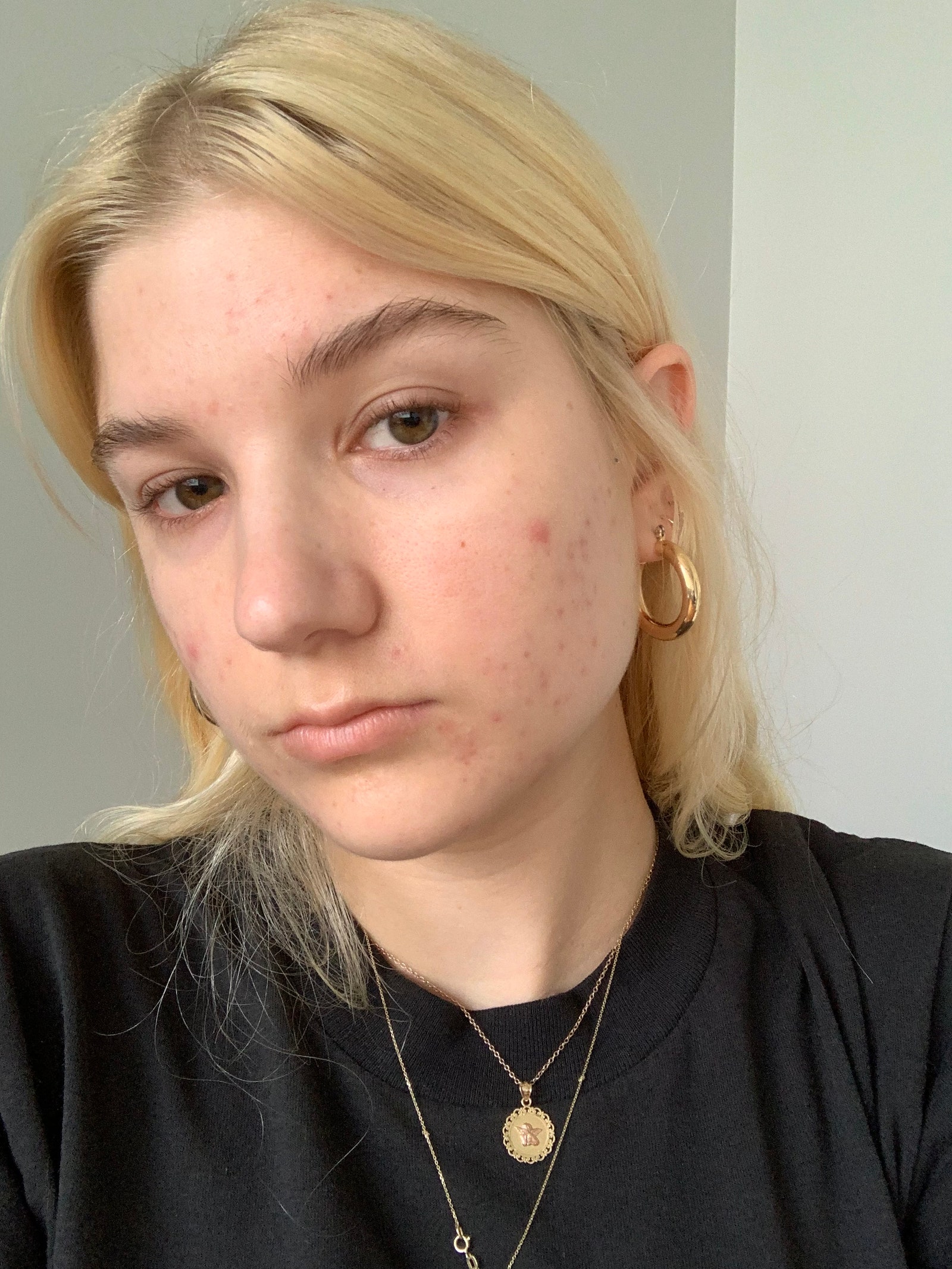
How I look most days now.

Bella Cacciatore

But on most days, I’m barefaced. It doesn’t seem to be helping my skin—thanks to a diet of stress and sugar, I’m breaking out just as much as usual. But I’m not stressing over it the way I usually would. Sure, I still don’t love what I see in the mirror (I’m not sure I ever will), but I’m slowly moving toward something resembling acceptance. Some days are better than others. I’ll consider swearing off foundation forever only to wake up the next day ready to cake myself in it. Currently, I have two giant red zits, but it doesn’t feel like the end of the world. Maybe because so many other things do.

Going makeup free has really hammered home the point I’ve always told myself but never fully believed: No one is looking at you. It’s become shockingly apparent that everyone is so caught up in stocking up on bread, enjoying their daily walks, or trying to make it to work without contracting a raging virus to judge me for leaving the house with visible pimples. In all the chaos, it’s become a strange comfort. I’ve even started to appreciate things I’ve never noticed: how dewy my skin is when I’m not suffocating it with foundation, or how green my eyes are in certain lights.

Does this mean I’ll retire my Charlotte Tilbury when this is all over? No. But it’s nice to know that if I do, the world will keep on turning.

Bella Cacciatore is the beauty associate at Glamour. Follow her on Instagram @bellacacciatore.


Source link

Categories
Health

'Tiger King' Review: Netflix's Latest True-Crime Doc Is the Perfect Isolation Binge


Netflix could not have dropped Tiger King: Murder, Mayhem, and Madness at a better time. In this time of isolation and virtual viewing parties, this seven-part docuseries checks every box for the true-crime obsessed: eccentric characters, cults, polygamy, and more twists than you’ll be emotionally prepared to unpack. The tigers are just the bait.

Actually, “eccentric characters” is probably a massive understatement. Tiger King begins as a series about Joseph Maldonado-Passage, aka Joe Exotic: a tiger-owning, gun-slinging, country-singing, gay polygamist who ran a national campaign for president. Say that 10 times fast. Except, as directors Eric Goode and Rebecca Chaiklin discover about five years into filming, this story is about so much more than an illicit zookeeper and his cast of equally bizarre enemies and friends. Suddenly Maldonado is arrested by the FBI for a tangled assassination plot, and viewers will probably come out of this with more knowledge about the various players and motives than the prosecutors.

[embedded content]

Tiger King is not just about the murder-for-hire accusations, though. If you’re looking for a documentary about the world of unregulated exotic animal zoos that are apparently rampant in this country, you’ll get what you came for. On one side, there are the keepers who profit off breeding and petting zoos. On the other, there are animal rights activists and sanctuary owners dead set on ending those harmful practices…while profiting off similar methods. Somehow these zoo owners and “conservationists” are also suspected cult leaders, internet savants, insanely rich, and accused murders. Some are all of the above, with followers who will do anything for them (and the chance to care for exotic animals).

There’s a scene in which one of Maldonado’s employees gets attacked by a tiger and loses her arm. She returns to work seven days later with zero indication that she even cares about her lost appendage. Reader, believe me when I tell you that this is the least ludicrous moment in the series.

Still, the deeper you get into Tiger King, the less it focuses on the lions and tigers and bears of it all. The people involved here—a big cat “savior” who’s been accused of killing her husband, another polygamist with a zoo, and a group of Vegas con artists with an affinity for tiger cubs—are real people. And they seem legitimately dangerous.

Later in the series, as Goode begins to realize the weight of the story that’s unfolding, he calls his directing partner to fill her in. “They were sorta funny when we started,” Chaikin responds. “But it’s getting really dark.” Oh my.

Stream Tiger King on Netflix, here.

Emily Tannenbaum is a contributing writer and weekend editor at Glamour. Follow her on Twitter.


Source link

Categories
Health

Peter Weber’s Family Is Reportedly ‘Closer Than Ever’ During Coronavirus Isolation


While Tyler Cameron and Hannah Brown social distance together in Florida, The Bachelor’s Peter Weber is quarantining with his family—yes, even Barb.

I guess there’s no better time to bond with parents than after they publicly scold you on national TV for dating a girl they don’t like. Personally, if I was locked in with my parents barely a week after they actively clapped when my ex tore me a new one on live TV, there would be a lot of fighting involved. But, like Weber made clear in an Instagram Story last Friday, March 13, there’s no bad blood.

Rumors of a rift between Weber and his mom spread immediately after the After the Final Rose ceremony aired, with Chris Harrison confirming to Glamour that their relationship had been “damaged.” However, the pilot—who split from Madison Prewett just a few days later—shut down those theories on social media, by referring to the headlines as “fake news” and featuring his mom in a post.

Now, the family reportedly continues to hang out amid the coronavirus pandemic. “This time of quarantine is bringing the Weber family closer than ever before,” a source told Us Weekly on March 19. “They are using this time together to bond. During isolation, Peter and his family have been watching movies, playing board games, and cooking together.” Barb, is that you? Are you the source? (Kidding.)

Perhaps Barb is happy thanks to a recent report that her son and Prewett never technically dated after she left The Bachelor. “They were never really back together,” a source told People. “They just realized they couldn’t make it work.”

Meanwhile, the rest of Bachelor Nation has their own quarantine hangs going. Prewett recently spent a day playing board games and looking happy with Selena Gomez. Then, news surfaced that Peter Weber’s ex and former Bachelorette, Hannah Brown, flew to Jupiter, Florida to isolate herself with her season’s favorite contestant, Tyler Cameron. They’ve been TikToking ever since.

Honestly, all of these coronavirus quarantines sound much more active than mine.


Source link