Through our Game Changers series, we spotlight women who have found success in their respective industries—from sports and politics to beauty and fashion. And with all of us spending more time indoors now more than ever, there’s no better time to highlight the inspiring women leading interior design today.
There are countless examples of passionate female designers leaving their mark on what a home (or any space, really) can be. From Athena Calderone and Lily Kwong to Nicole Gibbons and Leanne Ford, these multihyphenate women have extended their creativity into brands, businesses, and our own Instagram feeds. Ahead, 11 female interior designers changing the game (and reminding us that there is no place like home).
It sounds like the plot of a knock-off A Star Is Born, but Willa Ford‘s 2001 hit single “I Wanna Be Bad” stemmed from her being, well, bad. The then unknown singer tells me she was working with a record label at the time that asked her to make more “wholesome” music. She had other ideas.
“Everything I was writing was funky and, you know, like me,” Ford says. “I remember one day I was like, ‘I’m going to do the opposite of what they’re telling me.’ If somebody gives me an authority figure, I’m like, ‘Let me go the other way.'”
That’s when her “aha!” moment came. “I said [to my writing partners], ‘I want to write something where I just wanna be bad,'” Ford recalls. “And they were dying. They were like, ‘This is hilarious. The record label’s gonna kill us, but let’s do it.'”
“I Wanna Be Bad,” a stomping anthem with lyrics like, “I’m losing all my cool / I’m about to break the rules” was born. Ford says the record label liked the song but wanted a softer (read: cheesy) pre-chorus. But then a record executive from another label, Jason Flom, heard Ford’s original version and saw her potential. The rest is pop history: Flom signed Ford, and “I Wanna Be Bad” became a smash, reaching No. 4 on Billboard‘s dance charts and 11 on the Top 40. She was 20 years old.
“Doing the opposite of what I was constantly being told to do and being defiant is how that song came about,” Ford says.
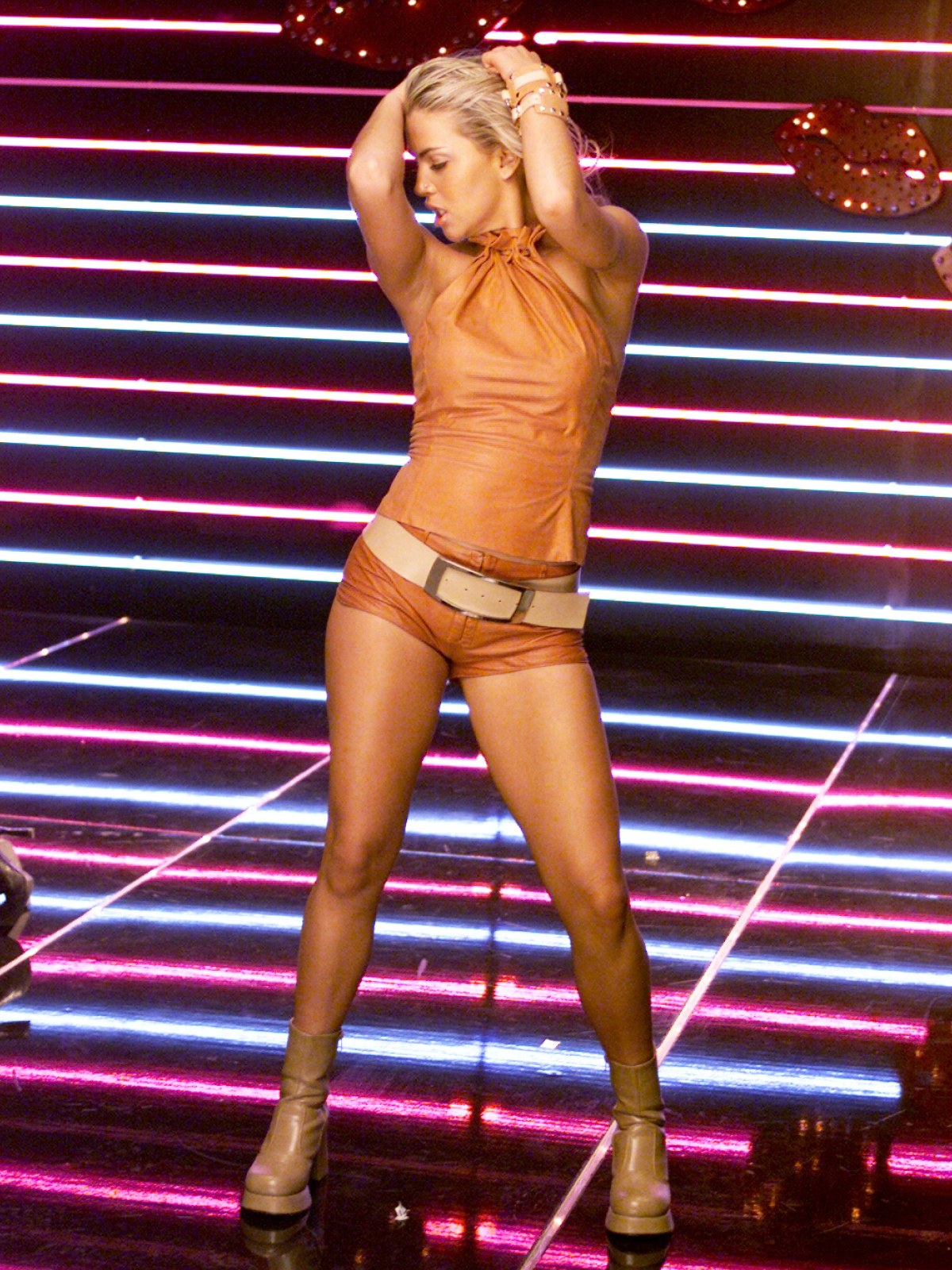
Willa Ford on the set of the “I Wanna Be Bad” music video in 2001
Getty Images
Defiance is in Ford’s DNA. It’s what ignited her pop-music career—and what gave her the courage to walk away when things went awry. Her journey to career fulfillment isn’t so well-known, but anyone contemplating a professional reinvention should hear it.
Born Amanda Lee Williford in Ruskin, Florida, her music talents appeared at an early age. She even scored a spot studying opera in a competitive program. “I was getting free opera training from about 12 to 17. I loved it,” she says. Her chops were strong (listen here), but Ford found herself rejecting opera’s rigid practices. “I was a 16-year-old girl, and my teacher was telling me, ‘You can’t talk on the phone because you’re straining your vocals’ and, ‘You can’t drink that’ and, ‘You can’t eat this.'”
Ford just wanted to let loose, so she pivoted. “I knew in my soul that I wasn’t meant to wear a black dress in front of an orchestra and sing,” she says. “In that moment I decided, ‘I want to dance and have fun and write fun music.'”
The industry was ready for her. Bombastic, bubblegum pop dominated radio in the early aughts, and most of the women making it looked like Ford: Britney Spears, Christina Aguilera, Mandy Moore, Jessica Simpson. Ford crossed paths with most of them as she made her transition to pop. “Britney was always the loveliest human—just a really cool, sweet, normal girl back in the day,” she says. “Jessica was always a doll. The only person I didn’t know was Christina, believe it or not. For whatever reason, we never came into each other’s circle.”