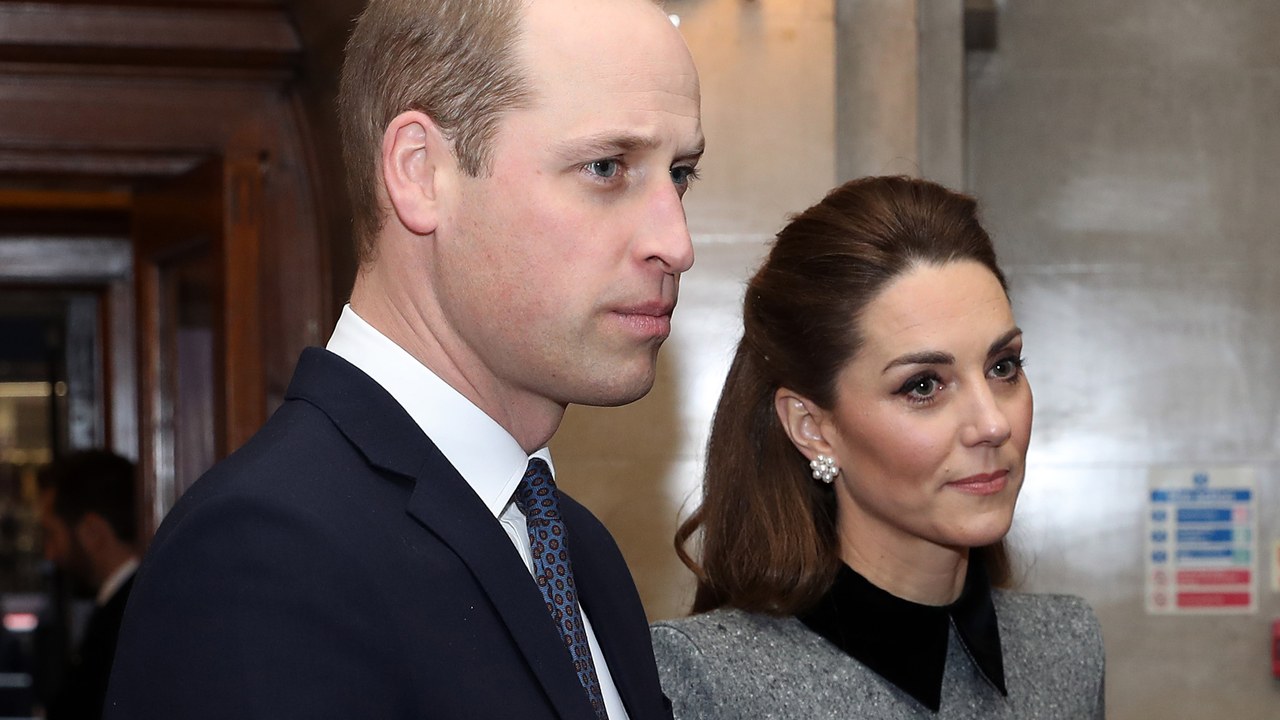
In honor of International Holocaust Remembrance Day, held on January 27 each year, Kate Middleton did more than show up to the annual U.K. Holocaust Memorial Day Commemorative Ceremony in Westminster. The Duchess of Cambridge also shared poignant photos of two Holocaust survivors and their grandchildren that she captured for an upcoming exhibition.
Middleton, who has taken some of the formal portraits of her children released to the public, photographed survivors Steven Frank and Yvonne Bernstein and their families at Kensington Palace to mark the somber occasion. And in honor of the 75th anniversary of the liberation of Auschwitz-Birkenau, Middleton’s photos will be part of a larger show of 75 total images that the Holocaust Memorial Day Trust, Jewish News, and the Royal Photographic Society have assembled.
“The harrowing atrocities of the Holocaust, which were caused by the most unthinkable evil, will forever lay heavy in our hearts. Yet it is so often through the most unimaginable adversity that the most remarkable people flourish,” read the caption of the official Kensington Royal Instagram page.
“Despite unbelievable trauma at the start of their lives, Yvonne Bernstein and Steven Frank are two of the most life-affirming people that I have had the privilege to meet,” Middleton continued. “They look back on their experiences with sadness but also with gratitude that they were some of the lucky few to make it through. Their stories will stay with me forever.”
The duchess photographed Frank with his granddaughters, Maggie and Trixie. According to the post, Frank was sent to the Theresienstadt camp where he and his brothers were three of just 93 surviving children. 15,000 children were sent there in total.
The second photo is of Bernstein with her granddaughter Chloe. Yvonne was one of France’s “hidden children,” escaping the Holocaust by “frequently changing homes and names” with her aunt and uncle.
“I wanted to make the portraits deeply personal to Yvonne and Steven—a celebration of family and the life that they have built since they both arrived in Britain in the 1940s,” the duchess added.
“The families brought items of personal significance with them which are included in the photographs. It was a true honour to have been asked to participate in this project and I hope in some way Yvonne and Steven’s memories will be kept alive as they pass the baton to the next generation.”
Frank said in a statement, “I would hope that the people who look at these pictures not only look at the beauty of the photography, but they will also think of the people behind the photos and their families that they lost in the Holocaust.”
The Kensington Royal Instagram account also released photos from today’s ceremony, where Kate and William spoke to survivors of the Holocaust and lit candles in memory of those who lost their lives.
Last week, President Donald Trump reversed a practice that separated migrant children from their parents, a move that came after many American citizens expressed outrage over the humanitarian crisis.
Since May, more than 2,000 children have been separated from parents crossing the US border, with some kept in facilities like the enclosed tent camp in Tornillo, outside of El Paso, Texas. The children have no idea if or when they will ever see their families again. The issue has transcended partisanship: according to a Quinnipiac poll released last week, two-thirds of American voters oppose these separations, and the administration has scrambled to explain whether it will reunite thousands of families and house them at family detention centers.
“I don’t believe it,” says Ruth Pagirsky, a 92-year-old Holocaust survivor. “There is too much going on that is reminiscent to me of how it all started in Europe. But I was a kid and I didn’t know, I didn’t understand the whole extent of it.”
Pagirsky and her family were forced to leave Berlin for Poland in 1936, after Germany passed a series of laws between 1933 and 1935 that pushed Jews out of professional life. The aim was to establish a pure Aryan utopia. At the time, Pagirsky was almost 10, and says her family’s effective expulsion introduced her to the capacity of human cruelty.
“I had a favorite ring my aunt had given to me, she always gave me something like jewelry and the S.S. man who came saw the ring on my ring holder and he just picked it up and took it. I just couldn’t believe this! I looked at my mother and she just put her finger to her mouth. It was the most frightening thing. Soon after, we left Germany and we went to Poland.”
The family moved to Katowice, where they had relatives. For three years, they survived in relative quiet. “Then we stayed in Poland, and the horror began.”
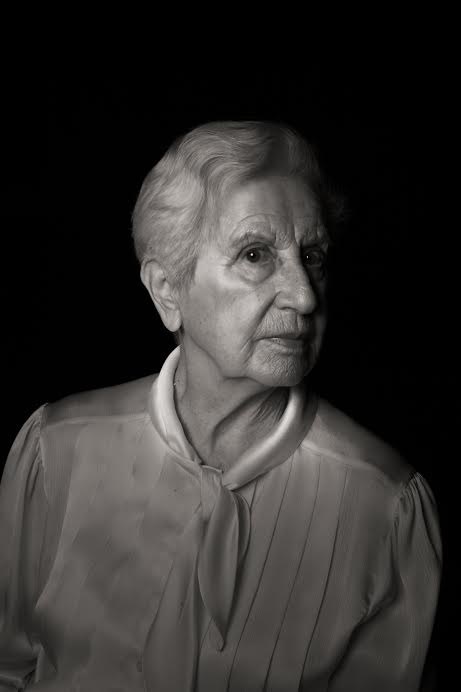
PHOTO: Photographer: John J. Nicastro and B.A. Van Sise
Ruth Pagirsky
In 1939, the Nazis invaded Poland, and in Katowice, S.S. officers came to round up Jews to take to concentration camps like Auschwitz. In 1942, two of Pagirsky’s cousins were playing in front of the house and thrown onto a truck. Her aunt rushed outside with her son (Pagirsky’s cousin), Joshua. He was almost two.
“They were crying, and screaming, everyone was screaming, and the little boy was screaming, and my aunt was trying to calm them down,” Pagirsky remembers. Her aunt offered to go to the camp with the children to help calm them, but the S.S. officer headed her off.
“The children are going to a very beautiful camp and they’ll be taught and they’ll be fine,” he insisted.
Pagirsky’s aunt continued to plead while Joshua sobbed in her arms.
“He was laughing and little Joshua was still crying. He walked over, and he took him out of her arms. Grabbed him and pulled him out of her arms. He walked over to the building and started banging his head on the stone. Can you imagine this?”
Pagirsky, then 16, recalls that all she could think about was whether that S.S. soldier would go home that night to play with his own children.
Soon, Pagirsky was also separated from her family. Her brother was taken to Auschwitz. Her father was sent to another concentration camp. Holocaust scholars would later estimate that over one million people were murdered at Auschwitz, a number that includes Jews, Catholic Poles, Roma and Sinti people, members of the LGBTQ community, and anyone else who stood in the way of the Nazis. (Six million Jews were murdered between 1933 and 1945.)
“My father’s last words to me were, ‘You, my child will live. You will live to tell it all’,” says Pagirsky. He spoke those words and Pagirsky never saw her father again. “And that’s what pushed me to survive, the story. My father said I will live to tell it all, I had a purpose. There were years when I was separated from my mother and it was terrible. I was alone and scared. And I would think about what my father said—that I will live—and that helped me. It gave me that impetus to survive.”
Pagirsky and her mother hid in the forest. Eventually, Pagirsky obtained false identification papers that allowed her to work on a farm in Germany, where she remained until 1945 when the area was liberated by Americans.
In 1946, Pagirsky made it to New York. She met her husband, with whom she would spend 63 years. Despite the fact that she immigrated with just a fifth-grade education, because the Nazis had barred Jewish children from public schools, she earned her high school degree and later became a dental hygienist. She had three children, and now has several grandchildren and great grandchildren.
The rhetoric that the current administration has relied on—words like “infest,” “animals,” and “invade”—to defend its attitudes toward the undocumented reminds Pagirsky of tactics used in Nazi propaganda. And some supporters, like Fox News host Laura Ingraham, have tried to wave off horrific reports. On television, she referred to the tents and chain-link enclosures in which immigrant children have been held to as “essentially summer camps.” But the Texas Tribune and Reveal surfaced federal court documents which came to light as part of a class action lawsuit in which children and adolescents held at Shiloh Treatment Center outside of Houston, Texas, alleged that staff held them down and even injected them with psychotropic drugs without consent or proper medical evaluations. (In a legal response, Shiloh representatives said that Texas monitors the center for compliance with state laws and guidelines, according to CNN.)
The news has made Pagirsky wonder whether America has learned from Europe’s mistakes. “I watch it on television and I am so upset with that! I see it, I lived through this! It is so cruel, never forget that.” And efforts to dehumanize those in detention centers or who want to come to America from other countries are causes of particular concern: “I tell people not to fall into the trap where you think it is okay and that [these people must] deserve it. We are not the judge to say who deserves what.”
“We cannot be apathetic,” Pagirsky concludes. “We have to be aware and cannot be afraid to speak up. In Europe people were afraid to speak up. This is what we can do here, we can speak up. And we have to speak up. If we stand by and do nothing, we are guilty.”