We stashed the bodies in the basement.
It was dark, windowless, and cold—almost morguelike. But the cousins and I didn’t care. The chill kept our grandparents upstairs, which meant no witnesses to interrupt our “crimes.” A few hours of euphoric destruction, and then we would pile the carcasses in a plastic weekender bag we shoved behind a rolled-up carpet until the next time, leaving errant limbs to roll around like loose pennies at the bottom.
Some of the happiest childhood memories I have were made in that basement. It was where we mounted drawn-out melodramas. Gave bad haircuts! Applied vulgar tattoos in Sharpie! And sure, it was home to the occasional decapitation.
What I mean is: God, we loved our Barbie dolls.
Like more than 90 percent of American women, I grew up with Barbies. Tons of them. I had a pilot Barbie and a waitress Barbie. I had a swimsuit Barbie, a disco Barbie, and several Barbies that I stripped naked to liberate them from their too-stiff organza gowns. (Truth: I wanted to see their boobs.) I also had a Barbie Dreamhouse—even in 2019, 30 are sold per hour—and a pink convertible that Ken “fell” out of when Barbie floored it. (Truth: He was pushed. I pushed him.)
I can’t remember “the first” Barbie or even the one I liked best. But somehow the collection just expanded, with new Barbies added to the group to make the others jealous like proto-contestants on Bachelor in Paradise. The Barbies in my grandparents’ basement were the most abused, but even the ones I had at home endured hideous bobs and occasional pratfalls.
It doesn’t take a therapist to explain what I understood at six: This world wasn’t built for me. With Barbies, I could act out.
The standard Barbie is 11 and a half inches tall, but her reach is enormous. She has more “brand awareness” than Kim Kardashian and the queen of England. (Mattel ranks it at 99 percent worldwide.) Over 58 million of her are purchased each year, and she’s available in 150 countries.
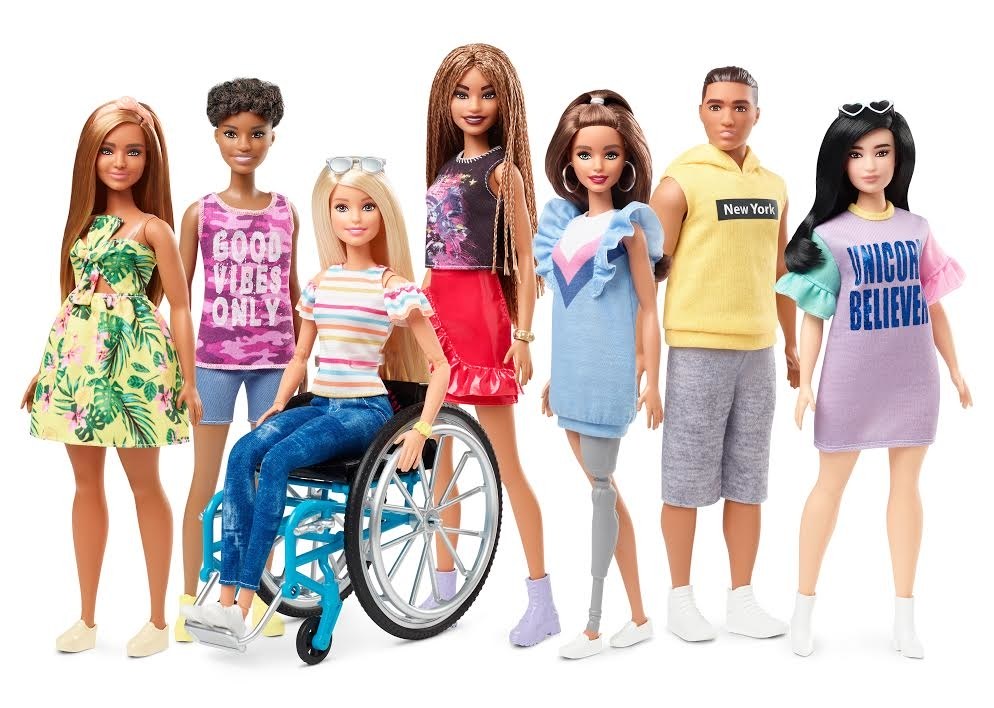
Six decades after her invention, she’s still the number-one fashion doll in the United States and, since Mattel introduced new skin tones and hair textures in 2015 in response to a 20 percent drop in sales between 2012 and 2014, the most diverse. In 2016 the brand also unveiled three new body types—petite, tall, and curvy. Last month it announced it’ll add to the collection: Barbie in a wheelchair, the first with a prosthetic limb, some with a new, braided hair texture, and an entire fourth shape, with a smaller bust, less defined waist, and more defined arms.
New Barbies in 2019 include a wheelchair-bound doll and doll in a fourth new shape, featured second from the left.
MattelFor a doll who was once programmed to complain that “math class is tough” on command, it’s all quite impressive. But then she didn’t have to do a lot to exceed expectations. Like most women born in 1959, she was underestimated from the start.
Barbie made her first appearance at the New York Toy Fair that March. At the time, she was an unprecedented experiment. But Ruth Handler was sure she would sell. Handler was the daughter of Jewish immigrants from Poland. At 43, she was an executive vice president at Mattel, the behemoth brand she had founded with her husband Elliot Handler and his friend Harold Matson in 1944.
From the moment Mattel was established, Handler decided to be essential to the business, both because she had brilliant ideas and because she couldn’t bear to remain at home. In an interview, Handler said she loved motherhood. But the conventions of it? Well, those repelled her. Or as she put it: “Knowing how to cook and keeping a good house? Oh shit, it was awful.” For all Barbie’s foibles—and the Sleepover Barbie released in 1965 that came with a scale set to 110 pounds and a diet book plastered with the words “Don’t Eat!” is but one example—it’s no surprise that when Handler created Barbie, she made her an independent woman and a wage earner. Fine, she was a teen swimsuit model at first, but then a flight attendant, a teacher, and an astronaut. An afterthought, her husband Ken wasn’t introduced until 1961. And like all of her accessories, he was sold separately.