Categories
Health

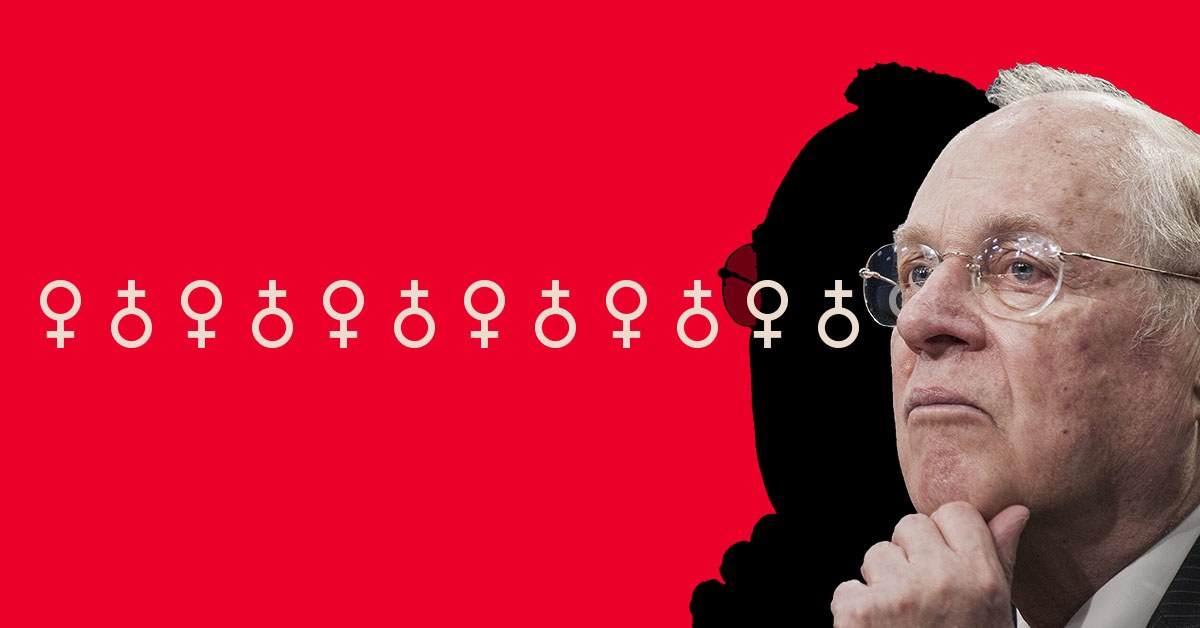
How Justice Anthony Kennedy's Retirement From the Supreme Court Could Erode Women's Rights


Presidents come and go, but Supreme Court justices last a lifetime—and their rulings can affect women for generations to come.

The privilege of nominating a high court judge now falls to President Donald Trump for the second time with the coming retirement of Justice Anthony Kennedy.

Trump has vowed to put conservative judges on the bench, and he kept that promise when he chose Neil Gorsuch to replace the late Antonin Scalia last year. In choosing Kennedy’s replacement, Trump could shift the court further to the right, changing the landscape on issues affecting American women—including abortion rights—and could fire up both sides of the aisle in an already tumultuous election year.

Here’s a look at what’s ahead for the court—and the the country.

What’s at stake?

Trump’s next nominee may matter even more than his last. Replacing Scalia with Gorsuch didn’t change the court’s partisan balance; it was a case of one conservative justice succeeding another.

That’s about to change, according to Melissa Murray, the Alexander F. and May T. Morrison Professor of Law at the University of California, Berkeley.

“Over the last 20 years, Justice Kennedy emerged as the sort of prototypical swing justice on the court, the person whose vote was pivotal in securing and upholding such policies as affirmative action,” Murray, who clerked for Justice Sonia Sotomayor before her SCOTUS appointment, told Glamour. “He often was on the progressive side [of issues], though not all. And he of course was famously the architect [of] basically the whole process of getting to same-sex marriage… His retirement is actually a huge void, and it sort of disrupts the equilibrium of the court.”

Murray said a rightward SCOTUS lurch could deeply influence women’s lives on issues ranging from abortion rights to voting protections to unionized labor.

What will happen with abortion law if a hard-right conservative gets the seat?

A huge amount of the attention surrounding Trump’s Supreme Court pick centers on how it might affect abortion—and more specifically the landmark 1973 case of Roe v. Wade, which effectively made abortion legal in the U.S. The departing Kennedy was the swing vote, siding with the liberals, in later cases seen as a direct threat to Roe.

A number of states already have their own legal restrictions on the termination of pregnancies. Abortion-rights proponents fear that cases now making their way through the lower courts could ultimately lead to the overturning of Roe and the end of legal abortions in America—something deeply conservative Vice President Mike Pence has openly said will happen this lifetime.

Pro-choice and anti-abortion advocates are mobilizing their bases ahead of Trump’s pick.

“The idea of Trump having his choice to fill another vacancy is terrifying for not only abortion rights, but for our ability to live free from discrimination in this country,” said Dawn Laguens, executive vice president of Planned Parenthood Federation of America in a press release issued in response to Kennedy’s retirement announcement. The group said its “11 million supporters call on the Senate to reject any nominee who would strip people’s individual rights and freedoms.”

“The most important commitment that President Trump has made to the pro-life movement has been his promise to nominate only pro-life judges to the Supreme Court, a commitment he honored by swiftly nominating Judge Neil Gorsuch,” said Marjorie Dannenfelser, president of the pro-life Susan B. Anthony List, in a press release issued by the group. “President Trump now has another crucial opportunity to restore respect for life and the Constitution. We trust him to follow through on his promise.”

So what does it mean if Roe v. Wade is overturned?

If the case is actually overturned, the landscape of where and what women can choose to do with their own bodies could change drastically.

In four states (Illinois, Kentucky, Louisiana, South Dakota), there are so-called “trigger laws” so abortion would be automatically banned if Roe is overturned.

According to the Guttmacher Institute, only eight states currently have legislation protecting the right to an abortion. Though it would be safe to assume that blue states without such laws would work to enact them quickly.

Red states and rural areas would likely see access to legal abortions disappear locally, meaning there would be an added financial burden in trying to travel to a state where they are still legal. This would disproportionately affect lower income women. CNN’s Jeffrey Toobin predicted that abortion would be illegal in 20 states within 18 months.

What does this mean for Trump’s base?

As Amy L. Howe noted in a piece for SCOTUS blog, “Anti-abortion voters had played a key role in [Ronald] Reagan’s election, and Kennedy initially provided both the president who appointed him and those voters with reason to be optimistic.”

Trump’s unfavorable ratings remain higher than his approvals in the runup to a midterm election that could make or break his party’s control of Congress.

“Without a doubt, the court appointment is a huge boost for Trump and Republicans, who were facing serious headwinds going into midterms. They still are—SCOTUS will drive significant [Democratic] and female turnout,” CNN commentator S.E. Cupp told Glamour.

At the same time, warned the conservative Cupp, “Don’t underestimate how much it will also motivate conservatives and evangelicals. If they were contemplating staying home, they now have reason to get out and vote. SCOTUS is the only—and I mean only—thing around which the fractured right can rally.”

Related Stories:

The NRA’s Most Wanted Customer: Women

Democratic Voters Wanted Something Different. They Got Alexandria Ocasio-Cortez.


Source link

Categories
Health

Why Anthony Bourdain's Life Is a Lesson in Allyship for White Men of Privilege to Follow


The culinary world shifted when news that rockstar chef and author Anthony Bourdain died of an apparent suicide was confirmed by CNN on Friday. Bourdain defied the boundaries of his job description, transcending barriers of disparate cultures, and, perhaps among his greatest feats, challenged the status quo he could have so easily chosen to thrive in.

And, aside from what he contributed to the world (taking us on adventures around the globe and giving us all a front-row seat to experience the gritty underbelly of New York City’s restaurant industry through his cult-classic book Kitchen Confidential), that’s why we loved him.

In recognizing his privilege, Bourdain was able to stand up for women, marginalized communities, and even question how his own past choices lent themselves to perpetuating dangerous environments. It would have been effortless for Bourdain to adopt the worldview of men who share his status and influence. Bourdain, instead, explored worlds besieged by that power and challenged its beneficiaries to do better.

In short, Anthony Bourdain was an ally. Not in the vein of entertainers who only wear colorful ribbons at functions and retreat to their luxurious homesteads. He was one who fundamentally believed in, and fought for, people at the margins even when hashtags weren’t trending. Though he could have merely embraced the glamour of glitzy restaurants and exotic locales in his work as a culinary superstar and travel correspondent, he weaved this value system into his work.

On Latino immigration in America, Bourdain once stated: “The bald fact is that the entire restaurant industry in America would close down overnight, would never recover, if current immigration laws were enforced quickly and thoroughly across the board. Everyone in the industry knows this. It is undeniable. Illegal labor is the backbone of the service and hospitality industry–Mexican, Salvadoran and Ecuadoran in particular…let’s at least try to be honest when discussing this issue.”

This was in 2007, before Trump’s walls or the fervent pitch of nationalist rhetoric reached its ascendance.

Bourdain’s ideals reached beyond the food sector to industries outside of his own. When Bourdain’s girlfriend, Asia Argento, added her voice to the symphony of women whose pleas for justice against Harvey Weinstein and sexual violence were finally being acknowledged in the mainstream press, Bourdain accompanied her. “To @dkny,” he tweeted to the designer after she seemed to suggest women had a role in being sexual assault victims, “[h]ow many seventeen year olds have you dressed like they are, in your words, ‘asking for it?'”

He called out the media.

He called out Weinstein’s associates by name.

And he called out the complicity with rape culture embedded in Hollywood and society at large.

In an interview with GQ magazine, Bourdain was asked about his 2014 Parts Unknown episode on the heroin and opioid crisis. He addressed both the double standard of pharmaceutical companies who traffic in drug sales without the stigma of criminality and the sympathy afforded to small town communities and rural whites (which policy makers and media outlets failed to extend to the largely black victims of the 1980s crack epidemic).

“Now that the white captain of the football team and his cheerleader girlfriend in small-town America are hooked on dope,” he asserted, “maybe we’ll now stop demonizing heroin as a criminal problem and start dealing with it as the medical and public-health problem that it is, and should be.”

“These pharmaceutical-company executives are dope dealers,” he added, “and they should be treated worse and more roughly than dope dealers. You’ve got some disadvantaged black kid. You’re working in a one-company town, and that company happens to be a street gang selling heroin.”

Bourdain is gone, this much is true. But as society pushes forward to answer the hard questions about what kind world we want for the future, how inclusive and how understanding we want to be, it’s important to know that allyship is not something you bestow upon yourself.

It’s not your equivalent of street credibility because you went to a protest.

It is, as Bourdain showed us, the way you live your life and make room for others. It’s being inclusive and understanding without being braggadocious. It’s looking inward and being self-aware. And it’s never claiming it for yourself.

Bourdain describes himself on his Twitter bio simply as an “enthusiast.” May we, too, strive to use our own enthusiasm to engage, and advocate for the many people marginalized in parts unknown.


Source link

Categories
Health

Alec Baldwin Got in a Twitter Fight With Asia Argento and Anthony Bourdain Through His Foundation’s Account


Alec Baldwin appeared on PBS News Hour on Friday talking about sexism, misogyny, and rape culture in the wake of the Weinstein sexual assault and harassment allegations, as well as those that have taken down other powerful men in Hollywood in the subsequent weeks—including director James Toback, who Baldwin had worked with in the past. His comments during his interview addressing those issues drew accusations of victim-blaming and mansplaining from more than a few notable women, who came for him on Twitter. It didn’t take long, then, for him to get embroiled in a tussle on the platform—using his foundation’s account, since he shut down his personal account—with actress and vocal Weinstein accuser Asia Argento, as well as her boyfriend, celebrity chef/foodie Anthony Bourdain.

The key part of his interview that women took issue with was when he appeared to criticize women taking settlements in exchange for their silence about acts of sexual assault and harassment. “What happened was that Rose McGowan took a payment of $100,000 and settled her case with him, and it was for Rose McGowan to prosecute that case,” he said. “When women take money and are silenced by that money, even though they took the money and were silenced because they were told, beyond the money, it was the right thing for them to do, keep quiet, don’t make too many waves, it is going to hurt your career. When they do it nonetheless, does it set back the cause of change?”

Not great, as women, including Argento, pointed out.

Baldwin suspended his Twitter on Saturday around midday, “for a period of and in the current climate,” with the note that “It was never my intention, in my public statements, to ‘blame the victim’ in the many sexual assault cases that have emerged recently … my goal is to do better in all things related to gender equality.”

And that’s when things started to kick off. Argento bid him a not-so-fond farewell:

Apparently Baldwin didn’t want to leave that unanswered, so he began tweeting from the Alec Baldwin Foundation page, which, um…isn’t a good look for a nonprofit.

Bourdain chimed in to stick up for his partner, and quickly followed it up with a casted stone of his own:

Baldwin then responded with a now-deleted tweet that Bourdain was careful to screencap and later posted.

Argento came back for it, but @ABFoundation had blocked her.

Baldwin wasn’t done yet, though—a few minutes later, he tweeted again at Bourdain:

Things kinda fizzed out (at least in our non-DM view) after that, but on Sunday morning, Alec Baldwin’s foundation retweeted a tweet of Rose McGowan’s—a highly vocal figure in the Weinstein fallout—that is…interesting.

So, not sure entirely what is happening, but given the rest of the day’s tweets, someone at his organization seems to have wrested control back of the account—with a dash of sass thrown in there. Never a dull moment on Twitter these days!

Related Stories:
Alec Baldwin’s Trump Called Puerto Rico Mayor a ‘Nasty Woman’ on SNL
Alec Baldwin Has Left the Twitterverse—This Time For Good!
These Are the Women Who Have Accused Harvey Weinstein of Sexual Harassment or Assault


Source link