Categories
Health

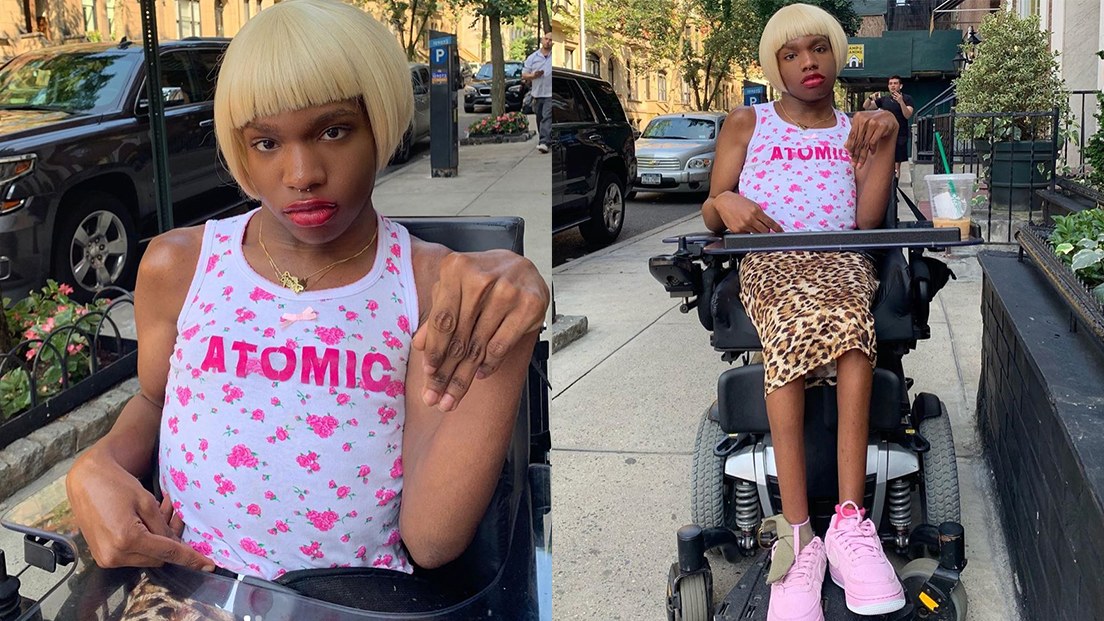
Model Aaron Philip Celebrates Red Lipstick and Her Disability


The process of applying lipstick often requires little more than muscle memory. Some outline their lips for precision. Others do a casual swipe and blot. It’s a routine one could easily take for granted, but Aaron Philip doesn’t. The Antigua-born 18-year-old is now based in New York, where she’s broken boundaries as the first black, transgender model with a disability to be signed by a major agency (Elite Model Management). Her meteoric rise over the last several months has seen her grace the cover of Paper magazine, land her first New York Fashion Week show, and graduate high school in June. The model, who was born with cerebral palsy, has also made a point to apply her own lipstick along the way. And through the seemingly commonplace task, she has found new ownership over her identity. This is her story, as told to writer Gina Marinelli.

I’d never gotten into makeup until this past year, when I started experimenting with my look. I didn’t care for it much because I wasn’t comfortable enough with myself to do so. As a person with a disability, I had no idea what I would be in for or what I was doing. And as someone with intercepting identities, I had to look inward and find where I would be comfortable with makeup. This past Fashion Week back in February, I had an awakening.

I finally felt comfortable enough to revamp my image and—even though femininity and masculinity are a construct—start looking more traditionally feminine. I wanted to resemble Sky Ferreira, Blondie, Courtney Love, and Foxy Brown. I bleached my hair and eyebrows. I also wanted to look like Island ladies because a lot of women tend to wear lipstick in the Caribbean. I combined all the things I love into the way I project myself to the world.

I actually bought my first lipstick weeks before my high school graduation. My ex-paraprofessional went with me to Sephora one day and got me MAC Red Lipstick. It was my graduation gift, and I couldn’t wait to wear it.

June was busy for me because of Pride Month. I was constantly getting my makeup done and spent a month with that lipstick in my bag. When you have others doing your makeup all the time—for events, photoshoots, bookings—you start to take notice. They line my lips before they fill them in, and they keep going over until the color pops. They use a lot of reds and purples, the types of colors that complement my skin tone. I don’t even think they notice that I’m noticing everything.

One day, when I finally had some downtime with my best friend, I tried applying it by myself for the first time. We were in her apartment on the Upper West Side in New York City just having a girls’ day. She pointed out that she had I handheld mirror I could use, so I pulled out my red lipstick.

My disability is physically very spastic. It can be hard to move my muscles in a way that I want to. It’s not fluid or easy to do things like lift up my hand to my mouth. It’s always easier when I’m in front of a mirror. The hardest part is lining my lips because I don’t want to get it all over my face, but I learned how to master that. Then I just fill in my lips and make sure they look even. If you want to make it spicy, you can put a gloss on top.

After that time, I did my lipstick on the way to a party a couple weeks ago. I combined my MAC lipstick with my Marc Jacobs lip gloss for that glossy, lush color. I wanted to share it on social media—my community online, these are my loved ones. I learned how to do something that’s important to me, and I care enough about them to share this part of me.

I don’t get the opportunity to talk that much about disability, but I realize how important it is that I do. When I talk about it, people understand my everyday life. Lipstick is now becoming part of that everyday life. I’m practicing. As a person with a disability, makeup is not easy, but I’m learning how to work my way around it. I’m having fun; it’s not a burden or a problem. I want to celebrate beauty and disability. People with disabilities are often made to not feel beautiful; people think that we can’t do things that make us feel beautiful, but that’s untrue. I hope other people—other women with disabilities, especially—can find some solace in my story. I know it can be hard.



Source link

Categories
Health

The Recall of Judge Aaron Persky Was Considered a Victory—but Not Everyone Agrees


Last week’s primary elections in eight states were closely watched, in part to see whether the so-called Blue Wave would materialize for November’s midterms. But in California eyes were also on a special inclusion to the ballot, one nearly two years in the making.

It was the recall effort to remove Judge Aaron Persky from the bench, an effort spearheaded by Stanford law school professor Michele Dauber following his sentencing of former swimmer Brock Turner for the sexual assault of “Emily Doe.” Turner was found guilty on three felony charges, and though the maximum sentence in the case was 14 years, Judge Persky (also a Stanford alum) sentenced him to six months.

Turner ended up serving just three months of that sentence.

Dauber’s mission to unseat Judge Persky had many critics. Many of her Stanford colleagues did not support the campaign; she received an envelope containing white powder (which turned out to be harmless) and a letter that threatened to treat her like “Emily Doe” for leading the recall.

When we spoke on the day of the vote and I asked if any of this had taken a toll on her, she responded with zero hesitation: “Not at all,” Dauber said. “Not even one bit. You can’t do something like this and not expect that there will be pushback. That’s not realistic. No part of that has had any impact on me in any serious way.”

She still receives threats on a regular basis, but she said that’s to be expected. “There’s no way that you can do something like this that is so directly challenging so many powerful institutions and so threatening to the status quo without engendering some backlash,” she said. “It hasn’t slowed us down not even one bit.”

In the end 60 percent of California voters said Persky should be out. Prosecutor Cindy Hendrickson was voted in to replace him, with nearly 70 percent of the vote.

Dauber, who has been described as a den mother to Emily Doe, declined to describe Doe’s reaction to the verdict. But she sees the removal of Persky as a victory for all women. “The voters of Santa Clara County are the winners of this election,” she said in an emailed statement. “We voted today against impunity for high-status perpetrators of sexual assault and domestic violence. We voted that sexual violence is serious and it must be taken seriously by elected officials. Our message is: Violence against women is a voting issue—alongside reproductive freedom, gun control, and the other issues that progressive Democratic women care about. If candidates want the votes of progressive Democratic women, they will have to take this issue seriously. If they do not, they will hear from women at the polls.”

“The right result here is not to change the law to tie the hands of 1,000 good judges who didn’t abuse their discretion. The right result is simply to unelect the bad judge who did abuse his discretion.”

The decision isn’t that clear-cut for Persky’s supporters, though, who argue that the recall will set a dangerous precedent. LaDoris Cordell, a spokesperson for Persky and a retired judge, told The New York Times that the recall was an attack on judicial independence that “encouraged people to think of judges as no more than politicians.” (Cordell did not respond to Glamour’s requests for comment.)

Santa Clara University law professor Margaret Russell told Glamour that the recall sends the message to state judges that they should “consider public opinion in their sentencing decisions.”

“This runs counter to the judicial oath or affirmation to protect and defend the United States and state constitutions,” Russell said.

Other Persky supporters also argue that he wasn’t handing down lenient sentences for certain defendants, especially privileged, white athletes, pointing to his record in criminal court, where he followed California sentencing guidelines, as reported by the Associated Press.

But Dauber argues that such reasoning is flawed. “What we have here is a judge who has repeatedly abused his discretion in order to help out privileged offenders, often athletes, college athletes, who have committed serious violence against women,” she told Glamour. “I don’t believe that judges are going to start imposing sentences that they think are wrong just in order to save their own political skins. I just don’t think that that’s how judges operate.”

She thinks the impact will be limited to this judge, for his behavior in this case. “Judge Persky made an exception for Turner and gave him probation even though the law provided a two-year minimum that was presumed not eligible for probation,” she said. “That’s the law of our state. As a result of that abuse of discretion, Jeff Rosen, our district attorney, went to the legislature and had them pass a new mandatory minimum.”

In 2016 California Governor Jerry Brown signed two bills to expand the definition of rape and impose mandatory minimum sentencing for crimes similar to the one Turner committed. (Persky’s supporters point out that the judge followed the sentencing recommendation from the county probation department.) At the time Brown voiced his opposition to adding mandatory minimum sentences, but said that the bill would bring “a measure of parity to sentencing for criminal acts that are substantially similar,” The Atlantic reported.

“The right result here is not to change the law to tie the hands of 1,000 good judges who didn’t abuse their discretion. The right result is simply to unelect the bad judge who did abuse his discretion,” Dauber said. “This victory is not for Emily Doe; this victory is for girls and women everywhere.”

When asked what the recall means for women and movements like #MeToo, Russell had a different view: “The chilling effect on the independence of the judiciary is palpable,” she said. But she did find one thing everyone can agree on: “Both the anti-recall and recall campaigns were led by self-identified feminists,” Russell said. “It is abundantly clear that the #MeToo movement is intersectional, complex, and not subject to simple classifications.”


Source link