Categories
Health

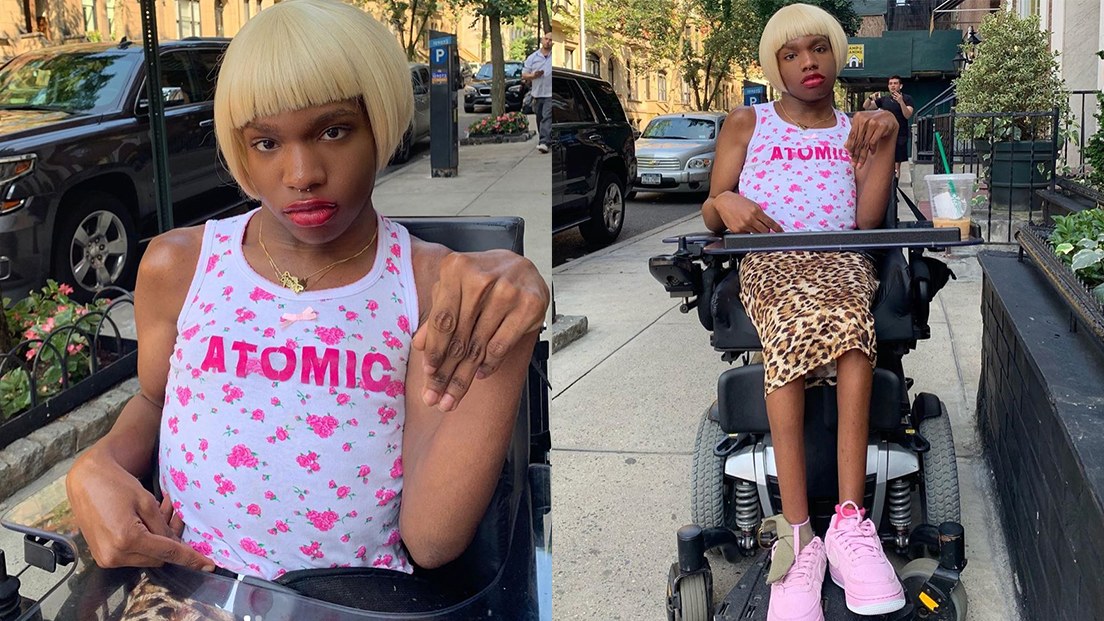
Model Aaron Philip Celebrates Red Lipstick and Her Disability


The process of applying lipstick often requires little more than muscle memory. Some outline their lips for precision. Others do a casual swipe and blot. It’s a routine one could easily take for granted, but Aaron Philip doesn’t. The Antigua-born 18-year-old is now based in New York, where she’s broken boundaries as the first black, transgender model with a disability to be signed by a major agency (Elite Model Management). Her meteoric rise over the last several months has seen her grace the cover of Paper magazine, land her first New York Fashion Week show, and graduate high school in June. The model, who was born with cerebral palsy, has also made a point to apply her own lipstick along the way. And through the seemingly commonplace task, she has found new ownership over her identity. This is her story, as told to writer Gina Marinelli.

I’d never gotten into makeup until this past year, when I started experimenting with my look. I didn’t care for it much because I wasn’t comfortable enough with myself to do so. As a person with a disability, I had no idea what I would be in for or what I was doing. And as someone with intercepting identities, I had to look inward and find where I would be comfortable with makeup. This past Fashion Week back in February, I had an awakening.

I finally felt comfortable enough to revamp my image and—even though femininity and masculinity are a construct—start looking more traditionally feminine. I wanted to resemble Sky Ferreira, Blondie, Courtney Love, and Foxy Brown. I bleached my hair and eyebrows. I also wanted to look like Island ladies because a lot of women tend to wear lipstick in the Caribbean. I combined all the things I love into the way I project myself to the world.

I actually bought my first lipstick weeks before my high school graduation. My ex-paraprofessional went with me to Sephora one day and got me MAC Red Lipstick. It was my graduation gift, and I couldn’t wait to wear it.

June was busy for me because of Pride Month. I was constantly getting my makeup done and spent a month with that lipstick in my bag. When you have others doing your makeup all the time—for events, photoshoots, bookings—you start to take notice. They line my lips before they fill them in, and they keep going over until the color pops. They use a lot of reds and purples, the types of colors that complement my skin tone. I don’t even think they notice that I’m noticing everything.

One day, when I finally had some downtime with my best friend, I tried applying it by myself for the first time. We were in her apartment on the Upper West Side in New York City just having a girls’ day. She pointed out that she had I handheld mirror I could use, so I pulled out my red lipstick.

My disability is physically very spastic. It can be hard to move my muscles in a way that I want to. It’s not fluid or easy to do things like lift up my hand to my mouth. It’s always easier when I’m in front of a mirror. The hardest part is lining my lips because I don’t want to get it all over my face, but I learned how to master that. Then I just fill in my lips and make sure they look even. If you want to make it spicy, you can put a gloss on top.

After that time, I did my lipstick on the way to a party a couple weeks ago. I combined my MAC lipstick with my Marc Jacobs lip gloss for that glossy, lush color. I wanted to share it on social media—my community online, these are my loved ones. I learned how to do something that’s important to me, and I care enough about them to share this part of me.

I don’t get the opportunity to talk that much about disability, but I realize how important it is that I do. When I talk about it, people understand my everyday life. Lipstick is now becoming part of that everyday life. I’m practicing. As a person with a disability, makeup is not easy, but I’m learning how to work my way around it. I’m having fun; it’s not a burden or a problem. I want to celebrate beauty and disability. People with disabilities are often made to not feel beautiful; people think that we can’t do things that make us feel beautiful, but that’s untrue. I hope other people—other women with disabilities, especially—can find some solace in my story. I know it can be hard.


Source link

Categories
Health

No, My Disability Doesn‘t Make Me ’Undateable‘


I’ve been struggling with this whole romance thing for the last decade. Honestly, who hasn’t? But my situation is apparently even more complicated: I have a disability.

I say “apparently” because I want to date—I want the same things any able-bodied woman wants out of a relationship. But I was born with a genetic bone and muscular disorder called Freeman-Sheldon syndrome that’s left me with a wheelchair and scars from about 25 surgeries. Despite all that, I’m still a pretty independent woman: I earned a college degree, get around on my own, make most of my own meals, and hold down a career as a freelance writer. My day-to-day life doesn’t look much different from my able-bodied peers’, but my dating life seems to exist in a different universe, one where my desires are nonexistent and everyone assumes I’m looking for a caretaker.

The truth is, though I’m 37, I haven’t dated anyone, mostly because there’s always been this voice in the back of my head telling me that men don’t want to date a disabled woman. The assumption I can never escape is “disability is an undesirable quality…. There aren’t many men or women who want to get into a relationship with someone they have to care for,” as one person so bluntly wrote on Twitter. “Melissa cannot accept the fact that men are not attracted to her,” another person commented on one of my posts. “Unfair as it may be, the wheelchair DOES matter. Her disfigurement DOES matter. It doesn’t matter how smart, witty, or sarcastic she is. She might have better luck concentrating on men who are disabled and disfigured like her.”

I’d be lying if I said comments like this weren’t part of the reason why I haven’t put myself out there. The message is always clear: Disability is a bad word and it makes you undateable. I wish these feelings were just the stuff of Internet trolls, but the reality is they’re not—and it’s gotten to me. Several years ago I asked some of my male friends if they would date someone with a disability. The sheepish response? Quite a few said they’d be afraid of the “responsibility.”

It’s time to set the record straight: I am disabled, desirable, and not looking for a nurse.

Sometimes I feel like I need to put those words on a neon sign in Times Square (or at least on a business card to hand out whenever I meet someone interesting). I know there are many ways my disability does make me different—like the fact that I use a wheelchair to get around—but it’s 2019, for goodness’ sake. Twenty-seven million women in the U.S. have disabilities. Don’t we deserve all the same things in a relationship as able-bodied women? My wheelchair doesn’t make me something other than a woman, my disability doesn’t disqualify me from wanting a rom-com-worthy relationship, my condition doesn’t mean I’m looking for a caretaker as a partner.

There are so many things I do want, and brace yourself, because this might come as a shock: I want the same things you want in a relationship. I want a guy who makes me laugh, who is kind and gentle and sensitive, who is family-oriented, who is as obsessed with pop culture as I am. I want to be myself, to be seen, to be loved—disability and all.

Melissa Blake is a freelance writer and blogger from Illinois. She covers relationships, disabilities, and pop culture. Read her blog, and follow her on Twitter @MelissaBlake.


Source link

Categories
Health

My Disability Made Me Dread Going to Weddings Alone. It Shouldn't Have


I’ve been to plenty of weddings in my life—cousins, friends, William and Kate (OK, that last one was from the comfort of my own home, but you get the idea)— and I left each one feeling kind of wistful. Will that ever be me? Am I destined to spend eternity at the single’s table? And, maybe the most telling of all: Had my disability really made me this jaded?

In a way, I’d been preparing myself for being my own plus-one for two decades, thanks to my obsessive pop culture consumption. If romantic comedies are to be believed, weddings are the single person’s kryptonite – the Achilles’ heel of the heart – that blasts our relationship status to the world like a giant neon sign. I grew up with a steady diet of these films and even from a young age, I couldn’t help but feel like I was peeking into a crystal ball of my future: Hours sitting dejected while watching the bride and groom dance or hopelessly trying to make small talk with strangers who I’d probably never see again.

There was My Best Friend’s Wedding, for example, which came out 20 years ago this past summer. In it, Julia Roberts’ character watches love find her best friend while she sits alone on the sidelines. In a panicked, last-stitch effort, she tries to stop the wedding because, as I saw things at 16, not even Julia Roberts in all her glory wanted to risk being a spinster. Alone equals lonely.

As I got older, it didn’t help that my physical disability made me feel as though I was on display; I felt incredibly self-conscious of my surgical scars, wheelchair, and deformities and was about ready to say goodbye to any sense of hope. I was born with Freeman-Sheldon Syndrome, a rare genetic bone and muscular disorder. And in my wheelchair, well, I tend to make an entrance wherever I go. I’ve realized that it’s impossible for me to go under-the-radar, no matter how much I might want to. People notice me. That’s just how it is.

So when I found myself sitting in a small banquet hall one rainy October evening in 2015, attending my first wedding as a solo guest, I felt especially seen—and not in a good way. Everything should have been perfect—I’d been friends with the bride for six years, and her now-husband almost as long, and I couldn’t have been happier for them. Plus, at 34, I knew most people my age had probably been attending weddings alone for nearly a decade and it’s really not that unusual. But here I was, drinking my Coca-Cola in a dimly-lit ballroom and feeling anxious. It would be one thing if I could just easily blend in with the crowd—I craved that kind of anonymity—but instead, I carried that self-consciousness with me that night. Insecurity was my plus-one.

I dreaded sitting at a table with strangers, fielding all those pesky, inevitable questions, “Who are you here with? Are you married? Are you engaged?” Everyone around me seemed to have come with their significant others. Watching them, I couldn’t help but feel like I’d let my disability create a wall that separated me from the happiness they got to experience. I was feeling too awkward to actually sit with any of the people pouring into the ballroom, so I remained at my suddenly-too-large table, all by myself.

And then, shortly before dinner, I felt a light tap on my shoulder.

“Would you like to sit with us?” asked a woman I’d never met. I turned around to see that she was seated with her husband a few feet away. I thought that maybe they just felt sorry for me, but realized I didn’t care even if they did. It felt nice to be acknowledged and invited. So far that evening, I’d avoided approaching other tables for fear of intruding, but here was someone coming over to me. It took some of the pressure off immediately, so I accepted her gesture and joined them.

A few hours later, I was enjoying some delicious wedding cake for dessert, chatting and actually smiling. I’d been sitting with them all evening, having lively conversations about our jobs and our cats. We even discovered that we’d gone to the same high school, and reminisced about the past. All night, I’d expected to feel like the third wheel, as if I was somehow imposing on them, but they made me feel like I could truly be myself. Even more surprising, neither my single status nor my disability came up in conversation. At all.

For once, I felt like I blended in with the crowd. Maybe I’d created that sense of impending doom in my head before I even gave myself a chance to have a good time. Obviously trying new things can be incredibly scary, but I realized that doesn’t mean they’re destined to end in failure. When I relaxed and opened myself up to forming genuine connections with new people—regardless of whether I had someone else there with me to divert some of the attention—it was such a refreshing feeling. Somehow going to a wedding alone helped me feel more confident in myself. I was my own plus-one, and it turns out I’m a great date.

For the second time that night, I felt incredibly seen. This time it was in a good way.

Melissa Blake writes about relationships, disabilities, and pop culture. You can read her blog, So About What I Said, and follow her on Twitter.


Source link