Categories
Health

Nicole Kidman Got Subtly Political While Accepting Her 'Glamour' Women of the Year Award


When director Sofia Coppola took the stage to introduce a Glamour Women of the Year honoree and friend (whom she directed in this year’s “The Beguiled”), she described her as “one of the great classic actresses of our era.” Obviously, she was talking about Nicole Kidman. Name a more iconic duo, we’ll wait.

Already an Oscar winner, Kidman won an Emmy this year for her wrenching portrayal as a victim of domestic abuse in “Big Little Lies,” in addition to being a UN Women Goodwill Ambassador.

Upon going up to accept her award, she noted that Coppola was “an example to all of you who want to be female directors that you can do it. Sofia is female power.” And then she turned the spotlight on everyone else in the room and watching at home: “Let’s use this moment to celebrate what makes us, us.” She also gave a touching tribute to her husband Keith Urban, acknowledging that having a strong man on your side can be an asset as good as any other. “As much as I’m a strong woman, I need help and I need support.”

But she ended the night urging people not to seek comfort solely with people who are too much like us. “I truly believe that we must share the good love that we receive whenever we see it’s needed,” she said. “It’s about building bridges, because bridges bring about new adventures and change, and that’s what we need—change.”

Read Nicole’s entire speech, below.

Thank you, Glamour, for this wonderful honor.  This has been the most
extraordinary year. I use that word extraordinary in all of its
meanings.  We’re in uncharted waters.

But as we take tonight to celebrate—and I bow down to the other
honorees for their phenomenal contributions to art, culture,
exploration, human rights —I want to take a moment to say this is a
celebration of us.  What makes us us.

In my household growing up, everyone was equal.  Maybe it was because
it was a house full of scientists and academics. Or because it was the
’70s in Australia and it was a time of demonstration and change. I had
a feminist mother, but I also had a father who was supportive and
loving. It was so much about union and support. I was very fortunate
to be the recipient of these parents – supportive, empowering,
encouraging. That was their love…what we call in my home now good
love. And that is something I want to pass along to not just my own
children, but to those around me.

I’m a sister, I’m a mother, daughter, I’m a wife, I’m a career
woman…I’m a mother to four loving children, daughter of a formidable
mother and father and wife of a truly good man.  It is who I am, why
I’m standing here tonight. And I am aware that not everybody has been
as lucky as I have been.

As much as we gravitate, with all of this going on in the world, to a
safe place, to the people most like us—the people whose gender,
sexuality, race or politics we share—I’m convinced the galvanization
of all of us together is essential. I truly believe we must share the
good love wherever we see it’s needed.

One of the first things I learned in my work with UN Women to support women survivors of
violence is how critical the solidarity of others is. The feeling that
they are not alone. That there is help. So let’s speak out. Let’s
offer our support and create change. It is about building bridges.
Bridges bring understanding, empathy, bring change…

I feel deeply indebted to the people in my life who made me, me.  It
has led me to this point, to this year. To my life and my purpose in
life.  I suppose what I want to say is thank you.  Thank you for
supporting and embracing me, for allowing me to fail and to fall down
and get back up, brush off my knees, even if they’re bloodied and
fly. Thank you for the good love.  I promise to pass it on.


Source link

Categories
Health

What Cindi Leive Has Learned in 16 Years of Editing 'Glamour'


A decade and a half ago, I walked into my new office with a spare pair of heels and my Rolodex (heard of that?) to set up shop in what was pretty much my dream job: as the editor of the Glamour magazine (and it was only a magazine then; this was even before Facebook, folks). Now I’m about to pack up again for my next adventure, leaving this wonderful brand—which has me reflecting on where women were back then, where we are now, and what’s changed for the better or the…not so better.

If you believe the conventional wisdom right now, it’s a crappy time to be a woman. I get the pessimism: You can barely load your social feeds without encountering another story about rampant sexism in Silicon Valley/Wall Street/Hollywood; we all now know that having your boss ask you to give him a massage and watch him shower is not, as one would have thought, an unsettling scene from American Horror Story but just a regular Tuesday in the film world. The numbers are kinda grim too: Over the 16 years I’ve been at Glamour, Congress has gone from 14 percent to only 20 percent female; Fortune 500 CEOs are stuck at less than 7 percent. And as for the pay gap? Women still make 7 percent less right out of college than men with the same degree and background!

Dear world, to quote Miranda Priestly: By all means move at a glacial pace; you know how that thrills me.

But still, I’m an optimist. Partly because you have to be—why get out of bed otherwise? But partly because SO MUCH GREATNESS has happened over the last 16 years as well.

For one thing, women embraced the workaround, something we’ve always been good at. (I refer you to Deborah Sampson, who dressed as a man to fight in the Revolutionary War. She dug a bullet out of her own thigh to avoid being found out! Wait, is this not a comforting example?) Yes, big business may be bro-heavy at the top, so over the last decade, rather than tear their hair out railing against that, women have increasingly struck out on their own, with women-owned businesses growing at a rate five times the national average (making more money than the average too—yas, ladies!). Sure, film studios seem to be obsessed with the eleventh-grade-male audience, so talented women creators have headed to TV, where the odds that you’ll find a female director are now 13 percent higher than at the movies. You get the picture: For every closed front door, there’s a woman climbing in a ­second-story window in tennis shoes and a DGAF T-shirt.

All of that’s good news. But honestly? To me, the real change from 2001 to 2017 is in our attitude as women: our willingness to say how we feel, live how we like, and ask the world to keep up. Glamour has always prided itself on taking on a wide range of subjects. Over the last year alone, our team has covered the opioid epidemic, racial injustice, the attempts to defeat Planned Parenthood, and yes, the wage gap; while we are sometimes admonished to “stay in our lane,” our lane is women, so that means both lipstick and legislation are on the table. But some of the work I’m proudest of has started with you, our readers—who have urged us more and more each year to represent women fully and without judgment. When I look back at our ­covers of five years ago, I’m startled to see we used words like diet and skinny, terms I’d no longer employ, in part because of your loud cheers for language and images that project strength and inclusion. And your passionate feedback about Malala Yousafzai, whom we honored as a Woman of the Year in 2013, led us to start The Girl Project, an initiative for girls’ education that has now supported women in over 100 countries.

You’ve also pushed me personally. Years ago I wrote an editor’s note about style and included a picture of my five beloved great-aunts, all in sleeveless dresses, with a caption I thought was funny about how now I knew where my upper arms were headed. A reader emailed to chastise me. She thought my arms were fine, she wrote; why had I run myself down and invited others to be critical? I took her words to heart. We women are given to self-deprecation, either by habit (“this old thing?”) or as a tactic to keep others from finding you braggy (something men never worry about, but I digress). This rarely serves us well, and I resolved after that letter to stop. Why give the world a script to use against me?

I think if we’re going to get anywhere as women, it’s on all of us to support one another in real, not-just-a-hashtag ways and, like that reader, to respectfully call one another on our stuff. (We all have stuff.) Give compliments publicly. Take compliments publicly. Get behind women who speak out about their experiences. Rather than just think, Wow, she’s brave, ask her, “How can I help?” Once you are a boss—congrats!—wield your honcho powers wisely on behalf of other women, and take a tough look at your own biases. One seriously feminist business owner I know told me she recently realized that she had been checking women’s references more scrupulously than men’s, as if on some unconscious level she trusted men more. Each of us has hang-ups, so for your ­sisters’ sakes, examine yours.

My point: We all have to be leaders. Back in my early days at Glamour, on an indelibly sunny September day just weeks into the job, I found myself packed into a conference room with my colleagues, silent with disbelief as we watched the Twin Towers fall on TV. One staffer sat at my feet, and as he began to shake with sobs, I remember rubbing his back feebly, wondering what to do and when someone would show up to help us do it. In that moment I realized, of course, that I was supposed to be that someone, meant to calm and soothe and determine next steps. But what did I know?

I don’t know if I did my best that day, though our coverage of the female heroes of 9/11 gave our staff purpose during the dark weeks that followed. But I do know that was the day I began to truly feel like someone responsible for others. We all are, of course, and I hope our our Women of the Year show you the wildly diverse ways it can be done.

I’ve loved being in conversation with all of you over these last 16 years, and I don’t intend to stop. But my hopes for the world 16 years from now are simple. That we will have leaders who respect, value, and frequently are women. That my self-driving car will be able to parallel park better than I do. And that you—all of you—will be able to walk through any front door you want, knowing that inside there’s a massive party of other women ready to hand you the champagne and celebrate.


Source link

Categories
Health

The $20 Uniqlo Dress Four 'Glamour' Staffers Own


Four months ago, I accepted a job at Glamour with zero clue of what I’d actually wear for a job at Glamour. A recent college graduate, I presumed “appropriate work attire” was the same across industries: blazers, suiting separates, sheath dresses, sensible pumps… It took all of five minutes on my first day to realize that wasn’t necessarily the case, especially at a full-time fashion gig. (That first day outfit, by the way, has only been seen in my office ID badge photo since.) Without access to a Fairy Fashion Godparent, I didn’t know where to turn for simple, polished staples that still felt modern and, most importantly, were in my budget. A few weeks into my role, my nightly online quest for items that checked the professional, fashionable, and affordable boxes led me to Uniqlo, home of minimalist basics that are within reach for a shopper with student loans. That’s where I found this dress—the one that I wear to work every other week.

A slip dress (or camisole, in Uniqlo parlance) once ranked pretty high on a list of trends I’d never buy into—right up there with colorful faux fur coats and runway-inspired suiting. The polite way to talk about my style would be to call it ‘classic’; the honest way to talk about my style would be to call it ‘Stepford-Wife preppy.’ (Think prim sweaters from J.Crew and other put-together staples that manifest in your closet after enough years living in New England.) But I was searching for something that would read more ‘cool’ than my usual bows and pearls to wear to the office—so I hit ‘Add to Cart’ on the Uniqlo dress and hoped for the best. The version I chose was a burnt orange, mid-calf length, spaghetti-strap dress in a satin-ish material. And, at $19.90, I could make the leap to a less ‘me’ style without sacrificing too much of my assistant-grade paycheck. Girl’s gotta pay rent.

PHOTO: Uniqlo.

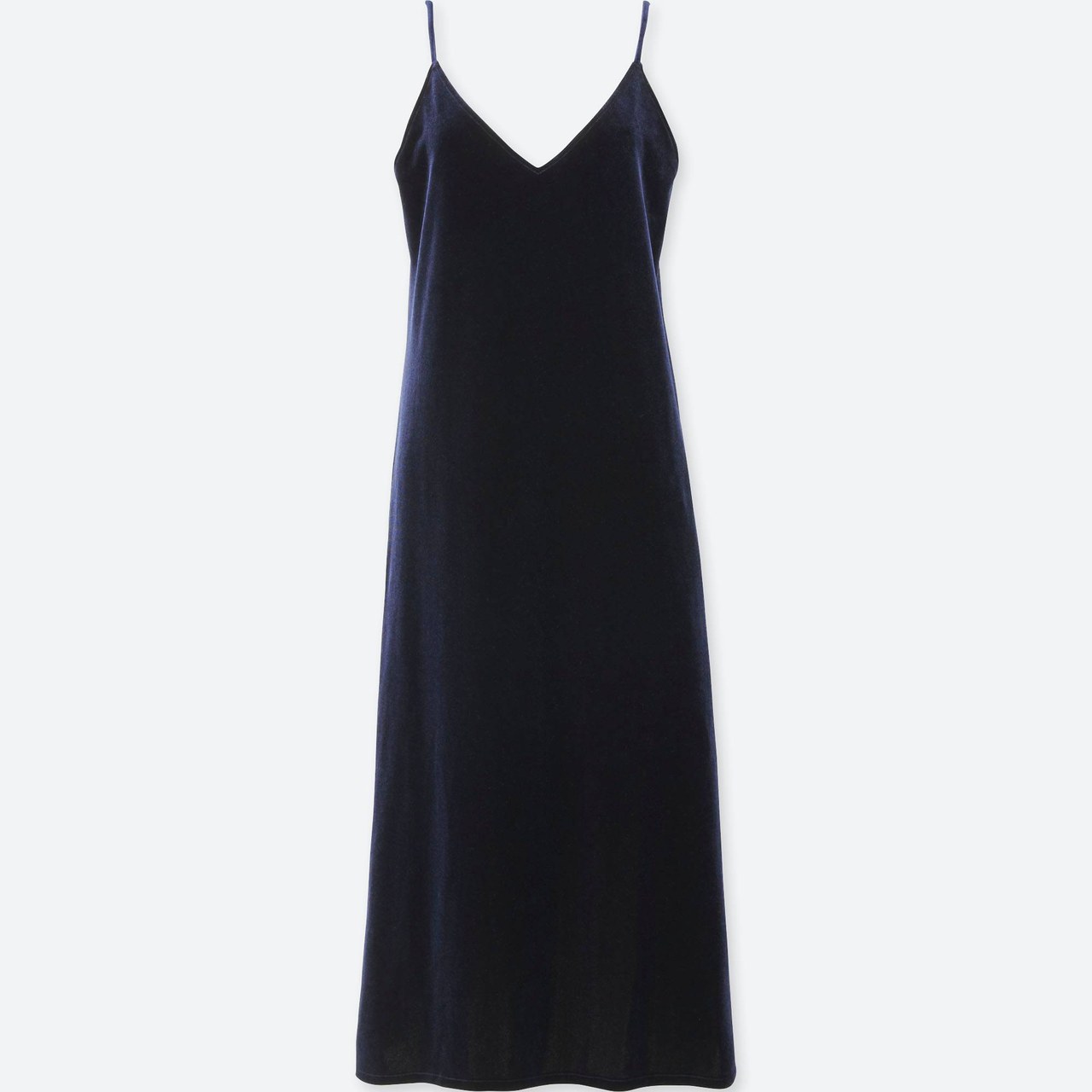
Uniqlo Velour camisole dress, $19.90, Uniqlo

I wore what would soon become my capital-F favorite dress in the simplest way possible, so that I could fly under the radar in case my fashion experiment went awry (I’m serious when I say that a slip dress was way out of my comfort zone): over a white T-shirt, under a denim jacket, with black loafers from Zara. For a rather understated outfit centered around a simple, solid-colored garment, I didn’t expect one editor—let alone a few strangers in the company cafeteria—to ask me where I got the dress from. What truly convinced me that this dress was the best work purchase I’d ever made, though? Finding out after my purchase that not one, not two, but three more Glamour team members owned and loved the exact same Uniqlo dress. The key to mastering professional dressing was just a few cubicles away, and I hadn’t noticed until I accidentally joined the club.

Unlike that off-the-shoulder Zara dress that everyone swiped up in 2016, this Uniqlo style doesn’t make us colleagues look like style clones. On the contrary: I didn’t even realize four different people on my floor had the exact same dress because everyone wore it so distinctly—from the editor who donned her black slip over a striped top with sneakers, to the writer who paired her rose velvet one with sleek ankle boots. We all have different body types and lean towards different aesthetics. (Though, two of us cite the Stranger Things kids as our style icons).) This $19.90 dress, though, unites all of our wardrobes.

After comparing notes with how my coworkers wear theirs, I’m one click away from buying it in another color. The rust-version that I wear at least once every two weeks is no longer available, but you can find velvet iterations in black, rose, and cobalt velvet in stores and online now. And if I’m any indication, you’ll wear yours literally all the time too.

Related Stories:

I Love This Uniqlo Camisole So Much I Now Own 5 of Them

This Neely & Chloe Bag Is a Compliments Magnet

This $35 Monki Dress Has Changed the Way I Dress for Travel


Source link