Categories
Health

My Favorite Black Tights Cost $6…and They're From Walgreens


Since I’m a dress addict living in a state with seasons, black tights are my lifeline in the winter months, allowing me to wear my beloved limb-baring pieces year-round. I was never precious about where I got my tights. (To me, they are a boring means to an end—not so much a part of my look, more like a necessary layer that didn’t command any attention.) Plus, finding the best black tights in the market didn’t feel like a totally urgent task. I just needed any ones that, ideally, didn’t rip on the first wear.

In fact, I had the one pair that I’d owned for an indefinite amount of time, from a brand I’d definitely forgotten, that I always reached for—until one faithful morning I noticed a thigh-length run on one leg. For some reason, that got to me: I was running late, I was already half dressed, and I couldn’t bear the thought of wearing…pants. So I did what anyone on a time crunch in need of a quick fix to a problem would: I went to the nearest pharmacy chain.

Anyone who’s been to a local drugstore has noticed the miscellaneous undergarments section, where you can pick up stockings and undershirts before grabbing some hair ties and shampoo. I’d walked past it a million times at my neighborhood Walgreens—and this time the $5.99 opaque tights on the display called my name.

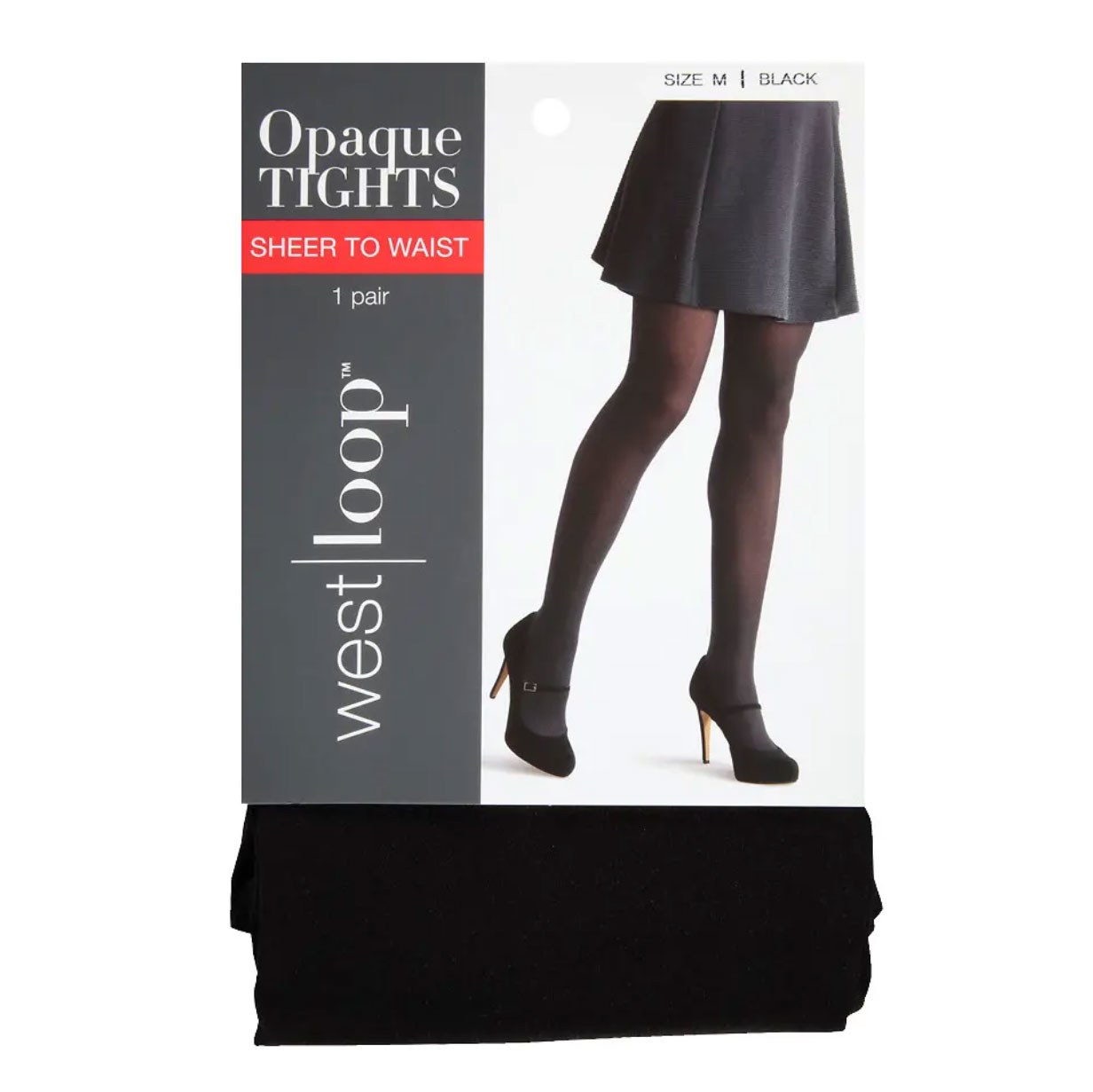
I bought the first and only pair I saw in my size: West Loop Sheer-to-Waist Opaque Tights. I thought of it as a band-aid solution to my timely problem—little did I know, the actual best black tights I’d ever own had been sitting next to the half-off scrunchies this entire time.

PHOTO: Walgreens

West Loop Sheer-to-Waist Opaque Tights, $5.99, Walgreens

There weren’t any fireworks or foot pops. It was only when I’d worn them for a week straight that I realized what an incredible discovery I’d made. No joke, these tights stood up against back-to-back wears without tearing, losing shape, or fading. (Laundry is expensive, OK?) The waistband doesn’t pinch my stomach like the so-called control-top pairs I’d tried before, and they sit at my natural waist, so I don’t have to pull them up over my stomach to my rib cage for a smooth line. Also, they’re $5.99—at my usual go-to stores, tights start at $19.50 (J.Crew) and can go all the way up to $285 (Wolford).

But the best part of this whole saga was realizing that a solution to my fashion #problems was right around the corner. Rip my tights on a sharp desk corner at work? I can hop over to the nearest drugstore. Scratched by the dog I couldn’t resist petting? There’s a replacement pair one block away, all for less than a breakfast sandwich. When I leave New York City to visit family in other states over the holidays, I don’t have to worry about what happens if I forget to pack tights—there are Walgreens, CVS, Rite Aids everywhere.

When I reach the point in my life when I want to spend money on name-brand tights, I’ll consider setting change aside for an extra-special pair with a silk tag. For that easy, basic pair I’ll wear every winter until then, these will do the trick.

West Loop Sheer-to-Waist Opaque Tights, $5.99, Walgreens

All products featured on Glamour are independently selected by our editors. However, when you buy something through our retail links, we may earn an affiliate commission.

Related Stories:

The Black Leggings I Never Hesitate to Wear as Pants

The Women’s Underwear a Lingerie Editor Buys in Bulk

I Finally Caved and Bought the ‘World’s Most Comfortable Shoes’—and I Get It Now


Source link

Categories
Health

A Walgreens Pharmacist Refused to Fill a Woman's Prescription to Induce Miscarriage. And It Was Legal.


An Arizona woman left a Peoria, Arizona, Walgreens pharmacy in tears last Wednesday after she was denied medication to induce miscarriage prescribed by her doctor following news of her unviable pregnancy. Now the incident, which hit on the most sensitive and controversial issues surrounding women’s reproductive rights, is also bringing up another issue—is it legal to deny someone a prescription based on moral objection?

That woman, Nicole Arteaga, posted a now viral Facebook status that has shined a light on a Walgreens policy that many were unaware of before this weekend.

Arteaga, a pregnant teacher in Peoria, took to Facebook on Friday to describe the disbelief she felt when she was denied her prescription at a local Walgreens pharmacy. (The post has now been shared over 34,000 times.) “This post isn’t something I generally do, but last night I experienced something no women should ever have to go thru especially under these circumstances or any other circumstances,” she wrote.

Arteaga then went on to describe how she found herself at the pharmacy, explaining that her doctor discovered her fetus was no longer developing and a miscarriage would ultimately occur. Her physician gave her the option of a D&C (the dilation and curettage surgical procedure) or a prescription medication. Arteaga opted for the prescription.

“Last night I went to pick up my medication at my local Walgreens only to be denied the prescription I need. I stood at the mercy of this pharmacist explaining my situation in front of my 7 year old, and five customers standing behind only to be denied because of his ethical beliefs,” she wrote on Facebook. “I get it we all have our beliefs. But what he failed to understand is this isn’t the situation I had hoped for, this isn’t something I wanted…If you have gone thru a miscarriage you know the pain and emotional roller it can be. I left Walgreens in tears, ashamed and feeling humiliated by a man who knows nothing of my struggles but feels it is his right to deny medication prescribed to me by my doctor. I am unsure where Walgreens draws the lines with their pharmacist but does this mean he denies women the right to birth control and morning after pill, and what’s the stance with fertility drugs.”

Arteaga was eventually able to pick up her prescription at another Walgreens location without incident.

Walgreens told Glamour in a statement: “After learning what happened, we reached out to the patient and apologized for how the situation was handled. To respect the sincerely held beliefs of our pharmacists while at the same time meeting the needs of our patients, our policy allows pharmacists to step away from filling a prescription for which they have a moral objection. At the same time, they are also required to refer the prescription to another pharmacist or manager on duty to meet the patient’s needs in a timely manner. We are looking into the matter to ensure that our patients’ needs are handled properly.”

According to the National Women’s Law Center, this right of refusal is actually legal under Arizona state law, as it is one of six states that has “laws or regulations that specifically allow pharmacies or pharmacists to refuse for religious or moral reasons without critical protections for patients, such as requirements to refer or transfer prescriptions.”

The others are Arkansas, Georgia, Idaho, Mississippi, and South Dakota.

Only eight states have laws that explicitly require pharmacists or pharmacies to provide medication to patients: California, Illinois, Maine, Massachusetts, Nevada, New Jersey, Washington, and Wisconsin.

The online conversation surrounding the incident—and Walgreens’ policy—led many to point out that this is an issue that almost only affects women.

The debate around Arteaga’s ordeal comes at a time when refusal of service is all over the news—from the Supreme Court ruling on the Colorado baker case to press secretary Sarah Huckabee Sanders’ tweet this weekend about a restaurant’s asking her to leave because of her position in the Trump administration.

Of course, these three things are not equivalent, but the responses to each are certainly indicative of the divided state of the union.

Glamour has reached out to CVS and Rite-Aid pharmacies to inquire about corporate policies surrounding a pharmacist’s right to refuse customer prescriptions. We have yet to receive a response.


Source link