Categories
Health

I Tried a $100 Revenge Candle


Two years ago, on my birthday, I got a DM from a girl across the country letting me know that my boyfriend also happened to be her boyfriend. After a year of refusing to acknowledge my existence on social media, he had finally, drunkenly slipped up and posted me to his Instagram Story. She wrote that she wouldn’t judge me if I chose to stay with him, but she was out. “Call me,” I typed back.

Hours of tears and fact-checking later, we’d plotted our revenge. Since I already happened to be flying home a week later to L.A., where she lived, we would meet up and post a photo of the two of us together for him to scroll upon. Until then, I would pretend to know nothing of his double life. I’d continue to sleep with him, feign interest in his virtual-reality obsession, and let him rack up flights and Airbnbs on his credit card for the New Year’s trip we’d been planning.

It wasn’t easy—I probably deserve an acting award of some sort—but it was worth it. Minutes after seeing the photo, he unfollowed both of us and disappeared from our lives without a word. Months later, his friend messaged me to deliver one of the greatest compliments an Italian could ever hope to receive: “You got the last laugh.” It was revenge at its best: served cold, in an unexpected way, with no room for escalation.

I haven’t been able to get the recipe right since. In May I was let go from my job in a pretty ugly way. As someone who has always placed career above all else, it’s been a huge identity loss for me. I was feeling a lot of pent-up anger I didn’t know what to do with, drinking too much, and regularly dreaming that all my teeth were crumbling to dust (which apparently signals inner turmoil and a sense of powerlessness, so…sounds about right). I got caught up in a wild, whirlwind romance that ended painfully—days before Kavanaugh happened and opened up more traumatic old wounds. The hearing marked the first time in my life I acted on the urge to throw plates at the wall.

Basically, I spent the summer feeling like a victim and imagining countless petty, vindictive ways to get even with those who’ve hurt me—and that of course got me nowhere. Not only does an eye for an eye feel dirty, it’s also just incredibly uncreative. Then, in a sort of spiritual intervention, I got an email from a “witch” directing me to take charge of my energy via a line of potions and dusts that can make you rich, sexually irresistible, and maybe even a little psychic, if you go in with the right intentions.

Something came over me and I found myself saying things out loud I didn’t even know I’d been thinking. Things about taking responsibility for my own happiness and healing and coming out stronger.

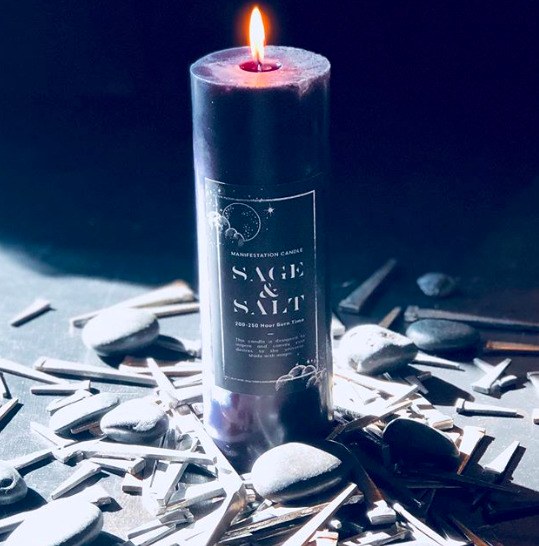
I want to be all of those things, but it was the tall, black Eye for an Eye Manifestation Candle that spoke to me in my time of need. “Want to see the universe dish up some steaming hot revenge?” it asks. “Need a poisonous relationship in your life to die? Release the flying monkeys and light this up.”

Sage & Salt claims it’s all about “good vibes,” so I asked Corbin Chamberlin, the self-described recovering fashion writer turned witch behind the brand, how exactly vengeance fits into that. “Positive intentions aren’t always in the form of Palo Santo sticks, mantras of love and light, or crystals sitting on your West Elm coffee table,” he wrote. (The candle and personal crystal he’d given me were sitting on a marble tray on my West Elm coffee table at that moment.) “Harnessing good vibes can mean setting tough boundaries for yourself or finding the courage and strength to leave a toxic job, relationship, or environment. The journey to good vibes can also be about asking the universe to keep the balance of karma by directing your magic to justice.”

Justice, Chamberlin told me, was key—I couldn’t just take down any old person in my path I didn’t like; I needed to be calm, focused, and fair for it to do its work. In other words: completely opposite of the person I’d been the past few months.

Eye for an Eye Manifestation Candle, $100

I figured I should try to take this somewhat seriously—the candle is $100, after all. The first step is to find a sacred space for it, so I chose my fireplace, right next to the Byredo Altar candle. (In a New York City apartment, I’d argue, the only thing more sacred than a fireplace is a washer-dryer unit.)

It took me another couple of weeks to get to step two: “Prior to burning the candle, spend some time with it…grip some crystals, journal, and even dance under the full moon.”

Every time I sat down on the floor with my crystal, I spotted dust bunnies to clean or became consumed with rearranging nearby books by color, a decor trend I absolutely do not agree with.

I finally committed to the process on a night my Bravo live stream was down and I had nothing to do. According to the instructions, though, Tuesday was the day for removing obstacles and finding domination and success, so it seemed serendipitous. I dimmed the lights, kneeled on a pillow in front of the fireplace with my crystal, and closed my eyes. I felt ridiculous. I wanted wine and for the radiator to stop clanking. But a few minutes later, something came over me and I found myself saying things out loud I didn’t even know I’d been thinking. Things about taking responsibility for my own happiness and healing and coming out stronger. Mature, good-person things.

The time had come to put a hex on some assholes, and I couldn’t even bring myself to care about them. Maybe that was the magic at work? I lit the candle and got off the floor.

A week later some unfortunate news came out about the financial state of my former company. The day after that, I went on a great date. Then, almost simultaneously, four big freelance projects fell into my lap. Who can say whether it’s the power of the candle or some positive energetic forces I’ve been sending out into the universe on my own—all I know is things are looking up and no one’s lost an eye…yet.


Source link

Categories
Health

Why Revenge Porn Needs Its Own #MeToo Movement


Nude photos were posted of Leah Juliett on the Internet without their consent when they were 15. As #MeToo has cemented itself in the conversation around sexual safety, Juliett is calling for revenge porn to have a reckoning of its own.

I remember straddling the bathroom counter, attempting to capture the perfect shot of my young body to appease the boy I wanted to like me. I was gay. I was 14. I was in the closet. I was depressed. I wanted to be loved. At first, I refused his request for nude photos, but I felt an overwhelming pressure to satisfy his needs. After almost a year of being asked on and off—I caved. I sent him four nude photos. My life has never been the same.

Quickly after sending those photos, he lost interest in me. I started to come out as gay to my close friends, and I moved on with my life. But several months later, I was in science class when my lab partner pulled out his phone. “Everyone has seen your pictures,” he said—I thought he was attempting to be sympathetic. On his screen was my naked body. He told me that the photos had circulated within a group of boys who traded and collected naked photos of girls in the community, and were posted on a website called Anon-IB, which was seized in April by the Dutch police.

At the time, I was unaware that I had been victimized by revenge porn, the practice of strategically distributing sexual images with the intent to shame, humiliate, or harm a victim. In that moment, ownership of my body was stolen from me—and I feared I would never get it back. Despite attempts to have the images removed, they were consistently reposted. If there was a national movement that fought against the cyber-violence that I was enduring at the time, I would have felt far less alone in my experience. I would have never believed that my silence could be used as a bargaining chip against my shame.

In the past year, we’ve seen the moral arc of the universe of sexual violence slowly bend toward justice. The Me Too movement has created a platform for millions of survivors to tell their stories and seek retribution. Most recently, sexual predator Bill Cosby was convicted of three counts of aggravated indecent assault against Andrea Constand. And we can’t forget the wealth of other accounts coming out of Hollywood and other industries.

But the work is far from over and the conversation must continue to become more intersectional. As a survivor of revenge porn, I’ve felt left out of #MeToo: We’ve celebrated victim stories, but it still feels like we shame imperfect narratives of victimhood. Photos of my bare breasts and face reached the screens of boys at my high school and across the state, with the intent of exposing my nudity and shaming my body. Does that not make me worthy of justice like any other victim?

I’m not alone: Revenge porn is a form of sexual abuse that has exploited more than an estimated 10 million Internet users in the United States, per the Data & Research Institute. But still, victims are not protected under federal law. And we are certainly not protected in a culture that demands that we “don’t take nude photos in the first place.” Few of us have had our day in court.

“Photos of my bare breasts and face reached the screens of boys at my high school and across the state, with the intent of exposing my nudity and shaming my body. Does that not make me worthy of justice like any other victim?”

Relatedly, in 2014, there was a short-lived uproar after nude photos of Jennifer Lawrence, Kate Upton, and other celebrities surfaced on the Internet without their consent. The man who hacked their accounts, Edward Majerczyk, took a plea deal and was sentenced to nine months in prison and paid $5,700 in restitution. But I don’t think that was enough. The effects of such an invasion of privacy can last a lifetime. Just like with #MeToo, we need the same continued outspoken public advocacy for revenge porn—otherwise, we risk leaving out millions of victims of cyber sexual violence worldwide. It’s time to say #MeToo to revenge porn.

I graduated from my high school, but my nude photos remained online. I realized that this experience would either kill me or drive me into action. I started telling my story in public and made the decision to save my own life. In college, I came out as non-binary, and started using they/them/their pronouns. At the time, #MeToo did not exist to encourage me to speak up and fight against revenge porn. Perhaps if it had been, I would have spoken up earlier. Nevertheless, taking back my life on my own terms has allowed me to start my own movement—one that is intersectional and inclusive for all who have been victimized by cyber-harassment.

Two years ago, I started the March Against Revenge Porn, an internationally-acclaimed grass roots organization dedicated to combating revenge porn through federal lobbying, cyber-sex education, and a series of national protest marches. On April 1, 2017, we marched across the Brooklyn Bridge to protest New York City’s lack of comprehensive revenge porn legislation.

We march on. This month, we will march in the Boston Pride Parade to shed light on the disproportionate victimization of LGBTQ+ communities by revenge porn. Research from the Data & Research Institute says that 17 percent of all lesbian, gay, and bisexual Americans have been victimized by revenge porn—in comparison to only 3 percent of all heterosexual people.

And at the end of June, we will march in Pittsburgh, alongside anti-revenge porn groups BADASS and 50 Shades of Silence, to fight for federal revenge porn legislation protecting victims nationwide. Later this year, we plan to march at the University of Hawaii and hope to bring a march to Orlando.

The Me Too movement was born from the strength and courage of those who society has historically refused to hear. Since telling my story, I’ve been told that what happened to me was my fault. It’s easier for society to blame and silence me than to allow me to take up space. I am not a perfect victim. My story is tough to digest. I sent the photos that would eventually be used to exploit me. But I did not consent to be harassed, exposed, or publicly shamed. I refuse to silence the story of my suffering and hope that others will come forward and speak about their own experiences. We belong in this movement. We refuse to be invisible any longer. Through marching; through movement; through saying #MeToo: we demand to be seen.

Leah Juliett is a senior at Western Connecticut State University and a 2018 Glamour College Woman of the Year.


Source link