
Categories
Health

I Asked My Boyfriend to Split the Cost of Egg Freezing


“We both want kids someday,” I said. “The only difference is, if I don’t freeze my eggs now, I might never be able to have them. But the option for you to have kids is always on the table, no matter how much money you do or don’t have in the bank. With that in mind, what do you think about us splitting the cost of egg freezing?”

It took every ounce of willpower in me to ask my boyfriend of almost two years if he would be open to splitting the cost of harvesting and freezing my eggs. Not so much because I was afraid of his reaction—though asking the man you are not legally bound to in any way to invest in your hypothetical future children is scary—but because I felt a deep sense of shame that I couldn’t pay for it myself.

The fact that egg freezing has me facing bankruptcy is, frankly, ridiculous. I’m a 32-year-old writer and small business owner who has worked very hard to be debt-free. I’ve saved a modest sum of money over the past decade and placed it into a savings account, which I’ve now labeled “Nest Egg vs. Egg Freezing.” The balance is a few thousand dollars less than the cost of the recommended rounds of egg harvesting, freezing, and storage for women over 27. In America, the average cost for this is $26,000—not including the cost of IVF when you’re actually ready to use your frozen eggs.

If I use my savings to harvest and freeze my eggs, I could lose everything I’ve spent a decade building: my financial freedom, my credit, my ability to afford my current modest lifestyle. But if I don’t spend my life savings on freezing my eggs, there’s a very real chance that I’ll never get to realize my dream of becoming a mom. My own mom was diagnosed with endometriosis in her 20s, and conceiving me, her only child, was extremely difficult. While I haven’t officially been diagnosed with the same condition, I did inherit many of the same symptoms and have been warned by doctors that pregnancy may be more difficult for me than for most.

My clock, in other words, is never far from my mind. But the simple truth is, I’m not ready to have kids yet. There are circumstances in my life that are too unstable and uncertain for me to be comfortable bringing a child into the equation. Deciding when to start a family is an incredibly personal decision. For me, trying to get pregnant right now feels selfish and irresponsible. Hence my desire to freeze my eggs to ensure a greater chance at a healthy pregnancy later, when I am ready.

It took some soul-searching to figure out why asking for financial help from my boyfriend made me feel such a sense of shame. After all, married women split the cost of egg freezing with their partners, right? We’re used to having conversations with our partners about preventing pregnancy, so why was it so hard for me to talk about planning for one?

The Big Question

Preparing for this conversation, I talked to my female friends about the dilemma facing so many of us as we enter our 30s; we’re not ready to have kids, but we can’t afford to freeze our eggs by ourselves. But when I broached the subject of the costs of fertility planning with my unmarried male friends, none of them had a clue what I was talking about. If anything (and I mean anything), they spoke about saving up to provide for a family down the road. But having a conversation with their current partners about those costs wasn’t even on their radar.


Source link

Categories
Health

The 'Outlander' Costume Designer Just Revealed an Easter Egg You Probably Missed


Outlander season four introduced a lot of big changes for Claire and Jamie—a home at Fraser’s Ridge, a reunion with their daughter Brianna, and even a new villain in Stephen Bonnet, to name just a few. But there was another, more subtle shift happening onscreen that might have escaped your notice: the character’s costumes. As Nina Ayres, the costume designer alongside Terry Dresbach, tells Glamour, Jamie, Claire, and their loved ones are literally in a new world. That means new cultural influences, new weather elements, even new fabrics that they wouldn’t have known or used before. “We’re making sure we’re telling the story as to where those clothes might have come from,” she explains. “Because they are really out in the wilderness, there’s barely anywhere to get anything.”

Oh, and several of these outfits had to be designed while keeping in mind what a twentieth-century woman would think an eighteenth-century outfit looks like. That’s a lot of work and research, but Ayres and her team pulled it off. They even found time to sneak in a subtle callback or two. Here, she explains.

Glamour: This season mostly takes place in colonial America. What was it like prepping for that?

Nina Ayres: The most important thing this season has been to try and establish that new world, what it was about eighteenth-century America that defined it, and then finding those key pieces to introduce to our characters. We started on Wilmington, in North Carolina, and did a lot of research into what, exactly, those elements would be. Really, it’s the mix of cultures. We looked into the cultural and traditional costumes of Europe, where [most of] the settlers would have come from. Then mix that with the Native Americans who were obviously there, as well as previous settlers. Then [we thought about] the practicalities of the terrain. What sort of practical garments they would have worn?

Glamour: For Claire, were there any specific challenges?

NA: It’s always hard because you want to make sure that nothing is just emerging from out of nowhere. So you start off with a question as to where her costumes would have come from. Then you’ve always got the fact that she’s a twentieth-century woman, so practicality is her thing, as well as trying to blend in with everybody else. She doesn’t want to stand out too much. And she’s not a very frivolous dresser, so one of the elements we brought in were block-printed cottons from India, which were exported to the Colonies at the time. We kept a silhouette that people understand as Claire’s, something she’s used to wearing, but we use linens more than wools [from Scotland]. Linens were a big thing, and generally used in warmer climates.

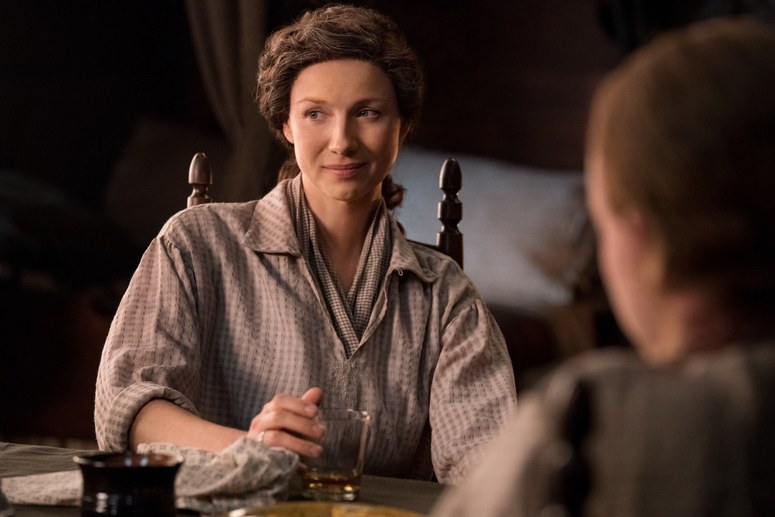
Claire (Caitriona Balfe) at Fraser’s Ridge on Outlander

Aimee Spinks

I think the most interesting thing was working out what she might have made herself when they get to Fraser’s Ridge. She’s more layered this season than we’ve ever seen her before. We used rabbit skins and things like that—that’s what they’re eating all of the time, so it’s what she has access to. We made quite a few garments that are simple, as if she has made them herself. We used the most basic techniques while [thinking about whether] it’s a practical thing that would keep her warm, or it’s waterproof, or it’s what she’s actually doing in these things.

Glamour: Whereas with someone like Jocasta, her costumes might reflect her wealth and status?

NA: For Jocasta, we made her wardrobe quite old-fashioned. She’s a little bit of a relic from the past. And Claire doesn’t particularly enjoy being with Jocasta, or at River Run. Jocasta is getting gowns made for Claire, so they’re not…she’s being forced to wear things she wouldn’t generally choose herself. But she’s just playing the part.


Source link