Categories
Health

Lifetime's New Movie About Olivia Newton-John Will Remind You That She Is the Best


How’s this for a meet-cute: Some 25 years ago, seven-year-old Delta Goodrem was visiting New York from her native Australia when her idol, fellow Aussie Olivia Newton-John, walked in to the same restaurant. “I was like, ‘It’s Sandy, it’s Sandy!'” Goodrem says of the iconic actress from Grease. “Olivia heard my Australian accent and walked over to ask why we were in New York. She was so sweet and said, ‘I hope I see you around tomorrow,’ so the next day I looked around the entire city trying to find her again. I did not.”

All Goodrem had to do was wait another 11 years, when Newton-John became a fan of Goodrem’s singing and acting, and sent her a letter. But it wasn’t just any letter of appreciation: Newton-John, a two-time cancer survivor who is now battling the disease for a third time, found out that Goodrem was battling cancer as well. “She said that one day I’ll understand this is a gift to give strength to people,” Goodrem says of her Hodgkin’s disease diagnosis when she was 18. “As time went on, she became my mentor, friend, and greatest influence.” In fact, in 2008 the two collaborated by writing and recording a song called “Right Here With You.”

And now, Goodrem will play the legend in Lifetime’s new television movie, Olivia Newton-John: Hopelessly Devoted to You, airing Saturday night, February 16. “It’s full circle,” Goodrem tells Glamour. “It’s beyond special.”

Goodrem, who has developed quite the fan following in Australia, says she only recently told Newton-John about their first meeting in New York City all those years ago. “We were doing a gala together for her charity, and I told the story to the entire ballroom,” she says. “I talked about the impact that moment had, and now when I see young kids, I always think of [Olivia coming up to me]. and I approach [others] rather than sit back.”

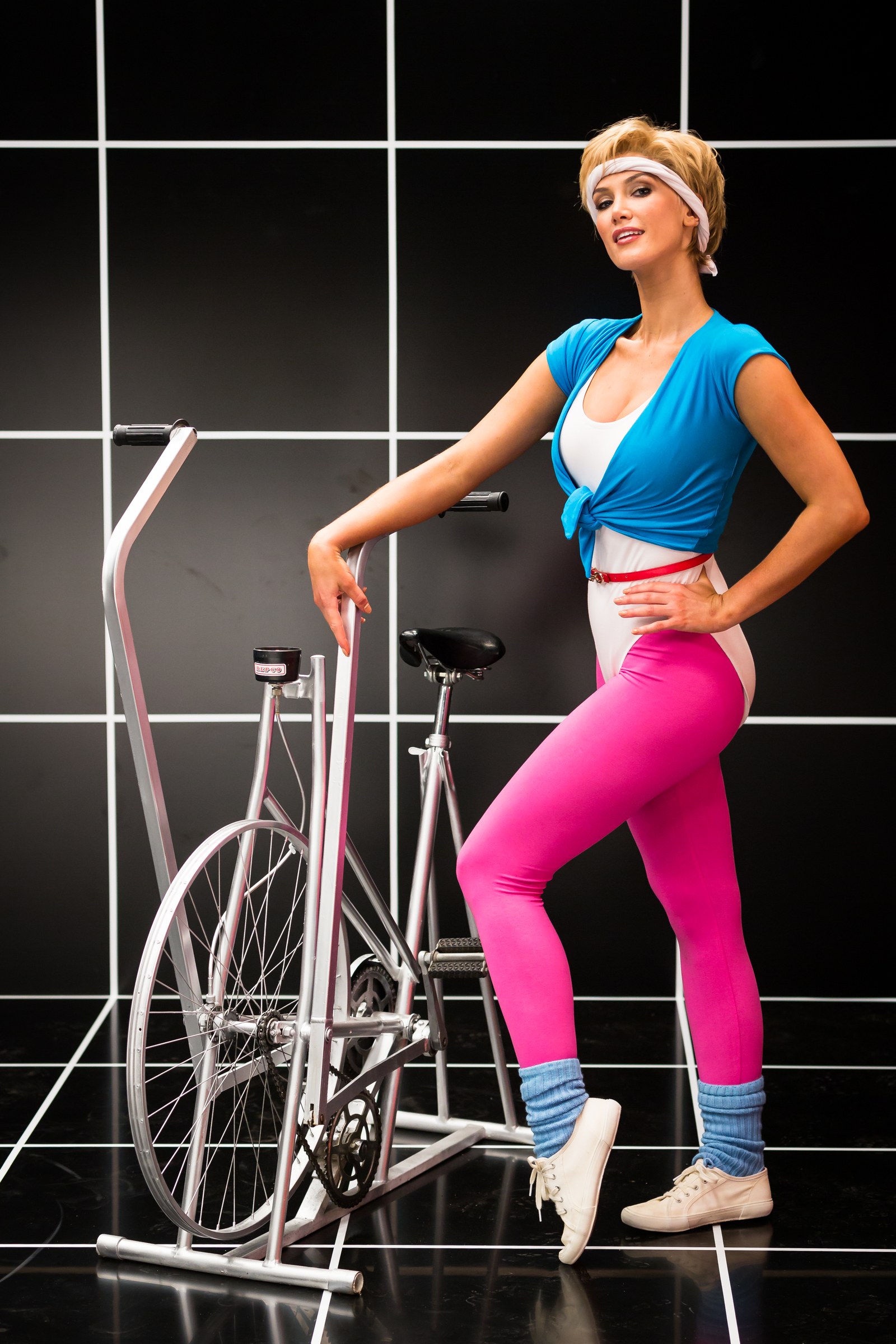
She takes the same approach in the new Lifetime movie, which required her to portray Newton-John over more than five decades. “My first day on set was filming [the music video for] ‘Let’s Get Physical,’ and the crew was all dressed up in headbands,” Goodrem says. “I thought, ‘Oh my God, what a way to start this project!’ And then my last day on set was the scenes during Grease, so that was really fun.”

Jackson Finter/Lifetime

Goodrem says she can’t help but examine every little detail of her performance, but overall she’s thrilled with the final product: “I’m really proud of it, and I can’t wait for people to watch it.” However, for the moment, at least, Newton-John won’t be one of those people. “I sent her footage throughout, and she’d be like, ‘Stop it! Stop it!'” Goodrem says, laughing. “She said she wants to watch [the finished version] in her own time so she can step back and have her own moment with it.”

But for all the Newton-John fans who do watch, Goodrem hopes the movie reminds them of their idol’s strength through good times and bad. “There’s only one Olivia Newton-John, and she’s a beautiful, unique, one-of-a-kind person,” Goodrem says. “She’s a reminder that it’s cool to be kind, and strength comes in many forms. No one can rock those Grease pants like her.”

Olivia Newton-John: Hopelessly Devoted to You airs Saturday, February 16 on Lifetime.

Jessica Radloff is Glamour’s West Coast Editor. Follow her on Twitter at @JRadloff and on Instagram at @jessicaradloff14.


Source link

Categories
Health

This Staggering Graphic Will Remind You That the Golden Globes Haven't Honored a Female Director in 25+ Years


In the wake of a year in which Harvey Weinstein and #MeToo dominated the entertainment headlines, this year’s overall awards season has—rightly—centered more on change in Hollywood than any red carpet predictions or accolade-worthy performances. This year, the spotlight is on worthy initiatives like Time’s Up, an ambitious initiative backed by 300 powerful women in entertainment with the goal of ending systemic inequality and harassment in the workplace.

And here’s the thing: One of the most meaningful ways to combat systemic inequality—and harassment, for that matter—is to ensure that all workplaces have a better gender balance. Most importantly, that women are visible in leadership positions and recognized for their achievements.

In the entertainment industry, for example, that means taking a hard look at areas like directing, where women are particularly underrepresented. Even in 2017—a year that saw Patty Jenkins crush box office records with Wonder Woman—just 11 percent of the directors of Hollywood’s top-grossing films were women. Looking ahead to the Golden Globes as an early indicator of how we’re honoring these female directors’ achievements, we see more bad news: Not a single female director was nominated for a Golden Globe award this year, despite heavy praise for Dee Rees’ work on Mudbound and Greta Gerwig’s first directing work with Ladybird. (Gerwig received a nomination for Best Screenplay.)

In the 75-year history of the Golden Globes, a woman has been given an award for Best Director exactly once: Barbra Streisand won for Yentl in 1984. Worthy women have since been nominated—including Ava DuVernay and Kathryn Bigelow—but none have won. (The Academy Awards haven’t fared better: Kathryn Bigelow is the only woman to have won—for Hurt Locker in 2010—in nearly 90 years.)

We looked at the data on female Golden Globe nominees in four clearly gender-neutral categories over the past 25 years and found that in categories like Best Screenplay and Best Score, women (meaning nominees who identify as female) are staggeringly underrepresented. Take a look at the data, below. You can filter the results to “Best Directing” or “Best Original Score” by clicking on any of the categories at the top, and you can also hover over any of the individual squares to see the nominee—male (in gray) or female (in peach)—and the work for which they were nominated.

In 2005, there were zero nominations for women in these four categories, full stop. In the Best Original Score category, men have outpaced women 143 to 7 over the past 25 years. Overall, female nominees represent just 12 percent of the overall nominees in these categories over the past 25 years. Twelve percent!

In the October 2017 issue of Glamour, cover star Reese Witherspoon elaborated on the problem female directors face: “It’s definitely easier for a male director with a few flops under his belt to get another job directing; that’s not the case for women. Shouldn’t female filmmakers get as many shots as men do? Or how about a shot, period? Women directors, writers, and producers still face considerable challenges just getting hired in the first place. Only about one in four people working in those roles in TV are women; in film it’s even worse—17 percent.”

The statistics inspired Witherspoon to start her own production company, and they also inspired us to launch the #NewView film competition to showcase how young female filmmakers see the world. (Watch the incredible winning films here!)

For this award season, we’re eschewing some of the standard fare of previous years—consistent “Best Dressed” round-ups, for example—to focus on spotlighting the ways women are changing Hollywood, from record-breaking awards to the characters redefining how woman are portrayed on-screen. (TV, for example, finally seems to be getting mothers right. Or at least more right.)

We’ll also keep digging into the data behind key categories at all the major award shows. Just how often do women get nominated? And how often do they win? And are we getting better at being truly representative of the people watching TV and film?

To be sure, this data is just a limited window into women’s representation in the overall business—and also doesn’t factor in the inequality that women of color, for example, face—but even this limited window offers a stark portrait of how far we have to go. The good news, at least, is that we’re speaking up and getting loud. Change is sure to follow.

Graphic: Condé Nast Data Visualization

MORE GOLDEN GLOBES:


Source link

Categories
Health

Serena Williams' Christmas Pic With Baby Alexis Is Here to Remind You She's the G.O.A.T.


Serena Williams is the Greatest Of All Time, a.k.a. the G.O.A.T. Sure, pretty much all new moms are G.O.A.T.s (case in point: 4 A.M. feedings), but Williams’ title is literal, having been ranked No. 1 in the entire world in women’s tennis singles eight times in the past 15 years. And, um, remember when she won the Australian Open while pregnant with her daughter, Alexis Olympia Ohanian, Jr.?

Now, Alexis is 3 months old, totally adorable, and enjoying her first Christmas with her family. You didn’t think Williams would leave us all without a photo of her daughter‘s Christmas debut, did you? Williams shared the snap, complete with a Christmas-themed Snapchat filter, and it’s almost too precious for words. (We’re glad to see that little Alexis doesn’t seem to be suffering from teething woes during the holiday, too!)

The photo itself is a simple selfie of Williams and her firstborn, but what we love most about it isn’t necessarily what’s in the foreground. Take a look right between mom and daughter.

Check that photo of Williams killing it on the tennis court in the background: a lil’ reminder for us that while she’s doing wonderfully at being a mom right now, she’s still the Queen of the Courts. Williams is actually set to return to the tennis court for the first time since giving birth this Saturday—and she’s doing it big. Williams will be playing at the Mubadala exhibition event in Abu Dhabi, and she’s one of the first women to do so. It pretty much makes her the definition of a cool mom—G.O.A.T., Snapchat filters, and all.

Related Stories:
Serena Williams Is Asking Instagram Moms for Teething Pain Remedies for Her Daughter
Serena Williams Wrote an Emotional Open Letter to Her Mom: ‘We Are Women and Proud!’
Serena Williams Makes Her First Appearance Since Giving Birth at Glamour’s Women of the Year Awards


Source link