Knowledge is power—especially when it comes to sex. The more we understand our own sexuality and desires, the more we can teach our partners about it, and the more we can get what we want. So when I learned about the Lioness, a smart vibrator that tracks various usage metrics to give you knowledge of your own arousal, the sex nerd in me was intrigued.
The Lioness functions like a Fitbit for your sex life, with sensors that measure tension (to detect arousal and orgasm), temperature (to track when you put it in and take it out), and motion (to keep track of how you’re moving the toy). It connects to an app, which displays each masturbation session on a chart. You can see your vaginal contractions represented as spikes or as a circle that contracts and expands. You can also tag each session with anything from “five-star” to “drunk” and learn how different outside circumstances impact your sex life.
But do we really need that kind of data about our sex lives? In some ways, it felt like solving a problem that only existed because this company said it did. Still, the stories the Lioness staff told me about women who had tested the product were pretty fascinating. One felt that her first orgasm per session was so strong it was painful, but the second one was more enjoyable. Her chart showed that the first was very brief, with extremely strong contractions, while the second was longer and less strong. One Lioness software developer, Maggie, told me she has stronger orgasms when she’s stoned, so unsurprisingly, her chart showed stronger contractions during these sessions.
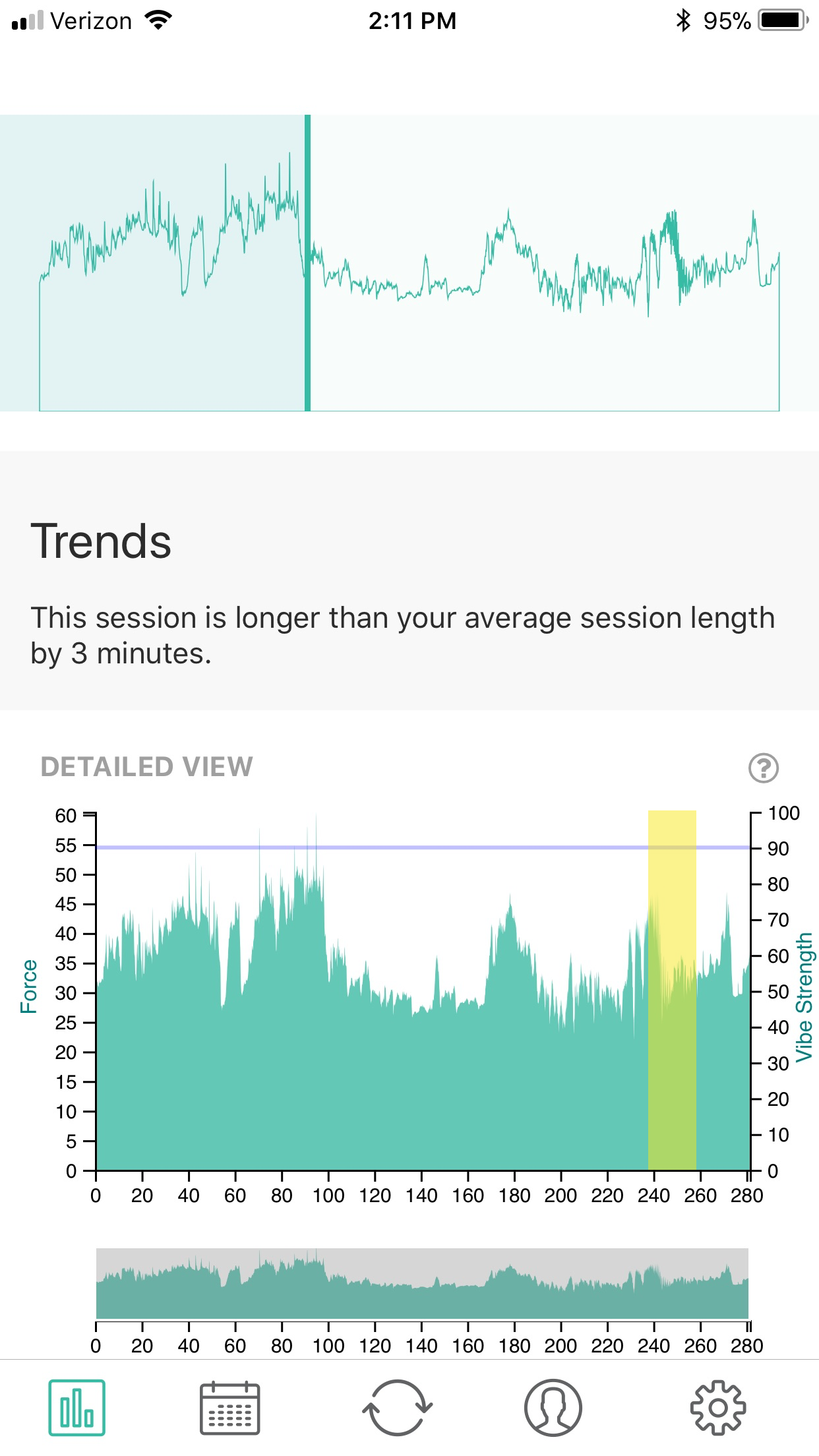
Sensors aside, the Lioness is a nicely-made vibrator, with a movable head to stimulate the clitoris at the top and an insertable one that reaches deep into the vagina, making orgasms more intense. Like many users, I found that my chart matched my subjective experience. It was extremely noisy—instead of one peak like some users have, it had peaks all over—which made sense, because my vagina tends to contract throughout a session rather than just during orgasm. It was validating to see that what seems to be happening in my body is actually happening. I couldn’t figure out much else from looking at my first one, though. I couldn’t even tell where the orgasm was. So, I sent a screenshot to the Lioness team.
Lioness happens to be working on an “orgasm detector,” which can identify where in your chart you orgasmed. It’s not just a question of the strength of your contractions (if that were the case, I’d have orgasmed about a hundred times); it’s a complex combination of frequency, amplitude, and other measures, Lioness Co-founder and VP of Engineering Anna Lee explained to me. In addition to identifying my orgasm, Lee did something else the Lioness will hopefully soon be able to do automatically: Tell me what “orgasm type” I have.
Based on users’ data, the Lioness team has discovered three main orgasm types, and each woman has the same one every time she orgasms. Mine was the “avalanche,” which means it starts off strong then tapers off—pretty accurate based on my experience.
My orgasm, highlighted
So, I knew my orgasms looked like avalanches on a graph—but what could I do with that information? This is where the tags come in, Maggie and Anna explained to me. To figure out under what conditions you orgasm the quickest or strongest or report the best sessions, you can review sessions with different tags. You can also write notes for each and read what you’ve written, making the app a sort of masturbation diary without any real work on your part.
I spent two weeks masturbating with the Lioness, adding tags like “with partner” and “morning.” The vibrator itself was solid, but as cool as the tracking capability was, I didn’t find much use in it. The things I learned—like that I orgasm more quickly at night and when I’m alone, for example—are things I knew already. And despite knowing it, I’ve never felt the need to use that information. I’m still going to masturbate whenever I feel like it. Decreasing my session length by a few minutes or strengthening my orgasms doesn’t matter much to me. I test sex toys for a living and even I think that an orgasm is an orgasm, and it’s best when I’m in the mood for it—not when an app predicts I will be.
And to be totally honest, knowing my masturbation sessions were being documented made me kind of self-conscious. In particular, after every session, the app tells you how much longer or shorter each session was than your average, and each session’s recording has the time span written on it. I’m already self-conscious about how long I take to orgasm, so I try not to think about the timing. Using Lioness forced me to, and I’m not sure what good that information does me.
Still, I will admit that seeing my vaginal contractions on a chart was pretty fun just for curiosity’s sake. It also helped me discuss my sexuality with my partner, which Lioness CEO Liz Klinger tells me was a major goal of hers. Hearing my partner point to a chart and say, “Is that your orgasm?” broke down a barrier for us; we hadn’t talked about my satisfaction that openly and frankly before. The fact that it was charted out made it more accessible and allowed for a clinical distance, like looking at a math problem rather than analyzing something so deeply personal.
The best potential for technologies like Lioness, though, is probably what they can tell us when all the data is put together (with participants’ consent, of course). The fact that it’s already introduced us to the concept of orgasm patterns—something about which nothing had been publishedbefor—is promising. I may prefer my masturbation sessions unrecorded for my own sake, but I’d gladly keep tracking them for science.
More:
—My Antidepressants Made it Hard to Orgasm Until I Discovered These Toys
—This Extra Powerful Sex Toy Is Frighteningly Good
—11 of the Most Opulent Sex Toys to Ever Exist (Hello, $15,000 Vibrator)