Categories
Health

The Supreme Court Backed Trump's Travel Ban. But Judges Sotomayor and Ginsburg Aren't Having It.


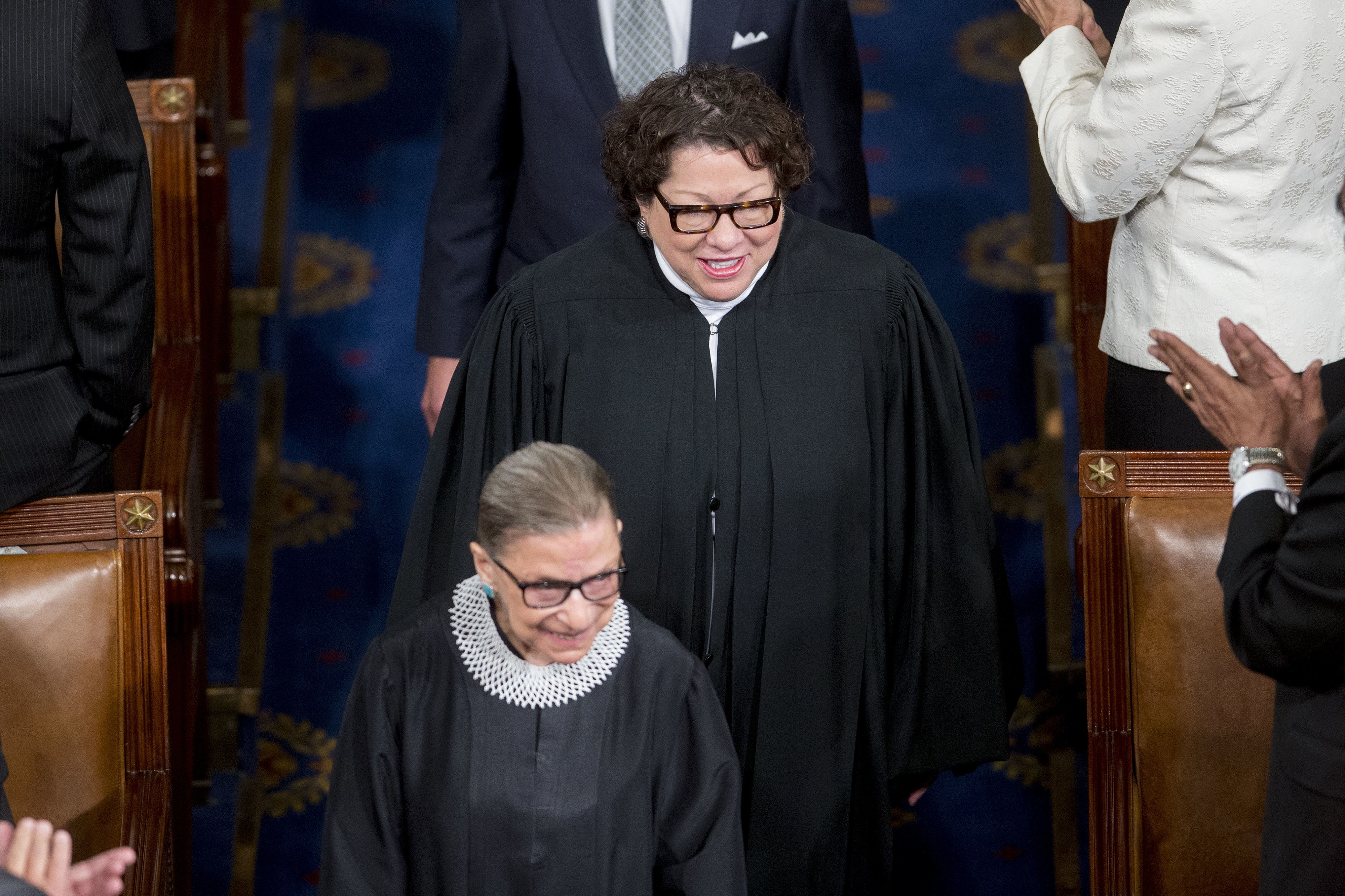
As the Supreme Court upheld President Donald Trump’s travel ban by a margin of 5-4 on Tuesday, it was two of its female justices—Sonia Sotomayor and Ruth Bader Ginsburg—who provided the harshest critiques of both the ruling and the policy itself.

As a refresher, this version of the travel ban (the administration’s third) restricts entry into the United States from seven countries, many of which have majority Muslim populations: Iran, North Korea, Syria, Libya, Yemen, Somalia, and Venezuela. The rules for entry vary by country. For example, immigrants (even those seeking asylum) and non-immigrants from Syria are barred from entering the country, but most Venezuelans will be unaffected. (Per CNN, the ban will mostly affect government officials from that country.)

Citizens from banned countries are able to apply for waivers on a case-by-case basis, like traveling to the US for medical treatment, or to visit a close family member. But The Guardian reports that there are a very limited number of waivers actually being granted.

Sotomayor, who was joined by Ginsburg in her dissent, boldly stated that the court failed to uphold the fundamental right of freedom of religion in her opening remarks. “The United States of America is a Nation built upon the promise of religious liberty,” she wrote. “Our Founders honored that core promise by embedding the principle of religious neutrality in the First Amendment. The Court’s decision today fails to safeguard that fundamental principle.”

She continues by calling the ban one that is designed to keep Muslims out of the country and calls out attempts to repackage it. “It leaves undisturbed a policy first advertised openly and unequivocally as a ‘total and complete shutdown of Muslims entering the United States’ because the policy now masquerades behind a façade of national-security concerns.”

Sotomayor calls out fellow justices in the majority saying they are “turning a blind eye to the pain and suffering the Proclamation inflicts upon countless families and individuals, many of whom are United States citizens.”

And the justices were not afraid to mention the president directly in their formal dissent.

“Ultimately, what began as a policy explicitly ‘calling for a total and complete shutdown of Muslims entering the United States’ has since morphed into a ‘Proclamation’ putatively based on national-security concerns,” the dissent reads. “But this new window dressing cannot conceal an unassailable fact: the words of the President and his advisers create the strong perception that the Proclamation is contaminated by impermissible discriminatory animus against Islam and its followers.”

Sotomayor did not shy away from noting the instances of Trump calling the policy a “travel ban” and his negative remarks about Islam and Muslims. “Despite several opportunities to do so, President Trump has never disavowed any of his prior statements about Islam. Instead, he has continued to make remarks that a reasonable observer would view as an unrelenting attack on the Muslim religion and its followers.”

“History will not look kindly on the court’s decision today—nor should it,” Sotomayor concluded.

While many applauded the justices’ passion in calling out the bigotry in the policy and ruling, the New York Times classified Sotomayor as having “lashed out” against President Trump in a tweet—and Twitter users were not happy about it.

You can read the full dissent here.

Related Stories:

The Hypocrisy in the Supreme Court’s Backing of California’s Anti-Abortion Pregnancy Centers

What Does That Supreme Court ‘Narrow Ruling’ on the Same-Sex Wedding Cake Case Really Mean?


Source link

Categories
Health

What You Should Know About the Supreme Court Arbitration Ruling that Ruth Bader Ginsburg Called 'Egregiously Wrong'


Ruth Bader Ginsburg has always been a fierce warrior for equal rights—so much, in fact, that her tenacity and determination has earned her the nickname of the “Notorious RBG.” On Monday, she lived up to her name and reminded everyone of her champion litigator skills by standing up to the Supreme Court’s majority opinion on allowing employers using arbitration agreements to block workers from coming together to file class-action suits, calling the decision “egregiously wrong.”

In a rare move, RBG read her written dissent from the bench, CNN reports, saying, “The court today holds enforceable these arm-twisted, take-it-or-leave-it contracts—including the provisions requiring employees to litigate wage and hours claims only one-by-one. Federal labor law does not countenance such isolation of employees.”

But what was this case really all about? Here are four things you should know about the ruling.

1. The Epic Systems Corp. v. Lewis Case looked at how federal laws relate to workplace lawsuits.

RBG was all fired up over Epic Systems Corp. v. Lewis, which consolidated three cases where employees wanted to file group claims against their employers, despite signing contracts that contained arbitration clauses. Arbitration clauses are legal methods used to resolve disputes in private settings through a third-party, instead of in public court or through a collective claim in court. To the disappointment of many, including RBG, the Supreme Court ruled that a federal law gives employers the right to enforce these kinds of legal agreements and that they can use arbitration clauses in contracts to keep workers from banding together as a collective.

According to the New York Times, the Supreme Court issued a 5-4 ruling, which is estimated to affect some 25 million employment contracts.

2. Arbitration agreements have come under fire in the wake of #MeToo.

You may have been hearing a lot about arbitration agreements lately—they’ve inspired a lot of controversy in the wake of the #MeToo movement. Critics have pointed out that in cases of sexual harassment, arbitration agreements can force victims into silence by limiting the ways they can pursue and talk about their claims.

The latest headlines about arbitration agreements involved Uber. Several women who accused Uber drivers of sexual misconduct wrote a public letter urging the company’s board to release them of a mandatory arbitration provision found in the Uber app’s user agreement, partially so that they could join a collective claim against the company together. Uber revealed in a post that it would reverse the policy as it pertains to sexual harassment.

3. Critics think the Supreme Court ruling will affect survivors of sexual harassment and assault.

Although Epic Systems Corp. v. Lewis was not specifically about sexual harassment, the Supreme Court signaled through their ruling that it would side with employers. The Cut writes that the ruling is a potential blow to the #MeToo movement—women and victims of sexual misconduct who sign arbitration agreements may not be able to fight sexual harassment together in the workplace. If their employer puts one of these clauses in the contract they sign as an employee, they’ll have to file individual claims and challenge their place of work on a one-on-one basis.

Additionally, they might also have to deal with non-disclosure agreements, which could prevent them from speaking publicly about disputes and corralling public support.

4. RBG says the decision has other implications on employee issues.

Justice Neil M. Gorsuch said the court came to their decision through a federal law that favors arbitration and the court’s precedents. But in her dissent, RBG was quick to point out specific employment issues that the majority opinion could lead to, suggesting that individual arbitrations may not offer results that are as impactful as class-action suits.

“By joining hands in litigation, workers can spread the costs of litigation and reduce the risk of employer retaliation,” she wrote.


Source link