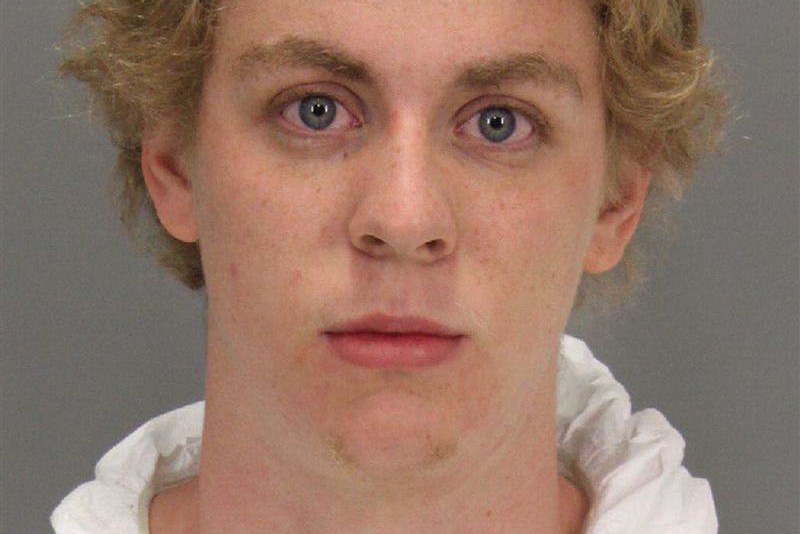
Former Stanford University swimmer Brock Turner, who served just three of his six-month sentence in jail for assaulting an unconscious woman in 2015, will not have his conviction overturned.
Following weeks of arguments and deliberations, Turner learned his fate when an appeals court refused to overturn his felony conviction on three counts, stemming from a case that lead to an outcry about lenient sentences, white privilege and how the justice system handles sexual assault cases. “We are not persuaded,” the justices wrote in response to arguments made by Brock’s attorney’s. In 2016, Turner was found guilty of intent to commit rape of an intoxicated/unconscious person, penetration of an intoxicated person and penetration of an unconscious person.
Last month, Turner’s lawyer Eric Multhaup argued that there was “a lack of sufficient evidence to support three convictions” against Turner in his assault of the victim, who came to be known as Emily Doe.
Even more specifically, according to CNN, Multhaup, raised issue about the timing of Emily Doe’s unconscious state. The defense also attempted to poke holes in Turner’s “intent to rape” conviction, arguing that because the former athlete was “fully clothed and engaged in forms of sexual conduct other than intercourse,” it would “negate an inference of intent to rape.” In a controversial move, the defense argued that Turner’s actions amounted to sexual “outercourse”, a term that spurred multiple headlines and conversations online.
https://twitter.com/realjuliegraham/status/1027437068341919744
Michele Dauber, the Stanford law professor who spearheaded the successful effort to have Judge Aaron Persky recalled from the bench for sentencing Turner to six months, spoke to Glamour about what the rejection of Turner’s appeal means for sexual assault victims and the justice system going forward. “Persky’s sentence sent the message that his crimes were not serious. The Appellate Court has now rejected that idea, as have the voters,” she said via email.
Every criminal defendant has the right to appeal, she said, but she did take issue with some of the arguments Turner’s defense chose to use in court. “Rather than arguing there were legal errors in the trial… he continued to argue that Doe consented and continued to blame the victim. He also advanced his ridiculous ‘outercourse’ argument, which was just offensive.”
So is this another win for the #MeToo movement? Dauber wouldn’t say directly, but she is moving forward with more initiatives to help women. “The recall of Judge Persky was a huge win for the #MeToo movement because it took the legitimate anger of women over sexual assault and harassment and transformed it into electoral victory,” she told Glamour. “I am launching a project with the Feminist Majority that will continue the work of ensuring that violence against women is a voting issue.”
“Women are 51 percent of the registered voters in this country, meaning we do not have to accept a state of affairs in which the crimes and offenses that we experience and which interfere with our ability to achieve equality in society are not treated seriously. Our goal in the Recall Persky campaign, and as we move forward through these new organizational forms, is to make sure that these issues are addressed at the ballot box.”
Turner’s sentence, and the decision to reject his appeal, means he must continue to register as a sex offender for life.