Categories
Politics

Plans still being drawn up to protect Kashechewan from spring flood and COVID-19


Hundreds of people in Kashechewan are heading into the wilderness to avoid spring flooding in the James Bay community.

The annual evacuation of the First Nation— that seese all 2,000 people flown out to wait out the melt in hotel rooms in places like Kapuskasing and Timmins— has been called off, with fears of COVID-19 in the cities to the south.

But plans are still in the works, as ice on the river starts to breaks up.

Chief Leo Friday says about 1,000 people have been supplied with camping equipment to allow them to go out on the land, thanks to $2.12 million in emergency funding from the federal government. A family of five or more received $2,000, while a single person was allotted $750.

“We have a little bit of funding, but not enough. There’s still people that want to go out,” says Friday.

He is hoping to get more funding to allow others to go out camping, at a time when Cree traditionally are out in the bush hunting geese, something people in Kashechewan haven’t done as much for the past decade because the geese arrive at the same time as floodwaters.

Friday says he’s pleased this gives his people a chance to reconnect with their culture and he isn’t too worried about people out on the land for the first time.

“Not really,” he says.

“They’re really enjoying going out. Some who have never gone out, want to go too.”

Kashechewan First Nation says about 1,000 people are heading out on the land to live in tents for about a month while the community is at risk of flooding. (Erik White/CBC )

There had been talk of setting up a tent city for all of Kashechewan in the outskirts of a nearby town like Kapuskasing or Smooth Rock Falls, or on the spot 30 km to the south known as Site 5 where a new community is to be built.

But Friday says there is no longer time to pull those plans together.

He says for elders and others who aren’t physically able to go camping, there is a search on for a facility such as a university campus where they could be brought if floodwaters come into Kashechewan.

Many in Kashechewan are looking forward to heading out on the land during break-up, a spring ritual that’s fallen by the wayside when the community is evacuated every spring. (Erik White/CBC )

Friday says spring break-up is delayed by a few weeks in Ontario’s far north because it’s still “January” weather in late April, which should give them enough time to make a plan that keeps everyone safe.

“I believe it will. But I don’t know what’s going to happen,” he says.

“Warmer days gets around, in no time there’s going to be lots of water.”

Indigenous Services Minister Marc Miller says unfortunately this kind of complex problem is becoming the “new normal” for many First Nations. 

“There’s absolutely nothing being ruled out. This is not an issue of financial resources or physical resources, it’s about making sure people stay safe,” he says. 

“Whatever we need to do, we’re going to be there.”

Canada’s Indigenous Services Minister Marc Miller says all options for keeping people in Kashechewan safe from flooding and the coronavirus are on the table, regardless of cost. (Carlos Osorio/Reuters)

The federal government has been promising to relocate Kashechewan for some 15 years now and Chief Friday is hoping the pandemic will make those plans come together faster.

“After this is over and done, maybe we can somehow speed up the process to build something in the new site, where we want to be every spring and where people can find peace and calm during the break-up season,” he says.

Miller says the Trudeau Liberals remain committed to moving Kashechewan, but right now his focus is elsewhere. 

“Being in the midst of a global pandemic, my ability to examine ‘what ifs’  is very limited,” he says. 


Source link

Categories
Politics

COVID-19 and food security at the heart of disagreement on Gull Bay First Nation


A short hold-up involving a shipment of food at a road block near Gull Bay First Nation this past weekend has revealed a disagreement between some band members and the community’s leadership over food security.

Gull Bay First Nation is located about 200 kilometres north of Thunder Bay off Highway 527, and has six confirmed cases of COVID-19.

On Saturday, a shipment of food destined for Gull Bay was stopped at a road block outside of the community.

The food collection had been organized by Mariah Wigwas, a member of Gull Bay who is now living off reserve.

Wigwas said her grandfather is currently in the hospital with COVID-19, and owns the only store in the community.

She said he had been coming to Thunder Bay every day to make sure people had food. So when he ended up in the hospital, she felt compelled to do something and applied for – and received – a grant for $3,000.

“We made 67 hampers with the concentration for the children on reserve,” Wigwas said. “We were able to get three trucks full and two trailers that we were able to pull it together. We were able to get face masks and hand sanitizers for those that were going to do those deliveries on the reserve. We made sure that we had everything in place, even the (personal protective equipment).”

Wigwas said they wanted to make sure to have the proper protection for the drop-off as community leaders in Gull Bay had expressed concern about safety. Wigwas said when they drove to the community, they were stopped at a gate manned by Ontario Provincial Police. She said they were told no band members could go through, although she said they “were all band members.”

Ultimately, Wigwas said an agreement was reached and the food was passed from the trucks and trailers without further incident.

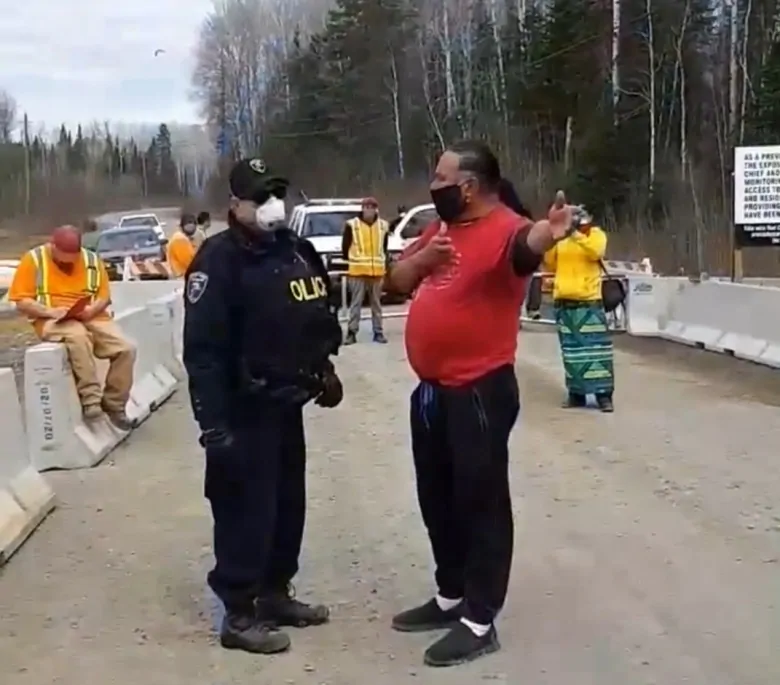
An unidentified man speaks with a police officer on April 25, 2002 outside a road block near Gull Bay First Nation. (source: Facebook )

“We were able just to fill their trucks up and we did it in an organized way,” Wigwas said. “One truck had families. One truck had the single house hampers. One truck had potatoes. One truck had flour. There are people on that reserve who are not allowed to leave their house because they’re in quarantine and no one’s bringing them food.”

Sharon Tyance, a band member living in Gull Bay, has concerns about food security in the community, in light of the closure of the only store.

In particular, Tyance has questions about a cache of food she said has been stored in the community’s recreation centre.

“For the past month here, our chief and council has been storing food in the community rec hall,” she said.”And it hasn’t been distributed to the people here in the community.”

Tyance said now that the community has been impacted by COVID- 19, she believes people should be staying home. But she said out of necessity, there are still people travelling to get food.

“When we had our first case here in Gull Bay, chief and council said they were going to barricade the doors and make sure nobody goes in or out but that didn’t happen,” she said. “We were told on-reserve members can go to Thunder Bay all you want to go get your groceries…a lot of people here don’t want to go to Thunder Bay because they’re so afraid of the virus.”

Gull Bay First Nation Chief Wilfred King had quite a different view of what happened on the road to Gull Bay this past weekend, and what is behind the concerns about food security in his community.

Gull Bay First Nation Chief Wilfred King. (Nicole Ireland/CBC)

“Well, I thought it was a good deed initially,” King said of the food delivery. “And the organizer has assured me this was going to be done in an organized fashion and that we would take all the safety protocols to get the food delivered it to the community. But as I’ve seen, obviously it was a politically motivated event. We had ex-councillors that were right in the midst of this. And to me they didn’t follow the protocols that we had established and they were trying to you know just run through our checkpoint.”

King said the community is not in full lock down, and that people can travel to Armstrong and Thunder Bay for groceries. He said the community store was never there for all the grocery needs of residents, but for day-to-day items like eggs or bread.

King also said the food stored in the recreation centre was for an emergency.

“In the event that there is no food in Thunder Bay, or if it gets to a point where people are too sick or whatever then we would utilize that food supply that’s in the community,” he said.

King said there had never been a question of concerns about food until the incident around the food transfer this weekend.

“I didn’t get any call from anyone in Gull Bay saying they needed food,” said King. “Not one call. So I don’t know where this issue of food supply shortage (came from). To my knowledge nobody in Gull Bay is starving.There is no shortage of food.This is all political.”


Source link

Categories
Politics

Group inspires Indigenous artists to channel creative energy into face masks


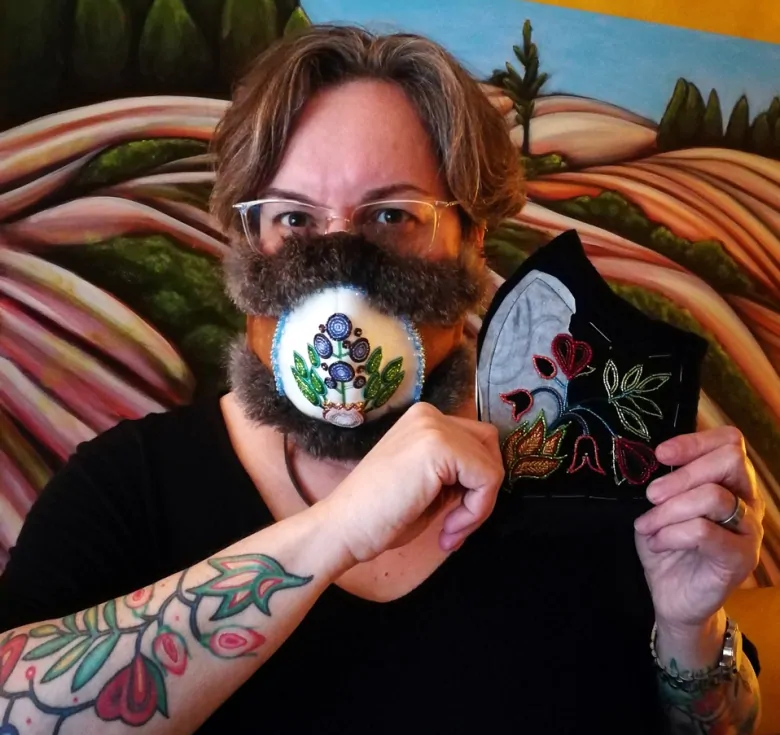
A Facebook group is creating space for Indigenous and non-Indigenous artists to express themselves while observing physical distancing measures because of COVID-19.

The group, called Breathe, was started by two Métis women, Nathalie Bertin and Lisa Shepherd. It calls on bead workers and traditional artists to put their spin on the concept of a face mask.

“This project is born out of our cultural arts and our desire to create community during this crazy time,” said Bertin. 

Bertin is a multi-disciplinary artist from Toronto with roots in the Michilimackinac and Nipissing regions of Ontario. 

She said when the two first conceptualized the idea for the online group, they thought about making it for Métis artists but then wanted to include First Nations and Inuit artists as well. 

“The virus doesn’t know any borders, doesn’t know race, doesn’t know ethnicity,” said Shepherd, who is currently living in Vancouver. 

They decided to open the group up to all artists but made sure that the description specifies work with traditional materials. 

Artists from across the country and beyond have been joining the group and sharing their creations. 

“This project is kind of borne out of our cultural arts and our desire to create community and during this crazy time,” says Bertin. (Submitted by Nathalie Bertin)

Shepherd said that at the beginning of the pandemic she felt bogged down by emotions and found it difficult to pick up a needle and thread to start creating.

“I still had this desire to want to be able to do something as an artist, to be able to offer healing, to offer opportunity for other people to work through their own thoughts,” she said.

In having discussions with fellow artists like Bertin, Shepherd said she realized she wasn’t alone in feeling this way.

“I could see the benefit for other artists getting involved in the project, in whatever way the project could help them, to untangle the threads and help them to move through all of this.”

Creating community

The group was opened on Facebook on April 6 and has over 1,200 members.

Members of the group are encouraged to share their creations through photos and stories about their process in designing and creating their masks. 

“The mask itself is the initial inspiration,” said Shepherd.

“We learned early on that the mask is not protecting [the wearer] from COVID-19. When I wear the mask, I’m protecting you and I’m taking care of the community.”

She said the idea of the group is to help everyone take care of each other. 

“I think that there’s an incredible beauty and incredible love that’s being created and I think that it deserves to be seen,” said Bertin. 

They hope to someday see a gallery exhibit of masks created. 


Source link

Categories
Politics

Indigenous artists reaching new audiences with online concerts during pandemic


As performance venues lie dormant across Canada due to public health orders to reduce the spread of COVID-19, some Indigenous musicians are continuing to connect with fans, old and new, through online concerts.

One of them will be this Sunday, as a number of Canadian media companies, including CBC, collaborate on a 90-minute special featuring music and messages from Canadian artists and entertainers. 

The program will be aired on television, radio and online. Included in the lineup of celebrity performers are Buffy Sainte-Marie and William Prince. 

Prince is one of many First Nations, Inuit and Métis musicians in Canada who have used social media platforms to stay connected with their fans while adhering to physical distancing.

“Truth is you caught me in the middle of what I’d be doing anyway, and we just decided to put a camera on it,” Prince told viewers as he strummed his guitar in his first online performance in March. 

“I’m super thankful for the opportunity to play some music, and I get to sleep in my own bed after this tour, after this gig tonight,” he said. 

Prince was selected to perform as part of a live streamed concert series by the National Arts Centre in Ottawa in collaboration with Facebook Canada called #CanadaPerforms. It’s tied to a $700,000 COVID-19 relief fund to support Canadian artists and authors.

According to the NAC website, artists are able to apply to receive a $1,000 payment for the online performances.

‘It brought me to tears’

Chelsey June and Jaaji, also known as the folk-rock duo Twin Flames, were in the midst of touring Canada’s west coast in January when they began to see the impacts of the novel coronavirus in other countries.

June is Métis, of Algonquin-Cree and French Canadian descent, and Jajii is of Inuk and Mohawk descent, from Nunavik and Kahnawake. 

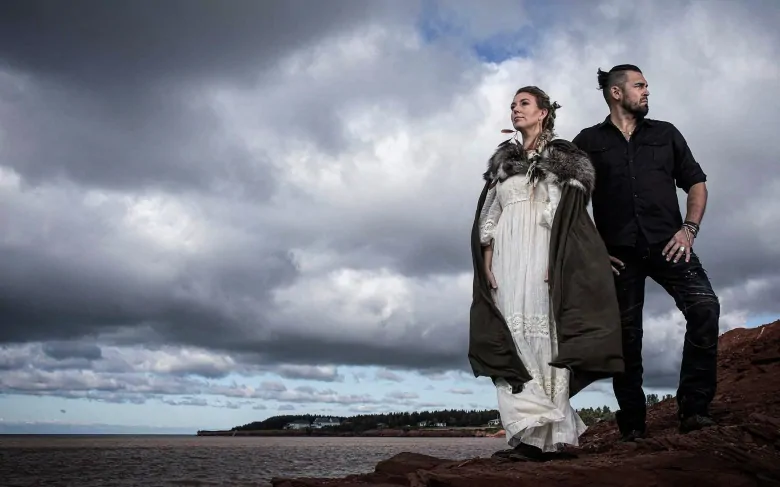
Chelsey and Jaaji June, also known as the folk-rock duo Twin Flames, were in the midst of touring their music across Canada’s west coast in January when they began to see the impacts of COVID-19 in other countries. (Dave Brosha/Twin Flames)

The artists, who are married with four children, made the decision to postpone their scheduled spring and summer concerts. 

“We were very scared, especially financially,” said June. 

“When all the tours and all of the shows started getting cancelled one after another, it was like, how are we going to feed our family? How are we going to pay rent?”
  
Artists across the country are struggling to make ends meet, and are trying to recoup money already spent on future tour dates and albums, June said.

The circumstances have given them more time to focus on their creative pursuits and their entrepreneurial skills, they said, because they manage their own business affairs. Prior to the physical distancing requirements, they’d spent thousands of dollars on travel costs for their five-person band to tour their upcoming album.

“When you don’t have a record label that’s incurring all these costs, it is a very expensive industry,” said June.

“So it’s kind of like all of that money is in limbo … It’s been a lot of readjusting and a lot of learning, but I think it’s all things that we are really going to keep with us as we continue going forward in this industry.”

Performing together since 2014, Twin Flames has played over 1,000 live shows. They were also selected by the National Arts Centre to do a live-streamed concert as part of the #CanadaPerforms series.

Their performance had about 8,100 viewers, one of the largest audiences they’ve played for, they said.

“It brought me to tears,” said June.

“That [live audience] energy is something that you don’t necessarily feel through the screen, but watching all the live comments come in kind of makes it as close as we can get to feeling it. I think this is the most grateful I’ve ever been for social media in my entire life.”

June said that trying to get thousands of people to discover new performers at concert venues was sometimes “like pulling teeth.” 

Jaaji said because online audiences, from the comfort of their homes, are focused solely on one act instead of various acts playing in the same live show, the situation could actually increase their fan base. 

“It’s made a huge difference … we appreciate playing again. I love playing on stage; I love that feeling, the rush of playing for people and engaging with the fans,” said Jaaji. 


Source link

Categories
Politics

First baby bison born on ancestral land in more than 150 years: Wanuskewin


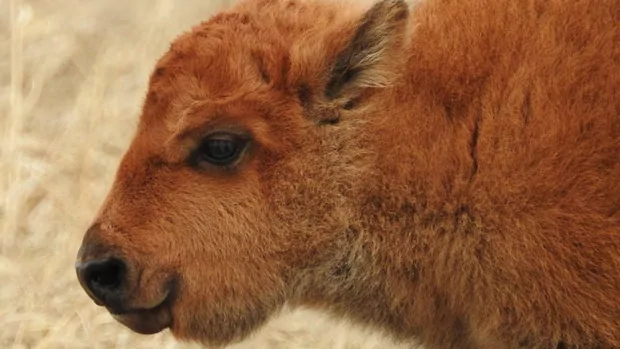
The herd of bison reintroduced to Wanuskewin lands late last year welcomed its first newborn bison on Earth Day. 

Wanuskewin’s CEO Darlene Brander said in a news release that, amidst the uncertain times of COVID-19, Wednesday’s birth reminds people that nature continues to move forward and offer gifts of life.

“This marks the first bison born on their ancestral land at Wanuskewin since before the signing of Treaty Six in 1876 and the subsequent extirpation of the species,” the release said. 

The release said more bison births are expected this spring. 

The herd is a mix of genetically pure bison from the United States and from Grasslands National Park in the province’s south.

Wanuskewin board chair Felix Thomas said bringing the animals back to the land was a central pillar of a recent fundraising campaign and that the organization looks forward to watching the baby grow.

The news release said the organization’s elders are delighted with the birth.

Wanuskewin is currently closed due to COVID-19, so visitors will need to wait until the site reopens during phase four of the Re-Open Saskatchewan strategy to see the newborn.


Source link

Categories
Politics

Cree School Board suspends in-school learning until at least the fall


Schools in northern Quebec Cree communities will remain closed until at least the fall.

The decision was announced late Thursday by the Cree School Board executive committee and made in collaboration with local government and health officials. 

“Bringing the students back into our schools really does pose a risk to our communities,” said Sarah Pash, Cree School Board chairperson, adding learning will continue online.

“It’s very difficult to maintain protocols with young children. Schools can be just that kind of place where an outbreak can happen.” 

Cree schools, along with schools across Quebec, have been closed since mid-March in an effort to slow the spread of novel coronavirus. 

Earlier this week, Quebec premier François Legault announced his government is working on a plan to reopen schools and daycares over the coming weeks and months, an idea that was causing anxiety in the North, according to Pash. 

The risk in our communities is different than the risk in the South.– Sarah Pash, Cree School Board chairperson

Diabetes touches a third of the Cree population and there is a high percentage of people dealing with chronic illnesses and other issues that make them more vulnerable to the effects of COVID-19. 

“We have elders and we have crowded housing to deal with,” added Pash. “The risk in our communities is different than the risk in the South.”

Goose Break holiday for Cree and important factor

Pash said it was important for the Cree School Board to take decisive action sooner than the rest of province, as many Cree families are heading out for the Goose Break holiday, an annual event where people head to their traditional camps to hunt migrating geese returning in the spring. 

Sarah Pash is the chairperson of the Cree School Board. (Cree School Board)

Pash said parents were “very concerned” the board would make decisions while they were out on the land and they wouldn’t be able to hear about it. They were also concerned that teachers working in Cree schools would travel to southern “hots pots” during the Goose Break holiday and put communities at risk if schools reopened.

The move will allow the board to really move its resources and energies to an online learning platform which was launched earlier this month, according to Pash and Abraham Jolly, Cree School Board director general. 

“Student success remains at the core of our vision,” said Jolly, in a press release. “We will do everything we can to assist students in their learning.”

Abraham Jolly is the director general of the Cree School Board. (Cree School Board)

The priority is to help the Cree School Board graduating class, of more than 250 students meet the requirements for graduation, said chairperson Sarah Pash. 

“Those students can still graduate. They still have work they need to do and complete to finish their courses and get their credits,” said Pash. “Our job right now should be to give them the support they need.” 

The Cree board has paired up Secondary 4 and 5 students (Grade 10 and 11) with mentors who will help support their learning for the rest of the school year. 

Plan for a return in the fall still in the works

Pash said the board is still working out plans for a return to class in the Fall.  

Health officials globally have warned a return to class in the fall might coincide with a second wave of COVID-19.

Pash said any decision regarding how Cree schools eventually reopen will be made in close collaboration with Cree leadership and the Cree Board of Health and Social Services of James Bay.

“The way we are setting ourselves up now in terms of moving to online learning platforms … in both youth and adult sectors is really going to take us a long way to preparing us for any possible second wave that comes in fall,” said Pash.


Source link