Categories
TV & Movies

Resident Alien Blends Humor, Heart into Effective Escapism


At its best, SyFy’s “Resident Alien” reminded me of the folksy charm of “Northern Exposure,” one of my favorite dramedies of all time. The writing isn’t quite of that caliber—it too often goes for easy character beats instead of nuanced storytelling—but this is a consistently likable show at a time when people could use something comfortable and easy. And there’s enough talent and potential in it that it could still develop into something even richer and deeper. It works from a premise that allows a bit of everything from sci-fi to murder mystery to fish-out-of-water comedy, and seems primed to be a needed hit for SyFy, a throwback to other basic cable dramedies that served as comfort food for millions.

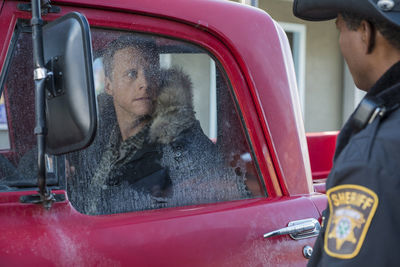
“Resident Alien” is based on the comic book of the same name by Peter Hogan and Steve Parkhouse, published by Dark Horse Comics starting in 2012 (and still running). Alan Tudyk plays an alien visitor who crash lands in a small Colorado mountain town on a mission and ends up forced to take the place of a reclusive doctor on the edge of town named Harry Vanderspeigle. When the actual town doctor ends up murdered, Harry is brought down from the hills and ends up taking his place, learning how to behave like a human while also investigating the crime with the assistance of the dead doctor’s nurse named Asta (Sara Tomko) and the town Sheriff (Corey Reynolds).

At first, it feels like “Resident Alien” might be a mystery-of-the-week show in which an awkward alien disguised as a man played by Alan Tudyk has to solve crimes and let me just say that I would totally watch that show every week. Somewhat surprisingly, the first few episodes don’t really dig into this potential, sometimes lazily pushing along their characters in a way that’s more primetime soap than it needs to be. Even “Northern Exposure” had more standalone stories wrapped up in individual episodes than “Resident Alien,” which basically uses its first few episodes to tell a continuous story about Harry’s attempts to merge in with normal human society. He struggles with simple human concepts like handshakes and decorum while also searching for something he lost in the crash landing and dealing with the fact that there’s a kid in town who can see his true alien form. It’s a show that gets by on the charm of its cast, but there’s a better version that has a bit more urgency, both in individual episodes and as a whole.

Despite the frustrating structure, “Resident Alien” is an easy hangout show thanks in large part to its cast. Tudyk nails the oddity of an alien who has to learn to deal with not only human behavior but the emotions and connections that come with it, things that aren’t really a concern for his species. He basically learns how to act like a human being from watching cable TV and Tudyk captures the character’s blend of awkward fascination with his predicament without going too broad. It’s a great physical performance, perfectly calibrated in a way that makes it believable that the locals would pause but also then brush of his oddity as a personality quirk. Most of the rest of the cast is forced to play straight man to Tudyk’s eccentricities, but they all do so admirably, especially Tomko and Alice Wetterlund, who almost steals the show as a charming bartender named D’arcy (especially in her scenes with Tudyk). It’s when the show contrasts fully realized and believable characters like D’arcy against the ridiculous concept at its center that it’s at its best. (Less so when it gets surprisingly soapish in some of its developments, including a secret baby.)

If “Resident Alien” can fix the slack narrative that sometimes derails its folksy charm, it could be a reliable hit for years to come. Ignoring the occasional missteps as it sets up its world and their characters, it’s a show that goes down easy at a time when it feels like audiences are looking for shows that don’t always need to challenge them with realism in every episode (witness the massive appeal of “Ted Lasso”). It probably won’t play in constant rotation like Harry’s favorite cable staple “Law & Order,” but you never know.

Four episodes screened for review.  


Source link

Categories
TV & Movies

Wrong Turn


Every now and then there’s a horror movie that proves reboots aren’t an inherently craven concept. (I happen to think that the recent “Child’s Play” and “The Grudge” movies fit that description.) “Wrong Turn,” directed by Mike P. Nelson and written by Alan McElroy (of 2003’s “Wrong Turn”) is such a gem. And it’s not just worthwhile in comparison to that Eliza Dushku-starring hicksploitation film, which equaled the artistry of a pancake. For my fellow skeptics, let me make it clear: gone are the West Virginian inbred cannibals and their hoard of corpse meat and car keys; the same goes for the dull predator vs. prey dynamic that dominated the first “Wrong Turn” (and inspired five sequels). The culture clash here between “goddamn hipster freaks” and people of the woods is more complicated here, and the way it unfolds is brutal and shocking without being depraved itself. 

This is a remake that has clearly moved on from the original, and now wants to be graded on its brains instead of its brawn—for the dialogue it adds to the tension between two civilizations, especially as McElroy evolves the slasher story to cult horror, like an Appalachian “Midsommar.” That last part is where it gets a little less sturdy, but director Mike P. Nelson has a confidence that keeps this movie bolder than you expect. And considering its fitfully nasty traps, it can be mighty thrilling when you don’t really know where a reboot like this is going. 

This “Wrong Turn” shares the title mostly by branding—a group of hip, diverse young hikers also make a bad decision here, this time in search of a rare Civil War fort off an Appalachian trail. The batch includes Jen (an incredibly game Charlotte Vega) and her boyfriend Darius (Adain Bradley), an out-and-out socialist who works for a non-profit and openly dreams about an equal society. In general these hikers, who include a gay couple and also an interracial couple, are a liberal beacon for what they think the future of America should be. They’re also dead meat, starting with the rogue tree trunk that suddenly barrels down the hill in an excellent, frantic sequence, killing one of them. 

Not that these outsiders weren’t warned by the locals of the nearby small Virginia town to stay away, after then accusing the hikers of never working “real jobs” (to which the young folks then reply with their different careers, albeit none of them blue-collar positions). The initial tension in the movie is between that of curdled Confederate dreams and Bernie Sanders-grade socialism, and while it can be a little on-the-nose, it does make for a strong foundation related to fear of the other. Which so happens to later manifest itself in the woods with a creepy cult known as The Foundation, who wear animal skulls as masks and moss as camouflage, and have created a secluded civilization the Appalachian mountains since 1859. Adam (Dylan McTee), the hiking group’s hothead, is dragged into one of the traps set by members of The Foundation, sending the hikers into panic mode. Along with the figures Jen sees in the woods, and the traps that injure them around the mountain (Darius takes a spiked ball to the chest, but recovers with help of med student Milla [Emma Dumont]), they’re convinced it is they who are being hunted. 

What’s striking, and a bit sloppy about this movie, is that it still humanizes everyone, albeit while honoring two different understandings of what is considered barbaric. When the hiking hipsters attack one of the Foundation members—without any outright violence committed beforehand—the act of killing becomes a divisive choice between the group. Adam, the guy who does the skull-smashing deed with a tree branch, screams out in self-defense, “These are clearly not good people!” The hikers face judgment when they are captured by other members of The Foundation. “Wrong Turn” then invests a chunk of its running time in a creepy court scene, inside the torch-lit caves of the cult, overseen by its stern ruler John (Bill Sage), whose rulings involve either darkness or death. He is deeply insulted when Jen, pleading for her life, accuses The Foundation of being barbaric. 

The Foundation is what particularly moves this film away from its original, instead bringing up memories of Ari Aster’s cult horror movie “Midsommar.” “Wrong Turn” is practically emboldened by the horror that Aster has popularized, of being doomed by a terror that’s just out of your eyesight. And it’s certainly Aster-like with the amount of head trauma here, as Nelson’s often jolting moments of skulls getting crushed, shot, stabbed etc., prove to be just the type of cold-blooded beats you’d want from a movie filled with visceral emotional and physical pain. Nelson certainly has a more down-and-dirty approach than Aster, using desaturated colors with his copious daylight (like Fede Álvarez’s “Evil Dead” remake), making the surrounding woods all the more claustrophobic, especially when it appears that the trees have eyeballs. 

But the intellectual ambitions of this “Wrong Turn” sometimes overwhelm it, and the ultimate meaning behind The Foundation comes apart when you think about it. As a snarky Frankenstein of Darius’ socialist dreams and the locals’ conservative ideology, the cult doesn’t make too much sense as the statement it clearly wants to be. It does, however, lead to some great thrills, as the traps set by The Foundation (for animals? for people?) on the mountains are horrific and surprising in their own right. 

There’s a lifeline during this horror in the form of Matthew Modine as Scott, Jen’s father. The movie even begins with his search for her, and it gives the story a depth that makes it especially painful and nasty—everyone here is a family member, someone’s loved one. And as the story goes on, McElroy scripts an often tight but long game with select pieces like Scott, and the locals back in town who beat him up when he asks too many questions. At the same time, “Wrong Turn” proves sharp at creating a strong sense of characters being doomed, but giving them a glimmer of hope if they can beat the next nasty threat in front of them. Meeting the mountain’s locals is only just the beginning, and it becomes exciting to see McElroy and Nelson evolve “Wrong Turn” into a bizarre, winding odyssey, albeit with a lot more on its mind than just a cool kill. 

In theaters only on January 26th and January 30th via Fathom Events. Available on VOD on February 26th.


Source link

Categories
TV & Movies

Jules Goes to Therapy in Her Own Special Episode of Euphoria


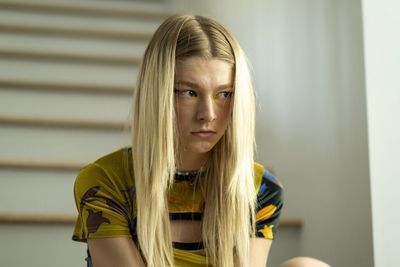
In December, HBO dropped one of the best single episodes of television in 2020 in “Euphoria Part 1: Rue,” a standalone chapter forced into existence by the pandemic that caught viewers up with the fallout after the end of the first season of the Emmy-winning drama. The yin to its yang premieres this weekend in “Euphoria Part 2: Jules,” another hour that distills some of the themes of the show into a two-hander that examines some of the same ideas but with the distinct, full voice of Hunter Schafer, who plays Jules and co-wrote the episode with creator Sam Levinson. It’s tempting to pick out commonalities between the two hours, but what’s more interesting is how much Schafer and Levinson differentiate the stories of Rue and Jules, making both characters richer by these two hours that will have to tide fans over until the full second season later this year. Jules’ chapter is vulnerable and heartfelt, a raw emotion compared with Rue’s constant obfuscation and denial of her own feelings.

Much like Rue’s chapter, most of this hour unfolds as a two-hander, this one between Jules and a therapist played by Lauren Weedman. After a tone-setting intro in which memories of her time with Rue play out in Jules’ tear-filling eye set to Lorde’s “Liability,” the conversation really kicks in, increasingly interrupted by flashbacks to her time with Rue, her continued infatuation with “Tyler” (Nate’s online persona), and even drama with the return of her addict mother into her life, revealing more of what Jules was going through in season one. There are times when this chapter feels like it’s trying to do too much in terms of its narrative construction—the joy of watching Zendaya and Colman Domingo bounce off each other purely in conversation for an hour was one of the strengths of “Part 1”—but the inconsistency captures where Jules is at in her life, her feelings going a hundred miles an hour since the break-up with Rue. A first meeting with a therapist is often about throwing it all out on the table, and Jules reveals a lot about herself through the stories she chooses to tell about the connections between her & Rue, her & her parents, and her & her online partner. How are these connections different? How does Jules hold back or give of herself differently in each of them?

“Part 2” starts off with Jules discussing gender as a construction, telling her therapist that she’s considering going off hormone therapy. How much of our identity is what we choose to present to other people and how much is internal? The discussion turns to when people instantly judge others based on how they look and how Jules has conformed to a self-formed perception of femininity for so much of her life. The theme of image vs. reality continues into memories of Tyler, the online paramour who turned out to be Nate (Jacob Elordi), and how much that passion became real to her, but was never real in a physical sense. All of this is prelude to a discussion about how Rue tore down all needs for concerns about identity and judgment, really seeing Jules in a way she hadn’t felt before.

As she was in the first season, Schafer is emotionally raw in a way that feels completely genuine. She nails all of the emotional backflips that she’s still processing without sinking into melodrama. Weedman is good but not given the kind of juicy part of her own that Domingo was in the first hour, and that hurts the process a little bit, but Levinson and Schafer compensate by opening up the episode more to flashbacks and other characters, including John Ales as Jules’ father and Elordi. There are revelations in the final scenes about Jules’ mother and even an encounter that might make people want to go back and watch Rue’s hour again in a new light.

Taken as a whole, these two hours deepen the relationship between Rue and Jules in a way that wouldn’t have been possible as merely two episodes to start a second season. They have their own space and room to breathe. These standalone chapters capture the passage of time in a different way and allow deeper analysis of characters than a traditional season would have allowed. Sam Levinson never wanted to have to make these episodes, but the truth is that his show is much better for having to do so.

“Euphoria Part 2: Jules” is now on HBO Max and will air on HBO tomorrow night. 


Source link

Categories
TV & Movies

Spoor


Environmentalism and feminism are one and the same in Agnieszka Holland’s gloomy, dystopian fable “Spoor.” Co-directed by Holland and her daughter Kasia Adamik with dreamlike quality, the film’s mossy world is a lush and damp one, where Mother Earth is threatened by men in ways both insidious and blatant. Imagine if the Coen brothers wrote and directed one of those darkly revisionist Disney films like “Maleficent,” and you will find yourself within the borders of this tale’s mountainous town pitched somewhere between Poland and Czech Republic, where men are ruthless, ungentlemanly hunters, empowered to disturb nature’s peace and wreck the well-being of the animals that reside within it.

They are also the destroyers of everything that matters to the movie’s central character Duszejko (Agnieszka Mandat), a hippy-ish, retired engineer and school teacher as well as a flesh-and-blood mother of the nature herself, leading a lonesome but principled life in that bloodthirsty village. Passionate about animal rights and astrology, the Klodzko Valley resident enjoys a decent, quiet existence with her two beloved dogs and plenty of Bach in the background until blood starts spilling mysteriously. It all begins with the inexplicable disappearance of her four-legged best friends one day. Facing man after unsympathetic man in her quest to find them—including one especially deranged priest who shames her for referring to her dogs as her children and denies a fact as obvious as animals having souls—Duszejko finds herself in the midst of an blood-splattered maze with an increasing body count.

One of the first victims that the crime wave claims is a violent poacher who lives next door to Duszejko. Then others join the ghastly aftermath: a police chief, a farmer, a local celebrity with shady connections. In the meantime, if only people would take Duszejko’s instincts seriously; that nature is finally fighting back and taking revenge from mankind for all their abuse and harm, and learn to read the earthly sings of dead deer and moody woods the way she does. But her warnings to all the local folk fall on disturbingly deaf ears, with curt and misogynistic authorities dismissing her worries (among them is a routine breaking of hunting laws) as crackpot theories from a crazy old woman. At least Duszejko proves to have some people around her that she could allegedly depend on—an interesting and deeply mysterious bunch with distinct peculiarities you’d expect in the orbit of such an eccentric character. There is Dyzio, an epileptic computer specialist who works at the police force. There is Matoga, a long-time neighbor who discovers the body of the dead poacher along with Duszejko. Also in the picture is a young woman on a heroic quest to regain the custody of her brother by any means necessary.

Adapted from Olga Tokarczuk’s novel Drive Your Plow Over the Bones of the Dead, there is a loud political edge to “Spoor,” one that deals with animal rights and patriarchy head on, if not a little heavy-handedly. In that regard, her tale is a crowded one covering competing themes, genres and an array of multifaceted characters (an even a romantic plot-line somewhere in there), making one wonder whether an episodic treatment would have suited the source material better. Still, Mandat’s committed performance that wears the horrors of the tale on its sleeve makes the affair more than worthwhile. Not to mention Holland’s cinematic mastery itself that charges every frame of her misty, mud-ridden and chilly-to-the-touch film with the grandeur and ominous aliveness of the nature that surrounds Duszejko’s world. (Sensitive eyes should be warned that dead animal bodies and related grisly scenes won’t be uncommon throughout “Spoor.”) While it doesn’t measure up to some of the director’s greatest such as “In Darkness” and “Washington Square,” “Spoor” makes an unmistakable political statement nonetheless, with Holland’s lens capturing the heart and soul of the animals some of the film’s despicable characters cruelly disregard. 

Now available on VOD. 


Source link

Categories
TV & Movies

PG: Psycho Goreman


In theory, the kitschy supervillain comedy “PG: Psycho Goreman” seems like a guaranteed hit: a gory and knowingly goofy riff on fish-out-of-water action-adventures like “Terminator 2: Judgment Day” combined with rubber-suit monsters from Japanese tokusatsu type shows and movies like “Ultraman,” “Masked Rider,” and even “The Guyver.” Throw in a couple of precocious kids, a bunch of practical effects that recall standout ‘80s sci-fi and horror movies (like “RoboCop” and “Videodrome”), and a murderous guardian angel sidekick, and you’ve got a surefire formula for success. That’s the theory, at least.

In reality, “Psycho Goreman” isn’t clever or lively enough to be more than fitfully fun, especially given how much time is spent mocking generic, but painstakingly recreated plot contrivances. Maybe there’s a more ambitious (or at least righteously silly) parody amidst all the schticky callbacks and corny dialogue, but it’s hard to tell based on the movie’s episodic sketches.

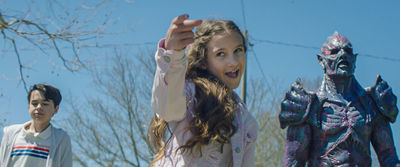
“Psycho Goreman” opens with what looks like a parody of ‘80s toy commercials: brother and sister Luke and Mimi (Owen Myre and Nita-Josée Hanna) play a spirited round of Crazyball, complete with slow-motion roughhousing, mid-air jumping, and electric guitar shredding. Mimi, being the more aggressive of the two children, wins, so Luke has to bury himself alive (ha, kids these days). He starts the process, but quickly stops once he discovers an alien gem from the Planet Gigax (sigh), which summons a murderous, potentially world-ending creature that refers to himself by his preferred nickname: “The Archduke of Nightmares.”

Mimi doesn’t like that title though, and since she’s got the Gigaxian gem that somehow controls the Archduke, she (and Luke) rename our guy Psycho Goreman (Mimi on this new name: “It’s fun, it’s hip, it’s now, and it’s wow!”). They bond and mix it up with PG while we wait for a clash between him and religious zealot/robot angel Pandora (Kristen MacCulloch), Psycho Goreman’s vicious, holier-than-thou arch-nemesis. In the meantime, Mimi forces Psycho Goreman to play with her and her brother, which sets up a few chintzy set pieces and/or splattery monster fights, none of which are personal, dynamic, or weird enough to be memorable.

Unfortunately, waiting for something to happen in “Psycho Goreman” is often the hardest part of watching this otherwise soft-boiled spoof. There are even a couple of jokes about how aimless the movie is, or more specifically: gags that either draw out or interrupt the already slack set-up for new plot developments and confrontations. At the end of a dream sequence, Joey asks Psycho Goreman, “What happens now?” to which PG growls, “We wait for this dream of yours to conclude.” There’s a long pause as a random gaggle of zombies moan and crawl around the two characters. “’kay,” Joey adds, whole seconds before the scene wraps up.

Soon after that: Psycho Goreman gets into a fight with a gang of men in rubber monster suits, all of whom look like ripoffs, I mean tributes to other shows or movies. Joey, who observes the scene with his sister, asks her: “How long is this going to go on for?” The implied answer is, in this case, the right one: too long, though that’s ostensibly part of the joke’s appeal.

The other part is just how proudly juvenile and silly “Psycho Goreman” is. Imagine a Troma movie, but without the goony anger or social conscience of founder/guiding light Lloyd Kaufman, or the usual horndog-placating, above-the-waist nudity. That’s “Psycho Goreman,” a sour comedy that never stops reminding us, often through Joey’s tinny dialogue, about how formulaic and incredible this sort of story is. No lessons are learned, as they joke at film’s end, but there’s a bunch of monsters hitting and/or disremembering each other, so presumably that’s enough to tick off most viewers’ boxes. I wish I enjoyed watching a fine, but unremarkable cast dig into dialogue that feels like an otherwise lazy mashup of sitcom and sci-fi tropes, like when Psycho Goreman learns to say “frig off” as his catchphrase after Pandora tells him that he “will not stand between me and my holy destiny.” I guess “hasta la huego, babe” was too on the nose.

I have to admit, I’m mostly disappointed by “Psycho Goreman” because everything in it is up proverbial alley, from the critique of action-figure-friendly superheroism to the nuclear family gone ballistic power dynamic of Joey and Mimi’s family. I just wish that the movie was either funnier and/or more focused on a scene-to-scene or joke-for-joke level. There’s some funny ideas here, like when the kids’ dad Greg (Adam Brooks) receives a pestering, urgent psychic distress call from PG while Greg tries to use the toilet. But the execution of this gag is so characteristically flat and uninvolving that I often wondered what the point of this genre exercise was, apart from being the cinematic equivalent of a geeky mood board. I theoretically understand the appeal of “Psycho Goreman”—I just didn’t see it on-screen.

Now playing in theaters and available on digital platforms.


Source link

Categories
TV & Movies

Coming Clean


More people will die from opioid overdoses while you are watching this film than have died from opioids in Switzerland in 15 years. That’s according to one of the experts in “Coming Clean,” a documentary about the staggering costs from the mishandling of addictive pharmaceuticals in the United States. In the first few minutes of the film, the death toll is compared to other kinds of disasters: like a 9/11 every three weeks, like a jumbo airliner crash every week, like a Super Bowl arena-full of people each year. 

This is a big, complicated subject. Writer/director Ondi Timoner brings together a strong group that explores every aspect from the chemical to the cultural (drug abuse is seen as a crime when it is poor Black people and as a social or medical problem when it is middle- and upper-class white people) to governance (regulators and legislators swayed or thwarted by post-Citizens United dark money). We hear very briefly about the impact of categorizing pain as a vital sign, asking patients to select one from a line of emoticon-style faces ranging from peaceful to agonized, and about reimbursement to hospitals based on their success in pain management.

We also get a quick look at the problem of direct advertising of medication to consumers, which was restricted until 1997. It is fascinating to hear that one of the pioneers of that advertising is none other than psychiatrist-turned marketing whiz Arthur M. Sackler, whose eight relatives ran Perdue Pharma, developer of opioid-based pain medication. The connection between the neurochemical impact of opioids and the psychological seductiveness of advertising and financial bonuses in creating this epidemic is clear. So is the connection between opioids and tobacco, both high-profit commercial products whose manufacturers hid their pernicious effects from the government and consumers. The same lawyer who got a $246 billion payment from the tobacco companies, Mike Moore, is a striking figure in this film as he targets the pharma firms for his next big lawsuit. (There are also significant lawsuits brought by large shareholders.)

Each of these elements could more than fill an entire movie. Excellent films like “The House I Live In” and “The Definition of Insanity” have focused on the failures and inadequacy of the criminal justice system to deal with these issues and alternative programs that show encouraging signs of safer, cheaper, more humane, and more successful outcomes. In this film, some of the larger points are pushed to the side in favor of personal examples. One involves a 60-something white woman who says she had a comfortable and happy middle-class life until she fell and hurt her back. She was prescribed opioids and became an addict. Like many others, she then turned to heroin, often cheaper and easier to get than prescription drugs. 

We also see a young Colorado state legislator named Brittany Pettersen at a hearing on opioids. But we do not find out until further into the film that there is a connection between these two women. The addict is the legislator’s mother. This example hits home, literally. Even with all of her contacts as a politician, Pettersen found that only ten percent of those seeing help for addiction have access to the programs they need. So Pettersen helped to make Colorado the first state to adopt a group of major legislative initiatives to address addiction. She and her warm-hearted and supportive husband, Ian Silveri, are among the movie’s highlights.

Admiral James Winnefeld, Jr., who served under Presidents George W. Bush and Barack Obama, tells us about his son Jonathan, who died from an overdose at age 19 in his first week of college. The admiral and his wife have started a non-profit called The SAFE Project that works with educators, health care professionals, legislators, along with school, workplace, and veterans’ groups to address opioid addiction. 

One of the documentary’s most compelling figures is Salt Lake City Mayor (later Congressman) Ben McAdams, who helped set up Operation Rio Grande, a diversion program that helps addicts detox and develop life skills. The program’s first graduates include a woman named Destiny Garcia. To demonstrate that being a part of the community and having a job is the best way to keep people from returning to drugs, the mayor hired her to work in his office, where she was happy, responsible, and so good at handling stressed out constituents she was promoted.

“Coming Clean” is about how we got here. It is also about why our response has been so counter-productive, in part because we blame addicts for a failure of will or morality, in part because the people who are profiting from opioids have been very effective at thwarting government oversight. It is also about people who are trying to do better, like the Swiss program of providing heroin AND support services to addicts, which has eliminated overdose deaths for 15 years. We see politicians, lawyers, and doctors trying to find a better way, and we see those struggling with recovery. But it is not just the addicts who need to come clean; it is those profiting from the current system. The most deadly addiction is not drugs; it is money.

Now playing in virtual cinemas.


Source link