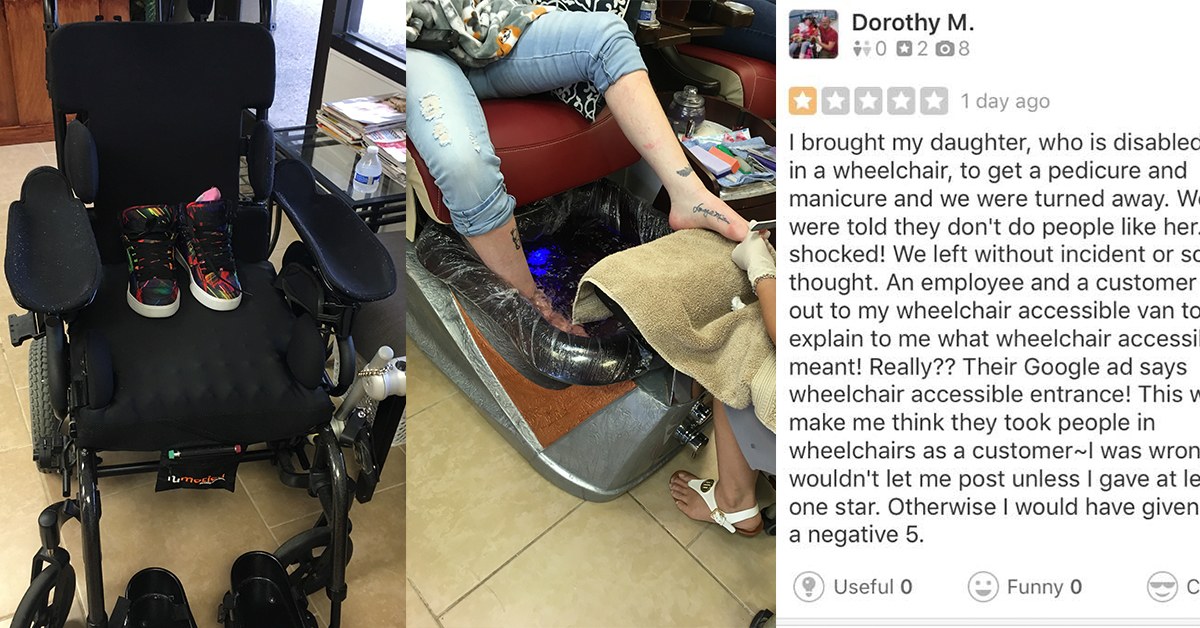
Early last week, a screenshot of a Yelp review for a nail salon started surfacing on Facebook. In the post, a woman from St. Peters, Missouri, a suburb of St. Louis, wrote about the shock and frustration she felt when a salon manager turned her daughter Beth away from getting a pedicure. The reason, Mintner claimed: Because Beth was in a wheelchair.
Like Beth, I live in suburban Missouri, I use a wheelchair, and I enjoy getting my nails done. I also understand that the fairly uneventful experience is uniquely different when you have a disability. It doesn’t change the way kicking back in a massage chair makes you feel—that’s still heaven—but when you’re unsure about how willing a salon will be to accommodate you, something as relaxing as a spa day can be the source of stress and anxiety.
As Dorothy Mintner, Beth’s mother, wrote in her now viral post, “I brought my daughter, who is disabled and in a wheelchair, to get a pedicure and manicure and we were turned away. We were told they don’t do people like her.” She went on to explain that, despite the fact that both she and Beth’s friend offered to help Beth into a pedicure chair, the manager still refused service.
“I said, ‘I’m sorry what?’ Mintner tells Glamour of the situation.” She said, ‘We don’t take people like her,’ to which I asked, ‘What do you mean?'” According to Mintner, the manager, whom she says she had a language barrier with, said they didn’t know “what’s wrong” with Beth and kept repeating that they could not accommodate her. “At that point, I just really needed to leave,” says Mintner. “I was too upset. And you could tell Beth was very upset.”
Mintner says the ordeal was particularly painful because it was her first time taking Beth to get a pedicure in seven years, when Beth was in an accident that left her with a traumatic brain injury. Now, Beth is non-verbal.
The salon manager (who is also part-owner) of Q Nails spoke to local news station KSDK and admitted she denied Beth service due to fear of hurting her. Glamour reached out to the salon manager who, at press time, had not responded to a request for comment for this story.
The issue could also be a violation of Title III of the Americans With Disabilities Act, which prohibits discrimination from “activities” or “places of public accommodations” on the basis of disability. Mintner says she is now taking her case to the Missouri Commission on Human Rights, which can issue penalties against the salon, if they decide to take and rule on the case. According to KSDK, the penalties usually aren’t financial; rather, they could require the salon to re-train its staff or create new business policies.
Here’s the thing: For far too many women with disabilities, this isn’t a rare occurrence. As Beth’s experience was making waves in St. Louis, a similar story surfaced in Burton, Michigan, last week: a woman with cerebral palsy was apparently refused service due to the fact that her condition caused her hands to shake. And in the 11 years I’ve been in a wheelchair, I’ve had countless experiences with salons—for both hair and nails—that made my existence feel like an inconvenience.
“I’ve had nail artists discuss ‘what to do with me’ without actually addressing me. It’s extremely disrespectful.”
I’ve never been straight-up refused service, but that’s always a fear in the back of my mind when I go to a new place. Sometimes workers will talk down to me the way you would with a child. They’ll call me “baby” or “sweetie” when I’m the same age as the friends there with me. Sometimes they try and do my nails as gently and quickly as possible because they feel nervous about getting close to me, which they have to since my arms don’t straighten. I have two rare forms of muscular dystrophy that cause excessive muscle weakness throughout my body, and I need an oxygen tank with a tube in my nose to breathe independently. It’s frustrating because when I see the person doing my nails is obviously uncomfortable, it makes me uncomfortable too.
As the shares from Mintner’s post continued to populate my feed, it’s clear her story resonates with other wheelchair users too.
“I worry that I’ll face inaccessibility or even be turned away because of my disability,” says Evelyn McConmell, 17, who lives in Pennsylvania. McConmell uses a manual wheelchair and also deals with breathing difficulties due to weak chest muscles. She says her fear is rooted in previous negative experiences. “I’ve had many incidents where I actually can’t fit under the tables, since they’re often lower than my chair. I have had to sit rather far away and lean in,” she says. “I’ve also had nail artists discuss ‘what to do with me’ without actually addressing me. It’s extremely disrespectful.” She adds that sometimes she’d just rather do her nails at home to avoid the hassle, but ultimately feels like it’s important to still go out in the world and advocate for other disabled people. “We need to be taken into account,” she says.
That’s not to say every salon experience is abysmal for people in wheelchairs. After Mintner posted her Yelp review, she ended up taking her daughter to a different salon where they were quick to accommodate her. “I’m so glad it made my daughter feel better. It made me feel better,” she says. “We were able to go home [relaxed] instead of thinking about what happened.”
When you have a disability, at least in my case, I don’t want people to feel awkward about asking me how they can be helpful or what they can do to make me more comfortable. What I do have a problem with is when they decide that I can’t do something before even trying to discuss a solution with me. It does, however, make it easier to pick a good salon. If my money isn’t as valued as an able-bodied person’s money for a service, they don’t deserve it.
All it takes for a good experience is for an employee to be empathetic and ask us what they could do to better accommodate us.
Alexis Villa, 23, who lives in California, has struggled over the years to find a salon that can accommodate her needs. She has spinal muscular atrophy or SMA, a progressive muscle-wasting disease that causes her to be in a wheelchair. “I found one lady and I only go back to her,” Villa says. “I’ve gone into my nail salon, asked for her, and when they say she’s not in, I’ll leave. I won’t make an exception. But Liz isn’t afraid of me, won’t over-extend my legs, isn’t afraid of my hands, and will do my brows with tweezers because I’m a princess! I’m only giving her my money and always a good tip for her efforts.”
When you look at a woman with a disability, the first thing that comes to mind probably isn’t, man, it must be really tough to get your nails done. Everyone asks questions like “Do you miss walking?” and “How do you get in and out of bed?” I mean, yes, I miss walking, and I do have to get assistance with what others consider to be basic movements. But the invisible struggles, like the anxiety that a place will turn me away simply because my mobility makes me “difficult” to serve are the hardest to process—especially when it comes to everyday luxuries like getting a pedicure or having my hair cut. The reality that some businesses still see people with disabilities as a burden, not a customer is frustrating. I’m tired of being put into a box that dictates what a person with a disability can and can’t do based on assumptions.
All it takes for a good experience is for an employee to be empathetic and ask us what they could do to better accommodate us. Recognize there’s a difference between empathy and pity, and never be afraid to ask if you don’t know how to meet our needs. Many wheelchair users have a hard time reaching all the way across the table when getting a manicure, and something as small as sitting closer to us and allowing us to be comfortable can fully alter an experience, and make it one we’ll return for. That simple gesture can take away a lot of fear.
People with disabilities make up the single minority that anybody could potentially become a part of at any point in their life.
When I asked my current nail artist—Cierra Sims in Boonville, Missouri, who is absolutely fantastic—she told me most cosmetology schools really only teach you the basics of technical training. “They never actually teach you how to service clients with disabilities,” she says.
The first time I went to Cierra, she asked me how I sit most comfortably. I told her the situation with my arms, and she brought her entire kit up to me so she could do my acrylics on the tray table of my wheelchair. I felt like everybody else in the salon. We spent our time gossiping about the Kardashians and our favorite trends. Now when I go in for an appointment, I don’t even think about the fact that I’m in a wheelchair because it’s not relevant. I’m just another paying customer.
You might be reading this as an able-bodied person thinking, “How can I do anything to help?” Recognize that people with disabilities make up the single minority that anybody could potentially become a part of at any point in their life. Seven years ago, before her accident, Beth walked into any salon she chose. She should be able to roll into any salon she wants to now.