Categories
Health

Watch Out, Tinder: The Singles Mixer Is Back


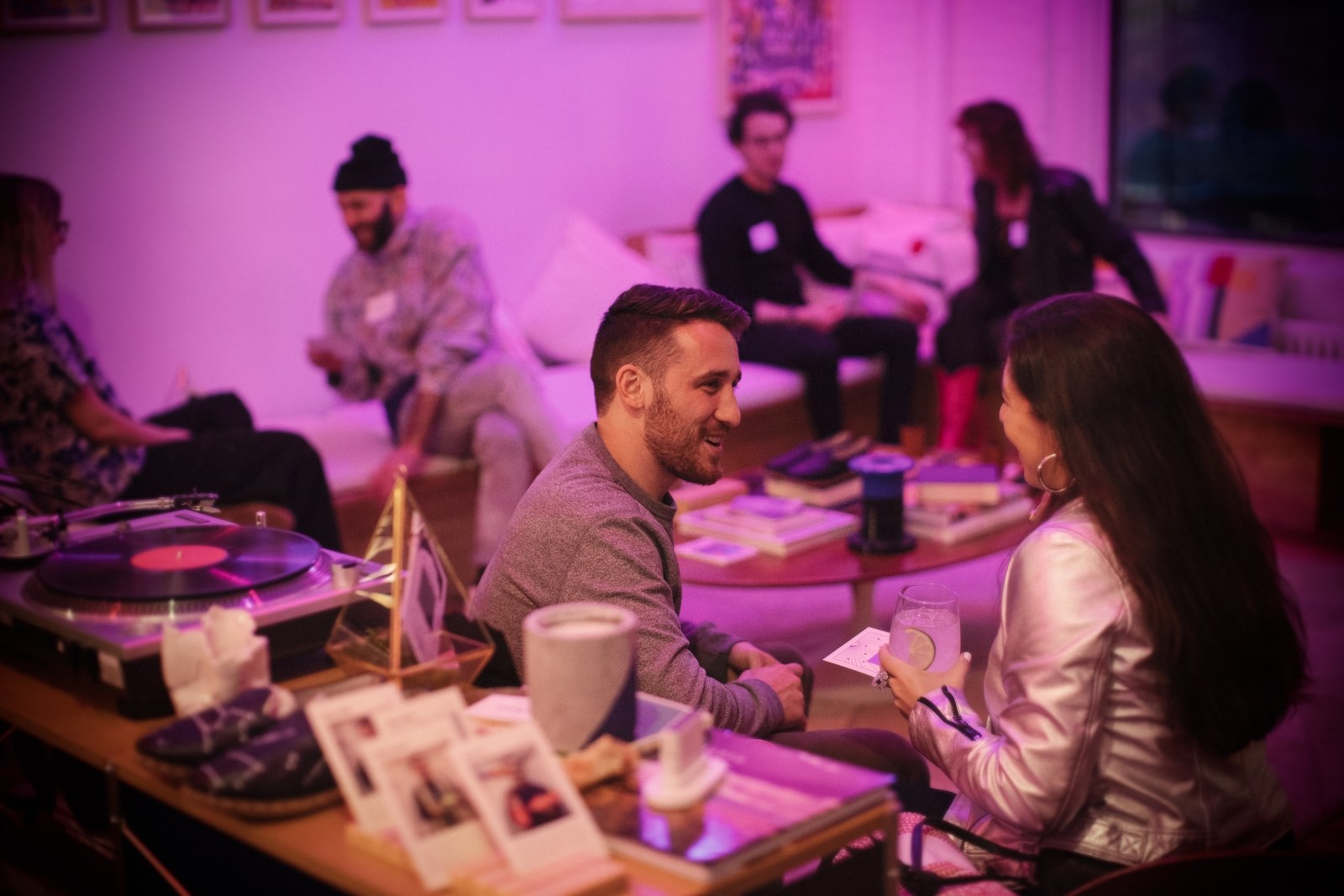
Last October I attended a singles mixer. No one forced me. Not the rabbi at the local temple. Not a well-intentioned grandmother or an overzealous friend. I went because it seemed…cool.

When my invitation arrived—in the form of a millennial-pink Paperless Post—the event was described as a night out for “beautiful people,” aged 27 to 42. A friend-of-a-friend who’d tipped me off to it also promised there would be snacks—sliders, grilled cheeses, premium finger food. So I decided I could take a night off from my busy schedule of watching Friday Night Lights while aimlessly scrolling Bumble, searching for my own Tim Riggins.

The mixer took place in a private room of a hip bar and the rosé was bottomless. An hour and a half in, and about three glasses of wine deep, I stumbled upon a VC bro on crutches and was convinced I was having a true meet-cute. We met at the bar after I almost stepped on his on cast and spent the night talking about his college baseball career, as I rambled on about the Red Sox and deep love for the film Fever Pitch.

At the end of the night I gave him my number, but he never called. (He also hated the Sox, so it never could have worked.) But for Tali Mishael, the mixer was a total success. Mishael, 33, works in branded content and had been on the New York scene long enough to feel, as she put it, “jaded.” When she accepted the invitation, she didn’t expect much. But once she got there, she was surprisingly into it. “When you meet someone on an app, typically within three minutes of the date, you know if you’re into each other. But nobody’s going to be like, ‘I gotta go, I’m not gonna waste my time or money,'” she says. “But at the mixer you could talk to someone for 10 minutes, quickly assess, and leave the conversation. Everyone talks about how the apps are a numbers game, but I really think the numbers game is a room of like-minded people.” Mishael also reveled in the “survival of the fittest” vibe in the room and the fact that there were no pretenses. If you approached someone, it was for one simple reason: You were single and ready to mingle.

Singles in the middle of a round of speed dating at Perchance.

Courtesy of Perchance

So when Mishael saw a tall, dark real-estate developer from across the room—talking to another girl—she knew she had to make her move. At one point, another friend of hers tried to come over and get in on the action (anything goes!) to no avail. “You know the rule that you’re not supposed to talk about politics, religion, or sex? Well, we talked politics for the first hour, so we clearly didn’t adhere to that,” says Mishael. The two exchanged numbers, started texting, and six months later, decided to move in together. “Meeting like we did heightened the stakes. It was a huge advantage in getting to know each other quicker,” she says.

Tali Mishael and boyfriend in Israel

Tali Mishael, with her boyfriend in Israel, where they traveled for Passover to meet her family.

Courtesy of Tali Mishael

As the events become more and more popular, the range of people interested in them grows, too. Babetown is a pop-up dinner for queer and trans women and non-binary people that invites guests to come together and make meaningful connections—romantic or otherwise. Founded by Alex Koones, a 29-year-old chef, the series takes place in a different location each month, with a new, kitschy theme. (Think: a Harry Potter movie marathon at which “Snape’s magically refilling platter of breakfast sandwiches” were served or a Babetown wedding complete with a MilkBar cake.) When Tara Chee, 34, who works at a non-profit in New York, decided to check out the event, it was a BBQ theme, and the group was grilling up a feast outside. Chee soon found herself in a conversation with a woman named Rachel, who was working at Rikers Island at the time. “I joke that Rachel and I bonded over the Prison Industrial Complex,” says Chee. “She started talking to me, and I thought she seemed like a wonderful person, and we connected over our work.” For their first date, the two had dinner and wandered through Washington Square Park. They’ve been together since.


Source link

Categories
Health

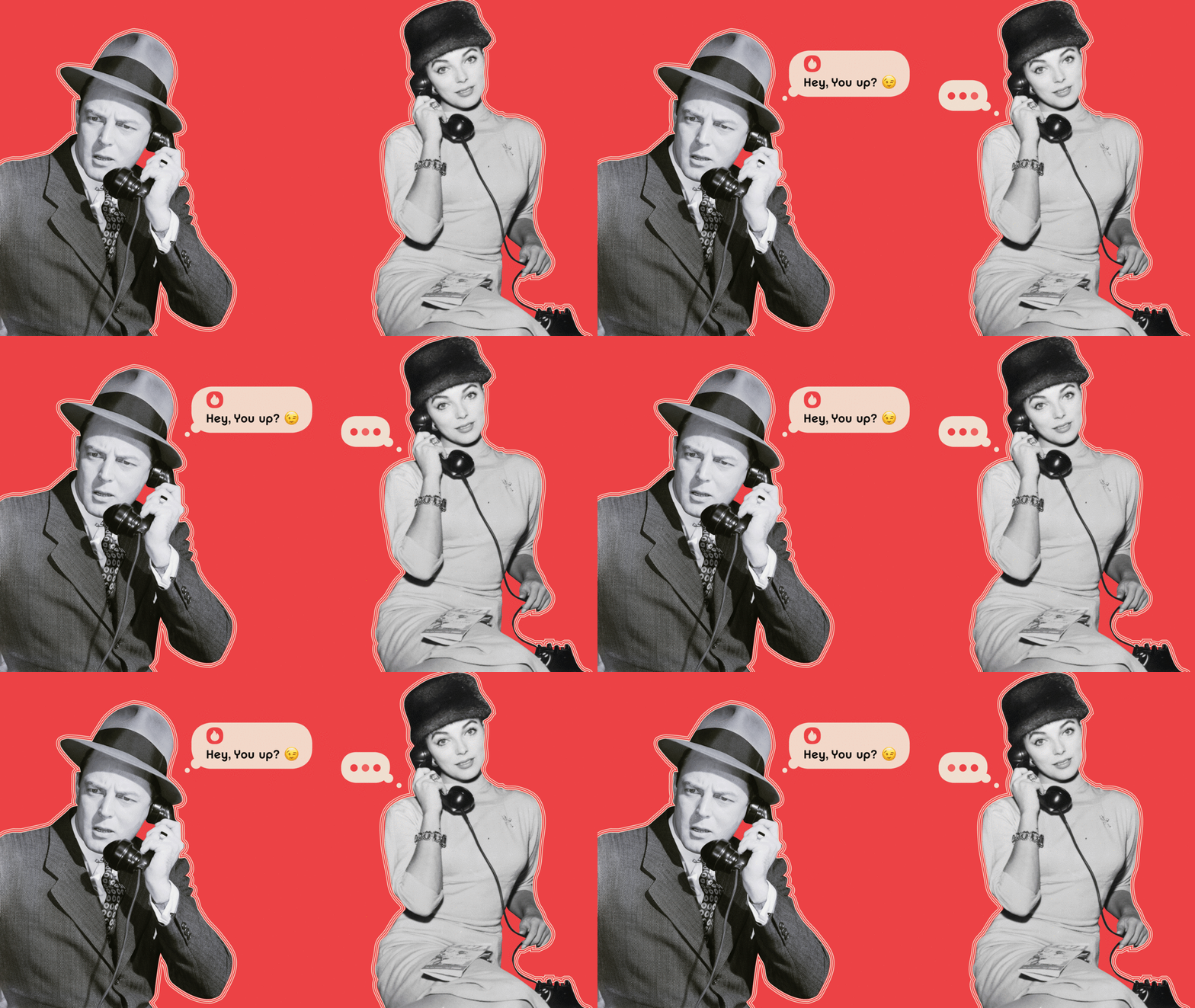
How Tinder Killed the Crush – Ode to the Crush


Your first crush is a rite of passage. The fixations that follow it are just life. Nervous, awkward, sublime. Disasturous. Transcendent. Here, we celebrate infatuations, obsessions, and passions in all their exquisite splendor. Meet our “It’s Just a Little Crush” series. Isn’t she divine?

I’ve decided to delete Tinder from my phone again, again.

To do it I have to hold down the icon of the app, then tap the little X to get it off my iPhone. Like all apps, the square does a little wiggle when the X pops up. The animation is more or less innocuous, but when it comes to Tinder that little wiggle is a taunt. You’ll be back, wiggle wiggle, I won’t stay gone for long, wiggle wiggle, you’ll get lonely and want to see if you can find someone who’s wiggle “fluent in sarcasm” wiggle.

For about five years, my relationship with Tinder has been more on-and-off than any of my (several) less-than-stable romantic relationships. But then, romantic relationships take discipline and commitment and time. The better metaphor for Tinder is addiction. Tinder is accessible when I’m at my lowest and gives me a temporary burst of dopamine and distraction, but never more.

And like an addiction, it’s robbed me of at least one of life’s purest pleasures. A million people and articles can explain how Tinder has ruined courtship—and even hook-up culture. But its truest victim is the single element that makes flirtation fun. Tinder killed the crush.

You might think that Tinder would be a crush paradise. After all, crushes are all about instinctual attraction, and what’s more instinctual than evaluating someone’s picture and swiping left or right based on your gut reaction (plus, learning they’re 6’1”, INTJ, and, from the looks of their picture, were once were on a boat). Tinder should fulfill the smartphone promise, making our lives quicker and easier. I’m able to order a pizza and ride in a stranger’s car at the touch of a button. When I’m lonely and bored, I should be able to materialize a crush—someone to joyfully obsess over with all of the hope of someone who thinks she’s found The One.

But see, that smartphone modus operandi (speed! convenience!) runs counter to how human connection works.

Part of the problem is after swiping on Tinder for a few hours (let alone days or weeks), potential partners become almost interchangeable. To the shrewd, practiced swiper, a mere glance at a profile picture is enough to know whether that person merits a right or left swipe. Glasses, right. Dog, right. Fish, left. Mirror selfie, left. Red hat, left. Even when you’re intrigued enough to click for more information on someone, everyone blurs together into a single amorphous Jim looking for his Pam. Far from being fun, early “getting to know each other” conversations quickly become a chore. Our attraction to a person in the real world is based on their smell, the sound of their voice, the things they laugh at. On Tinder, people are just cardboard cutouts. Every time I succumb to it, I find myself using the same trite questions and giving the same trite answers. It’s rare that I ever give someone my phone number to propel the conversation to text. It was even rarer to feel a connection so undeniable that it’s propelled us into the real world. It’s hard to get butterflies about someone who’s just a two-dimensional face in your screen, one of 25 guys saying “hey, how’s ur weekend looking?”

Now a crush. A crush is magnificent. After the “we’re comfortable enough to finally just wear pajamas and order in” stage, it’s the best part of a relationship, when each text notification sends a shiver of excitement through your entire body and you post selfies to your Instagram story just to see if they’ll see them. Yes, it’s also a stage of paranoia (who is that girl in that Facebook picture from 2011???) and misery in the minutes waiting for the response to a risky text, but that exquisite pain just heightens the euphoria when he does text back and when you find out that girl from 2011 was actually just his sister all along.

The one time I ever remember feeling something akin to a crush on someone I saw on an app, it was because I recognized him from Twitter. Without external context, he would have been completely inscrutable. In all likelihood if I hadn’t known he was hilarious and liked the same movies I did from his tweets, I would have swiped left. (Although, in all fairness, maybe I should have. We went out for three months then he dumped me via text.)

Tinder is transactional and gamified. The swipe is a slot machine. It entices you to go for one more swipe and then one more—just to see what else is out there. But no one can match up against the prospect of all the other single people in the world—plus the ones who exist in your imagination. It’s the same mentality that keeps people glued to the slots in Vegas casinos: The next swipe could be the jackpot!

But perhaps the biggest problem with Tinder is also how it sold itself to us: You only match with people whom you know are interested in you. (Or at least interested enough.)

The pleasure of the crush is in how it starts, the uncertainty of it. A crush is a challenge—and a terrifying risk. The not-knowing part, the time when you have no idea how the other person feels about you is about 80 percent of the sensation we describe as butterflies.

It’s exhilarating, miserable, torturous, and ecstatic, the stuff of sending a flirty text that you outsourced to your entire group chat. That tension doesn’t exist on Tinder—where you only end up in conversation with someone once you’ve established mutual attraction. That other person at least wants to meet up, if only just to hook up. And that happens after you’ve waded through throngs of fuckboys and randos.

If you’re looking to meet someone in real life but still want the expediency of the internet, I recommend a good, old-fashioned Twitter DM slide. A little audacious! Full of anticipation! But same rule applies for bathroom mirror selfies: If that’s their profile pic, metaphorically swipe left.

Dana Schwartz is the author of the memoir Choose Your Own Disaster. Follow her on Twitter @DanaSchwartzzz.


Source link