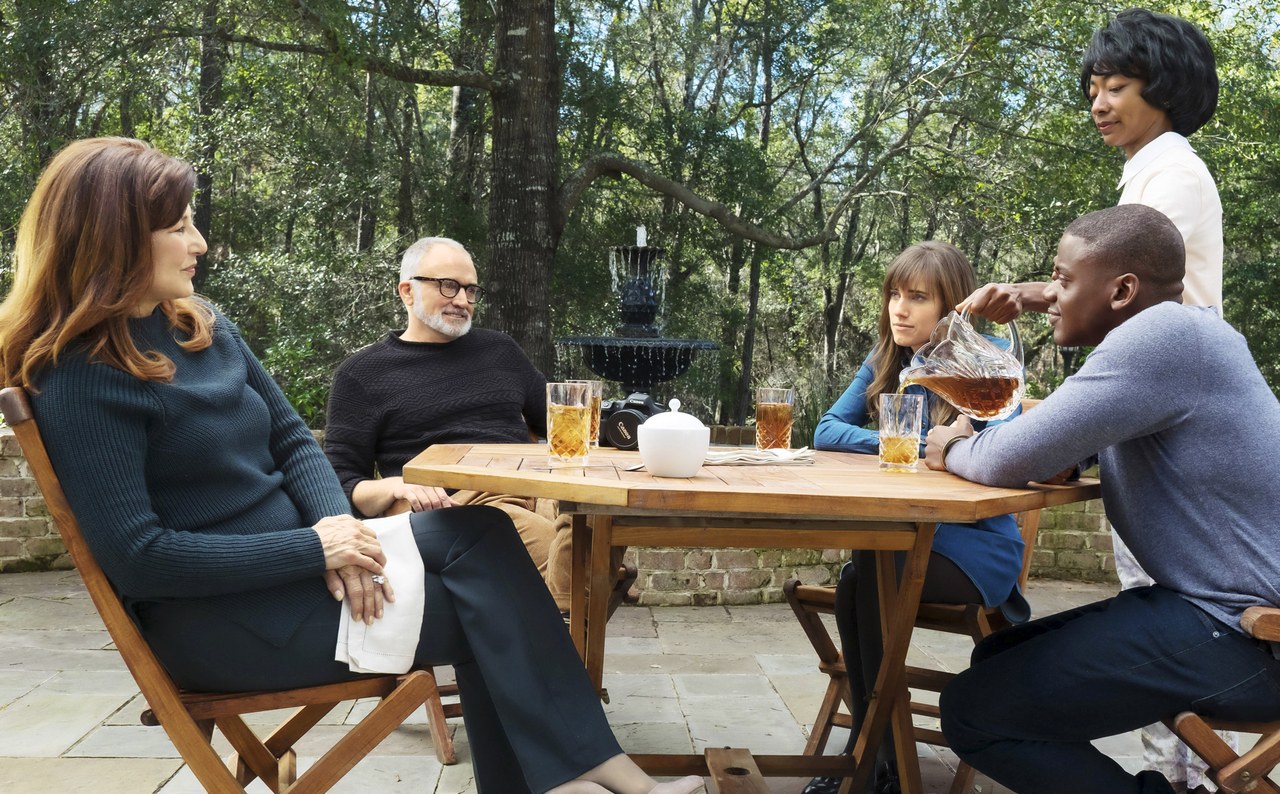
Here we were, eight months after our first date, driving to my boyfriend’s family’s country house for a weeklong visit. We were like the interracial couple in Get Out: I was a young black woman, riding in my boyfriend’s Prius to one of the whitest states in America, not knowing what to expect. I had read countless articles on dating across racial lines, and many more about class, but not much is out there about the intersection of the two. I was nervous about meeting his family for the first time, but as a woman of color with middle-class roots, I also worried how I would fit in with folks who were not just white but upper-class with Harvard Ph.D.s.
I imagined being alone in the dark woods of Maine with limited Wi-Fi service, surrounded by stacks of old New Yorkers and well-off, liberal white folk who probably could recite more of the latest Ta-Nehisi Coates book than I could. My career as a journalist covering politics and policy had given me a glimpse into this upper-crust world, but that wasn’t the same as dating into it. As we passed signs for Kennebunkport, where the Bush family has their summer homes, I wondered whether I would somehow end up in the “sunken place” or, more likely, a place that felt just as lonely, isolated, and distant.
PHOTO: Universal/Courtesy Everett Collection
“I recognized the similarities” to Get Out, Allen writes of meeting her boyfriend’s family for the first time.
When I first met Peter through a dating app, I didn’t know anything about his background. What attracted me was how similar we seemed: He had a graduate degree, a commitment to social justice, liberal parents who never married, and chronic lateness issues, just like me. We had a good first date at a random Irish pub in midtown Manhattan, until he took me up on my less-than-sincere offer to split the bill. I wondered whether or not to go out with him again (I’m a modern woman, but I still believe that if a man asks you out on a first date, he should pay). In the end, I decided it made zero sense to penalize someone for being broke, which I convinced myself Peter was. He was a public school teacher who lived in the Bronx. He talked about Marxism and socialism and believed in a revolution for the working class.
I must have been blinded by love, because as we continued dating I missed all the obvious signs that pointed to his wealth. I thought nothing of Peter’s debt-free Ivy League degree. His apartment was in the South Bronx (a changing neighborhood in the poorest borough of New York City), but it had 14-foot ceilings and views of the Manhattan skyline.
Peter and I talked a lot about race—it was hard not to. Black Lives Matter dominated the headlines; a certain presidential candidate ranted about Mexican rapists coming to America; and white supremacy and Nazism, ideas I thought had forever fallen out of favor, began to rise, even among millennials. I told Peter of my ambivalence about dating across racial lines when the country was so polarized. I explained my worry about somehow abandoning my race by dating him, my desire for chocolate-brown babies, and my fear that I couldn’t write about issues in the black community with someone white on my arm. I was honest with him about my concern about being a fetish or some sort of rebellion against his parents. And we still managed to fall in love, bonding over our love of political debate, obsession with used Toyota Priuses, and affinity for cooking homemade dinners. Our talks about race were often uncomfortable, but we seemed to be having all the conversations that “woke” young people were supposed to have to make sure we didn’t repeat the mistakes of generations past.
“I’d had a glimpse into this upper-crust world, but that wasn’t the same as dating into it.”
Then one day, after six months of dating, I started to Google-map the directions from Peter’s apartment to a friend’s place in Brooklyn but couldn’t remember his exact address. I knew the name of his building, though, and my Google search pulled up an article about the apartment next door to my boyfriend’s, which was for sale. The headline said it was the most expensive apartment in the neighborhood—nearly a million dollars—and it was clear from the pictures it wasn’t even as nice as Peter’s. My mouth dropped open. For the first time I realized that my sweet, socially conscious activist boyfriend was rich. I asked Peter about it, and he explained that he wasn’t exactly rich, but his family had some money and helped him get the apartment and live above the means of an average teacher. I felt betrayed. Angry. I didn’t even know at what or whom. But it stung.
Because class is not as immediately obvious as race, it is often harder to talk about, says Jessi Streib, Ph.D., a sociologist who studies class at Duke University. “People are like, ‘Well, we both went to college. We have jobs. Why would it matter what class we grew up in?’ ” she says. That was true for me and Peter. I’d told him that I grew up middle-class, went to college, and owned a home—often superficial signs of having “made it”—and he’d said the same of his background. I didn’t pry any further, and he never disclosed anything that would make me assume otherwise.
I had dated white men before, and while I couldn’t relate to their racial privilege, most of them had struggled financially, and we had that common thread to at least superficially unite us. But with Peter things weren’t the same. After I found out about his financial status, I felt that I couldn’t relate at all. He knew nothing about the stress of choosing a college because of cost, or what it was like to be maxed out on credit cards and denied for loans. And while I remained blissfully in love, I worried about how these differences would impact our lives.
I stumbled through many of these initial conversations about class with Peter. I got mad at him, mad at America, mad at seeing what it meant to be a young, white, rich man in this country. Sometimes I couldn’t tell whether he was benefiting from his race or his class—or both. I became hyperaware of how it all impacted Peter’s world. There was that illegal turn no one pulled him over for, the lawyers he could hire to help him out of a jam, the stocks he could cash in if he ever lost his job. And although I sometimes forget about his privilege because he can be hilariously cheap (the bumper on his 13-year-old car is held together with tape), there are other, subtle traits that reveal the advantages he has had: the confident bass in his voice when he talks to police; his freedom to move to any new neighborhood he wants, just to get a bigger and nicer apartment. He walks through the world as if no one has ever told him no (and he confirms they haven’t), whereas I walk through the world like no one has ever told me yes (and many times they haven’t). Sometimes it all makes me want to scream.
And some days I do. We’ve had it out because one of his elite peers asked whether my mom and I were “well traveled,” clearly implying that we’d been too poor or uneducated to leave New York, while Peter stood by and said nothing. Then there was also the time he started “helping” me cook dinner, and took over the stove and told me how to grill the shrimp. It led to a three-hour fight about how white men with power are always telling women—especially women of color—what to do and taking up all the air in the room.
Our fights may seem petty, and some would say they’re not even technically about race and class (a friend pointed out that the shrimp fight was probably about gender), but they were always about who has power in our society and who doesn’t, things that are important to me to hash out. And slowly we began to do just that. Our fights turned into deeper conversations about our pasts and feelings. We didn’t just do things like go to the Museum of African American History in Washington, D.C. (though, yes, we did that), but we began to have the really tough discussions about how class impacted his life and privileged him, about what a true ally looks like. For him, I think it meant things like taking a back seat at meetings, learning how to speak up for marginalized folks when necessary, fostering deep relationships with a diverse range of people. And for me, it meant dealing with my own class privileges while also trying to openly and honestly articulate my frustrations and feelings.
We still don’t have all the answers. As I was writing this piece, a white acquaintance of his used the N-word in front of me. I was outraged. Peter said he didn’t hear it but then immediately asked if I wanted him to speak to his friend. It felt to me like we were making progress.
Speaking of progress: Later this year I will move to the South Bronx to live with Peter. I love him more than anything in the world, but I recognize I’ll be living in an expensive loft apartment, funded in part by his family money, in a building that used to be a factory—the type of place where my grandparents once might have worked in the same Bronx community as far back as the 1940s. I constantly feel guilty about it.
I loved my childhood in New Jersey, but I often wonder if my family—had they been allowed to accumulate the same wealth as Peter’s, or been given middle- and upper-income jobs instead of struggling away under Jim Crow segregation laws—would have stayed in the Bronx and lived in the penthouse apartment. If law enforcement didn’t constantly chastise black people, would we have that same confident bass in our voices when a policeman approaches? Would my dreams have been different?
“Our fights may seem petty, but they were always about who has power in our society and who doesn’t.”
As someone who believes in a more equitable world, I wrestle with what my presence in a place like this will mean. I never envisioned any Disney fairy-tale-princess-like life, and this certainly isn’t that, but I have to admit that I am benefiting from Peter’s privilege. He has helped me hail cabs (drivers have come under fire for illegally refusing to pick up people of color), uses his account to rent Airbnbs when we travel (some renters discriminate based on race), talked to police when I needed to file a report after a car accident.
I feel icky about all of this, like, “Do I need some white dude taking care of me?” I turned down his offer to give me a loan, not because I didn’t need it but because it challenged that whole independent-woman idea I was taught to embrace while growing up. I wasn’t Cinderella. I didn’t need Peter to get me out of some so-called hood—I was living in my second home (which I own) in the New Jersey suburbs! But this relationship has made me question what exactly people like Peter are supposed to do with their privilege. One time, soon after I found out about the cost of his home, I asked why he couldn’t buy a more modest apartment and use his remaining funds to start a community nonprofit. But I’m not really sure what the answer is.
LaDawn Black, a relationship expert based in Baltimore, says that while unions bridging race and class often present problems, those aren’t insurmountable. “Initially you’re trying to figure out the race thing, but then you step into a bigger pool of ‘the way I was raised versus the way you were raised. So how do we live? How we do vacation? How do we educate our children?’ If success looks a certain way for you but it looks totally different for your partner, you need communication on a higher scale,” she says. Being able to talk to each other about these issues is key, says Black, as is having a supportive partner who validates your feelings, loves who you are, and can help you understand their world and family. So too is accepting that you’ll both make mistakes and have misunderstandings. It’s also imperative to recognize that both parties bring value to the relationship. “A lot of times we obsess over stepping into what we consider the better world,” she says. “Don’t be so concerned about preparing for that world that you forget the fact that your world is pretty fascinating too.”
Riding up to the Maine country house that first time, my real fear was not whether I would connect with my boyfriend’s family, but that they would be judging me. Thanks in no small part to my strong relationship with Peter, his family welcomed me with open arms. I didn’t end up in the sunken place or feel alone (there were, however, a few New Yorkers lying around). I know couples who’ve dealt with similar divides who say that once they fell in love, all of these worries disappeared. That hasn’t been the case for me, but it’s also led Peter and me to work harder to talk about these issues. Through it all, we’ve stopped pretending our differences don’t matter—instead we’ve learned how to understand them and appreciate them.
Reniqua Allen is an Eisner Fellow at the Nation Institute. Her book, It Was All a Dream, about black millennials and success, will be out in January.
This story is featured in the September 2018 issue of Glamour. Lead image: Getty Images, Art by Sarah Olin