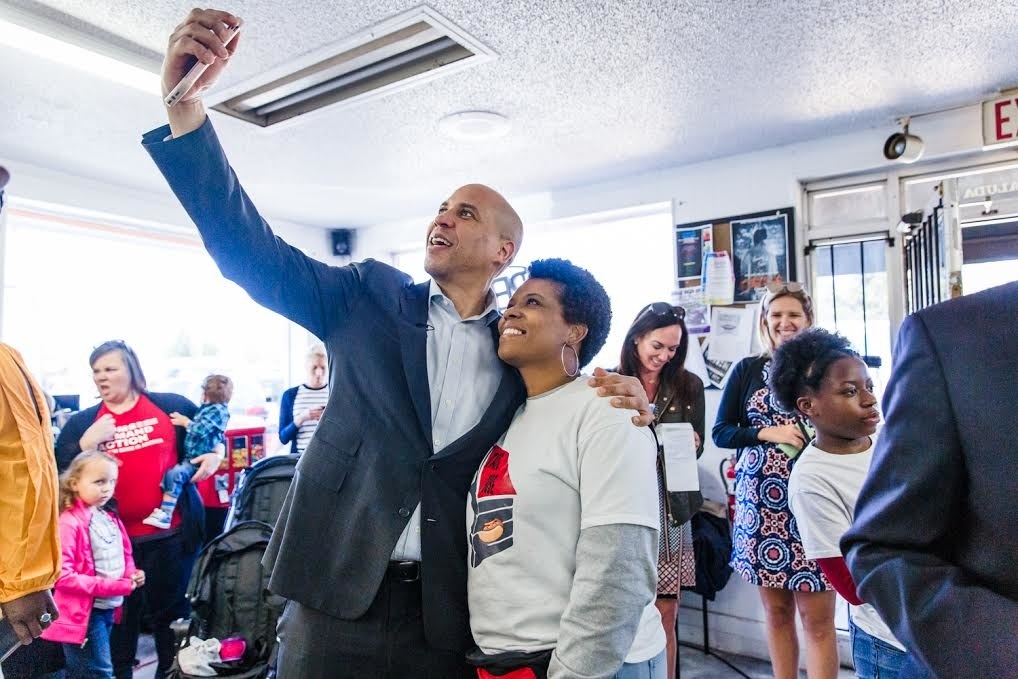
Julie McClain Downey, director of state communications for Senator Cory Booker’s presidential campaign, settled into the couch in her Washington, DC apartment last June—holding her newborn daughter with her left hand, and scrolling through TweetDeck with her right. Technically, she was still on the 12-week, gender-blind paid leave available to all of the campaign’s full-time staffers. But she wasn’t going to miss Booker’s first major televised debate of the election cycle, one that in other circumstances—when she wasn’t in the throes of diaper changes and feedings—she would have watched from campaign headquarters. And so with the baby swing pulled up next to the sofa, she and her husband (also a Booker campaign staffer, also on paid leave) sat in the glow of the TV, cozy in their sweats. “We were like, What is our life?,” says McClain Downey. “It’s so different now.”
It’s so different now could as easily describe the shifting demographics on presidential campaigns this election cycle, where for the first time in history, women dominate high-level positions. Almost a year after a record number of women won elected offices throughout the country (buoyed by female voters), there seems to be an understanding among presidential hopefuls that if you want to win, you better have women on your side—and on your staff. Of the 12 candidates who qualified for the October 15 debate, a third have female campaign managers; women hold more than half of senior leadership roles across the Democratic primary field; and multiple campaigns have teams that are at least 60 percent women.
“When I first started, I think I can remember three or four women who were leaders on campaigns,” says Beto O’Rourke’s campaign manager Jennifer O’Malley Dillon, who has worked on every presidential race for the last 20 years. “You knew who they were because there were so few of them.”
Almost eight years ago, when O’Malley Dillon was deputy campaign manager for President Barack Obama’s re-election bid, she approached older female colleagues about what it might be like to do this work with young children. “I was at that point like five years into my marriage, I was 35, contemplating kids, trying to decide, Can I do this campaign if I’m even thinking about kids? And I had women say to me, not in any other way than just to be supportive, ‘Absolutely no, you can’t do this with a kid,’…or ‘Sure, you can try that, but don’t tell anyone you might get pregnant.’” O’Malley Dillon went ahead with her plans to start a family anyway—soon learning she was pregnant with twins—but she was an outlier. “I really felt like I was a unicorn [working the 2012 race while pregnant],” she says. “People were looking at me like I was crazy.”
That’s hardly the case this election cycle, where multiple women are vying for the Democratic nomination and women have filled key campaign positions for more than a dozen candidates. Already, this increase in women’s representation behind the scenes has had an impact on campaign culture—and understandably so. It would be hypocritical for any candidate to talk about the need for better leave policies or equal pay on the debate stage, but not offer them to his or her staff. And so this has also pushed campaigns to become better workplaces. The difference from what O’Malley Dillon went through just seven years ago to what McClain Downey experienced this year is stark: McClain Downey not only interviewed for her position on Booker’s campaign while very visibly pregnant, she asked during the interview process what the paid leave policy would be before accepting the role.
Julie McClain Downey, back right, joined Senator Cory Booker’s presidential campaign while visibly pregnant.
Everyone who’s heard of a little brand called Fenty Beauty and its 40 shades of foundation knows that the beauty business is changing. It took years of women staunchly advocating for themselves and celebrating every milestone along the way, but we’re proud to say the beauty industry has made progress—even if there is still room for vast improvement.
This year followed the momentum set forward in 2017, resulting in beauty campaigns that were more inclusive, more inspiring, and less singular in what “beautiful” constitutes. A few of our favorite game-changing moments managed to celebrate people of all ages, sizes, and so-called “flaws” like acne and body hair. In a perfect world, these campaigns would be the norm. But until then, let’s give one more shout out to beauty campaigns that raised the bar in 2018. CEOs and marketing managers, if you’re reading, here are the groundbreaking campaigns to beat in 2019.
CVS Went Photoshop-Free
Back in January, CVS announced that it would no longer use digitally-altered images in its beauty advertising. The brand created the CVS Beauty Mark, a watermark that announces to customers that an image hasn’t been edited. The company pledged to no longer change or enhance “a person’s shape, size, proportion, skin or eye color, wrinkles or any other individual characteristics.” Watermarked products bearing the beauty mark logo and the phrase “Beauty Unaltered” hit CVS shelves this year. CVS is also reportedly working towards developing retouching guidelines for the drugstore beauty brands it carries, with the goal of transparency in advertising by 2020.
Billie Showed Off Body Hair
It’s hard to believe, but this year, razor start-up Billie became the first razor company to show body hair in its advertisements. Called Project Body Hair, the campaign proudly starred pubes, lip hair, and happy trails. “Shaving is a personal choice, and no one should be telling women what to do with their hair,” Billie cofounder Georgina Gooley told Glamour. “The fact is, we all have body hair. Some of us choose to remove it, and some of us choose to wear it proudly—and either way, we shouldn’t have to apologize for our choice.”
Billie doubled sales in the week that Project Body Hair launched and completely sold out of product. (Don’t worry, they’ve long since been back in stock.) Some customers appreciated the inclusivity while others confessed that no matter how splashy the advertising, they just don’t think too much about which razor they buy. Either way, we’re grateful that Billie helped us acknowledge that what you do with your body hair is purely personal.
Revlon x Ashley Graham
Ashley Graham has been pounding on the door of the beauty industry, and for years, no one listened. “In the past I’ve been been told things like, ‘Well, you’re only plus-size from your neck down; your face isn’t plus-size,'” she told Glamour. “What does that even mean? If my face isn’t ‘plus-size,’ then by that logic, why wouldn’t you put me in a cosmetics campaign?” Finally—after years of the industry ignoring plus-size women—Revlon had the good sense to cast Graham as the face of their “Live Boldly” campaign, a meaningful move for Graham and the women she’s been begging to represent for years. “At the end of the day, I hope people understand how groundbreaking this is—that Revlon now has a curve model with a contract on their campaign,” said Graham at the time. “This should be the norm. I’m really hoping and striving that in the next 10 years we don’t even have to discuss this. Beauty is beyond size.”
KKW Body
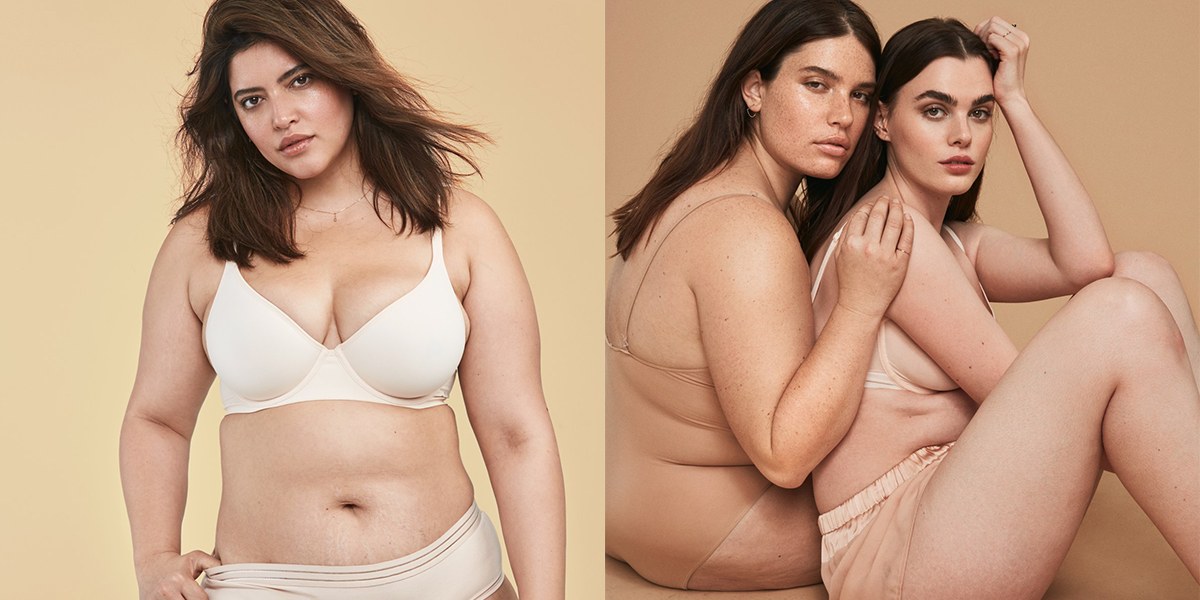
When Kim Kardashian West modeled the bottle of her first KKW Body fragrance on her own famous figure, critics were frustrated with its seeming endorsement of unrealistic beauty ideals. Amidst the backlash, one body-positive blogger even re-created the campaign to prove that there’s no real definition of a “perfect” body. But the conversation didn’t end there. Kardashian launched two new body fragrances, KKW II and KKW III, with a campaign that managed to celebrate bodies of all sizes.
The photos featured plus-size women, posed in the same nude, suggestive way as Kim (and her perfume bottle). Kardashian’s growth is exactly what we hope to see more of next year and beyond: She listened to the critics, she grew, and made the choice to be more inclusive. “I was talking to some friends of mine, and I had seen a couple other people re-create the [original KKW Body] campaign and I just thought, You know what? It’s not always about my body,” she told Refinery29. “The bottle obviously is my body shape, but I always celebrate and love confident women no matter what shape or size they are.”
Babor x All Woman Project
[embedded content]
Beauty giants aren’t the only ones making changes. Skincare brand Babor also ditched the airbrushed images this year to huge fanfare across the industry. In partnership with the All Woman Project, the company tapped non-traditional models and committed to publishing the photos without any editing. The campaign included 57-year-old model Nicola Griffin, international activist Nykhor-Nyakueinyang Paul, and former Glamour editor Lauren Chan. We can never use too many reminders that people of all ages, races, professions and sizes are beautiful, and Babor’s pared-down photos did just that. The campaign (and the accolades it gathered) helped set the tone for the future of beauty, and are working to inspire brands of all sizes to follow suit.
Isabella Rossellini Returns to Lancôme
In her late 20s, Isabella Rossellini signed a contract with Lancôme that made her the highest paid model in the world. She spent 18 years as the face of the brand, until, at age 42, she was told that she was no longer “aspirational” and let go. Even back in 1996, the break made headlines. But plenty has changed in the past few decades—including the fact that the General Manager of Lancôme International, Françoise Lehmann, is a woman.
This year, she approached Rossellini about returning to the brand. “[Lehmann] told me she wanted to be inclusive and not just portray women as beautiful when they’re young and thin with blond hair and blue eyes,” Rossellini told Glamour. “She wanted [the brand] to be an instrument of finding elegance and glamour, rather than dictating to women what they should be.” Rossellini said yes, and at age 66, she’s once again starring in a beauty campaign. The campaign is a reminder that beauty and youth aren’t synonymous, and as Rossellini notes, her fellow spokesmodels like Kate Winslet, Julia Roberts, and Penelope Cruz are also symbols of power. “Not only are these women incredibly beautiful, but they certainly speak up.”
The First CoverGirl With Vitiligo
[embedded content]
The definition of “CoverGirl” has evolved immensely in the past few years. In 2017, the brand welcomed 69-year-old Maye Musk into its family, along with Issa Rae (of HBO’s Insecure), chef Ayesha Curry, fitness trainer Massy Arias, and motorcycle racer Shelina Moreda. The women embodied the brand’s new, more powerful motto: I Am What I Make Up.
In 2018, CoverGirl continued to push past stale definitions of beauty, starting by teaming up with Amy Deanna, a Texan model with vitiligo. Instead of using foundation to cover up or even out Deanna’s skin tone, the advertisements used TruBlend Foundation to enhance her tone differences. “Amy’s skin happens to have variations in tone, and it’s equally as beautiful as the skin we’re used to seeing in beauty ads. It’s about flipping the script on the one-dimensional standard of beauty,” said CoverGirl’s senior vice president Ukonwa Ojo. In a year when Winnie Harlow walked the Victoria’s Secret runway, vitiligo is seeing more representation than ever.
Secret Tackles the Pay Gap
[embedded content]
Secret Deodorant took on both the gender pay disparity and the nuanced conversation about what exactly constitutes “women’s empowerment” with a music video that centered on the simple refrain: “I’d rather get paid.” Aside from its crazy-catchy melody, the video tackles the issue of power and taking back what we’re owed. Sample lyrics: “I see so many lovely gestures telling women ‘we’re strong,’ but paying us a fair wage is what we’ve wanted all along.” As part of the campaign, Secret teamed up with advocacy group Ladies Get Paid to develop a toolkit that educates women about their rights in the workplace.
Suave Gets Real
[embedded content]
“Shampoo commercial hair” is a windswept, idealized hairstyle we can all picture that pretty much none of us can re-create. In a series of commercials, Suave let customers behind the scenes of what it actually takes to get that hair. For the brand’s Hair You Can Believe campaign, Suave spotlighted the over-the-top ways that marketers create “perfect hair,” like hiding styrofoam balls underneath those lustrous waves to create volume or hiring people to stand in green-screen bodysuits to help a model’s hair flow in the studio’s fake wind. “Everyone just wants to see people in haircare ads that they can relate to,” hairstylist and Unilever expert Ursula Stephen told Glamour. “We all want to feel represented and have products available to cater to our specific needs.” The commercial went viral, and women everywhere heaved a sigh of relief and put down their blowdryers.
Calvin Klein Women Went Bare-Faced
[embedded content]
With the name “Women,” Calvin Klein’s new fragrance could have gone in a few directions. The clichéd campaign would probably have involved moody music, a woman slowly diving into a pool in an evening gown, and a whole lot of roses. But instead, creative director Raf Simons cast powerhouses Lupita Nyong’o and Saoirse Ronan as the face of “Women” and highlighted their career successes in a series of portraits that sits them among photos of Earth Kitt, Katharine Hepburn, Sissy Spacek, and Nina Simone, the women who inspired them. “Calvin Klein Women is inspired by the transmission of strength and inspiration from one woman to the next; by plurality combined with individuality; freedom of expression; and the notion that the collective is as vital as the individual,” Simons said in a statement. Instead of that cliché pool dive, the campaign videos showcase these two brilliant actors speaking to one another about craft. Not only that, the two were also shot bare-faced. Stunning.