Categories
Health

2 hops times 4 jumps in class equals better grades

Adding jumping jacks and running on the spot to math and language classes helps students to learn, say Dutch researchers, adding to findings on the benefits of physically active lessons.  

In Wednesday’s issue of the journal Pediatrics, researchers compared standardized math and spelling test scores for 499 children who were randomly assigned to physically active math and language lessons or regular instructions for two years.

The students in the physically active group were four months ahead of the others in their spelling and math achievement, Marijke Mullender-Wijnsma of the Center for Human Movement Sciences at the University Medical Center Groningen and her co-authors found.

Students were age eight on average.

Those in the physically active group jumped in place for 10 to 15 minutes while reciting times tables or spelling words.

During the remainder of the 30-minute lessons, the children did basic movements.

“We saw that it really worked, of course — we were very enthusiastic about it and a little bit surprised,” Mullender-Wijnsma said. “We didn’t think we would find this big of an effect.”

Best with memorization

But the researchers found no differences on reading scores. They think activity works better for subjects with a lot of memorization and repetition.

Previously, the large-scale U.S.-based study called Physical Activity Across the Curriculum or PAAC also reported students improved their academic achievements on standardized tests as well as positive effects on body mass index, say Sara Benjamin Neelon of the John Hopkins Bloomberg School of Public Health in Baltimore and her co-authors in a journal commentary published with the study.

The latest Dutch study adds to the increasing body of evidence in support of physically active lessons in schools, they said.

“Although there may be cause for cautious optimism, further research is required to assess the potential of these lessons to reach large populations and positively affect inequalities in health and educational attainment,” the commentators said.

So far, students seemed to concentrate better with the physical activity, Mullender-Wijnsma said.

At Royal Orchard Middle School in Brampton, Ont., Grade 6 teachers Laura Badevinac and Dave Perkin have introduced a similar program called Actively in Motion or AIM.

“Most of our kids are active learners. They need to be hands on, they need to move around, in order to really engage,” Badevinac said. They aren’t all athletes. 

The day starts with 40 to 80 minutes of exercise, Perkin said. At the same time, the students collect data for math and science. For instance, a lesson on flight includes badminton examples of what makes the birdie fly through the air. 

“We’re using sport and movement to actually teach the curriculum in as natural way as can occur,” Perkin said.

Sixth-grader and AIM participant Rhea Hicks said her report card has improved from “OK” last year to all As. “Being able to do my academics with my physical abilities, it’s like a dream come true,” Rhea said. 

Expand program

The researchers speculate that adding physical activity might cause new blood vessels to form to improve cognitive performance.

While the Dutch team wants to expand the program to children aged nine to 12, not all teachers were as enthusiastic in embracing the approach.

“Some teachers were not fond of physical activity themselves,” Mullender-Wijnsma said. “They find they are less motivated to teach these lessons.”

The physically active lessons also need to be tested in children with special education needs. 

Source:: http://www.cbc.ca/news/health/physical-activity-class-lessons-1.3460346?cmp=rss


Categories
Alberta Economic Ft Mac

Many Drones Grounded by Oil Companies in Cost Cutting Moves

Before oil prices went plummeting drones were seeing increasing popularity and use in the oilsands, but recent cost cutting due to continued low oil prices and an economy that is still struggling to recover seems to have grounded many of the drones intended to be used in the oilsands. Just a few years ago entrepreneurs were outdoing each other trying to attract energy and pipeline companies who operated in the oilsands but that is no longer the case. The ability to experiment with emerging and new technologies has been compromised by numerous canceled projects, capital spending reductions, layoffs, and billions in lost revenue because of the sharp drop in the price of oil. Workers are also hesitant to support drone and automation use out of fear that they will eventually be replaced by this technology in the future.

The current economy and the cost cutting that has grounded many of the oilsands drones could be seen as a benefit though. ING Robotic Aviation chief operating officer Jeremy Byatt explained that “You would think the low cost of oil would be a payday for innovation because our industry clearly reduces costs and risks. You would think the low cost of oil would brighten things up in terms of financing innovation because these clearly reduce costs and risks. That simply isn’t happening these days.” Centovus Energy spokesperson Sonja Franklin said “We’re not doing as much surveys as we were before based on activities and spending. We would like to use more UAVs more often, but we also want to reduce our spending right now.”

Categories
Health

2 hops times 4 jumps in class equals better grades

Adding jumping jacks and running on the spot to math and language classes helps students to learn, say Dutch researchers, adding to findings on the benefits of physically active lessons.  

In Wednesday’s issue of the journal Pediatrics, researchers compared standardized math and spelling test scores for 499 children who were randomly assigned to physically active math and language lessons or regular instructions for two years.

The students in the physically active group were four months ahead of the others in their spelling and math achievement, Marijke Mullender-Wijnsma of the Center for Human Movement Sciences at the University Medical Center Groningen and her co-authors found.

Students were age eight on average.

Those in the physically active group jumped in place for 10 to 15 minutes while reciting times tables or spelling words.

During the remainder of the 30-minute lessons, the children did basic movements.

“We saw that it really worked, of course — we were very enthusiastic about it and a little bit surprised,” Mullender-Wijnsma said. “We didn’t think we would find this big of an effect.”

Best with memorization

But the researchers found no differences on reading scores. They think activity works better for subjects with a lot of memorization and repetition.

Previously, the large-scale U.S.-based study called Physical Activity Across the Curriculum or PAAC also reported students improved their academic achievements on standardized tests as well as positive effects on body mass index, say Sara Benjamin Neelon of the John Hopkins Bloomberg School of Public Health in Baltimore and her co-authors in a journal commentary published with the study.

The latest Dutch study adds to the increasing body of evidence in support of physically active lessons in schools, they said.

“Although there may be cause for cautious optimism, further research is required to assess the potential of these lessons to reach large populations and positively affect inequalities in health and educational attainment,” the commentators said.

So far, students seemed to concentrate better with the physical activity, Mullender-Wijnsma said.

At Royal Orchard Middle School in Brampton, Ont., Grade 6 teachers Laura Badevinac and Dave Perkin have introduced a similar program called Actively in Motion or AIM.

“Most of our kids are active learners. They need to be hands on, they need to move around, in order to really engage,” Badevinac said. They aren’t all athletes. 

The day starts with 40 to 80 minutes of exercise, Perkin said. At the same time, the students collect data for math and science. For instance, a lesson on flight includes badminton examples of what makes the birdie fly through the air. 

“We’re using sport and movement to actually teach the curriculum in as natural way as can occur,” Perkin said.

Sixth-grader and AIM participant Rhea Hicks said her report card has improved from “OK” last year to all As. “Being able to do my academics with my physical abilities, it’s like a dream come true,” Rhea said. 

Expand program

The researchers speculate that adding physical activity might cause new blood vessels to form to improve cognitive performance.

While the Dutch team wants to expand the program to children aged nine to 12, not all teachers were as enthusiastic in embracing the approach.

“Some teachers were not fond of physical activity themselves,” Mullender-Wijnsma said. “They find they are less motivated to teach these lessons.”

The physically active lessons also need to be tested in children with special education needs. 

Source:: http://www.cbc.ca/news/health/physical-activity-class-lessons-1.3460346?cmp=rss


Categories
TV & Movies

From the Nostalgia File: “Northfork”

Thumb_northfork-2016

[Editor’s Note: The following review was originally published in the now-defunct weekly New York Press. It is being reprinted here in honor of the Ebertfest 2016 screening of “Northfork,” the film by Michael and Mark Polish that Roger Ebert praised. For more information about this year’s schedule, click here—Matt Zoller Seitz]

I don’t like describing the basic properties of cinema. It’s like trying to explain a sad song or a great joke. In describing the thing, you kill it; my grandfather called this “cutting up a bird to see what makes it sing.” But “Northfork,” the new feature from twin filmmakers Mark and Michael Polish, is the kind of movie that inspires one to reflect on such matters. It’s the first movie I’ve seen in a long time that moved me to tears, for reasons I can’t explain. The best I can do is describe it to you in hopes that you’ll go see it.

Supposedly the movie is set on the great plains of Montana in 1955, where government agents in dark suits and fedoras try to persuade (or force) rural citizens to abandon their homesteads before a newly finished dam switches on and floods the land. But it’s really set in the minds of the filmmakers and the audience. Using the desaturated, almost monochrome CinemaScope of M. David Mullen—who also shot the Polish brothers’ “Twin Falls Idaho” and “Jackpot,” and who should probably be considered one of America’s finest living cinematographers—the filmmakers devise a community that’s at once lonely and warm, barren and filled with life, fearful of abandonment and death and yet capable of empathy. The film’s elliptical script is linear in the way that a half-submerged stepping-stone path across a river is linear. Its themes and ideas only connect when the viewer decides to participate emotionally—to set aside his or her perceived notions of what movies are (or should be) and hop from one rock to the next.

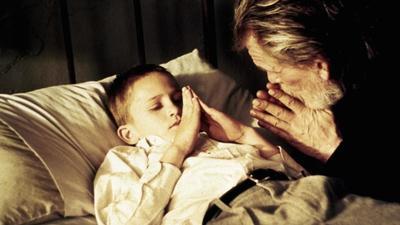
The central storyline is about an orphaned boy named Irwin (Duel Farnes), who was abandoned by his parents because he’s too sick to live much longer, and the shaggy-haired minister (Nick Nolte) who acts as the boy’s caretaker and tries to locate a couple that will adopt him. In the boy’s fevered dreams, he sees himself in a series of conversations with four Northfork citizens who might not exist. There’s a man with wooden hands and a mask made of optician’s goggles who calls himself Happy (Anthony Edwards); a fey and plumy-voiced commentator called Cup of Tea (Robin Sachs); a woman with a dark wig and vaguely Edwardian ruffled collar who’s known as Flower Hercules (Daryl Hannah); and a silent, pasty-faced young man named Cod (Ben Foster). All four are searching for a long-lost creature called the Unknown Angel, and in their conversations with Irwin, they slowly begin to suspect he might be The One.

Meanwhile, the government agents, who’ve been promised lakefront property if they evacuate everyone in their sector, split up to convince the few remaining homeowners to leave. One team is attacked by a shotgun-toting bigamist who plans to ride out the flood in a homemade ark. Another interrupts a young couple in flagrante and proceeds to trash their place. Yet another, a father-son team that go by the film-buff-teasing names of Willis and Walter O’Brien (Michael Polish and the great, uncharacteristically gentle James Woods), carry out their mission while having cryptic conversations about past domestic strife that neither man is bold enough to confront. Motifs include angel wings, feathers, guns, crucifixes, water, windows, reflections, tombstones, graves and dirt. The supposed real world merges with the dream world in a third act set piece that involves falling snow and an inexplicably bisected house that creates an abyss that must be bridged with a jump.

The movie’s mix of real-world wisdom and dreamy daring is summarized by Nolte, whose terse portrait of a man of faith struggling to understand God’s unknowability ranks with the best work of his career. There’s nothing sentimental about this character—he’s a gray-whiskered rock, wary of lies and battered by life. Yet Nolte’s coolly attentive performance in the scenes with the dying boy is the key that unlocks the film’s power. Even when the boy isn’t talking, the man listens to him; when he tucks him in at night, he speaks to him in a rumbling whisper. An image of the old man lowering the child into a bathtub is as simple as moviemaking gets; it may be the only important scene in the movie that doesn’t foreground its symbolic intent. Yet I can’t recall a more moving image of kindness in modern cinema.

As in “O Brother, Where Art Thou?,” a series of situations and images are linked by images, music and sound effects that reinforce one another glancingly-like elements in a poem or a song. The sense of humor is Bertolt Brecht cornball. Like David Lynch, the Polish brothers are fond of lines and exchanges that are repeated and repeated until you shut down and turn surly or surrender and start giggling. (Examining three feathers in row, Happy proclaims, “Duck? duck? goose.”) Lynch’s influence is obvious throughout—ditto the Coen brothers, Stanley Kubrick, Luis Buñuel, John Ford and Terrence Malick. (The latter is acknowledged both in Mullen’s desolate longshots and in Nolte’s nearly cosmic narration.)

Despite an occasionally too-quirky score, a couple of bum supporting turns and a handful of silly, anachronistic gags—the most egregious is, no kidding, a reference to the 1970s sitcom “Diff’rent Strokes”—the Polish brothers make an evolutionary leap forward with “Northfork.” As much as I enjoyed “Twin Falls Idaho” and “Jackpot,” their influences seemed chunky and undigested. This film absorbs its influences, breaks them down and recirculates them through the movie’s bloodstream, nourishing every frame. There’s something pure, confident and deeply private about it. Watching it is like having someone else’s dream.

Source:: http://www.rogerebert.com/mzs/from-the-nostalgia-file-northfork


Categories
TV & Movies

From the Nostalgia File: “Northfork”

Thumb_northfork-2016

[Editor’s Note: The following review was originally published in the now-defunct weekly New York Press. It is being reprinted here in honor of the Ebertfest 2016 screening of “Northfork,” the film by Michael and Mark Polish that Roger Ebert praised. For more information about this year’s schedule, click here—Matt Zoller Seitz]

I don’t like describing the basic properties of cinema. It’s like trying to explain a sad song or a great joke. In describing the thing, you kill it; my grandfather called this “cutting up a bird to see what makes it sing.” But “Northfork,” the new feature from twin filmmakers Mark and Michael Polish, is the kind of movie that inspires one to reflect on such matters. It’s the first movie I’ve seen in a long time that moved me to tears, for reasons I can’t explain. The best I can do is describe it to you in hopes that you’ll go see it.

Supposedly the movie is set on the great plains of Montana in 1955, where government agents in dark suits and fedoras try to persuade (or force) rural citizens to abandon their homesteads before a newly finished dam switches on and floods the land. But it’s really set in the minds of the filmmakers and the audience. Using the desaturated, almost monochrome CinemaScope of M. David Mullen—who also shot the Polish brothers’ “Twin Falls Idaho” and “Jackpot,” and who should probably be considered one of America’s finest living cinematographers—the filmmakers devise a community that’s at once lonely and warm, barren and filled with life, fearful of abandonment and death and yet capable of empathy. The film’s elliptical script is linear in the way that a half-submerged stepping-stone path across a river is linear. Its themes and ideas only connect when the viewer decides to participate emotionally—to set aside his or her perceived notions of what movies are (or should be) and hop from one rock to the next.

The central storyline is about an orphaned boy named Irwin (Duel Farnes), who was abandoned by his parents because he’s too sick to live much longer, and the shaggy-haired minister (Nick Nolte) who acts as the boy’s caretaker and tries to locate a couple that will adopt him. In the boy’s fevered dreams, he sees himself in a series of conversations with four Northfork citizens who might not exist. There’s a man with wooden hands and a mask made of optician’s goggles who calls himself Happy (Anthony Edwards); a fey and plumy-voiced commentator called Cup of Tea (Robin Sachs); a woman with a dark wig and vaguely Edwardian ruffled collar who’s known as Flower Hercules (Daryl Hannah); and a silent, pasty-faced young man named Cod (Ben Foster). All four are searching for a long-lost creature called the Unknown Angel, and in their conversations with Irwin, they slowly begin to suspect he might be The One.

Meanwhile, the government agents, who’ve been promised lakefront property if they evacuate everyone in their sector, split up to convince the few remaining homeowners to leave. One team is attacked by a shotgun-toting bigamist who plans to ride out the flood in a homemade ark. Another interrupts a young couple in flagrante and proceeds to trash their place. Yet another, a father-son team that go by the film-buff-teasing names of Willis and Walter O’Brien (Michael Polish and the great, uncharacteristically gentle James Woods), carry out their mission while having cryptic conversations about past domestic strife that neither man is bold enough to confront. Motifs include angel wings, feathers, guns, crucifixes, water, windows, reflections, tombstones, graves and dirt. The supposed real world merges with the dream world in a third act set piece that involves falling snow and an inexplicably bisected house that creates an abyss that must be bridged with a jump.

The movie’s mix of real-world wisdom and dreamy daring is summarized by Nolte, whose terse portrait of a man of faith struggling to understand God’s unknowability ranks with the best work of his career. There’s nothing sentimental about this character—he’s a gray-whiskered rock, wary of lies and battered by life. Yet Nolte’s coolly attentive performance in the scenes with the dying boy is the key that unlocks the film’s power. Even when the boy isn’t talking, the man listens to him; when he tucks him in at night, he speaks to him in a rumbling whisper. An image of the old man lowering the child into a bathtub is as simple as moviemaking gets; it may be the only important scene in the movie that doesn’t foreground its symbolic intent. Yet I can’t recall a more moving image of kindness in modern cinema.

As in “O Brother, Where Art Thou?,” a series of situations and images are linked by images, music and sound effects that reinforce one another glancingly-like elements in a poem or a song. The sense of humor is Bertolt Brecht cornball. Like David Lynch, the Polish brothers are fond of lines and exchanges that are repeated and repeated until you shut down and turn surly or surrender and start giggling. (Examining three feathers in row, Happy proclaims, “Duck? duck? goose.”) Lynch’s influence is obvious throughout—ditto the Coen brothers, Stanley Kubrick, Luis Buñuel, John Ford and Terrence Malick. (The latter is acknowledged both in Mullen’s desolate longshots and in Nolte’s nearly cosmic narration.)

Despite an occasionally too-quirky score, a couple of bum supporting turns and a handful of silly, anachronistic gags—the most egregious is, no kidding, a reference to the 1970s sitcom “Diff’rent Strokes”—the Polish brothers make an evolutionary leap forward with “Northfork.” As much as I enjoyed “Twin Falls Idaho” and “Jackpot,” their influences seemed chunky and undigested. This film absorbs its influences, breaks them down and recirculates them through the movie’s bloodstream, nourishing every frame. There’s something pure, confident and deeply private about it. Watching it is like having someone else’s dream.

Source:: http://www.rogerebert.com/mzs/from-the-nostalgia-file-northfork


Categories
TV & Movies

From the Nostalgia File: “Northfork”

Thumb_northfork-2016

[Editor’s Note: The following review was originally published in the now-defunct weekly New York Press. It is being reprinted here in honor of the Ebertfest 2016 screening of “Northfork,” the film by Michael and Mark Polish that Roger Ebert praised. For more information about this year’s schedule, click here—Matt Zoller Seitz]

I don’t like describing the basic properties of cinema. It’s like trying to explain a sad song or a great joke. In describing the thing, you kill it; my grandfather called this “cutting up a bird to see what makes it sing.” But “Northfork,” the new feature from twin filmmakers Mark and Michael Polish, is the kind of movie that inspires one to reflect on such matters. It’s the first movie I’ve seen in a long time that moved me to tears, for reasons I can’t explain. The best I can do is describe it to you in hopes that you’ll go see it.

Supposedly the movie is set on the great plains of Montana in 1955, where government agents in dark suits and fedoras try to persuade (or force) rural citizens to abandon their homesteads before a newly finished dam switches on and floods the land. But it’s really set in the minds of the filmmakers and the audience. Using the desaturated, almost monochrome CinemaScope of M. David Mullen—who also shot the Polish brothers’ “Twin Falls Idaho” and “Jackpot,” and who should probably be considered one of America’s finest living cinematographers—the filmmakers devise a community that’s at once lonely and warm, barren and filled with life, fearful of abandonment and death and yet capable of empathy. The film’s elliptical script is linear in the way that a half-submerged stepping-stone path across a river is linear. Its themes and ideas only connect when the viewer decides to participate emotionally—to set aside his or her perceived notions of what movies are (or should be) and hop from one rock to the next.

The central storyline is about an orphaned boy named Irwin (Duel Farnes), who was abandoned by his parents because he’s too sick to live much longer, and the shaggy-haired minister (Nick Nolte) who acts as the boy’s caretaker and tries to locate a couple that will adopt him. In the boy’s fevered dreams, he sees himself in a series of conversations with four Northfork citizens who might not exist. There’s a man with wooden hands and a mask made of optician’s goggles who calls himself Happy (Anthony Edwards); a fey and plumy-voiced commentator called Cup of Tea (Robin Sachs); a woman with a dark wig and vaguely Edwardian ruffled collar who’s known as Flower Hercules (Daryl Hannah); and a silent, pasty-faced young man named Cod (Ben Foster). All four are searching for a long-lost creature called the Unknown Angel, and in their conversations with Irwin, they slowly begin to suspect he might be The One.

Meanwhile, the government agents, who’ve been promised lakefront property if they evacuate everyone in their sector, split up to convince the few remaining homeowners to leave. One team is attacked by a shotgun-toting bigamist who plans to ride out the flood in a homemade ark. Another interrupts a young couple in flagrante and proceeds to trash their place. Yet another, a father-son team that go by the film-buff-teasing names of Willis and Walter O’Brien (Michael Polish and the great, uncharacteristically gentle James Woods), carry out their mission while having cryptic conversations about past domestic strife that neither man is bold enough to confront. Motifs include angel wings, feathers, guns, crucifixes, water, windows, reflections, tombstones, graves and dirt. The supposed real world merges with the dream world in a third act set piece that involves falling snow and an inexplicably bisected house that creates an abyss that must be bridged with a jump.

The movie’s mix of real-world wisdom and dreamy daring is summarized by Nolte, whose terse portrait of a man of faith struggling to understand God’s unknowability ranks with the best work of his career. There’s nothing sentimental about this character—he’s a gray-whiskered rock, wary of lies and battered by life. Yet Nolte’s coolly attentive performance in the scenes with the dying boy is the key that unlocks the film’s power. Even when the boy isn’t talking, the man listens to him; when he tucks him in at night, he speaks to him in a rumbling whisper. An image of the old man lowering the child into a bathtub is as simple as moviemaking gets; it may be the only important scene in the movie that doesn’t foreground its symbolic intent. Yet I can’t recall a more moving image of kindness in modern cinema.

As in “O Brother, Where Art Thou?,” a series of situations and images are linked by images, music and sound effects that reinforce one another glancingly-like elements in a poem or a song. The sense of humor is Bertolt Brecht cornball. Like David Lynch, the Polish brothers are fond of lines and exchanges that are repeated and repeated until you shut down and turn surly or surrender and start giggling. (Examining three feathers in row, Happy proclaims, “Duck? duck? goose.”) Lynch’s influence is obvious throughout—ditto the Coen brothers, Stanley Kubrick, Luis Buñuel, John Ford and Terrence Malick. (The latter is acknowledged both in Mullen’s desolate longshots and in Nolte’s nearly cosmic narration.)

Despite an occasionally too-quirky score, a couple of bum supporting turns and a handful of silly, anachronistic gags—the most egregious is, no kidding, a reference to the 1970s sitcom “Diff’rent Strokes”—the Polish brothers make an evolutionary leap forward with “Northfork.” As much as I enjoyed “Twin Falls Idaho” and “Jackpot,” their influences seemed chunky and undigested. This film absorbs its influences, breaks them down and recirculates them through the movie’s bloodstream, nourishing every frame. There’s something pure, confident and deeply private about it. Watching it is like having someone else’s dream.

Source:: http://www.rogerebert.com/mzs/from-the-nostalgia-file-northfork