Categories
TV & Movies

Love Survives Us: Steve De Jarnatt’s “Miracle Mile”

Thumb_mm3

In the summer of 2003, I was working in a video store.
Things were not going well for me. Things were about to fall apart for a good
long while. I sensed this on some level and stalked the rows of tapes to use
the free rentals I had as an employee to find movies I’d never heard of to take
my mind off the feeling of approaching doom. Some were hilarious, forgettable
trash. (Ask me sometime about “Eternity,” where Jon Voight plays a public
access host who learns he is a reincarnated prince who most stop Armand Assante
from buying his station.) And then there was “Miracle Mile.” I’m not sure what
I thought I was getting. But I remember the rising feeling of panic and
recognition as I watched it. I remember putting the tape back into the case
already trying to rewrite my memory of what I’d just seen. The film showed me
something I was not ready to know, or admit to myself. I was haunted by the
ending for days. I could only see the horror in it. It would be a long time
before I could recognize the benediction in it.

Recently released on Blu-ray by
Kino Lorber, 1988’s “Miracle Mile” was writer/director Steve De Jarnatt’s
vision of The End of Days in a candy colored Pop Luxe Los Angeles. It’s a
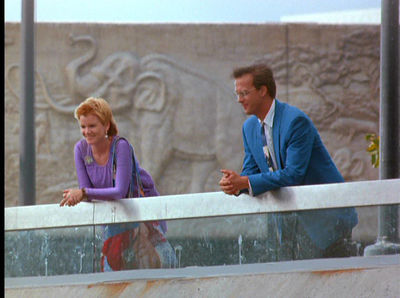
hysterical, lyrically beautiful film. Turning the tourist trap of the La Brea
tar pits and its museum into a widescreen paradise where our Adam and Eve,
Anthony Edwards as Harry and Mare Winningham as Julie, meet and instantly
connect. They spend a lovely day together, and the film takes in the various
mid-century kitsch of hamburger palaces and coffee shops that were quickly
becoming extinct. The film subtly comments that ‘80s Los Angeles, and
everywhere else, had no patience for its history. Harry and Julie make plans to
meet later that night. Harry oversleeps and rushes to the diner meeting spot
several hours too late. He finds a motley collection of character actors acting
out the Reagan era version of Hopper’s Nighthawks. He places a call to Julie on
the payphone outside the restaurant and starts to walk back in. The phone
starts ringing, ecstatic it might be her returning his call he’s in no way
prepared for the voice on the other end of the line. A panicked young man
thinking he’s calling his father from his missile silo warns that there’s only
an hour to get out before the missiles land and WWIII begins. A hail of gunfire
ends the voice on the other end of the line. Harry walks back in dazed, trying
to deny what he’s heard but quickly spreading his panic to the other people in
the diner. He can’t take the chance the call was a prank, and he can’t leave
for safety without Julie and so the race is on.

It’s funny that for a city that produces so many movies we
rarely see a movie set in Los Angeles. And certainly not this Los Angeles. This is a city of elderly retirees, hash
slingers, hookers and beat cops. The city of people who are up at four in the
morning, cleaning the streets or finishing the late shift—the people that in
other apocalyptic films are just the nameless horde we see crushed under
earthquakes and crumbling buildings. There’s a real searing sorrow underneath
these funny, exhausted characters. We get to know them, their names, and ache
for knowing they won’t make it. There is none of the insufferable indifference
of big budget disaster films, that the “right” people made it out alive so who
cares? The film dares to suggest that we’re all the “right” people in our way
and we deserve life. And the tragedy of the world is how often that’s denied to
us.

The film serves as a summation of its decade, the excess of
the wealthy that ground down the working class. The pastel colors that tried to
soothe away worries of coming nuclear Armageddon. The obsession with image and
more is always better. The colors on KL Studio Classic’s Blu-ray of the film
almost smother you at first but they’re perfect for the story—twilight’s last
brilliant, shimmering gleaming before the shroud of nuclear winter. That a film
about death could be so alive is its main paradox. And it’s why the film never
left me after that initial viewing in 2003.

And it seems right I caught back up with “Miracle Mile” this
year. This has not been a good year for me. I lost my father back in February
and since then everything has felt like it’s been moved a few inches off. I’m
paralyzed by indecision. I look at people and all I can think is “You are going
to die someday.” I’m only now regaining some sense of balance but it’s tenuous.
And yet that is the great, sad, kind message of the film. It’s always too late.
There’s never enough time. So live. Live the best you can. And maybe love is
the thing that survives us. Maybe that last part is even true. I’d like to
think so.

Source:: http://www.rogerebert.com/demanders/love-survives-us-steve-de-jarnatts-miracle-mile


Categories
TV & Movies

Conversations with Christian Petzold’s “Phoenix”

Thumb_phoenix_schrammfilm5365

All right class, what’s your first thought when analyzing
Christian Petzold’s “Phoenix”? That’s right, Alfred Hitchcock’s “Vertigo,”
anointed in 2012 as the Sight and Sound poll’s number-one film. The plot alone
guarantees it.

Petzold’s concerns Nelly Lenz (Nina Hoss), a Jewish cabaret
singer who survived Auschwitz, only to be shot in the face in the last
desperate days before liberation. Nelly is taken to a clinic by a friend, Lene
(Nina Kunzendorf), and the surgeon there offers Nelly her choice of new faces.
She insists that he try to restore her own. Nelly searches through the rubble
and dives of Berlin for Johnny (Ronald Zehrfeld), the husband who may have
betrayed her to the Nazis. She finds him, but not the reunion she craves,
because Johnny sees only a certain resemblance to the wife he believes is dead.
Nelly’s exact features will survive only in memory and photos. But this new
face is close enough for Johnny to have an idea. He’ll have this stranger
impersonate his dead wife, and collect the money she stands to inherit from the
family that the Nazis murdered.

As it happens, Petzold has seen “Vertigo”—any director who
hasn’t seen “Vertigo” is one to regard with deep suspicion—but “Phoenix” calls
up other influences, too. When Nelly roams the clinic at night, her face hidden
behind a mass of bandages, it’s easy to see Edith Scob wandering through her
mad father’s mansion in Georges Franju’s “Eyes Without a Face.” When Nelly is
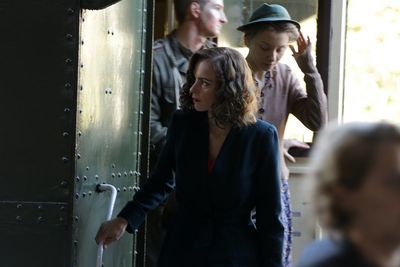
dolled up in a black suit with a veiled hat, it evokes Hanna Schygulla,
maneuvering through a new but still-ruthless Germany in Rainer Werner
Fassbinder’s “The Marriage of Maria Braun.”

The delicate, mournful song “Speak Low,” sung so effectively
by Nina Hoss in “Phoenix”’s final scene that it will be forever linked to her,
is from the 1943 Broadway musical “One Touch of Venus.” Petzold says he has
seen the 1948 movie, in which Robert Walker has brought to life this statue of
the ideal woman (Ava Gardner, that is to say, a goddess), and still can’t
control her; “Speak Low” is what she sings as she leaves her mortal lover. “One
Touch of Venus” is a comedy, yet knowing its plot somehow makes “Phoenix”’s
finale more wrenching, not less.

But good movies converse with one another across time, and
the connections between them are sometimes in the mind of the audience, not the
director. That doesn’t make them irrelevant. “Phoenix,” my film of the year so
far, can set off a lot of associations.

One of the film’s few bad reviews came from Peter Bradshaw
of The
Guardian, who said “reconstructive
surgery could never come anywhere near the convincing results shown here: not
in 1945 – and not in 2015, come to that. The flaw is fatal, and the fantasy
crumbles.

I strongly believe that this is dead wrong. Not merely
because it’s an example of the mindset that Hitchcock himself dismissed as “the plausibles,” but also because the
plot is not nearly as credulity-stretching as it seems. Similar things have
been said about “The Scar,” aka “Hollow Triumph,” a film noir from 1948. Paul
Henreid plays Muller, a gangster who encounters his precise double in the
person of psychoanalyst Dr. Bartok, save for Bartok’s prominent knife scar
across one cheekbone. On the lam, Muller decides to murder Bartok and take his place,
and to do so, Muller works from a photograph and cuts his own face.

But in an earlier scene, we see the photographic developers
flip the image, reasoning that no one will know the difference. Thus Muller
puts the scar on the wrong side of his face. And here is the psychological
genius of “The Scar”: The boys from the darkroom were right. Almost no one
notices. Not even the secretary, played by Joan Bennett, who was in love with
Bartok.

But that’s ridiculous, say the plausibles. No, it isn’t.
Think of the people who have a substantial change in appearance—nose trimmed,
waistline altered, a bandage or even a cast—and are astonished to discover that
almost no one notices. Think of the thousands who go to jail on faulty
eyewitness testimony. When Bennett finally figures out the ruse, it’s because
she knows the cold, indifferent Bartok couldn’t suddenly began to lust for her.
Faces change; emotions don’t.

But like Johnny, we privilege our vaunted logic over our
feelings. We think we observe; most of us don’t. And “Phoenix” adds an extra,
self-serving layer of reasons why Johnny wouldn’t recognize his wife, and why
their old friends would believe that a woman fresh out of Auschwitz looks like
post-surgery Nelly: It assuages their guilt. “My wife will never know what I
did,” thinks Johnny. “Everything is alright now that the Nazis are gone,” think
the friends.

Ah yes, those old friends of Nelly and Johnny, who show up
towards the end of the film. That brings me to one movie Petzold, surprisingly,
says he hasn’t seen: “Return from the Ashes,” directed by J. Lee Thompson in
1965, based on the same Hubert Monteilhet novel as “Phoenix.” Ingrid Thulin
plays a Jewish anesthesiologist who falls in love with Maximilian Schell’s
scheming, social-climbing chess pro. They marry just as Paris falls to the
Nazis, and she is arrested and sent to Auschwitz. The Thompson film has a far
more convoluted plot and isn’t as resonant (despite touching work by Herbert
Lom, who basically has Nina Kunzendorf’s part). But it’s highly entertaining, a
brash and at times lunatic thriller graced by Samantha Eggar as Thulin’s
viperous stepdaughter, a character whom Petzold jettisoned.

The one scene that can stand up to logical comparison with “Phoenix”
is the first. “Return From the Ashes” begins on a train to Paris late in 1945.
The carriage is full of tired middle-class people, an elderly man, a matronly
woman traveling with a little boy of about 10 years of age, and Ingrid Thulin.
(Thulin here looks remarkably like post-surgery Nelly: hollowed-out cheeks,
bruised eyes, straw-like hair, even a similar shabby raincoat.) The train is
traveling very fast. The boy entertains himself by kicking the door to the
outside of the rail carriage—bump, bump, bump, as steady and as maddening as a
dripping faucet. Then we see his bored, curious hand reach for the door latch.
The old man sees it too, shouts “be careful,” but it’s too late. The little boy
opens the door and falls through a blast of smoke and air, presumably to his
death. The mother wails, someone pulls the cord, the train halts and the
carriage fills with people, as the conductor comes to lead the distraught
mother away. And of all these passengers, the only one who doesn’t so much as
shift in her seat is Thulin. She is utterly still, staring. “Really, such lack of feeling,” says one
woman, and the old man starts to agree. Then he breaks off mid-word, as the
camera moves to show us the number on Thulin’s arm.

It’s a shattering opening, an example of what melodrama,
unfettered by notions of taste, can show that a more sober drama cannot. There
is nothing else in the 1965 film that comes so close to suggesting what
implacable, hideous cruelty and constant death might actually do to someone’s
personality, and it’s the sole moment that throws survivors’ trauma directly in
the face of bystanders. It reverses “Phoenix”’s trajectory, putting first what
Petzold saves for last.

Because it’s only in the closing minutes of “Phoenix” that
we watch Johnny finally, finally get some picture of what he’s done, and what
he’s lost. But even then, as Nelly sings and Johnny plays, the audience of
blandly indifferent post-war Germans regard Nelly with no trace of guilt. They
have already convinced themselves that they did nothing that needed forgiving.

And here is where I come to my last conversation with “Phoenix,”
because sometimes, a film can alter how you see something that lies well
outside movies. As soon as I got home from seeing the film, I opened my copy of
Salka Viertel’s memoir, “The Kindness of Strangers.” She grew up in a
well-to-do and cultivated Jewish family in Sambor, Galicia, which is now part
of Ukraine, moved to California with her family in 1928, wrote screenplays
(including “Queen Christina” and “Deep Valley”) and turned her home into a
magnet for people fleeing Hitler’s Europe.

When I read the book, I couldn’t understand Viertel’s
decision at the end of this passage, and I am not sure I do now. But in my
mind, the trajectory of Petzold’s heroine is now caught up with the following
story, permanently.

Viertel’s brother Siegmund, known as Dusko to the family,
didn’t make it out of Sambor in time. By 1946 Viertel was convinced that Dusko
hadn’t survived; she got one unconfirmed report that her brother had jumped off
a train to the camps and been killed by the SS. Frantic to keep any details of
Dusko’s fate from their elderly mother, who had managed to reach the U.S. in
1941 and was living in her daughter’s home in Los Angeles, Salka made a point
of intercepting the mail every day.

One morning, Viertel opened a letter from a woman named
Viktoria, an orphaned Galician who had been raised alongside Salka and Dusko in
Sambor, as part of the family. Viktoria wrote, “In 1943 [Dusko] came to my house begging me to hide him, but as we are
living in a rented place I could not do it, and since the last German Aktion I
have not heard from him again.
” Aktion, Viertel knew, was the word used to
mean rounding up Jews.

Viktoria closed the letter by saying she now had four
children, and asking, “would Salka, who
has always been like a sister to me, send us a food parcel?

Viertel started to reply.

I wrote her that she had forfeited
the right to appeal to my sisterly feelings. She had cruelly denied shelter to
a hunted Jew, whose father and mother had given her love and devoted care since
she was born, and she had allied herself with monsters and torturers. My tears
stained the paper and I had to stop. Could I reproach this cowardly woman for
not risking her life? Hadn’t others, more powerful than she, stood by
indifferently when these unspeakable horrors took place? She was only one among
millions ….

I tore up the letter, mailed a CARE
package to Sambor, and never told Mama what happened.

Source:: http://www.rogerebert.com/balder-and-dash/conversations-with-christian-petzolds-phoenix


Categories
Alberta Health

Blue Heron Deaths at Syncrude Site Under Investigation

blue heron deaths, Syncrude

The recent blue heron deaths at a Syncrude site are under investigation. Approximately 30 dead blue herons have been located at the Mildred Lake site operated by Syncrude. The Syncrude Canada spokesman Will Gibson reported that the first dead birds were found Wednesday afternoon close to a pump house at the site, and there were 29 birds initially found. One of the blue herons was still alive but had to be euthanized. Shannon Phillips, the Environment Minister for Alberta, said “Events like this are extremely troubling, and that’s why we have taken initial, very quick steps to ensure there is a high quality investigation, which has already begun.” An investigation by the Alberta Energy Regulator has been started to determine the cause of death for the blue herons.

The investigation into the blue heron deaths at the Syncrude site will be thorough. Gibson reassured the public that the blue heron deaths are being investigated as a serious matter, saying “There will be a very thorough investigation into what caused this. We are co-operating with the three agencies that are investigating this on site. We intend to find out what happened and address it. From our CEO on down…this is something that every Syncrude employee wants to find out the answers to. Because there’s nobody happy at our site today.” Energy Regulator spokesperson Bob Curran stated “Where they found them was close to an old sump. And the bird that they first found was oiled in that bitumen.” Gibson reported that the wildlife deterrence systems were operating, and added “Those are deployed in areas where there’s active tailings facilities. When we file our waterfowl protection plan, with the regulator, that’s where we have to have our deterrents.”

Categories
TV & Movies

A Vanishing Place: Agnès Varda in California

Thumb_blackpanthers

It’s not exactly accurate to say that Agnès Varda is an underrated filmmaker. As the only female member of the French New Wave, she stands out. Additionally, her film “The Gleaners and I” is one of the most acclaimed documentaries ever made; it placed at #8 in a recent critics’ poll conducted by “Sight and Sound” magazine compiling its participants’ favorite docs. However, her films that don’t fit into the French New Wave (“Cleo From 5 To 7,” “Le Bonheur”) or the documentary tradition (“Gleaners,” “The Beaches of Agnes”) have received much less attention. Part of the problem is that much of her work mixes fiction and nonfiction modes; while this may be hip at the moment, it was taboo for quite a while. The very existence of Eclipse’s new box set “Agnès Varda in California” points to another issue. While she’s mostly worked in France, she can’t entirely be pinned down to one nationality. As her husband Jacques Demy completed the underrated “Model Shop” in 1969 Los Angeles, Varda made “Lions Love (…and Lies)”. Fascinated by the counterculture, she would return to California after its demise. If memory serves, her L.A. films are never mentioned in Thom Andersen’s “Los Angeles Plays Itself,” but they’re great examples of work that avoids the usual cliches about the city. The Hollywood sign is nowhere to be found in this box set. Varda’s far more interested in Chicano muralists.

Eclipse has grouped together the shorts “Uncle Yanco” and “Black Panthers” on one DVD. In a certain way, the films, made in 1967 and 1968, depict various forms of counter-cultural activity in the Bay Area. But the tone of that activity couldn’t be more different. “Uncle Yanco,” centers around a long-lost relative of Varda’s, celebrating its subject’s vibrant paintings and laid-back lifestyle. The cinematography is as colorful as Yanco’s art. Although Yanco must be at least in his 60s, he invites much younger hippies to come out to his Sausalito houseboat and go sailing with him every Sunday. Jean Hamon’s montage is playful. Varda apparently had made “Uncle Yanco is great” buttons made, and she fills blank spaces in the frame with them. Yanco’s politics are anti-war but not exactly activist; he trusts that disengagement from conventional politics will eventually lead to change.

On the other hand, the Black Panthers were a lot more focused, to put it mildly. “Black Panthers” is centered around the 1968 Oakland demonstration to free then-imprisoned leader Huey Newton. It gives an introduction to the group, which took style—black leather jackets and berets, natural haircuts—as a political statement. If their celebration of Mao and chants of “off the pigs” haven’t aged well, the continuing relevance of their view of the police as a hostile occupying force in minority communities is undeniable. Varda slips in hints of her work to come. She speaks with Kathleen Cleaver and interviews Newton about the important role played by female Panthers. By documenting radicals, Varda opened up new vistas in her future films: if the Panthers could rewrite American society’s rules about what it meant to be black, she could do the same about what it meant to be female, eventually leading to films like “One Sings, The Other Doesn’t” and “Vagabond.”

Varda seemed pretty sympathetic, if not actively enthusiastic, about the hippie counterculture in “Uncle Yanco.” Two years later, when she made “Lions Love (…and Lies)”, that seemed to have changed. The film centers on a trio of lazy hippies played by Viva and the two writers of “Hair,” James Rado and Gerome Ragni. They don’t seem to have any worries about money and spend their days idling about a L.A. house. Shirley Clarke, who plays herself, doesn’t have such privilege. Her efforts to make a Hollywood film culminate in a suicide attempt, although Clarke is reluctant to stage the pill overdose and Varda steps in front of the camera to show her how it’s done. In fact, Clarke is clearly playing a stand-in for Varda, whose reflection appears in a mirror in one scene. “Le Bonheur” is the Varda film that “Lions Love (…and Lies)” most resembles—both films have a surface bubbliness and underlying darkness. Viva, Jim and Gerry seem apolitical until the death of Robert Kennedy. The shooting of Andy Warhol also affects Viva, who was a Factory “superstar.” The group’s antics resemble those of the teenage girls in Vera Chytilova’s “Daisies,” but with all the brattiness intact and the feminist edge removed.

“Mur Murs,” a 1980 documentary about murals in L.A., comes close to Les Blank’s depictions of American subcultures. The artists profiled by Varda are white, African-American, Mexican-American, male and female, but she seems most fascinated by the city’s Latino subculture. She even takes time out for a performance by a Chicano punk band, Los Illegals. This may have the most densely worked soundtrack of any Varda film; while the director delivers a voice-over, a male voice offers counterpoint in a whispery tone, sometimes translating her words into Spanish. The murals are a varied lot, ranging from expression of radical politics to pure surrealism to decorations for schools to ads for businesses.Varda relishes their non-commercial nature, something all the artists she interviews value. For various reasons, they don’t think they’d fit into the conventional gallery scene, and they’re happy to swap the chance to get paid much (or at all) for the opportunity to reach a wide audience of everyday people. One can see parallels with Varda’s filmmaking practice, particularly her tendency to alternate between films aimed at a relatively wide audience (like “One Sings, The Other Doesn’t” and “Vagabond”) and more arcane projects. In some respects, “Mur Murs” picks up where “Black Panthers” left off, showing the traces of African-American and Latino leftist politics that were still hanging on in 1980. In that regard, it’s a more optimistic film than one might expect.

“Documenteur” closes the box set, but it also sums up the films that came before it. The title is an untranslatable pun—“menteur” is French for “liar”—but it’s subtitled “an emotion picture.” The tone is rather cool, though. “Documenteur” follows a French mother, Emilie Cooper (Sabine Mamou, who edited “Mur Murs”), and her young son Martin (played by Varda’s son Mathieu Demy) through L.A. It’s not a tourist’s view of the city, although Emilie does briefly get involved in the film industry. In fact, the Los Angeles shown in “Documenteur” bears some resemblance to the fishing village of Varda’s first feature, “La Pointe Courte.” As the title suggests, the film mixes documentary and fiction: Emilie and Martin get involved in real-life situations, such as a performance by a mariachi band in the film’s final scene. Emilie works as typist, sitting at a desk facing the beach. The DVD preserves the cinematography’s grain and gritty look, enhanced by the fact that Varda and cameraman Nurith Aviv so often shot through windows. Delphine Seyrig’s narration creates a distancing effect, as she spends the first ten minutes musing on language before the film really introduces us to the Coopers’ lives. What’s most surprising about its depiction of L.A. now is how safe the city seems and how Emilie trusts Martin to run around on his own. After films like “Nightcrawler” have depicted it as a sprawling hellscape, the gentle alienation of “Documenteur” seems almost utopian. This city has vanished, from films and TV shows about L.A. if not from reality. Thanks to “Agnès Varda in California,” it remains preserved, however.

Source:: http://www.rogerebert.com/demanders/a-vanishing-place-agn%C3%A8s-varda-in-california


Categories
TV & Movies

Thumbnails 8/10/15

Thumb_1920

1.

“That’s Not Funny!”: The Atlantic‘s Caitlin Flanagan reports on the censorship of stand-up comics on college campuses.

“For the comics, the college circuit offers a lucrative alternative to Chuckle Hut gigs out on the pitiless road, spots that pay a couple hundred bucks and a free night in whatever squat the club owner uses to warehouse out-of-town talent. College gigs pay easily a grand a night—often much more—and they can come in a firecracker string, with relatively short drives between schools, each hour-long performance paid for (without a moment’s ugliness or hesitation) by a friendly student-activities kid holding out a check and hoping for a selfie. For all these reasons, thousands of comics dream of being invited to the convention. The colleges represented were—to use a word that their emissaries regard as numinous—diverse: huge research universities, tiny liberal-arts colleges, Catholic schools, land-grant institutions. But the students’ taste in entertainment was uniform. They liked their slam poets to deliver the goods in tones of the highest seriousness and on subjects of lunar bleakness; they favored musicians who could turn out covers with cheerful precision; and they wanted comedy that was 100 percent risk-free, comedy that could not trigger or upset or mildly trouble a single student. They wanted comedy so thoroughly scrubbed of barb and aggression that if the most hypersensitive weirdo on campus mistakenly wandered into a performance, the words he would hear would fall on him like a soft rain, producing a gentle chuckle and encouraging him to toddle back to his dorm, tuck himself in, and commence a dreamless sleep—not text Mom and Dad that some monster had upset him with a joke.”

2.

“Edward Norton Has a Solution to the ‘Monetization’ of the Oscars”: A great interview conducted by Eric Kohn of Indiewire.

“[Norton:] ‘I think the industry needs to set some boundaries. It’s like Melville’s story ‘Bartleby, the Scrivener’ — you know, an individual who tries to politely say, ‘I prefer not to.’ It’s like Garry Trudeau’s line: ‘America is the only country in the world where failure to promote oneself is considered arrogant.’ If you skip out on it, everybody takes that as a middle finger. And that’s challenging, even for a very brave person who doesn’t want to diminish a quality experience. It’s going to happen anyway in many ways.’ [Indiewire:] ‘What do you mean?’ [Norton:] ‘I’ve talked about this with some people. I think the Academy could do things. Nobody in the industry cares about any of it except the Academy, which carries weight, because they’re peers. The rest of it is seen as a dog and pony show. The Academy, which is a private organization, could save the industry by saying, ‘It’s our award and we can do whatever we want.’ They could say that any film putting out paid solicitation ads of any kind — all these for your consideration ads that cost millions and millions of dollars, which just solicit awards — they could say that any film using them is disqualified from the Academy Awards. It would end it overnight.’”

3.

“Two Nine-Year-Olds’ Magnificent Open Letter to Disney About Racial and Gender Stereotypes”: A must-read piece spotlighted by Maria Popova at Brain Pickings.

“In the spring of 2015, a nine-year-old boy named Dexter went to Disneyland with his family and found himself deeply unsettled — not by a scary ride or the unpleasantness of waiting in line, but by some of the most unsettling cultural issues of our time: racial and gender stereotypes. Disney, the world’s most prolific purveyor of pink plastic, has a long history of perpetuating gender stereotypes and feeding our unconscious biases, but what Dexter so astutely observed seemed like a particularly acute symptom of a larger cultural malady. I’ve known Dexter since he was a peanut — the son of my dear friends Jake Barton and Jenny Raymond, he is the smartest, most sensitive child I know — so I was hardly surprised by what happened next: Upon returning to New York, Dexter conferred with his classmate Sybilla, who had just had a similar experience while visiting Disney World in Orlando with her family; with the disarming sincerity and simplicity of which only children are capable, the two third graders wrote a magnificent, precocious, immensely insightful open letter to Disney, calling out the problematic treatment of race and gender, and suggesting more intelligent and culturally sensitive alternatives.”

4.

“William Friedkin Q&A: ’70s Maverick Revisits A Golden Era With Tales Of Glory And Reckless Abandon”: Deadline‘s Mike Fleming Jr. pens a very entertaining interview with the iconic filmmaker.

“The chase scene [in ‘The French Connection’] was never in a script. I created that chase scene, with the producer Philip D’Antoni. We just spit-balled ideas. We walked out of my apartment, headed South in Manhattan and we kept walking until we came up with that chase scene, letting the atmosphere of the city guide us. The steam coming off the street, and sound of the subway rumbling beneath our feet, the treacherous traffic on crowded streets. We didn’t have a lot of time, because Dick Zanuck, who had already turned it down, told us that he would make the film for a million and a half dollars if we could get it done right away, because he knew he was going to get fired. And he was right. That’s why we settled on Gene Hackman who was not our first choice. We walked 55 blocks and came up with a chase. Nobody ever asked to see a script. We went three hundred thousand over that million and a half dollar budget, and they wanted to kill me every day for that. Nobody spent the kind of money they do today. You had groups of guys running the studios who were afraid they might be out of touch, and young filmmakers who had fresh ideas that were more like what indie film is today than what fit the classic Hollywood movie, which was the musicals of the ‘40s and the ‘50s like ‘Singing in the Rain.’ What prevails in American film today that didn’t then was, if a film succeeds and seems to represent a formula, it will be repeated over and over, with more and more computer-generated images. I can’t think of any superhero film that existed in the 70s. None come to mind. No formulas and the start was the fear of those executives back then that ‘Easy Rider’ caused in the hearts of guys running the studios back then.”

5.

“How ‘Shaun the Sheep’ creators use woofs, oinks, bleats but no words in its wooly adventure”: Filmmakers Richard Starzak and Mark Burton chat with Rebecca Keegan of The Los Angeles Times.

“In 2007, when Starzak started writing and directing the ‘Shaun the Sheep’ TV show, which aired on the Disney Channel in the U.S., he needed to keep budgets down. Manipulating characters’ mouths was time-consuming for animators and, therefore, expensive. ‘The initial idea was labor-saving,’ Starzak said of the lack of dialogue. ‘I knew it would help us internationally a bit, but I had no idea — Shaun’s gone really global now. That’s been the big surprise. The lovely thing is when you go to China and everyone laughs in the same place.’ Starzak, who previously went by the name Richard Goleszowski, started out fetching coffee and props at Aardman in the 1980s. He worked as an animator and director on projects as varied as the video for the Peter Gabriel song ‘Sledgehammer’ and a British TV special about Rudolph the Red-Nosed Reindeer’s overweight son, Robbie. He’s the shy, self-effacing member of the filmmaking duo, while Burton, who wrote dialogue for ‘Chicken Run’ as well as the script for DreamWorks Animation’s ‘Madagascar,’ is more gregarious. Together, they have a dryly humorous rapport. Burton teased Starzak when the latter paused before listing his film references for ‘Shaun the Sheep.’ ‘You’re trying to sound film-literate, but you can’t. Your crib sheet’s gone missing,’ Burton said. ‘Uhhhhh … ‘Casablanca.’’ Actually, the list includes classic film comedians like Charlie Chaplin, Buster Keaton, Laurel and Hardy and Jacques Tati.”

Image of the Day

AnOther Mag‘s Holly Isard presents a glimpse at the various places ‘where great writers write,’ including Vladimir Nabokov (pictured above).

Video of the Day

Proper Path: The Films of Paul Thomas Anderson – A Tribute from Parker Mott on Vimeo.

Parker Mott presents an excellent video essay on the films of Paul Thomas Anderson that serves as a prelude to his upcoming book, “The Proper Path: The Films of Paul Thomas Anderson.”

Source:: http://www.rogerebert.com/thumbnails/thumbnails-81015


Categories
Ft Mac Health

Health Study Shows that Northern Alberta Residents are More Likely to be Heavier than Average

Northern Alberta, health study

A new health study show that residents of Northern Alberta, including those in the Fort MacMurray and Wood Buffalo areas, are more likely to be heavier than average when the national and provincial weight averages are calculated in. The Health Quality Council of Alberta released a report on July 29, 2015 that detailed the findings. According to the report 59% of the adults from Northern Alberta who were surveyed, out of 4,424 adults in all, were either overweight or obese. On average across the entire nation 54% of Canadians are either overweight or obese according to the statistics released by Statistics Canada. To be considered overweight or obese an adult will have a body mass index that is considered higher than what is acceptable for good health.

According to the health study estimates for Northern Alberta 7 out of 10 adults in the north zone area are overweight or obese. This area includes all communities north of Edmonton, which means Wood Buffalo and Fort MacMurray. South zone adults fared a little better, with 6.4 out of 10 people categorized as overweight or obese according to their BMI. Wood Buffalo Primary Care Network communications advisor Jordan Hiltunen explained “There’s so many factors at play, and what makes us as one community more prone to obesity than another, outside of years and years of data and analysis, that’s very hard to speculate on. One of the most common anecdotal bits of feedback that we get is that people find it a lot harder to incorporate regular daily exercise into their lives when we hit those epic winters. You don’t see that playing as big of a role in, for example, Vancouver.”