If your introduction to face rollers and gua sha tools comes from a cursory scroll through Instagram, you’d be forgiven for thinking they serve more as focal points for flat lays than anything else. The jade, marble, and quartz skin care tools aren’t a new phenomenon; their origins go back centuries. But, the methods I’m familiar with have also undergone a gradual evolution for social media (my childhood version of 刮痧 (gua sha) involved soup spoons, loose change, and copious amounts of Tiger Balm, which is significantly different from what influencers are currently posting on their feeds).
While I can think of plenty of Instagram-backed products that amount to little more than empty hype, dermatologists and aestheticians agree that these tools deliver legitimate skin benefits. The problem is, you need to know how to use them correctly in order to maximize their benefits. If you’re looking for more detailed instructions for the jade rollers, ice rollers, and gua sha tools sitting on your bathroom counters, consider this your definitive guide. Below, celebrity aesthetician Karee Hays and founder and CEO of Shiffa Beauty, Dr. Lamees Hamdan, break things down step by step.
Face Rollers
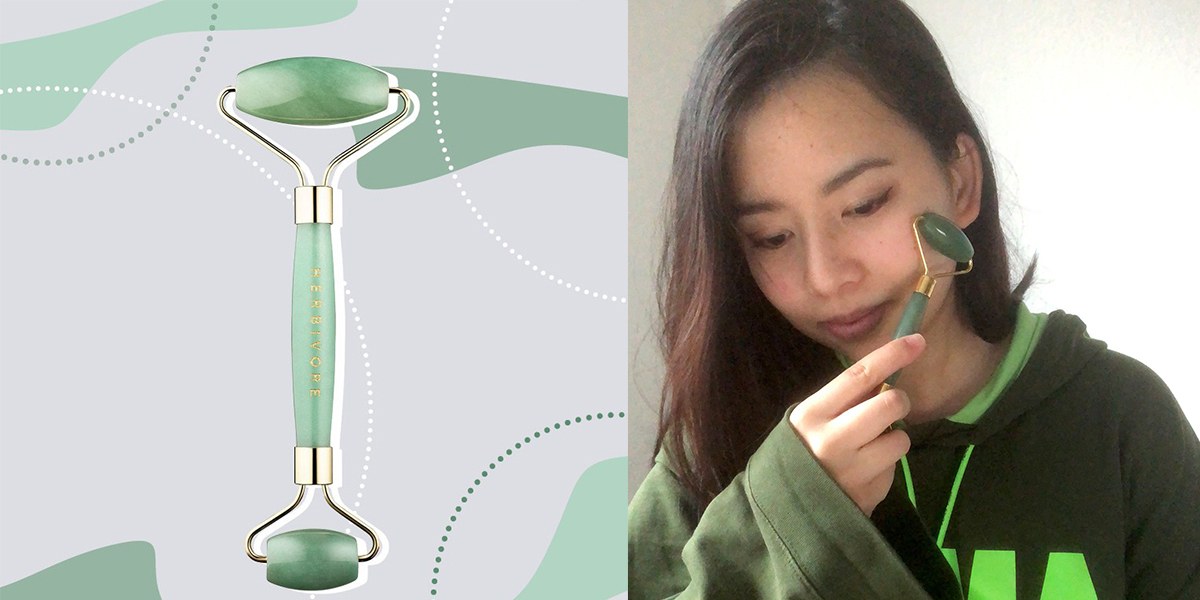
Both Dr. Hamdan and Hays tell me to work from the neck upwards, using sweeping strokes that go toward the outer edges of my face. I grab my $30 Herbivore Jade Facial Roller and do my best to follow their detailed instructions. First, I cover my clavicle with an up-and-down motion. Next, I do a sweeping up-and-down roll on my neck. After this comes the jawline; here, I switch to a back-and-forth roll that starts at the center of the chin and goes toward my ear, repeating this all the way up to my cheekbone. On my forehead, I repeat the vertical roll, starting from the middle of my face and moving outward toward my temples. I like that Herbivore’s extremely chic offering is double-sided; I flip it over to apply the smaller attachment under my eyes (in a horizontal motion toward my temple) and then roll once more in a horizontal movement down my nose.
The phrase to remember here is “lymphatic drainage,” a form of massage that pushes fluids to your lymph nodes, which subsequently process and filter them out of your system. When you perform this technique consistently (i.e., via your face roller of choice), it’s supposed to deliver de-puffing, glow-boosting benefits. Also, it just feels really nice.
According to Dr. Hamdan, there are two key things to keep in mind. “There is no point in rolling your face expecting drainage if you haven’t started with your neck first. You need to roll your neck first to clear the lymph passageways before starting on the face,” she says. Secondly, she cautions against pressing too hard. Use a light hand; the weight of the roller will do the rest.
Hays echoes those sentiments, explaining that too much pressure can actually irritate your skin and break capillaries, a warning I’ve heard repeatedly from aestheticians. “If you are re-using a roller at home, always sanitize it with alcohol,” she adds. Hays recommends beginning with a clean, moisturized face and adding additional layers of product if you wish to do so; the massage will help push them further into the skin. “When I have the time, I apply a KH Koji pad packed with antioxidants, then add Revision Skincare Hydrating Serum and DEJ Face Cream and roll in an upward motion while the products are absorbing.”
While I found that the roller already felt slightly cooling when stored at room temperature, there are options for even chillier applications. I like the $30 Ice Roller from Stacked Skincare, which has a stainless steel barrel and houses a liquid core of water and gel. You store it in the freezer between uses and breathe out a sign of relief when it meets your face. (You can, of course, also store your regular rollers in the freezer; the Stacked Ice Roller just retains the cool temps for longer.) Hays recommends this refreshing approach for those experiencing TMJ or sinus issues. And if you want to take things up a notch, you could invest in a vibrating version—Jillian Dempsey’s $195 Gold Sculpting Bar doesn’t roll per se, but the device delivers an automated massage that performs the same type of lymphatic drainage. Vibrating devices are also said to be particularly effective in aiding product absorption. All you have to do is slowly move it across different sections of your face to get the contouring, reviving effects.
Both experts tell me I should repeat the ritual daily for the best results—”at least three times a week,” says Dr. Hamdan. As for time of day, it’s entirely up to you. Dr. Hamdan prefers facial rolling in the morning “because it helps with puffiness, especially under the eyes.” Personally, I can barely manage to get dressed without injuring myself before I race out the door each day so I reserve my at-home facials for pre-bedtime relaxation.
Gua Sha
Gua sha tools vary significantly in appearance; the futuristic Marble Eraser from Make doubles as a decorative object if you have $150 to spare. It looks absolutely nothing like the $40 Shiffa Fasha Crystal Clear Quartz Tool, but they accomplish the same purpose. For my experiments in Instagram-friendly gua sha, I go with Herbivore’s $18 Rose Quartz Gua Sha. The brand sells a variety of shapes—I choose the one labelled “Teardrop,” basing my decision on the fact that it loosely resembles a cute dinosaur foot.
“Gua Sha needs a well-oiled face,” Dr. Hamdan tells me, so I coat mine in a layer of Herbivore Lapis Facial Oil before proceeding.
Dr. Hamdan and Fays both tell me to do my gua sha from the neck upwards, following a similar order as I did with my facial rolling. The motions differ here, though; I scrape the tool across and down my face (hitting the jawline, cheeks, and forehead), and switch to a zigzag motion on my smile lines and around my mouth.
Over the course of my experiments, I found that gua sha (unlike rolling) perceptibly lessened the tension in my neck and jaw. Because I’m already used to performing the latter on my body, I also included the back of my neck and shoulders in the demonstration. A little maneuvering is needed here, but nothing that requires superhuman flexibility. This is probably my favorite part of the ritual, since it noticeably decreases the soreness in my neck and shoulders. Once I move to the front of my body, I find that some edges of the tool work better for certain areas of my face, so I flip it accordingly. Dr. Hamdan tells me that each movement should be repeated three times.
“The main difference between jade rollers and Gua Sha tools, is that jade rolling is mainly a lymphatic drainage massage, and Gua Sha is a fascial [aka fibrous tissue] release massage,” says Dr. Hamdan. “Think foam rolling, but for your face. My own Fasha Tool is designed with different edges because fascia is multidirectional, so to properly release tightness, you need to use it a little differently from the jade roller.”
This process feels especially relaxing because you’re gradually releasing the tension in your face. “Imagine you have a tight muscle in your neck or back,” explains Hays. “When you [use] a foam roller or a foam ball, you’re pressing into the tension to create blood flow and break up the fascia, which brings relief. These tools are working the same way. Their common goal is to promote optimal circulation and lymphatic drainage.”
As for the reason why you see so many different variations, that’s part spirituality, part catering to social media. “There are many healing and spiritual beliefs around different stones and crystals,” says Hays. For the uninitiated, rose quartz is often said to radiate loving energy, clear quartz opens the mind, and jade is both soothing and purifying. Go for rose quartz if you love incorporating the material into your environment; opt for stainless steel if that speaks to your aesthetic more. As Dr. Hamdan advises, make sure whatever material you pick can be kept hygienic and doesn’t crack easily.
“Whether it’s round, on a roller, square, or rectangular, you are doing the same thing,” says Hays. “Just find one you’re comfortable using.”
Since my foray into the realm of facial massage, I can see why so many have become converts; these tools really do deliver the sensorial experience of a luxuriously long facial. My beauty-related laziness means I can’t claim to use either one on a consistent basis, but on weekends when I’m feeling particularly indulgent, I’ll reach for my jade roller or clear quartz Fasha tool. I have yet to see any firming and contouring benefits (if they exist, they are definitely reserved for people who can commit to a daily routine), but they do give me the subtle glow of a circulation boost. There are acid peels and active-packed serums that do this more quickly, but the draw of these tools is the fact that they make you slow down. It could be the jade and rose quartz talking, but I always feel surprisingly pampered after 10 minutes. For those that can’t swing by the spa whenever the mood strikes (so, everyone reading this and also me), they’re well worth the investment.
Related Stories:
–I Asked Jade Roller Obsessives to Convince Me That I Need One
–These Skin Care Tools Are the Closest Thing to a Facial for Under $50
–I Tried the Weird Mouth Massage Meghan Markle Loves
