U.S. President Donald Trump said his press briefings are “not worth the time and effort” as his administration prepares to adjust his public presence amid the COVID-19 pandemic toward addressing the nation’s economic woes.
Tweeting on Saturday, one of the few days in which he has not held a daily briefing since the start of the outbreak, Trump said: “What is the purpose of having White House News Conferences when the Lamestream Media asks nothing but hostile questions, & then refuses to report the truth or facts accurately.”
The president’s tweet comes two days after he used a briefing to muse about the injection of chemical disinfectants, drawing warnings from manufacturers and the nation’s top medical professionals. The White House claimed Friday that Trump was misinterpreted, though the president later asserted he was speaking “sarcastically.”
His tweet questioning the value of press briefings also comes as White House aides are developing plans to shift the president’s public emphasis from the virus to addressing the economic crisis it has caused and the government’s plans for reopening the economy.
According to a Johns Hopkins University database, there are now more than 2.8 million known COVID-19 cases worldwide, with more than 200,000 deaths. The U.S., where some states are also taking steps toward reopening, accounts for more than 906,000 of those cases, as well as 52,000 deaths.
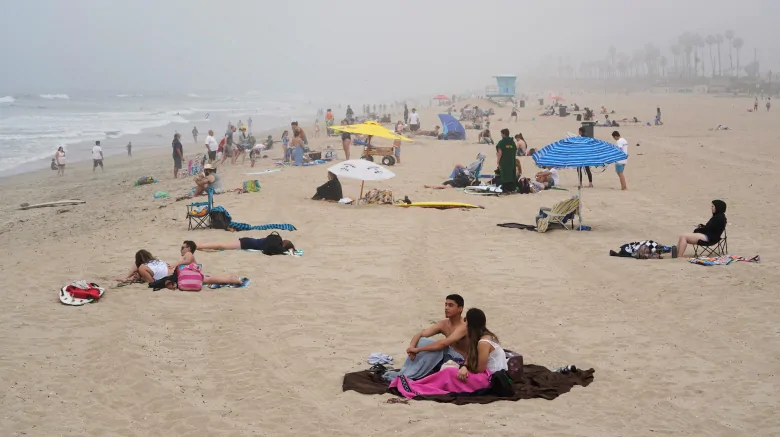
Many Americans flocked to beaches on Saturday as one Florida county expanded access and California experienced a heat wave. Hair salons and other shops in Georgia, Oklahoma and some other states opened for a second day as pockets of the country sought to restart their economies following a month of government-ordered lockdowns.
People sit in groups at Huntington City Beach on Saturday in Southern California. (Kyle Grillot/Reuters)
The tentative steps toward restarting life run against the warnings of many public health experts, who say the increased human interaction could spark a new wave of cases of COVID-19, the respiratory disease caused by the highly contagious virus.
N.Y. governor ‘obsessively focused’ on testing
New York Gov. Andrew Cuomo repeated his warning that reopening businesses too soon was risky, while Rhode Island Gov. Gina Raimondo pushed back against a protest at the State House in Providence as short-sighted, arguing it could force her to delay her restart date of May 8 at the earliest.
“At this point to violate social distancing rules, it’s just selfish,” Raimondo told a briefing, referring to the protest. “If everybody today went out and violated the rules I will definitely have to push back the date at which we can reopen the economy.”
Cuomo said on Saturday that his state began conducting antibody tests of nurses, doctors, police officers, grocery clerks and other essential workers while also allowing local pharmacies to collect samples for diagnostic tests.
The focus on testing comes as the crisis appears to be subsiding in New York, the epicentre of the pandemic in the United States, with hospitalizations falling to their lowest in three weeks.
“Twenty-one days of hell, and now we are back to where we were 21 days ago,” Cuomo told a daily briefing. “Testing is what we are compulsively or obsessively focused on now.”
British Prime Minister Boris Johnson will be back at work on Monday, a Downing Street spokesperson confirmed on Saturday.
Johnson has been recovering from COVID-19 at Chequers, his official country residence, after spending three nights in intensive care earlier this month.
Johnson, 55, was discharged from St Thomas’ Hospital in central London last week. In his first comments since leaving intensive care, Johnson said he owed his life to National Health Service (NHS) hospital staff.
“I can’t thank them enough. I owe them my life,” he said in comments that were released to journalists and confirmed by his office last week.
WATCH | Boris Johnson discharged from hospital after COVID-19 treatment:
British Prime Minister Boris Johnson is thanking health-care workers after being released from hospital. 2:29
China has dispatched a team to North Korea including medical experts to advise on North Korean leader Kim Jong-un, according to three people familiar with the situation.
The trip by the Chinese doctors and officials comes amid conflicting reports about the health of the North Korean leader. Reuters was unable to immediately determine what the trip by the Chinese team signaled in terms of Kim’s health.
A delegation led by a senior member of the Chinese Communist Party’s International Liaison Department left Beijing for North Korea on Thursday, two of the people said. The department is the main Chinese body dealing with neighbouring North Korea.
The sources declined to be identified given the sensitivity of the matter.
The Liaison Department could not be reached by Reuters for comment by late Friday, and China’s foreign ministry did not immediately respond to a request for comment.
No unusual signs, says South Korea
Daily NK, a Seoul-based website, reported earlier this week that Kim was recovering after undergoing a cardiovascular procedure on April 12. It cited one unnamed source in North Korea.
South Korean government officials and a Chinese official with the Liaison Department challenged subsequent reports suggesting that Kim was in grave danger after surgery. South Korean officials said they had detected no signs of unusual activity in North Korea.
On Thursday, U.S. President Donald Trump also downplayed earlier reports that Kim was gravely ill. “I think the report was incorrect,” Trump told reporters, but he declined to say if he had been in touch with North Korean officials.
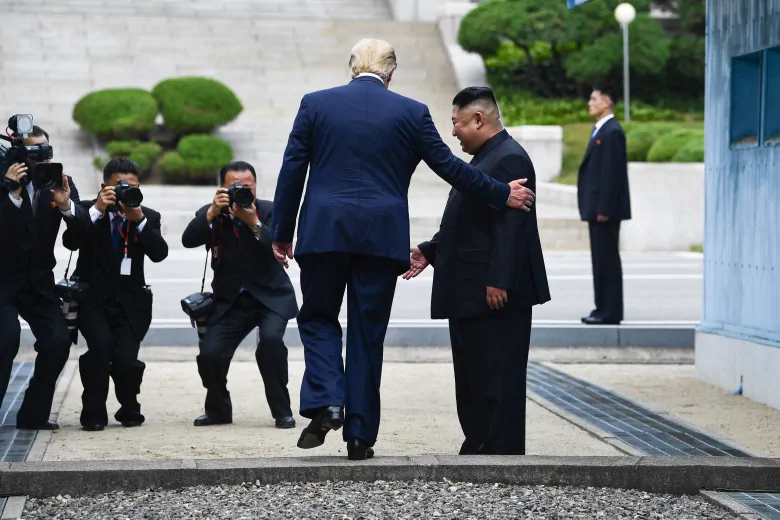
U.S. President Donald Trump meets Kim Jong-un in the Military Demarcation Line that divides North and South Korea, June 30, 2019. On Friday, Trump dismissed reports that Kim is gravely ill. (Brendan Smialowski/AFP/Getty Images)
On Friday, a South Korean source told Reuters their intelligence was that Kim was alive and would likely make an appearance soon. The person said he did not have any comment on Kim’s current condition or any Chinese involvement.
An official familiar with U.S. intelligence said that Kim was known to have health problems but they had no reason to conclude he was seriously ill or unable eventually to reappear in public.
A U.S. State department spokeswoman had no comment. U.S. Secretary of State, Mike Pompeo, when asked about Kim’s health on Fox News after Trump spoke said, “I don’t have anything I can share with you tonight, but the American people should know we’re watching the situation very keenly.”
Kim’s health a matter of state security
North Korea is one of the world’s most isolated and secretive countries, and the health of its leaders is treated as a matter of state security. Reuters has not been able to independently confirm any details on Kim’s whereabouts or condition.
North Korea’s state media last reported on Kim’s whereabouts when he presided over a meeting on April 11. State media did not report that he was in attendance at an event to mark the birthday of his grandfather, Kim Il-sung, on April 15, an important anniversary in North Korea.
Kim, believed to be 36, has disappeared from coverage in North Korean state media before. In 2014, he vanished for more than a month and North Korean state TV later showed him walking with a limp. Speculation about his health has been fanned by his heavy smoking, apparent weight gain since taking power and family history of cardiovascular problems.
When Kim Jong-un’s father,Kim Jong-il, suffered a stroke in 2008, South Korean media reported at the time that Chinese doctors were involved in his treatment along with French physicians.
Last year, Chinese President Xi Jinping made the first state visit in 14 years by a Chinese leader to North Korea, an impoverished state that depends on Beijing for economic and diplomatic support.
People watch a large screen showing an image of Chinese President Xi Jinping, second from left, posing with his wife Peng Liyuan, left, North Korean leader Kim Jong-un and his wife Ri Sol Ju, June 21, 2019. (Jon Chol Jin/The Associated Press)
China is North Korea’s chief ally and the economic lifeline for a country hard-hit by U.N. sanctions, and has a keen interest in the stability of the country with which it shares a long, porous border.
Kim is a third-generation hereditary leader who came to power after his father Kim Jong-il died in 2011 from a heart attack. He has visited China four times since 2018.
Trump held unprecedented summits with Kim in 2018 and 2019 as part of a bid to persuade him to give up North Korea’s nuclear arsenal.
There are signs the political bounce U.S. President Donald Trump’s received in the polls earlier in the coronavirus crisis has, at least for now, deflated.
Election polls in key states show him trailing Joe Biden, the presumed Democratic nominee for president in the November election, and the Gallup polling firm registered his biggest drop in popularity since taking office.
Trump enjoyed a brief rise in public opinion in late March, getting some of his best polling numbers since early 2017, averaging 46 per cent approval and 50 per cent disapproval on the polling site FiveThirtyEight, which tracks a number of polls.
That polling pop fizzled this month, dropping to 43 per cent and 52 per cent, respectively.
The polling aggregator RealClearPolitics.com shows a widening gap between Trump’s approval and disapproval in April in several of the polls it tracks, with the spread ranging between two and 11 percentage points.
‘You never mention it’
In recent days, some polls also suggest Trump is out of sync with public sentiment when it comes to reopening of the economy. Multiple surveys suggest an overwhelming majority of Americans favour a go-slow approach, but Trump has been vocal about his support for protesters in several states calling for an end to COVID-19 shutdowns.
This week, Trump chastised reporters for not giving him the credit he says he deserves for tackling the pandemic.
While the death toll from the virus has surpassed 50,000 in the U.S., projections have been revised significantly downward in recent days.
Trump also expressed annoyance at the lack of media coverage about how the U.S., after a panic over ventilators, now has such a surplus of ventilators that it can start exporting some.
“You never mention it. You never mention it,” Trump said at a press conference Wednesday.
“There’s no story [about] what a great job we’ve done with ventilators.”
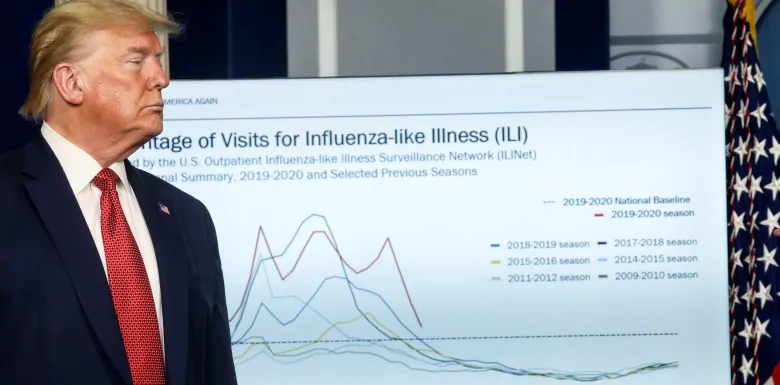
Trump at his daily press conference at the White House on April 16, during which he berated the media for not adequately covering his coronavirus successes stories. (Leah Millis/Reuters)
Disapproval ratings higher
Any mention of presidential polling merits an important caveat: the overwhelming consensus among American political observers is that the 2020 election will be a close, hard-fought affair, as modern U.S. presidential contests usually are.
In other words, it’s a game of inches.
Compared to most politicians, Trump’s approval numbers have been seemingly set in concrete — they budge a couple of points one way, a couple of points the other way.
I’ve had great “ratings” my whole life, there’s nothing unusual about that for me. The White House News Conference ratings are “through the roof”(Monday Night Football, Bachelor Finale , <a href=”https://twitter.com/nytimes?ref_src=twsrc%5Etfw”>@nytimes</a>) but I don’t care about that. I care about going around the Fake News to the PEOPLE!
But Trump did come close to achieving a distinction that’s eluded him since the start of his presidency: for one brief moment last month, Trump nearly had an approval level higher than his disapproval ratings, which hasn’t happened since his first days in office at the start of 2017.
The website Real Clear Politics illustrates how Trump briefly had a majority of Americans supporting his handling of the pandemic. (Real Clear Politics)
But now, he’s back to being what polling junkies refer to as under water.
RealClearPolitics.com finds his disapproval rating is on average five percentage points higher than his approval rating; FiveThirtyEight puts the gap at nine per cent.
Governors faring better
It’s not looking any better in the election polls.
Trump is trailing his general-election rival Biden in 29 of the last 30 head-to-head polling matchups, a lag that persisted even during his brief popularity spike in March.
In addition, he’s also getting lower marks for his handling of the crisis: both polling aggregators now show more disapprovals than approvals.
A number of other politicians, outside and inside the U.S., have gotten a bigger political lift, including Democratic state governors Trump has been fighting with.
Trump’s approval numbers have fallen off their March highs, to where they were in February, which is still better than last fall. (Real Clear Politics)
Those state numbers matter most.
That’s because winning the popular vote doesn’t make you president. Just ask Hillary Clinton. What decides elections is states such as Michigan, Wisconsin and Pennsylvania.
There’s more bad news here for Trump.
Polls in Florida in the last week show him three or four points behind Biden.
His numbers are worse in Michigan. A handful of surveys in the last week show him lagging Biden by between six and nine points.
In Pennsylvania, numerous surveys show him behind between five and eight points. One shows him tied with Biden.
Wisconsin is a bit better for Trump. But he was still lagging in a number of surveys.
It’s been a couple of weeks since the last survey from Arizona, but Trump was down by as much as nine per cent in some polls in a state Republicans almost always carry.
Seniors favour gradual reopening
In Michigan, where demonstrators protesting Democratic Gov. Gretchen Whitmer’s lockdown orders were among those cheered by Trump, a poll commissioned for Fox News last week showed the governor about 15 points more popular than Trump.
That same poll showed Biden eight points ahead of the president.
Another important trend for Trump is his score among older voters. Senior citizens are an indispensable, solidly Republican constituency.
A large majority of Americans opposes reopening the economy now, and a small majority opposes Trump’s handling of the crisis. Here a woman affixes a sign to her vehicle during a protest Thursday in Washington, D.C. (Kevin Lamarque/Reuters)
That Fox survey from Michigan also showed Biden leading Trump by 18 points among self-described baby boomers. And it appears Michigan seniors aren’t as ready to reopen the economy as the protesters Trump cheered on.
Only one-quarter of self-described baby boomers in the Michigan poll said they preferred a quicker reopening.
Noisy minority, meet silent majority
A mere 12 per cent of Americans think current lockdown restrictions go too far, according to a new poll for the Associated Press.
But about 80 per cent of Americans want to keep pandemic restrictions in place, said the poll, which is supported by multiple similar surveys.
That’s after days of widespread news coverage of protests. One such scene unfolded in Pennsylvania this week, where people honked car horns at a rally outside the state legislature.
Thousands of people frustrated by the ongoing COVID-19 lockdown protested in Harrisburg, Pa., on Tuesday. 2:02
Even though a Fox poll from Pennsylvania found most residents favoured a go-slow approach to reopening the economy.
Trump’s message has wavered several times. His official guidelines actually call for a slow, multi-phase reopening of the economy based on a series of criteria.
But then last week, he expressed support for protests against lockdowns in Democratic-controlled swing states, tweeting “LIBERATE MICHIGAN!” and “LIBERATE MINNESOTA!”
Now, he’s gone back to a cautious message.
This week, Trump questioned the logic of Georgia’s Republican governor to immediately open gyms, massage parlors, tattoo shops and beauty salons.
“I disagree strongly,” Trump said, pointing out that the idea violates federal recommendations.
“I think spas and beauty salons and tattoo parlors and barbershops … is just too soon. I think it’s too soon.”
A number of Trump supporters say the restrictions need to loosen up, arguing that they penalize small businesses, and hurt the economy in rural areas where there are few cases.
“They’re using our constitution like toilet paper in a crisis,” said one woman at the Pennsylvania rally, holding up a flag and a booklet containing the constitution.
“We’re living by science and data, not our constitution. That’s wrong. We are not safe if we are not free.”
Protesters did get some concessions this week: In Michigan, Whitmer extended stay-at-home orders to May 15 but also allowed some businesses and outdoor activities to resume.
When New York’s first cases of COVID-19 were announced at the beginning of March, attention was focused on China as the source of the threat.
But preliminary research now suggests dozens of patients with genetic markers of the virus that can be traced to Europe may have been spreading it across the city as early as late January— a key factor that led New York to become the epicentre of the outbreak in the U.S.
The first identified case of community spread in New York, a lawyer from the suburb of Westchester, is linked to more than 100 other COVID-19 cases. So the likely spread from dozens of other unknown cases put New York behind the eight ball right from the beginning, said Dr. Eric Cioe-Pena, director of global health for Northwell Health, a non-profit network that runs hospitals and research and testing facilities in the state.
“It became kind of a losing game. We were already on the wrong end of the curve and time was no longer our friend,” said Cioe-Pena, noting that scientists are still studying the origin of these cases, including how the Westchester lawyer contracted the virus.
“As we were learning about this virus, how it was transmitted, about the asymptomatics, it was already raging in New York.”
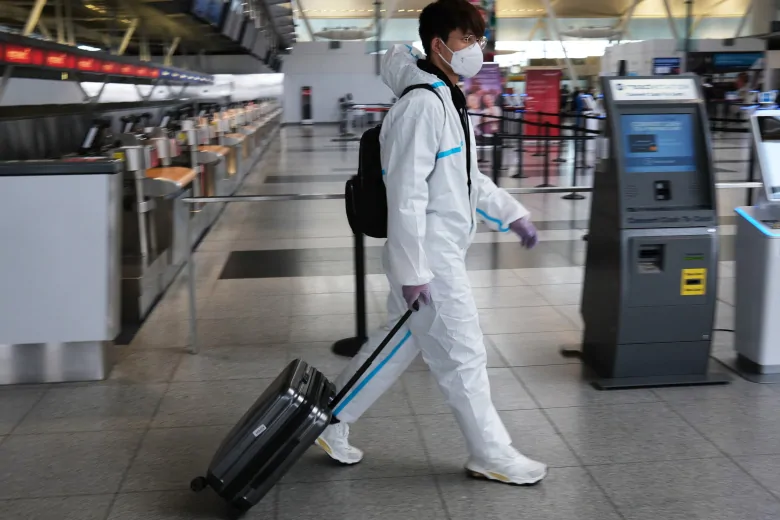
Travellers wearing protective gear walk through New York’s John F. Kennedy Airport on April 16 as it stands mostly empty due to the ongoing cutbacks in travel because of the COVID-19 pandemic. (Spencer Platt/Getty Images)
Experts say a lack of available testing, poor screening at the city’s international airports and a dense urban area combined to bring New York to its knees, forcing millions into isolation and pushing hospitals to the brink.
With more than 15,000 probable and confirmed deaths due to COVID-19, New York City has the fifth highest recorded death toll in the world, behind only Italy, Spain, France and the U.K.
Early disadvantage
That such a high number of probable cases went undetected early on put New York at a disadvantage compared to cities on the West Coast, which had fewer initial cases and locked down sooner, said George Rutherford, the head of infectious disease and global epidemiology at the University of California, San Francisco.
“When New York started off, they had 200-plus chains of transmission going on, whereas out here in the West, we had six, seven, eight, something like that,” he said.
In California, health officials have determined the earliest death they can trace to COVID-19 came on Feb. 6, indicating the virus was likely in the region in January.
A study from Mount Sinai Hospital in New York links the city’s first cases to Europe and other parts of the U.S. — not to China, where the virus originated — and suggests the virus was possibly circulating in late January. The research is what’s known as a preprint study, meaning it has yet to be peer reviewed by independent experts.
“Basically, the virus was already in the population and there was already community transmission before we even realized that we needed to do this social distancing,” said Elodie Ghedin, professor of biology and global public health at New York University.
Medical staff provide COVID-19 testing in the parking lot of their clinic in the Staten Island borough of New York City. Testing sites continue to open throughout the city. (David Dee Delgado/Getty Images)
An estimate from researchers at Northeastern University, shared with the New York Times, suggests that by March 1, New York City may have had in excess of 10,000 cases.
“It stands to reason that there was community transmission occurring in New York that we didn’t know about,” said virologist Dr. Angela Rasmussen of Columbia University. “Because New York is so densely populated, there’s the opportunity to really amplify that and have it go out of control.”
A failure of testing
Cioe-Pena said the initial lack of testing infrastructure meant health officials were unable to keep on top of the spread, contributing to New York’s inability to control the outbreak.
Early stumbles by the U.S. Centers for Disease Control and Prevention meant states and municipal officials didn’t have access to large numbers of tests, so they were limited to testing only the sickest patients, and it would take days to get results back.
“It was already too late for us to scale up testing. We had already missed the boat on that,” Cioe-Pena said.
By March 5, the city was monitoring 2,773 people in home isolation, and Mayor Bill de Blasio was calling on the federal government for more help with testing. It would be more than two weeks before Gov. Andrew Cuomo issued the shelter-in-place order.
New York City Mayor Bill de Blasio visits Union Square to distribute information about the coronavirus on March 9. At the time, there were 20 confirmed COVID-19 cases in the city, out of the 142 total cases in the state. (Jeenah Moon/Getty Images)
Rasmussen said such an order may have come sooner had the city had the ability to test more proactively for COVID-19, as well as antibody testing to detect those who’d already had the illness.
“I think that was definitely a missed opportunity,” she said.
As of Thursday, officials said there were more than 138,000 confirmed cases of COVID-19 in New York City, but that number misses the mark because, from the beginning, people with mild symptoms were told not to get tested.
“It wouldn’t surprise me if at this point in time, we have probably close to a million New Yorkers who have been exposed to COVID-19,” said Dr. Oxiris Barbot, New York City’s health commissioner.
Political missteps
Not knowing the true footprint of the virus may have given elected officials a level of misplaced confidence early on. In the beginning of March, New York state and local officials sought to reassure the public even as the virus was apparently spreading silently throughout the population.
On March 11, Mayor de Blasio was still advising healthy city residents to continue socializing.
“People should go out and continue to live life, should go out to restaurants,” he said.
Officials at the city and state level also clashed over everything from closing schools to postponing New York City’s St. Patrick’s Day parade. Containment measures focused on the suburbs, not the city.
A statewide stay-at-home order was announced on March 20 and went into effect two days later. California, following earlier measures implemented by some of its jurisdictions, shut down on March 19.
“I still think that the response was too slow at the federal level, at the state level, at the city level,” Ghedin said.
Gov. Andrew Cuomo, now widely praised for his steady demeanour during the crisis, also sounded a confident note on March 5, saying, “We have the best health-care system in the world here.”
Cuomo on Friday reacted to the recent research, saying it offers a valuable lesson for future pandemics, that an outbreak on the other side of the world can and will travel fast.
“When you look back, does anyone think the virus was still in China waiting for us to act two months later?” Cuomo said.
New York Gov. Andrew Cuomo, seen last month, has received widespread praise for his handling of the COVID-19 crisis. He ordered a statewide stay-at-home order that began on March 22. But by then, the coronavirus may have been spreading for nearly two months, research suggests. (John Minchillo/The Associated Press)
He pointed out that between January and when the state shut down in March, there were 13,000 flights from Europe to New York, bringing in 2.2 million people.
Cuomo said the ban on travel from China to the U.S. on Jan. 31 was appropriate, but the European travel restrictions on March 14 came too late.
“We closed the front door with the China travel ban … but we left the back door open.”
No easy choices
Nonetheless, New York officials were facing difficult choices, Ghedin said. She points out, for example, that the mayor and governor clashed over when to close schools, in part because of the large number of students who rely on the school system for free or subsidized meals.
“As a virologist and as an epidemiologist, of course my first thought was, ‘You have to close the schools.’ But it’s hard when you start weighing all these other elements that are important in a society.”
Dr. Tom Frieden, the former head of the U.S. Centers for Disease Control and a former New York health commissioner, told the New York Times that stronger quarantine measures a week or two earlier could have reduced the death toll by 50 to 80 per cent.
However, as Cioe-Pena points out, shutting down New York City simply wasn’t an idea people could wrap their heads around at the time.
“This is something that was conceptually inconceivable in February, for an American city the size of New York to lock down.”
Warning: Speculating about medical cures on live television during a global pandemic may carry multiple unwanted side-effects.
Just ask U.S. President Donald Trump.
On Friday, institutions in different countries were issuing health warnings about different medical ideas the president of United States had shared with millions of television viewers.
The most attention-grabbing alert came from the British company that makes Lysol disinfectant products, which issued an obvious-sounding admonition: Don’t inject yourself with Lysol.
“Under no circumstance should our disinfectant products be administered into the human body,” said the statement from British company RB.
“[That includes] injection, ingestion or any other route.”
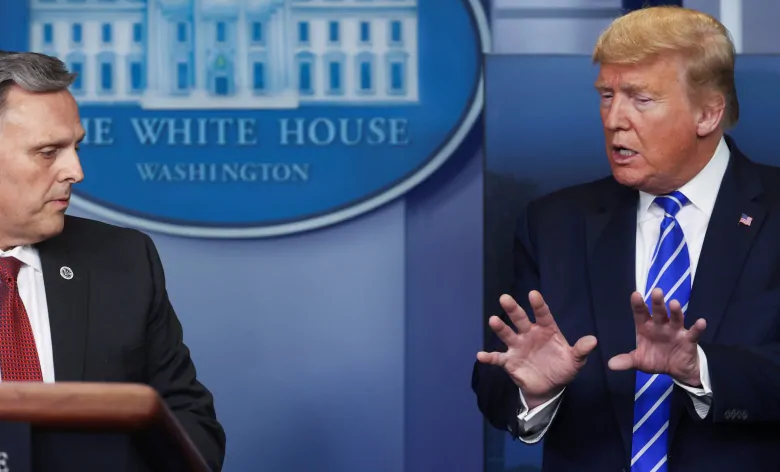
Trump says the media twisted his remarks. The bleach-injecting controversy began with an offhand comment Trump made in response to Homeland Security official William Bryan, left, discussing promising coronavirus tests involving sunlight and disinfectant on surfaces. (Jonathan Ernst/Reuters)
The genesis of this medical warning was an offhand remark by Trump, which his staff says was twisted out of context, and which Trump himself now claims was meant sarcastically.
During Trump’s daily news conference on Thursday, a U.S. official from the Department of Homeland Security made a routine announcement about lab tests indicating that sunlight and cleansing agents drastically weaken COVID-19 on surfaces.
Trump chimed in, suggesting maybe these things could be tested on humans. He talked about possibly hitting the body with a “tremendous” amount of light, and also proposed tests with injections.
He then quickly appeared to contradict himself.
A reporter asked whether the president was really talking about injecting people with bleach and Trump replied that he wasn’t.
WATCH | Trump’s comments about light and disinfectant:
After suggesting what some call ‘dangerous’ ways to combat COVID-19, the U.S. president was once again criticized for his handling of the coronavirus outbreak. 3:23
And that’s the exchange that launched hundreds of embarrassing headlines around the world, in a variety of languages. French TV networks, for example, called it “mind-blowing,” and suggested the president was telling people to inject disinfectant.
The office of Maryland’s Republican governor, Larry Hogan, issued a public alert, after the state received more than 100 calls from people inquiring about ingesting disinfectants to combat COVID-19.
We decided to take the step of posting this alert after receiving more than 100 calls to our hotline.
But a White House spokesperson pushed back on the reporting. “Leave it to the media to irresponsibly take President Trump out of context and run with negative headlines,” said Kayleigh McEnany.
It was just her latest entanglement with the press this week. She also blasted a reporter for not addressing Trump as the “president,” which drew reminders that she herself wasn’t especially courteous to Trump’s predecessor.
Now, about that malaria drug
Warnings emanated from inside the administration about another potential medical solution floated by the president.
The U.S. Food And Drug Administration advised against the use of hydroxychloroquine, the malaria drug Trump spent weeks touting as a possible game-changer in the fight against COVID-19.
It released a statement saying hydroxychloroquine, which also treats lupus and rheumatoid arthritis, can cause heart and kidney problems, increase insulin levels, and raise the risk of severe hypoglycemia.
The FDA said it reviewed case reports and found no proof the drug works against COVID-19. Given the side-effects, it said use of the pill should be limited to clinical trial settings or for certain hospitalized patients.
The president’s backers point out that there’s some nuance here.
Early studies are contradictory. And when discussing the drug, Trump put up some caveats, too. He repeatedly mentioned the possible side-effects of hydroxychloroquine, even as he was promoting its use during his news conferences.
Trump did couch his medical advice with safety caveats. Here’s what he said about hydroxychloroquine on April 6. (White House transcript)
However, for weeks, he and an entire ecosystem of supporters touted this cheap generic medicine as a possible solution to the COVID-19 crisis.
Fox News played a significant role.
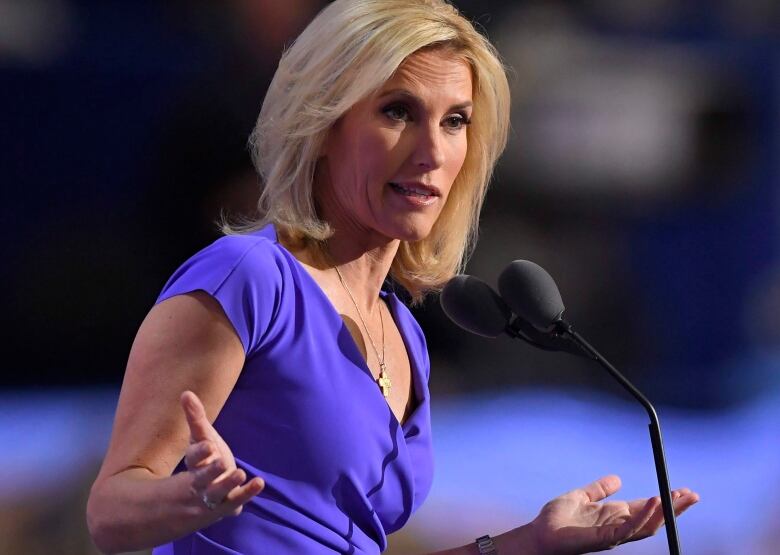
A devoted Fox News viewer, the president would have seen frequent appearances by celebrity doctor Mehmet Oz and segments from Fox host Laura Ingraham talking up hydroxychloroquine.
But those television personalities didn’t just promote the drug on the air: they both personally spoke with administration members about the issue.
Trump supporters, such as Fox News host Laura Ingraham, have been promoting the use of hydroxychloroquine for weeks, despite the lack of evidence showing it’s an effective treatment for COVID-19. (Mark J. Terrill/The Associated Press)
Ingraham met with Trump to discuss it, The Washington Post reported. Oz even spoke on-air about how he discussed hydroxychloroquine with senior U.S. health official Seema Verma.
Now, a U.S. study conducted among veterans suggests the drug offers no benefit against COVID-19 — and might be likelier to harm people.
A French study drew similar conclusions. The National Institute of Allergy and Infectious Diseases, led by Dr. Anthony Fauci, issued guidelines that say there are no proven drugs for treating COVID-19.
This week, a U.S. federal official said he was ousted from his senior role in the Department of Health and Human Services for resisting Trump’s promotion of hydroxychloroquine.
The fact is, the hydroxychloroquine research is still at an early stage. Some studies have suggested it might act as an anti-viral agent.
Ingraham this week again defended the drug and pointed to methodological shortcomings in the new U.S. study.
A member of the Trump cabinet also warned against drawing conclusions. Veterans Affairs Secretary Robert Wilkie said the U.S. study, conducted in conjunction with his department, is not a definitive conclusion. He called it a non-clinical study, involving a small number of veterans in the last stages of life.
‘Limit the mistakes you’re making’
As for Trump’s daily televised event, Republican strategist Matt Mackowiaksaid it’s understandable why the president views them as useful.
He said the president can communicate directly with voters, around a media filter that sometimes distorts his message.
But still, said the strategist, stricter message discipline might help.
Instead of the freewheeling daily event, he said Trump would be better off doing a brief announcement, then turning the event over to experts.
“Get your message out there. And also limit the mistakes you’re making,” he told CBC News.
“Do … five or 10 minutes at the beginning, then do the substance, then evacuate.”
Which is what happened Friday. A day after the bleach-injection musings, Trump and his team held their shortest coronavirus briefing ever, and the week ended without a fresh controversy.