Spanish authorities on Monday prepared to further loosen one of Europe’s toughest coronavirus lockdowns and played down concerns that letting children outdoors after six weeks had led to crowds forming in public spaces.
Having suffered one of the world’s deadliest outbreaks of the COVID-19 pandemic, Spain shut down public life on March 14 to curb its spread, but recently began to ease restrictions as it reined in the infection rate. The government is now preparing to phase out further restrictions on mobility.
In the most significant relaxation of the lockdown yet, on Sunday children under 14 were granted one hour of daily supervised outdoor activity if they adhered to physical distancing guidelines and stayed within one kilometre of their homes.
Health Minister Salvador Illa told a news conference the first day under the new regulations had gone well and the behaviour of most people had been “exemplary,” though again stressed the need for all to observe physical distancing rules.
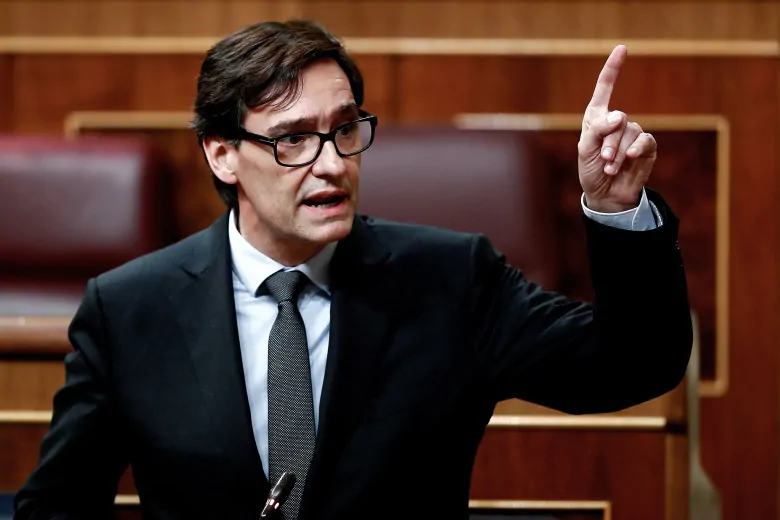
Spanish Health Minister Salvador Illa addresses parliament in Madrid on April 22. Illa has continued to stress the need for physical distancing rules even as the country begins to relax restrictions. (Sebastian Marsical/EFE/AFP/Getty Images)
Some local authorities had complained parents were allowing their kids to flout the regulations, and TV footage showed large crowds gathering in parks and on boardwalks across the country.
In the capital Madrid, police deployed drones to patrol recreational areas, broadcasting the new rules over loudspeaker and monitoring for any breaches.
“The rules are there to protect your children’s health,” Interior Minister Fernando Grande-Marlaska said.
He said he had received reports of entire families out strolling together and children playing in groups, both of which remain prohibited.
At a press briefing in Barcelona, Catalan regional interior secretary Miquel Buch called for more nuanced regulations such as allowing children of different ages out at different times to avoid crowds.
He also said that, in future, the Spanish government should set aside specific times for vulnerable groups, such as the elderly, to be outdoors.
More testing underway
A long-awaited study into the prevalence of the coronavirus among the Spanish population began on Monday. Directed by the Carlos III Health Institute, it aims to test 36,000 families for the presence of antibodies generated to fight off the virus.
It should help researchers identify people who were infected but never tested because they did not become ill enough to seek medical attention or never developed symptoms.
The testing will help the government gauge the real extent of the epidemic, taking into account also those who may be immune or resistant to the infection.
In this file photo, people pass the entrance of the Carlos III Health Institute in Madrid, where a study on the prevalence of COVID-19 antibodies in the general population is being directed. (Andrea Comas/Reuters)
“Its relevance goes beyond the purely scientific,” said the institute’s director, Raquel Yotti. “The goal is to help us make public-health decisions.”
Daily fatalities from the virus rose by 331 on Monday to a total of 23,521, edging up from 288 the previous day but well below the daily peak of more than 900 recorded in early April. Cumulative cases rose to 209,465 from 207,634 the day before.
If the daily death toll continues to fall, Spaniards of all ages will be allowed to exercise outdoors starting May 2, Prime Minister Pedro Sánchez announced on Saturday.
He also said his cabinet would approve on Tuesday a wider plan to lift restrictions and gradually restart the country’s stuttering economy.
Although some key businesses have continued to operate through the shutdown, bars and restaurants remain closed and the country’s vital tourism sector has ground to a halt.
Other companies that had halted production are resuming trade in Spain as the contagion eases. Car-maker Volkswagen said Monday it would restart its assembly lines at its Seat factories in Spain.
The lockdown loosening will not be rolled out by the authorities in unison across the country. Instead, each region will decide its own plan based on several criteria, including the infection rate and capacity of local health services.
British Prime Minister Boris Johnson urged his lockdown-weary country to be patient Monday, arguing that easing social and economic restrictions too soon would create a second deadly spike of coronavirus infections.
On his first day back at work in three weeks after a bout of COVID-19 that left him dangerously ill, Johnson said Britain had reached the moment of “maximum risk” in its outbreak.
Speaking outside his 10 Downing Street office, Johnson said the country was reaching “the end of the first phase of this conflict” but warned that a quick end to a lockdown due to last at least until May 7 was not in sight.
“I refuse to throw away all the effort and the sacrifice of the British people and to risk a second major outbreak and huge loss of life and the overwhelming of the [National Health System],” said Johnson.
As of Sunday, Britain had recorded 20,732 deaths among people hospitalized with COVID-19, the fifth country in the world to surpass 20,000 deaths. Thousands more are thought to have died in nursing homes during the pandemic.
Despite the death toll, Johnson’s government is under mounting pressure to set out a blueprint for easing the lockdown that has sharply curtailed business and daily life since March 23.
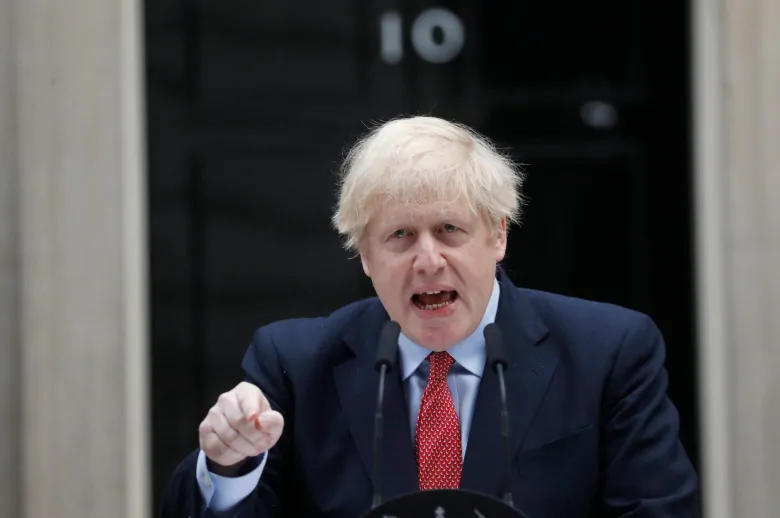
British Prime Minister Boris Johnson makes a statement on his first day back at work in Downing Street on Monday after recovering from a bout with the coronavirus that put him in intensive care. (Frank Augstein/The Associated Press)
More than 1.5 million Britons have applied for welfare benefits in the past month, and the government’s economic watchdog says the economy could shrink by 35 per cent by June 1.
In signs of lockdown fatigue, the volume of road traffic has begun to creep up, and businesses including construction sites and home-supply stores have begun to reopen after introducing social distancing measures.
As other European countries begin to reopen businesses and schools, Johnson said he shared Britons’ impatience to get back to normality. But he said “we simply cannot spell out now how fast or slow or even when those changes will be made.”
Johnson indicated that any loosening of the lockdown would happen in stages, as authorities “begin gradually to refine the economic and social restrictions and one by one to fire up the engines of this vast U.K. economy.”
Promises transparency
Johnson, 55, spent a week in St. Thomas’ Hospital in London earlier this month, including three nights in intensive care. When he was discharged on April 13, he thanked medical workers at the hospital for saving his life, saying his condition “could have gone either way.”
During his absence, Johnson’s Conservative government has struggled to counter criticism over shortages of protective equipment for medical workers and a lack of testing for the virus. The government has promised to conduct 100,000 coronavirus tests a day by the end of April, but has yet to reach even 30,000 a day.
Countering claims that the government has been secretive, Johnson promised decisions about ending the lockdown would be made “with the maximum possible transparency” and in consultation with businesses, regional authorities and opposition parties.
The Australian government launched a controversial coronavirus tracing app on Sunday and promised to legislate privacy protections around it as authorities try to get the country and the economy back onto more normal footing.
Australia and neighbouring New Zealand have both managed to get their coronavirus outbreaks under control before it strained public health systems, but officials in both two countries continue to worry about the risk of another flareup.
“We are winning, but we have not yet won,” Australian Health Minister Greg Hunt said at a televised briefing announcing the app’s launch
The app, which is based on Singapore’s TraceTogether software, uses Bluetooth signals to log when people have been close to one another. It has been criticized by civil liberties groups as an invasion of privacy.
The Australian government, which wants at least 40 per cent of the population to sign up to make the effort effective, said the voluntary app, which would not track location, is safe.
Only public health will access data
The app’s stored contact data will enable health officials to trace people potentially exposed to infections.
“It will help us as we seek to return to normal and the Australian way of life,” Hunt said. “No one has access to that, not even yourself … only a state public health official can be given access to that data.”
A legislative directive ensuring that will be proposed to the parliament in May, the health ministry said on the app’s website on Sunday.
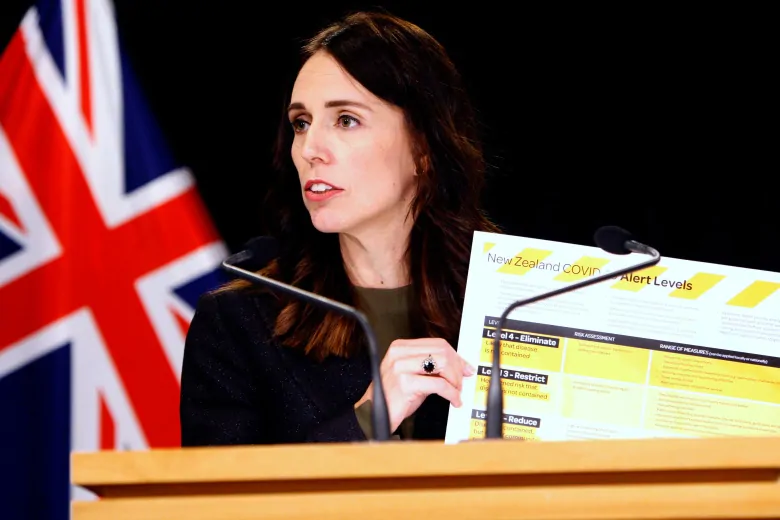
In this March 21 photo, New Zealand Prime Minister Jacinda Ardern holds up a card showing a new alert system for COVID-19 in Wellington, New Zealand. New Zealand implemented some of the strictest lock-down measures in the world and is set to begin lifting those Tuesday. (Nick Perry/The Associated Press)
A few countries, including South Korea and Israel, are using high-tech methods of contact tracing which involves tracking peoples’ location via phone networks, though such centralized, surveillance-based approaches are viewed as invasive and unacceptable in many countries.
Trust in governments in Australia and New Zealand has risen since the start of the pandemic, opinion polls show, with leaders of both countries — ideologically opposite — hailed for their management in suppressing the coronavirus.
The rate of increase in new cases has been below one per cent for two weeks now in both countries, much lower than in many other countries.
New Zealand to ease measures Tuesday
On Sunday, Australia’s states of Queensland and Western Australia said they would slightly ease social distancing rules this week to allow for larger outdoor public gatherings, among others, but officials in Victoria, second most populous state, said they were not ready to relax the state’s hardline restrictions.
Australia reported 16 new coronavirus cases on Sunday, which took its total to 6,703, according to health ministry data. There have been 83 deaths.
In New Zealand, there were four new confirmed cases, bringing the total to 1,121. Eighteen people have died, health ministry data showed.
On Tuesday, New Zealand will start to ease some of the world’s strictest lockdown measures, and is also set to roll out a tracing app soon, but Prime Minister Jacinda Ardern has warned this is not the only panacea.
“We have been very clear on from the beginning that no tracking app provides a silver bullet,” Ardern said earlier this month.
A man shot in the Aug. 3 attack targeting Latinos in an El Paso, Texas, Walmart died after months in the hospital, raising the death toll from the attack to 23, according to a hospital official.
“After a nearly nine-month fight, our hearts are heavy as we report Guillermo ‘Memo’ Garcia, our last remaining patient being treated from the El Paso shooting, has passed away,” said Del Sol Medical Center CEO David Shimp.
Garcia and his wife, Jessica Coca Garcia, were fundraising for their daughter’s soccer team in the Walmart parking lot when the suspected gunman opened fire that Saturday morning.
Garcia is survived by his wife, who suffered leg wounds but recovered. A week after the shooting, she rose from her wheelchair to give a speech across the road from the county jail where the suspected shooter was being held.
“Racism is something I always wanted to think didn’t exist. Obviously, it does,” she said.
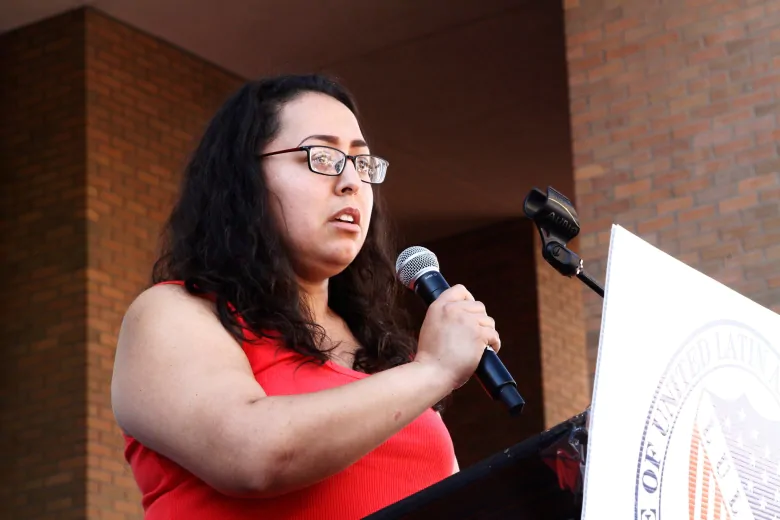
Jessica Garcia speaks at a gathering in El Paso, Texas, in August 2019. (Cedar Attanasio/The Associated Press)
The suspect, 21-year-old Dallas-area man Patrick Crusius, remains in the same jail awaiting trial. State prosecutors have charged him with murder and are pursuing the death penalty, and federal prosecutors charged him with hate crimes.
Police said they arrested Crusius near the shooting after he surrendered to officers, telling them he was targeting “Mexicans.” They also attributed to him a four-page racist screed that decried a Hispanic “invasion” of Texas and the U.S., and called for ethnic and racial segregation.
The shooting was the largest terrorist attack targeting Hispanics in modern history, and spread fear throughout the Latino community.
In the wake of the attack El Paso police said the Walmart had previously hired armed off-duty police officers to guard larger stores, but removed them at some point.
A Texas state trooper walks back to his car while providing security outside the Walmart store in the aftermath of a mass shooting in El Paso in August 2019. (Andres Leighton/The Associated Press)
The Garcia family joined a number of victims who sued the Walmart over lack of security on the busy Saturday shopping day when about 3,000 people were in the store. The lawsuit is ongoing.
Following the attack, the Bentonville, Ark.-based company added armed and unarmed officers to all of its stores. It stopped selling handguns and short-barrel rifle ammunition.
The store where the shooting took place reopened in November.
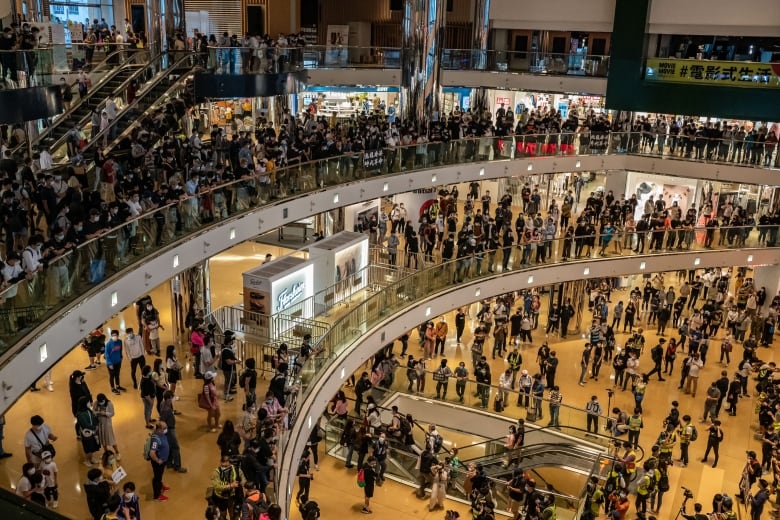
Demonstrators gathered in a Hong Kong mall on Sunday chanting pro-democracy slogans, even as Hong Kong’s social distancing measures banned gatherings of more than four in public.
Police officers, including riot police with shields, entered the Cityplaza shopping mall in Tai Koo to disperse the crowds shortly after demonstrators gathered.
Hundreds of protestors gathered and sung the protest anthem Glory to Hong Kong. They shouted slogans reiterating their demands to the government and called for the Hong Kong police force to be disbanded.
The demonstration comes on the heels of the arrest of 15 former lawmakers and pro-democracy activists last week on charges of unlawful assembly stemming from huge rallies that were previously held against a controversial extradition bill that would allow detainees to be transferred to mainland China.
The extradition bill was later withdrawn in September 2019, although protests continued for several months. Protesters demanded voting rights and an independent inquiry into police conduct.
Hundreds of protestors gathered and sung the protest anthem Glory to Hong Kong. They shouted slogans reiterating their demands to the government and called for the Hong Kong police force to be disbanded. (Anthony Kwan/Getty Images)
Sunday’s demonstration is the city’s largest this year. Protests had quieted down in January after the COVID-19 outbreak in China led to a global pandemic.
Hong Kong reported no new cases on Sunday for the third time in the last seven days. The city has recorded a total of 1,038 infections and four deaths so far.
Kim Jong-un’s disappearance from the public eye has raised speculation about the North Korean leader’s health as well as who would take over should anything happen to him.
North Korea is one of the world’s most isolated and secretive countries, and the health of its leaders is treated as a matter of state security. Reuters has not been able to independently confirm any details on Kim’s whereabouts or condition.
Kim, believed to be 36, has disappeared from coverage in North Korean state media before. In 2014, he vanished for more than a month and North Korean state TV later showed him walking with a limp. Speculation about his health has been fanned by his heavy smoking, apparent weight gain since taking power and family history of cardiovascular problems.
Here is what we know — and don’t know — about Kim’s health:
When was Kim last seen?
North Korea’s state media last reported on Kim’s whereabouts when he presided over a meeting on April 11. According to the North’s official Korean Central News Agency, he discussed coronavirus prevention at the meeting and elected his sister, Kim Yo-jong, as an alternate member of the political bureau of the ruling Workers’ Party.
Questions about Kim’s health flared after he skipped an April 15 commemoration of the 108th birthday of his late grandfather, North Korea founder Kim Il-sung. Kim hadn’t missed the event since inheriting power from his father, Kim Jong-il, in late 2011.
Report of heart procedure
Daily NK, a Seoul-based website, reported on Monday that Kim was recovering after undergoing a cardiovascular procedure on April 12. It cited one unnamed source in North Korea.
A special train possibly belonging to Kim was spotted this week at Wonsan, a North Korean resort town, according to satellite images reviewed by a Washington-based North Korea monitoring project.
A special train possibly belonging to Kim is seen in a satellite image with graphics taken over Wonsan, North Korea on April 21, according to a Washington-based North Korea monitoring project. (Maxar Technologies-38 North/Handout/Reuters)
Kim’s health has deteriorated in recent months due to heavy smoking, obesity and overwork, a Daily NK report from Wednesday said. “My understanding is that he had been struggling [with cardiovascular problems] since last August but it worsened after repeated visits to Mount Paektu,” a source was quoted as saying, referring to the country’s sacred mountain. Kim left for the hospital after presiding over the April 11 meeting, the report said.
Any comment from North Korea?
The state-controlled media in North Korea has been silent on Kim’s whereabouts, while South Korean officials reported no unusual activity in North Korea on Tuesday following the unconfirmed media reports.
North Korea’s state media on Wednesday said Kim sent a message thanking Syrian President Bashar al-Assad for conveying greetings on his grandfather’s birthday, but didn’t report any other activities, while rival South Korea repeated that no unusual developments had been detected in the North.
Danny Russel, a former U.S. National Security Council director and assistant secretary of state for Asia who has dealt with North Korea in the past, cautioned that rumours have abounded for years about Kim, his father and his grandfather, and most turned out to have been false.
“While serving in government I was on the receiving end of multiple intelligence reports about alleged accidents, illnesses and assassination attempts against North Korean leaders — only to have them reappear in public,” he said.
‘I hope he’s OK,’ Trump says
On Thursday, U.S. President Donald Trump downplayed earlier reports that Kim was gravely ill. “I think the report was incorrect,” Trump told reporters, but he declined to say if he had been in touch with North Korean officials.
Trump held unprecedented summits with Kim in 2018 and 2019 as part of a bid to persuade him to give up North Korea’s nuclear arsenal.
U.S. President Donald Trump, right, last met with Kim in 2019 at the demilitarized zone separating North and South Korea in Panmunjom, South Korea. (KCNA/Reuters)
On Friday, a South Korean source told Reuters their intelligence was that Kim was alive and would likely make an appearance soon. The person said he did not have any comment on Kim’s current condition or any Chinese involvement.
An official familiar with U.S. intelligence said that Kim was known to have health problems but they had no reason to conclude he was seriously ill or unable eventually to reappear in public.
Any comment from South Korea?
South Korean government officials, as well as a Chinese official with the Liaison Department, challenged reports suggesting that Kim was in grave danger after surgery.
“We have no information to confirm regarding rumours about Chairman Kim Jong-un’s health issue that have been reported by some media outlets,” South Korean presidential spokesperson Kang Min-seok said. “Also, no unusual developments have been detected inside North Korea.”
The South Korean presidential office later said Kim is believed to be staying at an unspecified location outside of Pyongyang, North Korea’s capital, with some close confidants. It said Kim appeared to be normally engaged with state affairs and there wasn’t any unusual movement or emergency reaction from North Korea’s ruling party, military or cabinet.
China sends medical experts
China has dispatched a team to North Korea including medical experts to advise on Kim, according to three people familiar with the situation. Reuters was unable to immediately determine what the trip by the Chinese team signaled in terms of Kim’s health.
A delegation led by a senior member of the Chinese Communist Party’s International Liaison Department left Beijing for North Korea on Thursday, two of the people said. The department is the main Chinese body dealing with neighbouring North Korea.
The sources declined to be identified given the sensitivity of the matter.
Last year, Chinese President Xi Jinping made the first state visit in 14 years by a Chinese leader to North Korea, an impoverished state that depends on Beijing for economic and diplomatic support. China is North Korea’s chief ally and the economic lifeline for a country hard-hit by U.N. sanctions, and has a keen interest in the stability of the country with which it shares a long, porous border.
Who would take over if something happened to Kim?
Kim is the third generation of his family to rule North Korea, and a strong personality cult has been built around him, his father and grandfather. The family’s mythical “Paektu” bloodline, named after the highest peak on the Korean Peninsula, is said to give only direct family members the right to rule the nation.
That makes Kim’s younger sister, senior ruling party official Kim Yo-jong, the most likely candidate to step in if her brother is gravely ill, incapacitated or dies.
“Among the North’s power elite, Kim Yo-jong has the highest chance to inherit power, and I think that possibility is more than 90 per cent,” said analyst Cheong Seong-Chang at the private Sejong Institute in South Korea. “North Korea is like a dynasty, and we can view the Paektu descent as royal blood so it’s unlikely for anyone to raise any issue over Kim Yo-jong taking power.”
Kim Yo-jong, the North Korean leader’s sister, is a likely candidate to step in if her brother is gravely ill, incapacitated or dies. (Jorge Silva/File/Reuters)
But some experts say a collective leadership, which could end the family’s dynastic rule, could also be possible. “North Korean politics and the three hereditary power transfers have been male-centred. I wonder whether she can really overcome bloody socialist power struggles and exercise her power,” said Nam Sung-wook, a professor at Korea University in South Korea.
A collective leadership would likely be headed by Choe Ryong-hae, North Korea’s ceremonial head of state who officially ranks No. 2 in the country’s current power hierarchy, Nam said. But Choe is still not a Kim family member, and that could raise questions about his legitimacy and put North Korea into deeper political chaos, according to other observers.
Other Kim family members who might take over include Kim Pyong-il, the 65-year-old half-brother of Kim Jong-il who reportedly returned home in November after decades in Europe as a diplomat.