Some businesses prepared to reopen in Georgia on Friday as the United States passed another grim milestone in the spread of the pandemic.
The U.S. death toll from the novel coronavirus reached 50,031 early Friday, according to tracking by Johns Hopkins University.
American deaths have doubled in just 10 days to become the highest in the world, according to a separate Reuters tally. While the first known coronavirus death in the country is said to have occurred on Feb. 6, the U.S. only reached 1,000 deaths a month ago, on March 26.
About 875,000 Americans have contracted the highly contagious respiratory illness COVID-19, which is caused by the virus.
Home care nurse Flora Ajayi in the Queens borough of New York City dons personal protective equipment to protect herself and prevent cross-contamination while visiting a client during the COVID-19 outbreak. (Lucas Jackson/Reuters)
The toll exceeds deaths from the seasonal flu in seven out of nine recent seasons, according to the Centers for Disease Control and Prevention (CDC). Flu deaths range from a low of 12,000 in 2011-2012 to a high of 61,000 in the 2017-2018 season.
High per-capita death rate
Of the top 20 most severely affected countries, the United States ranks ninth based on deaths per capita, according to a Reuters tally. The United States has 1.5 deaths per 10,000 people. Belgium ranks first, at more than five deaths per 10,000 people, followed by Spain, Italy, France and the United Kingdom.
Coronavirus deaths are also likely higher, as most states only count hospital and nursing home victims and not those who died at home. About 40 per cent of the deaths have happened in New York state, the epicentre of the U.S. outbreak, followed by New Jersey, Michigan and Massachusetts.
Although the rate of hospitalizations and other indicators of the outbreak’s severity have begun to level off in recent days, California registered its highest single-day loss of life to date on Thursday, with 115 deaths reported over the previous 24 hours.
California Gov. Gavin Newsom urged state residents to follow stay-at-home orders despite weekend forecasts of warm, sunny weather that could tempt many to beaches that are officially still closed.
Americans may not rush to businesses, polls suggest
From Tennessee to Texas to Ohio to Montana, a handful of governors around the country have announced plans to swiftly allow the reopening of some workplaces that had been ordered closed as a way of curbing the spread of the coronavirus.
Some of those plans have drawn fire from public health experts and other governors who warn that a premature easing of stay-at-home orders and business closures imposed over the past five weeks could trigger a renewed surge in coronavirus cases.
It’s uncertain how much activity businesses will receive. A Reuters/Ipsos survey this month found that a bipartisan majority of Americans want to continue to shelter in place to protect themselves from the coronavirus, despite the impact on the economy.
Several opinion polls have shown a bipartisan majority of Americans want to remain at home to protect themselves from the coronavirus, despite the impact to the economy.
WATCH l Intense focus on COVID-19 vaccine has other consequences:
There’s growing concern that if children’s routine vaccinations are delayed because of the COVID-19 pandemic preventable diseases like measles could see a resurgence. 2:03
Only 13 per cent of Americans polled in a CBS News survey released on Thursday said they would definitely return to public places over the next few weeks if restrictions were lifted now, no matter the status of the outbreak.
Georgia Gov. Brian Kemp, a Republican, has cleared the way for gyms, hair salons, bowling alleys and tattoo and massage parlours to resume business on Friday, followed by movie theatres and restaurants next week. South Carolina began to ease restrictions on Monday. Florida opened some of its beaches last Friday.
‘No way is it safe’
Some business owners, despite the financial blow of the forced closures, were less than enthusiastic about reopening just yet.
“No way is it safe,” said Michael Sponsel, 39, owner of the Freedom Barber shop in Atlanta, the capital and largest city of Georgia. “Not for my barbers, not for my customers. We looked at the numbers and they don’t look good.”
He told Reuters he planned to keep his doors closed.
Georgia has recorded nearly 850 deaths out of more than 21,000 cases, the 11th-highest fatality toll among the 50 U.S. states.
WATCH l ‘Give me liberty or give me death!’:
Thousands of people frustrated by the ongoing COVID-19 lockdown protested in Harrisburg, Pa., on Tuesday. 2:02
Others were more sanguine. Angie Bullman said she would reopen her suburban Atlanta hair salon on Friday and was fully booked for the weekend.
“We got to get back to work,” Bullman said.
President Donald Trump at first seemed to urge Georgia on when their plans were announced, but by midweek he was saying in his daily news briefings at the White House that it was “too soon.”
He said Thursday he was “not happy” with Kemp, as the state does not meet the first phase of guidelines the administration encouraged states to follow in deciding how to bring economic life back closer to capacity.
Rather than permitting companies to reopen their doors to customers, some states, including Wisconsin and Illinois, were taking a more cautious approach by allowing merchants to conduct curb-side business, while requiring face-coverings in the workplace.
Body bags dropped at Trump’s hotel
Some states have encouraged physical distancing but stopped short of issuing stay-at-home orders, including Iowa and South Dakota — which have each seen outbreaks at key national meat-processing plants — as well as Arkansas, Nebraska, North Dakota, Oklahoma, Utah and Wyoming.
State leaders in some of those states have cited low case numbers, though other jurisdictions have seen that infections can lurk undetected for several days.
Millions of Americans have felt the pain from the pandemic. U.S. Labor Department data released on Thursday showed 26.5 million Americans had sought jobless benefits over the last five weeks, effectively erasing all jobs gained during what had been the longest economic expansion in U.S. history.
While some idled workers have welcomed moves to reopen the economy, others fearful of returning before it is safe to do so face a quandary – state unemployment laws generally bar them from collecting jobless benefits if they refuse work, said Thomas Smith, an associate professor at Emory University’s Goizueta Business School.
“You’re asking people to put their life on the line,” Smith said. “These people aren’t Army Rangers – those people signed up for combat. A barber did not.”
The economic pain has led to a smattering of protests across the nation by those who are eager to return to work or who accuse states of encroaching on their liberty. Another protest of that kind was scheduled for Wisconsin on Friday.
On Thursday, a protest from the other side of the political spectrum took place. The Center for Popular Democracy Action organized a demonstration in which mock body bags were placed on the sidewalk in front of the Trump International Hotel in D.C., accusing the president of dropping the ball on the pandemic response to deadly effect.
Africa’s coronavirus cases have surged 43 per cent in the past week but its countries are behind in the global race for scarce medical equipment. Ten countries have no ventilators at all.
Outbid by richer countries and not receiving medical gear from top aid donor the United States, African officials scramble for solutions as virus cases climb past 27,000. Even in the best scenario, the United Nations says 74 million test kits and 30,000 ventilators will be needed by the continent’s 1.3 billion people this year. Very few are in hand.
“We are competing with the developed world,” said John Nkengasong, director of the Africa Centers for Disease Control and Prevention. “The very future of the continent will depend on how this matter is handled.”
Politicians instinctively try to protect their own people and “we know that sometimes the worst in human behaviour comes out,” said Simon Missiri, Africa director with the International Federation of Red Cross and Red Crescent Societies, urging an equitable approach to help developing nations.
The crisis has jolted African countries into creating a pooled purchasing platform under the African Union to improve negotiating power. Within days of its formation, the AU landed more than 100,000 test kits from a German source. The World Health Organization is pitching in. It has reported fewer than 2,000 ventilators across 41 African countries.
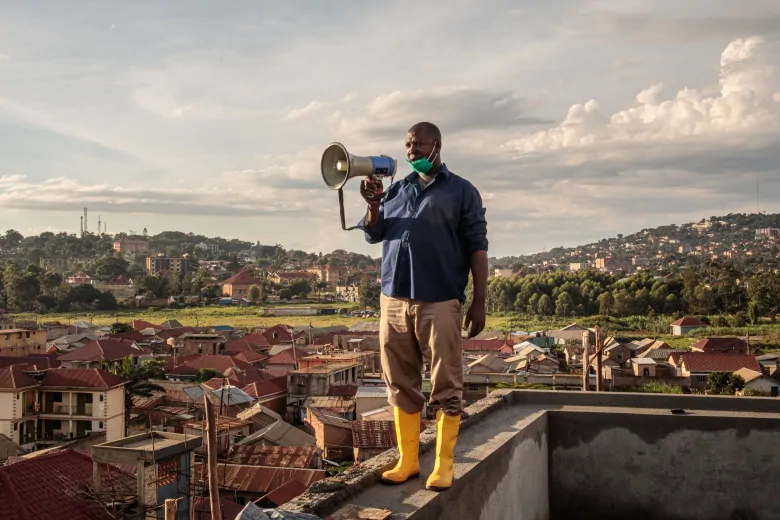
Gonzaga Yiga, a 49-year-old community chairperson, spreads information about how to curb the coronavirus in Kampala, Uganda, on March 24. (Badru Katumba/AFP via Getty Images)
Africa also benefits from the UN’s largest emergency humanitarian operation in decades, with medical cargo including hundreds of ventilators arriving in Ethiopia this month and sent to all countries across the continent. Another shipment from the Jack Ma Foundation is on the way.
But Africa isn’t holding out a begging bowl, Nkengasong said. Instead, it’s asking for a fair crack at markets — and approaching China for “not donations. Quotas that Africa as a continent can purchase.”
WATCH | On April 10, the WHO raised concerns about COVID-19 in Africa:
The World Health Organization is increasingly concerned about the spread of the coronavirus in Africa, where rural areas are particularly vulnerable. 1:09
Such efforts are a response to a global thicket of protectionism: More than 70 countries have restricted exports of medical items, putting Africa in a “perilous position,” the UN says. New travel bans have closed borders and airports, badly wrenching supply chains.
“It’s like people hoarding toilet paper, which I still don’t understand,” Amer Daoudi, the UN World Food Program’s senior director of operations, told The Associated Press. “Countries in Europe and North America are paying attention to their own internal needs, but we think that will ease off very soon.”
African imports almost all its pharmaceuticals
While countries that are traditionally the world’s top humanitarian donors are distracted, the WFP, the UN’s logistics leader, heaved the emergency operation into place with unprecedented reach. Normally in about 80 countries, this effort involves almost 120, Daoudi said.
The WFP seeks $350 million US to keep the operation running for Africa and elsewhere, delivering aid for the pandemic and other crises like HIV and cholera that need drugs and vaccines to keep flowing. Africa imports as much as 94 per cent of its pharmaceuticals, the UN says.
A staff member of the Ministry of Health measures the temperature of drivers and passengers on the highway in Nakuru, Kenya, on March 31. (Suleiman Mbathiah/AFP via Getty Images)
“I’ve never been involved in anything like this before. I don’t think any of us have,” said Stephen Cahill, WFP’s director of logistics. “We’re seeing countries taking measures we think aren’t always rational. When you start closing borders, we start to get very nervous.”
Some African countries, after securing medical equipment, have complicated delivery by causing cargo to stall at ports; 43 have closed their borders.
The global supply crisis is so pressing that the UN General Assembly this week approved a resolution urging countries to immediately end “speculation and undue stockpiling.” Separately, China said it won’t restrict exports of needed medical goods.
WATCH | The founder of the non-profit SHOFCO addresses some of the obstacles ahead for Kenya:
Kennedy Odede is the founder and CEO of the non-profit SHOFCO. He addresses some of the obstacles ahead as COVID-19 testing expands in Kenya. 9:30
Developing regions are taking different approaches. China is the main source of help in Southeast Asia. In South Asia, several countries have committed to India’s proposed COVID-19 Emergency Fund. Small South Pacific island countries have teamed up to get equipment. And some Latin American countries are trying to free equipment stuck in U.S. ports or making supplies themselves.
But the global disruptions are especially felt across Africa, where governments that have historically underfunded health systems are partnering in an effort that’s been compared to going to war.
“Where a product cost, for example, a dollar before, it’s now gone up a hundredfold,” said the Africa CDC deputy director, Ahmed Ogwell. While many African countries have money on hand, the trading companies they use face extreme challenges: “Country X can go and say, ‘I’ll pay you double what you’re offered.’ “
In the United States, the Trump administration has said coronavirus aid to at-risk countries would not include key medical equipment, to meet demand at home.
“I’ve heard no situation yet in any of our countries where the U.S. has made any medical supplies available anywhere,” said Charles Franzen, director of humanitarian and disaster response for World Relief.
‘Not great for Africa’
When asked how many ventilators and test kits have been sent to Africa, a senior U.S. administration official said aid has focused on water, sanitation and messaging: “We’re also looking at the PPE and ventilator needs and will be making those decisions very quickly.”
So African public and private health sectors have teamed up as never before. “Irresponsible behaviour by richer countries” will not solve the pandemic, said Amit Thakker, president of the Africa Healthcare Federation, criticizing “any country that diverts supplies for the sake of their own citizens” at developing countries’ expense.
The private Business for South Africa works closely with the Health Ministry to get supplies. With better-resourced countries more likely to score deals, “that’s not great for Africa…. Ventilators are like trying to spot a dodo bird at the moment, literally,” said Stavros Nicolaou, who leads BSA’s efforts.
But South Africa has used relationships with economic allies to obtain drugs from India and protective gear from China.
And yet, South Africa has only about four weeks’ worth of protective gear, Nicolaou said. With the pandemic arriving in Africa later than elsewhere, “we have entered the fray quite late when the supply chain is highly, highly constrained.”
Global powers must share, especially as the pandemic hits countries at different times, said one of Africa’s most prominent philanthropists, Sudanese-born billionaire Mo Ibrahim. “This is the time for everybody to act together, not to compete.”
Canadians got a glimpse of how one province plans to handle a phased reopening amid the COVID-19 pandemic on Thursday as Saskatchewan’s premier and top doctor offered details about a recovery plan they say will start in early May.
The question of how and when to reopen is one being debated across Canada and in many regions of the world that have seen some progress in slowing the spread of the novel virus, which first emerged in China in late 2019.
Saskatchewan’s premier outlined the province’s reopening plan on Thursday, saying COVID-19 testing and contact tracing will be critical. Scott Moe said the province had to find the “middle ground” that keeps case numbers low and people safe, while also allowing businesses to open.
WATCH | See how Saskatchewan plans to handle a phased reopening:
Saskatchewan Premier Scott Moe unveiled the province’s plan to start easing COVID-19 restrictions starting in May. 2:03
Restrictions will be gradually lifted in phases over a period of weeks, he said. All businesses and public venues will be required to keep following physical distancing and cleanliness rules — as will customers.
“We will carefully monitor the case numbers each and every day and we will adjust our plan accordingly if required,” Moe said.
According to a Johns Hopkins University database, there are now more than 2.7 million known coronavirus cases worldwide, with more than 190,000 deaths. In Canada alone, there are more than 42,000 confirmed and presumptive cases, with more than 2,200 deaths. Some provinces, including hard-hit Quebec and Ontario, are still seeing hundreds of new cases daily, while others, including New Brunswick, Prince Edward Island and Newfoundland and Labrador, have seen several days with no new cases.
New Brunswick Premier Blaine Higgs is set to release details of a four-phase reopening plan for that province Friday afternoon.
Conservative Leader Andrew Scheer has called for a national plan, expressing concern about a “possible patchwork approach across the country.”
The prime minister has said that the question of how to handle reopening will be led by the provinces, which have all had varying experiences with the virus.
Justin Trudeau has said that different provinces and territories will make different decisions around when and how to loosen restrictions. He said the federal government is working to co-ordinate “so that we are working from a similar set of guidelines and principles to ensure Canadians right across the country are being kept safe as we look to those next steps.”
As of 6 a.m. ET on Friday, Canada had 42,110 confirmed and presumptive cases, with 14,774 listed by provinces and territories as resolved or recovered. A CBC News tally of coronavirus-related deaths, which is based on provincial data, local public health information and CBC reporting, put the death toll at 2,232 in Canada, with two deaths abroad.
WATCH | Could herd immunity to COVID-19 be as effective as a vaccine?
An infectious disease specialist answers your questions about COVID-19, including whether herd immunity could eventually be as effective as a vaccine. 1:44
Public health officials caution that the numbers don’t capture the full story, as they don’t include people who haven’t been tested or potential cases that are still being investigated.
Dr. Theresa Tam, Canada’s chief public health officer, has urged people to behave as though there is coronavirus in their community, even if there aren’t any officially recorded cases. There are no proven treatments or cures for the novel virus.
Read on for a look at what’s happening in Canada, the U.S. and around the world.
Here’s a look at what’s happening in the provinces and territories
An iconic Alberta event, the Calgary Stampede, won’t go ahead this summer because of the coronavirus and restrictions to fight it. “Stampede is such an important part of who we are as a community, and it’s hard for me to even imagine what a July without a Stampede will look like,” Calgary Mayor Naheed Nenshi said. “But this year, with this risk, we simply cannot continue to do that.” Read more about what’s happening in Alberta.
Saskatchewan Premier Scott Moe outlined a five-phase reopening plan on Thursday. The first phase will begin on May 4 and will lift some restrictions on outdoor activity and allow medical practices, ranging from dentists to physiotherapists, to reopen with precautions in place. A second phase, which includes restricted retail operation and businesses like hairstylists, is set for May 19. There are no dates attached to subsequent phases, which means the timeline for full resumption of places like restaurants, theatres and gyms isn’t yet clear. Read more about what’s happening in Saskatchewan.
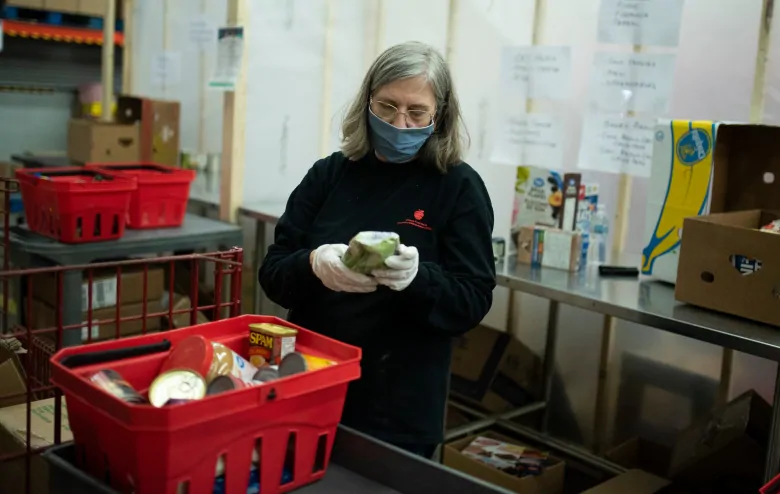
A volunteer sorts food items at the Ottawa Food Bank on Thursday. The Ottawa Food Bank, like many others across the country, has seen an increase in demand due to the COVID-19 pandemic. (Justin Tang/The Canadian Press)
Nurses at one Quebec long-term care home say they are still facing a shortage of personal protective equipment, despite recent assurances from the province’s health minister that there was enough supply. When asked about reports of shortages, Danielle McCann suggested the issue could be around distribution and urged facilities facing shortages to reach out. Read more about what’s happening in Quebec.
Nova Scotia reported four more COVID-19-related deaths on Thursday, all linked to long-term care homes. The province has now seen a total of 16 deaths linked to the coronavirus. Read more about what’s happening in N.S.
Prince Edward Islandreported no new cases of COVID-19 on Thursday, keeping the province’s total of confirmed cases at 26. Chief Public Health Officer Dr. Heather Morrison said more testing and strong screening measures at points of entry are important as the province looks to ease back restrictions. Read more about what’s happening on P.E.I.
WATCH | Surgery backlog from COVID-19 could reach 100,000:
The backlog of surgeries created by the cancellations during the COVID-19 pandemic could be as high as 100,000 across Canada. 2:06
Newfoundland and Labrador also reported no new COVID-19 cases on Thursday. Following several days of no new cases reported in the province, Chief Medical Officer of Health Dr. Janice Fitzgerald said authorities have begun considering ways to relax lockdown measures. Read more about what’s happening in N.L.
Announcing plans to begin reopening his state, South Carolina Gov. Henry McMaster cited the ongoing economic damage from the coronavirus pandemic.
“South Carolina’s business is business,” he declared this week as he lifted restrictions on department stores, florists, music shops and some other businesses that previously had been deemed nonessential.
At the same briefing, the state’s chief epidemiologist, Dr. Linda Bell, seconded the importance of economic recovery but quickly inserted a note of caution: “The risk of exposure remains for everyone,” she said.
It is a scenario playing out across the country as governors wrestle with weeks of quarantine-fuelled job losses and soaring unemployment claims, and the simultaneous warnings of public health officials who say lifting stay-at-home orders now could spark a resurgence of COVID-19.
Meanwhile, as scattered groups of protesters have staged loud demonstrations in favour of rescinding quarantine orders, a recent public opinion poll finds that a majority of Americans believe it won’t be safe to stop following physical distancing guidelines anytime soon.
Thrift and consignment store Sid and Nancy was open to shoppers in Columbia, S.C., on Thursday. Beaches and some businesses deemed nonessential were allowed to reopen this week in the state. (Sean Rayford/Getty Images)
The dire hit to the economy is clear: Jobless numbers released Thursday show Depression-era levels of unemployment, with one in six American workers losing their job amid the pandemic. In South Carolina, more than 14 per cent of the labour force has claimed to be out of work due to the outbreak.
In Georgia, gyms, hair salons and bowling alleys were being allowed to reopen Friday.
Most state leaders acknowledge they have not met many of the key benchmarks that federal guidelines recommend before reopening, such as having robust systems in place for testing and tracing the contacts of those who are positive for the virus.
The difference in how governors are responding to that reality depends largely on their political party, with a handful of Republican leaders moving eagerly forward despite the discrepancies, while most Democratic governors have slammed on the brakes.
Here’s a look at what’s happening around the world
From The Associated Press and Reuters, updated at 9 a.m. ET
In Muslim communities around the world, the pandemic was casting a shadow over the holy month of Ramadan — marked by daytime fasting, overnight festivities and communal prayer.
Ramadan begins for the world’s 1.8 billion Muslims with this week’s new moon. Many Muslim leaders have closed mosques or banned collective evening prayers to ward off infections.
South Korea starting next week will strap electronic wristbands on people who ignore home-quarantine orders in its latest use of tracking technology to control its outbreak.
Vice Health Minister Kim Gang-lip on Friday said those who refuse to wear the bands after breaking quarantine will be sent to shelters where they will be asked to pay for accommodation.
Officials said around 46,300 people are under self-quarantine. The number ballooned after the government began enforcing 14-day quarantines on all passengers arriving from abroad on April 1 amid worsening outbreaks in Europe and the United States.
A customer sits in one of chairs that were set up to maintain physical distancing in order to prevent infections amid the coronavirus disease outbreak at a bank in Tokyo on Friday. (Kim Kyung-Hoon/Reuters)
Japanese emergency medicine is starting to collapse amid dire shortages of protective gear and test kits that can quickly identify infected patients, putting medical workers at risk of infection. Some are refusing to treat suspected COVID-19 patients and even others suffering heart attacks and external injuries, representatives of health-care workers in acute medicine said Friday.
The limited number of advanced and critical emergency centres are overburdened with the surging patients and risk of coronavirus infections because many other hospitals are increasingly turning away suspected patients, said Takeshi Shimazu, head of the Japanese Association for Acute Medicine, and Tetsuya Sakamoto, who heads the Japanese Society for Emergency Medicine, during a joint video news conference.
“We can no longer operate normally, and in that sense I say the collapse of emergency medicine has already started,” Shimazu said.
India’s prime minister says the country’s 1.3 billion people are bravely fighting the coronavirus epidemic with limited resources and the lesson they have learned so far is that the country has to be self-sufficient for meeting its needs.
Addressing the country’s village council heads through video conferencing on Friday, Prime Minister Narendra Modi said the country can’t afford to look outward to meet a crisis of this dimension in future. Self-reliance is the biggest lesson taught by the epidemic, Modi said.
India has so far reported 22,358 positive novel coronavirus cases and 718 deaths. India has been importing critical medical supplies, including protective gear, masks and ventilators, from China.
WATCH | New Zealand goes beyond flattening the curve:
New Zealand’s sweeping lockdown to prevent the spread of COVID-19 has allowed the country to go beyond flattening the curve; it’s nearly eradicated the virus. 2:04
Sweden threatened to close bars and restaurants that do not follow physical distancing recommendations by public health authorities.
“We see worrying reports about full outdoor dining and crowding. Let me be extremely clear. I don’t want to see any crowded outdoor restaurants in Stockholm” or elsewhere, Swedish Interior Minister Mikael Damberg told a news conference.
The Swedish government on Friday asked the country’s 290 municipalities to report on how restaurants and cafes follow the Public Health Authority’s advice. Sweden has opted for relatively liberal policies to fight the coronavirus pandemic.
While the health crisis has eased in places like Italy, Spain and France, experts say it is far from over, and the threat of new outbreaks looms large.
“The question is not whether there will be a second wave,” said Dr. Hans Kluge, the head of the WHO’s Europe office. “The question is whether we will take into account the biggest lessons so far.”
Signs on the ground read ‘Dirty’ and ‘Clean’ as health-care workers attend to coronavirus patients at the intensive care unit of the La Paz University Hospital in Madrid on Thursday. (Pierre-Philippe Marcou/AFP/Getty Images)
In France, the government is leaving families to decide whether to keep children at home or send them back to class when the countrywide lockdown, in place since March 17, starts to be eased from May 11.
In Spain, parents face a similarly knotty decision: whether to let kids get their first fresh air in weeks when the country on Sunday starts to ease the total ban on letting them outside. Even then, they will still have to abide to a “1-1-1” rule: no more than one hour per day, within a one-kilometre radius of their house and with no more than one supervising adult.
Some German states were moving too quickly to reopen, said Chancellor Angela Merkel, whose government has won praise for how it has handled the pandemic and how its death toll has remained much lower than in other large European countries.
A volunteers wearing protective clothing prepares to spray disinfectant along a street as a preventive measure against the spread of the COVID-19 novel coronavirus in Yangon on Thursday. (Sai Aung Main/AFP/Getty Images)
Britain’s Health Minister Matt Hancock, who has faced intense questioning over testing, promised to expand testing to all those considered key workers.
South African President Cyril Ramaphosa said the government will allow a partial reopening of the economy on May 1. In Nigeria, the governors of the country’s 36 states agreed to ban interstate movement for two weeks.
In Africa, COVID-19 cases have surged 43 per cent in the past week to 26,000, according to John Nkengasong, director of the Africa Centers for Disease Control and Prevention. The figures underscored a World Health Organization warning that the virus could kill more than 300,000 people in Africa and push 30 million into desperate poverty.
Doctors and health experts urged people not to drink or inject disinfectant on Friday after U.S. President Donald Trump suggested scientists should investigate inserting the cleaning agent into the body as a way to combat COVID-19.
“[This is an] absolutely dangerous, crazy suggestion,” said Paul Hunter, a professor of medicine at Britain’s University of East Anglia.
“You may not die of COVID-19 after injecting disinfectant, but only because you may already be dead from the injection.”
Trump said at his daily media briefing on Thursday that scientists should explore whether inserting light or disinfectant into the bodies of people infected with the new coronavirus might help them clear the disease.
“Is there a way we can do something like that by injection, inside, or almost a cleaning?” he said. “It would be interesting to check that.”
Trump looked over at Dr. Deborah Birx while making the comments. The co-ordinator of one of the White House’s coronavirus task forces appeared uncomfortable and caught off-guard.
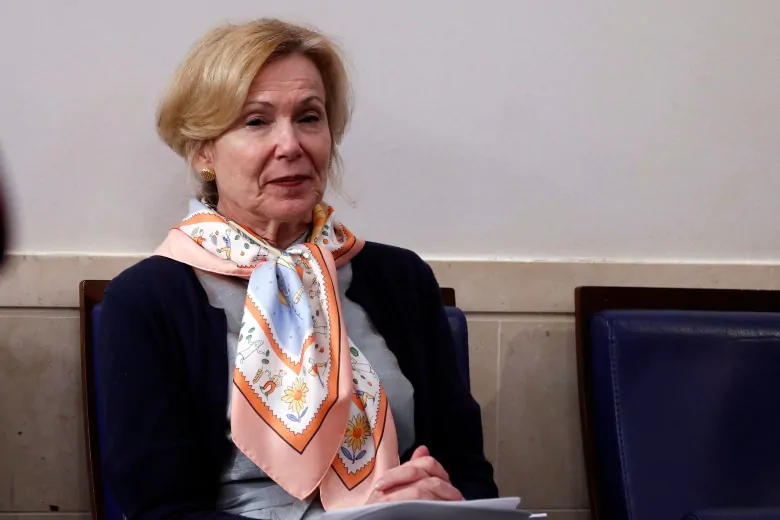
Dr. Deborah Birx, White House coronavirus response co-ordinator, is shown during Thursday’s media briefing. (Alex Brandon/The Associated Press)
Parastou Donyai, director of pharmacy practice and a professor of social and cognitive pharmacy at the University of Reading, said Trump’s comments were shocking and unscientific.
Donyai said people worried about the new coronavirus and the COVID-19 disease it causes should seek help from a qualified doctor or pharmacist, and “not take unfounded and off-the-cuff comments as actual advice.”
‘Under no circumstance’: Lysol
Robert Reich, a professor of public policy at the University of California at Berkeley and a former U.S. labour secretary, added on Twitter: “Trump’s briefings are actively endangering the public’s health. Please don’t drink disinfectant.”
Reckitt Benckiser, which manufacturers household disinfectants Dettol and Lysol, issued a statement on Friday.
“Under no circumstance should our disinfectant products be administered into the human body [through injection, ingestion or any other route],” the company said.
Trump’s comments were also met with alarm by the medical experts that the U.S. news networks employ as contributors.
“I just don’t think we should be normalizing that in any way, shape or form,” said Dr. Sanjay Gupta on CNN.
In the same segment, Dr. Leana Wen said the experts serving in the administration are engaged in a difficult balancing act of needing to tell the truth “while at the same time not upsetting the president so much that they can’t be credible in his eyes.”
WATCH l Misinformation on cures spreads along with virus:
Misinformation about so-called miracle cures for COVID-19 are spreading online. Can you really buy your way to a better immune system? We ask an expert: UBC professor Bernie Garrett, who studies deception in healthcare, including alternative medicine. 5:27
On MSNBC on Friday, former congressman and Morning Joe host Joe Scarborough said the president’s comments had now gone “beyond parody.”
Trump, in his bid to provide optimistic news as the country grapples with the deadly pandemic, has previously been criticized for dismissing the dangers of coronavirus as overblown.
As its dangers became clear, he began touting drugs whose efficacy in treating patients with the coronavirus has not been proven and which sometimes lead to deadly side-effects.
Michigan Gov. Gretchen Whitmer on Thursday blasted U.S. Senate Republican leader Mitch McConnell for his comments suggesting bankruptcy would be a better route for some states rather than federal aid, as money is doled out to help buffer an economy ravaged by the coronavirus pandemic.
“I was really disappointed to see Sen. McConnell’s comments about letting the states go bankrupt,” Whitmer said in an interview with MSNBC. “I just think that it’s incredibly irresponsible.”
The topic flared up as the U.S. House is expected to vote on Thursday on a fourth relief bill of nearly $500 billion US that passed the Senate earlier this week without including any funding for state and local governments. President Donald Trump said he will begin discussing more aid to state and local governments after he signs that bill into law.
McConnell, whose party controls the Senate, on Wednesday poured cold water on efforts by Democrats to tap federal coffers to provide assistance to state and local governments.
“I think this whole business of additional assistance for state and local governments needs to be thoroughly evaluated,” he said on Hugh Hewitt’s syndicated conservative talk radio show. “There’s not going to be any desire on the Republican side to bail out state pensions by borrowing money from future generations.”
Democrats push back on idea
Later, in an interview with Louisville, Ky.-based radio station WHAS, McConnell said Congress “may well” approve further aid, but that he would want it tightly tied to coronavirus-related costs.
Illinois Sen. Dick Durbin pointed out the stakes, as many municipal and state employees are those who are on the front lines of the pandemic battle.
Forcing states and localities into bankruptcy in the midst of this crisis would mean dire consequences for our schools, teachers, first responders, retirees, and the nation’s economy.
Whitmer, who expressed hope that Democrats and the Trump administration could overcome objections from Republicans in Congress to providing aid, told MSNBC her state was facing a $3-billion hit to its budget this fiscal year and possibly even a bigger impact next year.
“It will undermine everything from public health to education if we don’t get the kind of support we need out of Washington, D.C.,” she said.
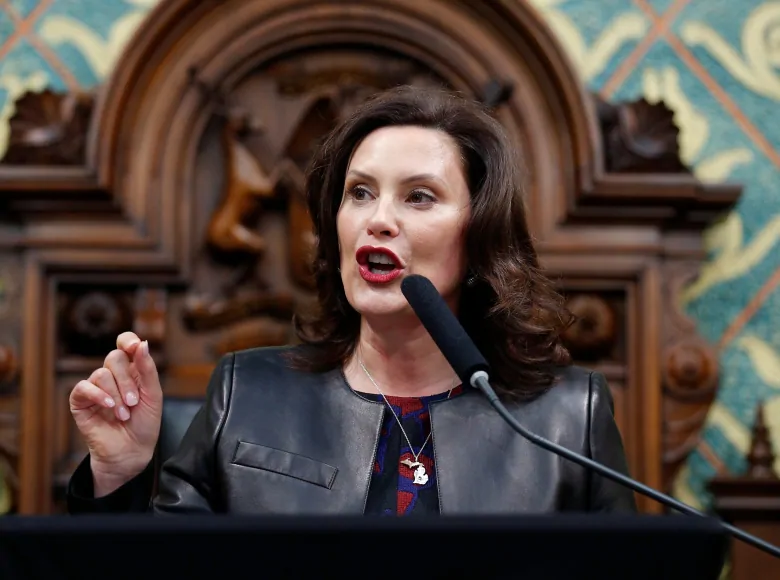
Michigan Gov. Gretchen Whitmer said Thursday her state was facing a $3-billion US hit to its budget this fiscal year and possibly even a bigger impact next year. (Al Goldis/The Associated Press)
Other Democratic governors on Wednesday slammed the idea.
“Almost hoping for bankruptcy of American states amid the biggest health-care crisis this country has faced is utterly irresponsible,” New Jersey Gov. Phil Murphy said at a press conference.
A spokesperson for Illinois Gov. J.B. Pritzker said “every state is facing budget shortfalls and we need partners in Congress who will work with us on real solutions, instead of using this crisis to propose an ideological Hail Mary.”
Bankruptcy rules differ for states and cities
In a letter to Congressional leaders, the National Governors Association on Tuesday reiterated its call for an additional $500 billion to replace revenue lost by the states. The $2.3 trillion federal CARES Act allocated $150 billion to states and local governments exclusively to cover virus-related expenses.
Currently, states cannot file for bankruptcy, while cities and other local governments can use Chapter 9 municipal bankruptcy to restructure their debt if allowed by their states. Puerto Rico, a U.S. commonwealth, commenced a form of municipal bankruptcy in 2017 after the U.S. Congress authorized it.
With social distancing and stay-at-home orders in place around the nation aimed at slowing the virus’s spread, non-essential businesses and services have shuttered, leading to skyrocketing unemployment — a further 4.4 million claims were registered in Thursday’s report — and lower consumer spending. As a result, cities and states are starting to project deep revenue losses, particularly for big money generators like income and sales taxes.
The whole point is a red herring. [McConnell’s] statement is more about how Republicans are going to require concessions from Democrats if Democrats want states to get additional aid.– Market analyst
The IShares National Muni Bond Exchange Traded Fund traded lower after the news, but there was no immediate reaction in the $3.8-trillion U.S. municipal market, where states, cities and other issuers sell debt.
Municipal market analysts played down McConnell’s comments as political posturing. Matt Fabian, a partner at Municipal Market Analytics, said he doubted whether such a move was constitutionally or politically possible.
“The whole point is a red herring,” he said. “[McConnell’s] statement is more about how Republicans are going to require concessions from Democrats if Democrats want states to get additional aid.”
Hugh McGuirk, who oversees just under $30 billion in municipal bonds at T. Rowe Price, said bankruptcy should be an absolutely last resort for any government.
“I think, bankruptcy or not, that ultimately investors want a stable governmental entity providing the necessary services for its citizens,” he said.
The head of a U.S. government agency combatting the coronavirus pandemic is alleging that he was ousted for opposing politically connected efforts to promote a malaria drug that President Donald Trump touted without proof as a remedy for COVID-19.
Rick Bright, former director of the Biomedical Advanced Research and Development Authority, said in a statement Wednesday that he was summarily removed from his job on Tuesday and reassigned to a lesser role. His lawyers, Debra Katz and Lisa Banks, called it “retaliation plain and simple.”
Controversy has swirled around the malaria drug hydroxychloroquine since Trump started promoting it from the podium in the White House briefing room.
BARDA, the agency that Bright formerly headed, is a unit of the Department of Health and Human Services created to counter threats from bioterrorism and infectious diseases. It has recently been trying to jump-start work on a vaccine for the coronavirus.
“I am speaking out because to combat this deadly virus, science — not politics or cronyism — has to lead the way,” Bright, who has a doctoral degree in immunology, said in his statement, which was released by his lawyers.
“Specifically, and contrary to misguided directives, I limited the broad use of chloroquine and hydroxychloroquine, promoted by the administration as a panacea, but which clearly lack scientific merit,” Bright said.
“I also resisted efforts to fund potentially dangerous drugs promoted by those with political connections.”
‘Maybe he was’ pushed out: Trump
Trump, when asked about Bright at Wednesday’s White House briefing on coronavirus, said he “never heard of him.”
“The guy says he was pushed out of a job,” Trump said. “Maybe he was. Maybe he wasn’t. … I don’t know who he is.”
Bright and his lawyers are requesting investigations by the HHS inspector general and by the Office of Special Counsel, an independent agency that has as part of its charge the protection of government whistleblowers.
“While I am prepared to look at all options and to think ‘outside the box’ for effective treatments, I rightly resisted efforts to provide an unproven drug on demand to the American public,” Bright wrote.
He also alluded to “clashes with HHS political leadership” over his efforts to “invest early in vaccines and supplies critical to saving American lives.” One of the major criticisms of the Trump administration’s pandemic response is that little was done in the month of February to stockpile needed equipment.
“Science, in service to the health and safety of the American people, must always trump politics,” Bright said.
U.S. Vice President Mike Pence is seen engaging with Department of Health and Human Services Secretary Alex Azar during a daily coronavirus task force session on April 3. (Tom Brenner/Reuters)
Alex Azar, a lawyer and former drug industry executive, leads the HHS, the second permanent chief for the agency during Trump’s term.
Two agencies Alex Azar oversaw as HHS secretary, the Centers for Disease Control and Prevention and the Food and Drug Administration, wouldn’t come up with viable coronavirus tests for five and a half weeks, even as other countries and the World Health Organization had already prepared their own.
Behind the scenes, his aides say, Azar had alerted the White House to the alarming virus reports in China in early January, and then later that month spoke directly to the president. It is unclear exactly what Azar told the president, because transcripts are not available.
Trump denied Azar sent out alarms. “@SecAzar told me nothing until later,” he tweeted earlier this month.
By late February, Vice-President Mike Pence had taken over from Azar as the lead on the administration’s main coronavirus task force.
In a statement Wednesday night, HHS confirmed that Bright is no longer at the BARDA agency, but did not address his allegations of political interference in scientific matters.
Questions over efficacy of hydroxychloroquine
HHS said it was Bright who had requested an emergency use authorization for chloroquine and hydroxychloroquine. In his statement, Bright had said he insisted that the authorization be limited to a restricted group of patients, those hospitalized with confirmed COVID-19 under the supervision of a doctor.
Hydroxychloroquine was given to patients in the New York area, the nation’s most intense COVID-19 hot spot. It is usually administered in combination with the antibiotic azithromycin.
LISTEN l Front Burner, April 6, on hydroxychloroquine:
Chloroquine and hydroxychloroquine – two drugs touted by U.S. President Donald Trump, who says they could be game changing treatments for COVID-19. But around the world health experts have tried to temper expectations for these medications. Today, on Front Burner, we talk to infectious disease specialist, Dr. Isaac Bogoch about these drugs and the testing being done to determine if they hold any promise at all. 13:33
The HHS inspector general’s office had no response to Bright’s request for an investigation. But on Capitol Hill, leading Democrats seconded the call for an inquiry.
“President Trump is not a doctor, a scientist or a medical professional,” said Rosa DeLauro, the Connecticut Democrat who chairs a House panel that oversees HHS finances. “The notion that he and his political appointees are making personnel decisions based on how effective the president thinks drugs like chloroquine and hydroxychloroquine will be … is completely unacceptable.”
Trump has repeatedly touted the malaria drug during his regular coronavirus briefings, calling it a “game-changer,” and suggesting its skeptics would be proved wrong. He has offered patient testimonials that the drug is a lifesaver.
But a recent study of 368 patients in U.S. veterans hospitals found no benefit from hydroxychloroquine – and more deaths. The study was an early look at the medication, which has prompted debate in the medical community, with many doctors leery of using it.
Bright’s allegations were first reported by The New York Times, and echoed the events that led to Trump’s impeachment in the House and subsequent acquittal in the Senate in January. In the latter case, Trump and several Republicans in Congress excoriated an anonymous whistleblower whose complaint raised alarms about the motives of the administration’s foreign policy in Ukraine.
WATCH l Remdesivir also subject to early studies:
Researchers say Remdesivir, a drug designed to treat Ebola, is showing promising results against COVID-19 but warn it’s too soon to say. 1:57
An official biography describes Bright as a flu and infectious disease expert who joined the agency 10 years ago and was focused on vaccine development. He also held the title of HHS deputy assistant secretary for preparedness and response, reporting to Dr. Robert Kadlec. HHS said Bright is now assigned to the National Institutes of Health, working on new approaches to testing.
The HHS is a very large department, overseeing almost every federal public health agency in the country, with a $1.3-trillion budget that exceeds the gross national product of most countries.