Categories
TV & Movies

Thumbnails 8/7/14

Thumb_the-strain_612x380

1.

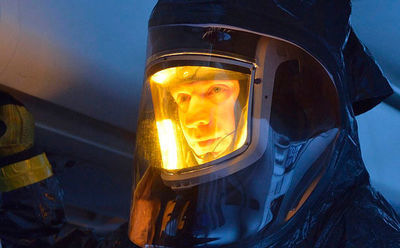
“Doc Jensen on ‘The Strain’—and when real life interrupts TV”: An amazing, beautiful piece from Entertainment Weekly‘s Jeff Jensen, who grapples with the death of his wife in the midst of his work.

“In a different world, I would have shared my thoughts about ‘The Strain’ in advance of the series premiere on July 13. In fact, I had been assigned to do a review, and was preparing to write one, when my wife—who had been battling brain cancer for years—took a grave turn. She died on June 19. Amy was just 41. A few days before she passed, my father arrived in town to join my mom in helping me care for Amy, my kids, and… well, me. Dad was surprised that I was still trying to make time for work, and so he offered to alleviate my load by reviewing ‘The Strain’ for me. He was only half-joking. Before I knew it, Dad was typing away, despite having not seen one second of ‘The Strain.’ He had only seen commercials and the press kit sent to me. My father—skilled at many things, including hunting serial killers—did not quite grasp the basics of television criticism, like actually watching television. He was halfway through his goofy project when Amy died. Suddenly, reviewing ‘The Strain’ wasn’t all that fun or urgent anymore. For either of us.”

2.

“The Problem With Saying ‘True Detective’ was ‘Plagiarized'”: Slate‘s Dave Haglund offers his rebuttal to Mike Davis and Jon Padgett’s conversation, “Did the Writer of ‘True Detective’ Plagiarize Thomas Ligotti and Others?” published on Lovecraft eZine.

“The exchange between Padgett and Davis may spur interesting questions about pastiche, homage, attribution, and influence, but a ‘strong accusation’ of plagiarism it isn’t. Consider perhaps their strongest example, these lines from Rust Cohle, the character played by Matthew McConaughey: ‘I think about the hubris it must take to yank a soul out of nonexistence into this meat … Force a life into this thresher.’ At different points in ‘The Conspiracy Against the Human Race,’ Thomas Ligotti refers to people being ‘stolen from nonexistence,’ says ‘we are meat,’ and asks, ‘Why should generations unborn be spared entry into the human thresher?’ It’s clear from these similarities that Pizzolatto has read the Ligotti book and borrowed from it—something he has himself acknowledged, about which more below. If ‘True Detective’ was not a cop show on HBO but a term paper in a philosophy class, then it would indeed be wrong for him to lift such ideas and metaphors from an author without citing him in the work itself. But Davis, at least, does not seem to fully grasp that distinction: He explains his charges by quoting a Cambridge University statement on plagiarism that was explicitly provided for people giving and taking written examinations.”

3.

“‘Los Jets’ leads a wave of shows about Latinos in the United States”: A fine report from The Washington Post‘s Alyssa Rosenberg.

“The summer television schedule is no longer a wasteland scattered with the occasional non-rerun oasis. Instead, it’s a newly verdant (sometimes overwhelmingly so) environment, blooming with new shows and upstart networks. Among them are ‘Los Jets,’ a documentary series on the 10-year-old network NuvoTV about a high school soccer team in Siler City, N.C. Founded by Paul Cuadros, a former investigative journalist who first came to Siler City to cover immigration and the food processing industry, the Jets represent an effort by the town’s new residents to establish a recognizable foothold in their new community. And ‘Los Jets’ is part of a larger ongoing effort to establish a place for Latino and immigrant stories in prime-time television that ramps up this fall.”

4.

“Two Thumbs Up for Ebert’s Legacy”: Anthony Berteaux of The Daily Aztec writes a superb tribute to the late critic’s influence and integrity.

“What is revolutionary about Ebert’s perspective as a film critic is his acknowledgement of his shortcomings as someone who assigns value to an artist’s work. Who is anyone to assign value to something that he or she can’t fully understand, because it doesn’t originate from his or her world? You may not understand a film but you can’t deny it if it makes you feel something. Granted there are films that are stupid, as there are films that are smart, but to dismiss films that one doesn’t understand as bad is another thing. Another film review where Ebert articulates this sentiment is his review of the critically panned, ‘Cloud Atlas.’ The complex film interweaves six different storylines into a single narrative. It was criticized as being overly long, complicated and pretentious. I loved the film because it wasn’t a movie one could explain. Its core ideas transcended what people viewed as a traditional film narrative. I loved Ebert’s review even more because he understood that films couldn’t be explained but simply experienced.”

5.

“This day 15 years ago changed the future of American horror movies”: At Vox.com, Todd VanDerWerff reflects on the 15th anniversary of “The Blair Witch Project” and “The Sixth Sense.”

“‘The Sixth Sense’ suggests that we now live in a world where it probably wouldn’t be made, at least not with this level of craft and budgetary support. The film doesn’t fit in a neat box. It has scary sequences, and it’s a ghost story on some level. But it’s primarily a family drama, about two broken families trying to reassemble themselves. The biggest ghost in the film, for instance, is the no-longer-present father of Osment’s character, who’s not even dead. Shyamalan’s canniest move is to make the things haunting the characters rarely be actual ghosts but, instead, past failures and sorrows. ‘The Sixth Sense’ has unfairly been lumped in with some of Shyamalan’s later films as a movie that only exists to prop up its twist. But to watch it in 2014 is to be haunted, anew, by how thoroughly the existence of that twist derailed Shyamalan’s career. (Case in point: Imagine a version of his 2004 film ‘The Village’ wherein the twist is revealed fairly early on. It becomes both a much better film and a powerful post-Sept. 11 story, qualities Shyamalan tried to bestow on the rest of the film retroactively in a way that didn’t work.) The children of ‘Blair Witch’ are many, but the children of ‘Sixth Sense’ are mostly a bunch of films that shoehorned in twists that didn’t make any sense whatsoever, rather than films that wedded intelligent family drama to genre trappings.”

Image of the Day

Matt Wood of The Dallas Observer reports on the concert scheduled tonight at the Dallas Museum of Art featuring jazz pianist Dave Zoller, father of RogerEbert.com‘s Editor-In-Chief Matt Zoller Seitz.

Video of the Day

Rick Schober’s 11-second mashup fuses Pharrell’s wildly overexposed “Happy” with Frank Capra’s 1946 masterpiece “It’s a Wonderful Life” to utterly hilarious effect.

Source: http://www.rogerebert.com/thumbnails/thumbnails-8714


Categories
TV & Movies

The Hundred-Foot Journey

Thumb_hundredfootjourney-2014-1

“The Hundred-Foot Journey” is a film that demands that you
take it seriously. With its feel-good themes of multicultural understanding, it
is about Something Important. It even comes with the stamp of approval from titanic
tastemakers Oprah Winfrey and Steven Spielberg, who both serve as producers.
What more convincing could you possibly need?

There’s something familiar about the treacly and
sanctimonious way this film is being packaged. It reeks of late-‘90s/early ‘00s
Miramax fare: films with tasteful yet ubiquitous ad campaigns and unabashed
Oscar aspirations which suggested that seeing them (and, more importantly,
voting for them) would make you a better person. Films like “The Cider House
Rules,” “Chocolat” and “The Shipping News.” Films by Swedish director Lasse
Hallstrom.

Hallstrom just happens to be the director here, as well, and
the similarities to “Chocolat” are inescapable. Stop me if think you’ve heard
this one before: A family moves into a quaint but closed-minded French village
and shakes things up with an enticing array of culinary delicacies. This new
enterprise happens to sit across the street from a conservative and revered
building that’s a town treasure. But the food in question isn’t a bon bon this
time—rather, the movie is the bon bon itself.

But despite being handsomely crafted, well acted and even
sufficiently enjoyable, “The Hundred-Foot Journey” is also conventional and
predictable. And for a film that’s all about opening up your senses and
sampling spicy, exotic tastes, this comic drama is entirely too safe and even a
little bland.

What livens things up, though, is the interplay between
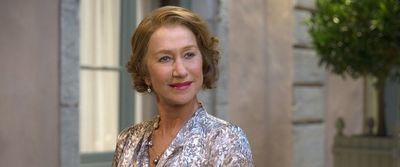
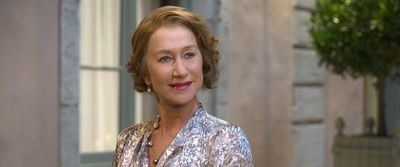
Helen Mirren and Om Puri as battling restaurant owners operating across the street
from each other—100 feet away from each other, to be exact, a short but
fraught trip that various characters take for various reasons. Watching these
veteran actors stoop to sabotage each other provides a consistent source of
laughs. She’s all sharp angles, piercing looks and biting quips; he’s all round
joviality, boisterous blasts and warmhearted optimism. The contrast between
the British Oscar-winner and the Indian acting legend offers the only tension
in this otherwise soft and gooey dish—that is, until the film goes all soft
and gooey, too.

Mirren stars as Madame Mallory, owner of Le Saule Pleurer
(The Weeping Willow), an elegant and expensive French restaurant that’s the
winner of a prestigious Michelin star. But one star isn’t enough for the coldly
driven Mme. Mallory—she wants another, and then another.

But her bloodless quest for gourmet grandeur is interrupted
by the arrival across the street of an Indian family: the Kadams, who’ve been
wandering around Europe ever since their beloved restaurant back home burned
down during political rioting. When the brakes on their car malfunction on a
treacherous stretch of spectacular countryside, Papa (Puri) insists it’s a sign
from his late wife and decides to open a new eatery in the charming town at the
bottom of the hill.

Never mind that one of the most celebrated restaurants in
all of France is sitting right across the street from the empty building he
rents. Never mind that they are in an insular part of the country where the
residents probably don’t even know what Indian cuisine is, much less like it,
as his children point out. He has faith in his food—and in his son, Hassan
(Manish Dayal), a brilliant, young chef.

Just as Papa and Mme. Mallory strike up a sparky rivalry,
Hassan enjoys a flirtatious relationship with French sous chef Marguerite
(Charlotte Le Bon, who played an early model and muse in the recent “Yves Saint
Laurent” biopic). The script from Steven Wright (who also wrote the far
trickier “Locke” from earlier this year, as well as “Dirty Pretty Things” and
“Eastern Promises”) is full of such tidy parallels, as well as trite and overly
simplistic proclamations about how food inspires memories. Dayal and Le Bon do look lovely
together, though, and share a light, enjoyable chemistry.

Then
again, it all looks lovely—both the French and Indian
dishes as well as the lush, rolling surroundings, which we see through
all four
seasons; the work of cinematographer Linus Sandgren, who recently shot
“American
Hustle.” This sweetly pleasing combination of ingredients would have
been perfectly suitable if the film didn’t take a wild and needless
detour in the third act.
That’s when it becomes an even less interesting movie than it already
was, in spite of its loftier aspirations.

Source: http://www.rogerebert.com/reviews/the-hundred-foot-journey-2014


Categories
TV & Movies

“Boyhood”: Richard Linklater’s Divine Comedy

Thumb_boyhood1

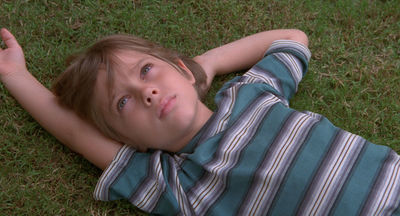
The first image of Richard Linklater’s “Boyhood” is a vaguely circular opening in the clouds, the line of sight reaching out to the clear blue sky. On the soundtrack is the now embarrassingly familiar pop warmth of Coldplay’s “Yellow,” still fresh in the early ‘00s, Linklater cutting to six-year-old Mason Jr.’s (Ellar Coltrane) eye on cue with Chris Martin’s lyrics telling us to “Look at the stars.” Of course, we, like Mason, cannot see the stars through the blue of day much less “see how they shine” for him, but he’s still searching through that stratospheric hole in the clouds for the yellow.

For 12 years we will persist in looking with Mason and at Mason, through windows and video screens, through camera lenses and binoculars, in darkrooms and around doorways, and finally up at the desert twilight. The fractals of what “Boyhood” presents us are the narrow and incidental puzzle pieces that Mason, in a wandering exodus, accumulates through an Empyrean journey to understand why “anything” happens. The film is not reducible to a life affirming passage through the boundaries of childhood to adult freedom, or merely a humorous novelty stunt with conspicuous markers, from pop music (“Oops, I Did It Again”) to rapidly changing technology (XBox). Even more than the philosophical digressions of “Waking Life” and the “Before” trilogy, “Boyhood” is Linklater’s most fully realized effort in reaching—and failing to grasp—the ineffable. It’s a comedy in search of divinity, an ascending journey through time with the same star-gazing longing that concludes Dante’s three Commedia canticles; its opening image reminiscent of the opening from Hell to Purgatory (“…I saw through a round opening, some of those things of beauty Heaven bears. It was from there that we emerged, to see—once more—the stars.”) Linklater himself, whose autobiographical reminiscences were reflected in the strikingly antipodal “Dazed and Confused,” assumes the guiding role of Virgil, leading the incessantly gazing pilgrim Mason, the boy searching for something magical or transcendent in the suburban sprawl text, accumulating undecipherable bits of “urban art” along the way (his own tag, “KEZJO,” he admits “Doesn’t really mean anything”). And, as in Dante, the path to grace is seeing—and then understanding—out of which healthy acts of love grow.

“Boyhood” begins with Mason’s eyes and references to his wandering scopophilia: Mason spends most of class time staring out the window; he entrancedly sits in front of a TV set, delights in looking at lingerie ads with an older friend, and voyeuristically peers around a doorway to observe a late night fight between his struggling singer mom Olivia (Patricia Arquette) and a boyfriend. External objects confusedly collide in Mason’s reading of the universe. Looking in the present, he conjectures how things are created; he threw a rock in the air, and then a wasp flew by, therefore wasps come from rocks. But there’s a budding awareness of the end, as when his sight is locked in morbid fascination with a dead baby bird in the dirt. Feeling the passage of time, Linklater invites us to share Mason’s confusion as to where things begin and end, beautifully conveyed as Olivia, Mason, and big sister Samantha (Lorelei Linklater) drive away from their old neighborhood for a new one, Mason seeing his bike-riding best friend waving to him before evaporating with the tall grass in the foreground.

We encounter Mason’s optical associations elsewhere with his taste for movies, love for videogames, interest in graffiti, compulsion to watch the “Funny or Die” bit “The Landlord” repeatedly, and finally a passion for photography. His watchfulness is even noted by Nature, when a Magnificent Owl butterfly—known for the owl-like eye shapes on its wings—perches on his shoulder. Toward the end of the film, Mason wears a psychedelic t-shirt, the design an endless spiral of eyeballs with a mandala-like center of blinding light.

While I won’t suggest that “The Divine Comedy” is a key influence on “Boyhood,” Mason’s t-shirt is an interesting Dantean prop. In Italian, the poem’s most commonly used noun is occhio or “eye.” Dante is retelling episodes of horror and grace that he saw from hell to heaven, some of which he admits he lacks the proper language to describe. In Canto XXVIII of the Paradiso, Dante speaks about “a point that sent forth so acute a light, that anyone who faced the force with which it blazed would have to shut his eyes,” and around that blinding point nine rings of angels in spiraling revolution. Beatrice then explains to Dante that “blessedness depends upon the act of vision, not upon the act of love—which is a consequence; the measure of…vision lies in merit, produced by grace and then by will to goodness: and this is the progression, step by step.” Mason’s vision has become his key to freedom, his photography winning him a scholarship, but the irradiation in “Boyhood” is still transient and contingent on the maintenance of that vision, being able to see himself through his interactions during a process that never ends. Just as the men in Mason’s life who appear good-humored and well-natured—the stepfathers Professor Bill (Marco Perella) and military vet Jim (Brad Hawkins)—develop into contemptible and resentful assholes because of alcoholic flights from self-observation, he’s susceptible to losing sight of himself, such as during an argument with his ex-girlfriend Sheena, who’s left Mason for a college lacrosse player, when Mason’s defense mechanism is to make her jealous about girls that he’s been with. “Now you’re just trying to be an asshole,” she tells him and walks away, and he knows that she’s right.

Mason is wearing the eye shirt while receiving advice from his father, Mason Sr. (Ethan Hawke), and then in the presence of his mother being thanked by a young man whose professional development from a migrant pipe worker to restaurant manager and college student, he says, is indebted to her advice years ago. Both scenes argue about progress, as Mason Sr. has become the minivan-owning insurance salesman Olivia probably wanted him to be 20 years ago, while his paternal advice, related to Mason’s heartbreak over Sheena, is, if practical, insistently trivializing in how it generalizes women and men, and simplistic in assigning Mason’s responsibility for his self-esteem and actions. Similarly, the pipe worker’s progress is uplifting, but I wonder if there’s a hint of ambivalence regarding someone acclimating to the English-speaking dominant culture and buying into the system for bourgeois success; his conspicuous rosary from the earlier scene replaced by a dress shirt and tie. The navigational process through human encounters in “Boyhood” however isn’t judgmental, but beseeches us to keep our sight and hearing attuned through those encounters, understanding the melancholy truism, famous from “The Rules of the Game,” that everyone has their reasons. This differentiates Mason from other young protagonists, including most of Linklater’s notorious “Dazed and Confused” ensemble. During an early conversation with Sheena, he notes how he hates how people try to control others, but he understands that these trespassers don’t even realize that they’re doing it.

The sentiment evokes Christ’s forgiveness on the cross, the notion that Love is seeing and understanding others, who know not what they do. “Boyhood” is brimming with religious intimations, sometimes even subverting the expectations of an audience Linklater understands is secular. We laugh when Mason Sr.’s rural in-laws from a new marriage give 15-year-old Mason a Red Letter Bible for his birthday (Mason’s name inscribed on the cover), and chuckle more at his puzzled expression when he attends church with this fresh extended family. The pastor is speaking about John 20, when the disciple Thomas was doubtful of Jesus’ resurrection and needed to see and feel the physical scars of his teacher’s crucifixion. What could have been a condescending scene about red state faith suddenly alters, as Linklater cuts from the pastor to Mason, his fingers thumbing through his new Bible as his eyes remain intent on the preacher; he’s reading the moment. The message of John 20 is “Blessed are those who have not seen and yet have come to believe,” but the pastor is sensible to how Thomas could at least touch the nail marks on Christ’s body; he saw Jesus in the flesh and we don’t have that advantage. “But we’ve felt him in the spirit, or at least I have,” the pastor says and the scene ends, the resonance completely different from where we thought we were going, hushing any smug laughter as Mason wanders through mazes lost, struggling, like Dante, to see God, which in Canto V of Purgatorio we learn is the primary goal: “[Then] light from Heaven granted understanding, so that, repenting and forgiving, we came forth from life at peace with God, and He instilled in us the longing to see Him.”

That spirit, or desire to believe in something transcendent, follows Mason throughout his journey, as he looks at the stars that aren’t there, draws his amusingly absurd corollaries between rocks and wasps, and, most pointedly, when he asks his father if magic exists in the world (namely, elves). The phenomenal world, into which early friends fade into grass and birds decay in the dirt, isn’t enough, even in the majesty of Mason Sr.’s description of a blue whale as a feat of evolution. Alternative magic is in human ingenuity, which Mason grows up idly adoring (video games) and then of which he’s very wary, as human beings seem to be evolving into cyborgs by the ubiquitous gadgetry around them, the bower of private subjectivity unlocked and exposed by an algorithm that neatly figures out the right college roommate for you, satisfaction guaranteed. It’s magic, yes, but far removed from the magic felt by a child who grew up emulating—as he we see Mason in costume during a book release party—the wizardry of Harry Potter, and then the universe of Star Wars. The real world of biological and legally binding relationships has let Mason down; he mistakes the Totem his father has given him as a gift for a Tiki—the symbol of land and family for a religious and transcendent symbol.

This dance between the mystical and technological points to how magic means different things through changing times, but behind Linklater’s pragmatism, so pertinent to “A Scanner Darkly” and “Before Midnight”’s discussions of a “last generation” and posthumanity, he probably sees things in the manner of George Lucas’ Force, with a benevolent Zen side of letting go and a Dark Side based on power and control, where good men (like the film’s two stepfathers) become bad. During a brief exchange between Mason and his neighborhood friends, Star Wars’ own villainous cyborg, General Grievous from 2005’s “Revenge of the Sith,” is set up as a superior alternative to the sage Jedi mysticism of Yoda; it’s a comparison that would probably only gain traction with viewers of George Lucas’ prequel trilogy, summarily dismissed by fans of the older movies (similarly, when Mason Sr. advises 17-year-old Mason, via FaceTime phone conversation, to “be Obi Wan” during a road trip with Sheena to Austin, we probably take for granted that Obi Wan Kenobi denotes two very different characters for father and son). Roger Clemens, pitching for the Houston Astros, looks like a miracle on the mound, with a 1.90 ERA and striking out hitters half his age, but in retrospect—and something Linklater could have only suspected but not known at the time of filming—such remarkability on the mound may be reducible to anabolic steroids (or maybe midi-chlorians, if we’re going to stick with the new generation’s Star Wars parlance).

Instead of life opening up to Dante’s blinding Empyrean wonder of something all-encompassing above the nine heavens, education neatly dissects our wonder. Dante’s Creation, the good and bad of it, is Love, which is God, the radiant Living Light of Paradiso’s Canto XXXIII where the poet’s words fail to reach the measure of what he gazes (“As the geometer intently seeks to square the circle, but he cannot reach, through thought on thought, the principle he needs, so I searched that strange sight: I wished to see the way in which our human effigy suited the circle and found place in it–and my own wings were too far weak for that.”), but now Love is reduced to Pavlovian responses and Bowby’s attachment theory. Relatedly, Linklater’s choice of Arcade Fire’s “Deep Blue” for “Boyhood”’s end credits isn’t an arbitrary music selection, but lyrically intones Linklater’s fears about holding onto something cosmic through accelerating changes, the melancholy of the singer’s prayers “to a dying star” tying the end of the film to the callow aspirations of Coldplay at the beginning. The star dies and collapses and the emerging technology can now “see through you,” alluding to chess master Kasparov’s defeat by the Deep Blue computer in 1996—or to Mason’s prediction that NSA data scanning will essentially unriddle every human being. The song admonishes us to “put the cellphone/laptop down for a while” because “in the night there is something wild, I feel it, it’s leaving me.” Mason notes how the Inbox ring presents us with the newest Pavlovian response of mental salivation, “experience” jotted out for the stream of “information” as the desire to feel the transcendent “in the spirit,” awakening oneself to divinity, evaporates with the stars when I can see a cute little pig on my cellphone right now.

More than technology, cybernetics refers to “control” and that’s from which Mason longs to escape, in the same way Dante aspires to get out of the political machinations of his Florence. Himself exiled from home because of political corruption, Dante often alludes to the Psalms and Exodus, relaying the prayers of wandering shadows looking for home though, because of nostalgic disobedience (the golden calf, hearkening to the time of slavery in Egypt), they’re doomed to wander in the desert until the whole Exodus generation has passed on, still nevertheless dreaming of seeing the Promised Land. This is the condition of Purgatory, where souls purge themselves through the span of their earthbound timelines in order to reach Paradise. All time, in Dante and as we come to see in Linklater’s “Boyhood” (and memorably spoken about elsewhere, particularly “Dazed and Confused” when each of life’s stages is realized as another step to dying), is bound with the Future. Olivia, Mason, and Samantha go from household to household, stepfather to stepfather, school to school, where the freeing endgame is college’s freedom. The rest of life passes by, Mason even jokingly identified as “a stick in the mud” by Samantha.

In 2013, Mason Sr. has gone from wild musician vagabond to affable (and uncool) bourgeois dad; Samantha is content in college, but is indolent (she doesn’t seem to really care who her mute, handsome boyfriend is as a person) and zombiefied; and most devastatingly, long-suffering Olivia, finally with an empty nest, can only see death after the Exodus’ completion, even if she’s jumping 40 years into the future. These three characters have fulfilled, however abstractly, their respective Future roles, but the aspiration’s satisfaction makes them look thirsty and girdled in the motions of circular repetition, the condition of which is not parallel to Paradiso but Inferno.

Mason, though not sculpted as a heroic character, is different. Unlike Linklater’s slackers and good-time getters in “Dazed and Confused,” Mason resists the given rites of passage from boyhood to manhood. He is ushered into it by age 6, mimicking his older friend pointing and laughing at lingerie ads, then taking football lessons from his dad and golf tips from a stepdad; attending parties where he drinks, smokes pot, and enacts “manly” destruction (in this case, throwing a saw blade at a drawing of a man), but, by virtue of his perceptiveness, he sees through the rituals. His definition of Manhood is tainted by a loving but absent father and two macho abusive stepfathers—all three of whom are eager to define how a person should act when they lack their own reflexivity (Mason Sr. is certainly lovable and listens to reason, but notice how he instructs the politically indifferent Mason and Samantha how to vote in the 2004 election). His peers further influence him: encountered by bullies in a school restroom, Mason doesn’t play along as victim or combatant so much as he tolerates the pestering stupidity of two more abusive males who don’t understand why they’re doing what they’re doing; Mason observes how a friend who refuses to drink a beer is taunted by older boys who call him gay; Mason’s head is shaved at the behest of stepdad Bill, who tells him he’s “not going to look like a little girl anymore”; older, Mason’s ears are pierced and he doesn’t mind wearing fingernail polish to the dining room table, where new stepdad Jim abusively teases that next he’ll be holding a purse.

The characters in “Dazed and Confused” might be drunk and high (well, dazed and confused) but the social hierarchies and charades are well in order. Buying a six-pack at the local liquor store is a step toward success, whereas in “Boyhood” (featuring the same dopey liquor salesman from “Dazed and Confused”) it feeds into the infernal repetitions and degradation of a malignant household, hidden by the appearance of suburban affluence and normality. Mason is, however, a stick in the mud. Whereas “Dazed” ends with incoming freshman Wiley Wiggins coming home, lying to his mom about alcohol intake, and closing his eyes and ears into headphones that take him away, Mason is, however coyly, frank with Olivia about drugs and alcohol. Mason is strikingly alone, bereft of camaraderie with only one male friend at his graduation party (a friend who doesn’t really want to be there), and, crucially, he’s resistant to sharing a beer with his old man during the long-awaited final scene of fatherly advice—which is advice that amounts to very little Mason can find helpful, further feeding into long-standing generalizations of men and women.

Mason remains—literally, we see—in the desert, wandering, in Exodus, and grasping the weight of how all time is the Present. Sitting on the rocks of Big Bend in southern Texas with his college roommate’s friend Nicole, he says, “It’s like each moment is happening right now,” and it’s hard not to laugh as he fumbles in articulating something that sounds both philosophically complex and kind of dumb. But as the film cuts to the credits we see the point: that for which we’re nostalgic is happening now, as Linklater filmed it, from 2002 to 2014. There was no time to reflect and remember.

Like the filmmaker, Mason is committed to the sanctity of time; the moments themselves indifferently create and take away. Professor Bill became a monster, but Mason’s years with him engendered important experiences with two step-siblings from Bill’s previous marriage. Jim seemed a corrective to Bill, an intelligent war veteran who actually gave Mason his first camera and engendered creative bliss, but he too became a ghastly domineering obstruction, psychologically crumbling under life’s disappointments. People go in and out of Mason’s life with such sorrowful consistency that we can see why he’s taken his photographic vocation and committed himself to antiquated celluloid development.

On the road to college, Mason turns his film camera on ghostly markers, abandoned stores, old signs, and useless traffic lights scattered on the eroded sprawl. Maybe his urge to commemorate the past is because the future scares him. He’s still reading the abject and wasted world, watchfully trying to decipher the magic within the profane. In this sense he hasn’t really changed. Think of the 6-year-old listening to Olivia read the moment from Harry Potter when the young wizards talk about the ghost Moaning Myrtle, who haunts the Hogwarts restrooms and whose wailing gets in the way of one having a pee, and then years later camping with his father, going through a “Native American ritual” of giving back to the Earth by pissing on last night’s campfire.

For all the spiritual yearning, even touching the indescribable Empyrean that produces “the Love that moves the sun and the other stars,” Dante comes back to the human body and the living Earth, where he will return, write his poem, and seek to move readers to investigate the same divine mystery and desire for freedom that moved him, on the page and on the Earth, right now. “Boyhood” looks up at the stars and searches for the same encompassing mystery, and its resolution of freedom, time, and understanding comes through a similarly circular trajectory, seeing the old familiar world with new eyes. Mason sits with Nicole, a dance instructor whose passion is tap because of the creative freedom it allows. If we remember, her visage and ethnicity is similar to a girl who smiled at 7-year-old Mason in class while he cut out the state of Texas on construction paper. Some years later, Mason bashfully walks in late to another classroom because of his embarrassing haircut, just in time to complete the Texas pledge of allegiance; sitting down, he receives an admiring note from a girl—named Nicole—a few desks away. Here he is now, a subset in the ageless geography of his home state, looking out at Big Bend Park, with another Nicole who seems to hand him the answer to time’s riddle of how we are subject to its demanding Now. Another reminder of his origins, she’s a shade of what he glimpsed at years ago, not played by the same actress from that early schoolroom scene but certainly an eerie evocation of her. It’s as if this moment has been chasing him his whole life, through the past and toward the future, and landing squarely at the present—which is what time always is.

Time’s not a perfect circle, but maybe it’s close enough, like that vaguely round opening in the clouds from the film’s opening moments. Though his life and destiny are hardly complete and assured, this moment, as Mason’s companions profanely yawp at the glorious universe, is one of calming transcendent union, a conclusion that makes “Boyhood” a truly divine comedy. Mason and Nicole look out at the twilight around Big Bend, recognized as one of the nation’s best sites for stargazing, their searching eyes likely to find what that embarrassing Coldplay lullaby promised at the beginning, Mason, like Dante at the summit of the Earthly Paradise, now “remade, as new trees are renewed when they bring forth new boughs…pure and prepared to climb unto the stars.”

Source: http://www.rogerebert.com/mzs/boyhood-richard-linklaters-divine-comedy


Categories
TV & Movies

Harun Farocki, 1944-2014: His Inextinguishable Fire

Thumb_551a

When filmmaker Harun Farocki died last week at 70, critics and artists mourned him. Among them was Houston-based critic Michael Sicinski, who writes about movies for CinemaScope and Cineaste and on his website The Academic Hack. He said on Twitter that he’d studied only briefly with Farocki but that the experience had a profound effect on him. I asked him if he wanted to elaborate on that statement, and perhaps explain his importance to people unfamiliar with his work; the result was this extraordinary email, which I’m publishing in its entirety here.—Matt Zoller Seitz

Although it is factually accurate to call Farocki a “German
documentary filmmaker,” all three of the words in that phrase seem somehow
inadequate. Calling Farocki “German” is probably the most unproblematic
of the three designations, as he spent much of his career based in Berlin,
identified quite deeply with German film culture, and eventually became
something of an axiom within it.

Farocki was born in January of 1944 in
Nazi-occupied Sudetenland, the present-day Czech Republic. His mother was
German, his father an Indian-German. After the end of World War II, Farocki’s
family lived in India and Indonesia, but he returned to Germany and, at age 22,
entered the Deutsche Film- und Fernsehakademie Berlin (dffb), a school now
particularly well known as the wellspring of the “Berlin School” of
contemporary German cinema.

Although Farocki’s training and aesthetic interests were
deeply bound with German history – the New German Cinema’s commitment to
excavating and exorcizing the Nazi past, as well as retrieving the humanistic
values of Weimar cinema – his political interests inevitably made him as much a
global filmmaker as a specifically German one. This can be seen in films such
as 1992’s Videograms of a Revolution
(made with Andrei Ujica), one of Farocki’s better-known works. It is a critical
examination of the Romanian revolution, made using real-time television footage
from the Ceausescu regime intercut with analytical commentary. (The likely
influence of this film on the fine work of Corneliu Porumboiu is certainly
worth considering.)

Some of Farocki’s later efforts also move well beyond
Germany’s borders.
His 2000 work I
Thought I Was Seeing Convicts
(which exists both as a single-channel tape
and as a video installation) exposes the California correctional system’s
underlying practices by patiently working with surveillance footage from the
state pen in Corcoran. And In Comparison (2009),
one of Farocki’s last films to receive wide exposure in the U.S., is a
meticulously assembled observational documentary about, of all things, brick
production around the world. Using his carefully articulated mode of montage,
Farocki created visible dialectical relationships among the material practices
of production in France, Germany, India, and Burkina Faso. In a remarkably deft
homology worthy of the Russian Formalists, Farocki created In Comparison as a story of bricks whose piece-by-piece
construction directly mirrored its subject matter.

At the same time, of course, Farocki never failed to bring
his cultural critique right back home to Germany. Like New German Cinema
fellow-travelers Jean-Marie Straub and Danièle Huillet (with whom Farocki
worked on their Kafka adaptation Class
Relations
), Farocki considered the repression and capitalist
acquisitiveness of postwar West Germany to be a form of cultural amnesia, a way
to both sublimate Nazi guilt and to divert all that well-honed discipline into
more acceptable channels. Farocki’s efforts along these lines were sometimes
highly focused, as in An Image (1983),
which displayed the tedious production process behind a Playboy centerfold, or the later Still Life (1997), which expanded on John Berger’s thesis regarding
the connections between Renaissance still life paintings and contemporary
advertising photography by providing deep analysis of the former, and again
showing us how exactingly the latter is constructed.

Farocki was a deeply materialist filmmaker who saw the editing
process as a site for the physical construction of argument. This meant that,
ultimately, a film could and should connect Germany with the world, and also
the documentary form with other modes of address. When I indicated above that
calling Farocki’s work “documentary” is partly inadequate, it is because the
artist so often relied on speculative fiction, re-enactment, or the analytical
conjecture constitutive of the essay form, all in the service of achieving
truthful arguments. The two films that remain Farocki’s finest achievements
exemplify this willingness to move outside the confines of simple reportage.

1969’s Inextinguishable
Fire
is one of several early films Farocki made in protest of the Vietnam
War.
In this case he is specifically addressing the use of napalm, and directly
condemning Dow Chemical Corporation for manufacturing it. Working in a
Brechtian theatrical mode, Farocki sits at a table as a kind of narrator /
host, discussing the effects of napalm. The filmmaker rolls up his sleeve and snubs
out a cigarette on his own arm, then notes that napalm burns seven times
hotter. The majority of the film features intentionally stiff performers at a
makeshift Dow Chemical plant, trying to reckon with their role in manufacturing
hot liquid death.

1989’s Images of the
World and the Inscription of War
is a very different film,
one that
contains no performance segments but is sprawling in its essayistic reach.
Containing scenes of robotic architectural etching, fluid wave analysis,
photographs from Auschwitz, and theories of perspective from the Renaissance
onward, Images is Farocki’s grand
statement on human culpability with respect to knowledge and ignorance. There
is no neutrality in how we perceive the visual world, the film argues. The key
fact around which Farocki organizes his other related ideas is the discovery
that Allied reconnaissance pilots photographed Auschwitz during World War II
and were in position to destroy it. However, the pilots didn’t know what it
was, were not looking for it, and so the images were misinterpreted, costing
thousands of Jewish lives.

As is certainly clear, Farocki was a deeply intellectual
artist, and the impact he has had on film culture has been a decidedly critical
one, based in a belief that images are constructions to be interrogated both in
art and in life. When I claimed, finally, that “filmmaker” was yet another
inadequate appellation for the man, it was because his total practice
encompassed so many more vital elements, some of which may even prove to be
more influential than his films. Lately Farocki had been showing more video
installation work in galleries, sidestepping the problematic selection
processes of film festivals.

But Farocki also had a significant career as a writer,
editor and theorist. From 1974 to 1984 he edited the highly influential German
magazine Filmkritik, a publication
that focused less on reviews and evaluation than on formal analysis,
explicating how important films performed their rhetorical work. Some of
Farocki’s major essays from this period are collected in the book Nachdruck / Imprint, available in a
German / English bilingual edition.

The spirit of the Filmkritik
project – analysis over “criticism” can be seen today in the German film
magazine Revolver, edited by
Christoph Hochhäusler and Benjamin Heisenberg, younger filmmakers associated
with the Berlin School. And, of course, one cannot mention the Berliners
without noting that Christian Petzold, one of the members of the first
generation and the director who has become something of the group’s
international standard-bearer, had a long association with Farocki. Beginning
with Petzold’s breakthrough film The
State I Am In
(2000), Farocki was the co-writer on Petzold’s films Ghosts (2005) and the recent Barbara (2012).

And Farocki was a teacher. He recently held a post at the
Academy of Fine Arts in Vienna, and taught at Berkeley for several years in the
90s. I was fortunate enough to be at Berkeley back then, and I was able to take
a class with Harun. The course was co-taught with Kaja Silverman; the two of
them were also working on their excellent, underrated book Speaking About Godard at the time. The premise of the course was
theory and production, considering the relationship between the still and the
moving image. I was utterly hopeless behind the camera, and luckily the lousy
video I made has been lost to the winds of time.

But Harun’s pedagogy – direct, occasionally gruff, but
unfailingly supportive and based in a rare, active listening – had a real
impact on me. In one of the best lessons of the course, Harun loaded his 16mm print
of Images of the World onto the
school’s Steenbeck flatbed so we could discuss his editing decisions one by
one, for nearly three hours. This simple gesture helped to open a world of
possibility for me, just to think of “cinema” as material stuff that was arranged, could be rearranged, and therefore
different. As I’ve continued watching Harun’s films over the years, new lessons
were unfailingly revealed.

Source: http://www.rogerebert.com/mzs/harun-farocki-1944-2014-his-inextinguishable-fire


Categories
TV & Movies

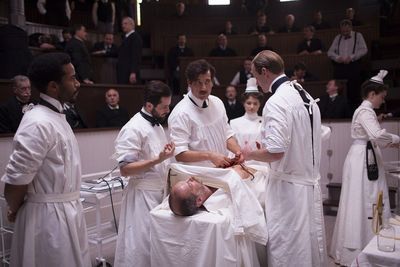
TV Review: Steven Soderbergh’s “The Knick” Plays with Modern Concerns

Thumb_knick07

No one handles the
unexpected like John Thackery.

It’s where I live.”

Steven Soderbergh’s retirement is going splendidly. One of
the most influential American filmmakers of the last quarter-century
notoriously retired from feature film directing only to continue to develop his
voice and hone his skills on the small screen with HBO’s award-winning “Behind
the Candelabra” last year and Cinemax’s “The Knick,” which premieres this
Friday, August 8, 2014 for a 10-episode run. Soderbergh’s program, written by
Jack Amiel & Michael Begler, perfectly illustrates the power of television
in 2014 by telling a story of 1900. Detailing the medical developments of the
era through the eyes of a few characters at the Knickerbocker Hospital,
Soderbergh doesn’t just offer a historical document, he goes out of his way to
successfully craft a drama that feels vibrantly current. As much as I have
loved “Boardwalk Empire,” it is a period piece that has often lived in that
bubble of its era, serving as much as a portal to the past as anything else
thanks to its attention to detail. “The Knick” is not that kind of show. It may
be set in 1900 and the research into the medical profession of that time was
clearly solid but this is a program about today. It is clearly shot on a
digital camera and Soderbergh and his team make clear choices to keep it from
feeling like a Merchant/Ivory production. Most of all, it is a show about our
concerns, about outbreaks, about inequality, about racism, about socio-economic
disparity, and about our hope that there are people out there spending their
intellectual currency on finding ways for us to cheat death.

Dr. John Thackery (Clive Owen) is a highly functioning drug
addict. In the opening scenes of “The Knick,” Thackery awakens in a brothel and
instructs his driver to take his sweet time getting him to work so he can
inject cocaine into one of the few places he can keep it relatively secret—between
his toes—in the back of the carriage. This prologue perfectly illustrates
Soderbergh’s intent. The angles are a bit off and more contemporary than a
traditional period piece, such as the first shot of Thack’s shoes (Soderbergh
often uses close-ups of clothes to reflect socio-economic standing and Thack’s
are nice). And then there’s the amazing score by Cliff Martinez (“Drive,” “Spring
Breakers”) which gives the show a tone it would not otherwise have. Watch the
opening scene of “The Knick” and imagine it set to a Mozart piece. It would feel
completely different. Setting “The Knick” to music not even imagined in that
day not only gives the show a modern edge while also feeling thematically appropriate
in that Thackery is a man looking for new solutions to old problems. It makes
sense that his theme music would be downright sci-fi in its sound.

After a brutal childbirth gone horrendously wrong changes the surgical staff, Dr.
Thackery is promoted to the lead role at the Knickerbocker Hospital in New York
City. He gives a rousing eulogy (a truly fantastic piece of writing) about how
people trying to pioneer the future of medicine are not unlike the men who put
dams in rivers or railroads through mountains—those fighting against the
seemingly impossible will of Mother Nature herself. Thackery’s remarkable
intelligence comes with both addiction and arrogance, two traits that Owen
seems perfectly cast to portray. The underrated actor finds the right mix of
ego and frustration that often blends in men like Thackery. He’s great here,
doing the best work of his career since “Children of Men.”

Owen gets an interesting cast of characters to support him,
headed by André Holland as Dr. Algernon Edwards, the new Harvard-trained
surgeon who is still forced to the basement of the Knick because he happens to
be black. Thackery refuses to work with Edwards at first but sees something
greater than the rest of his staff in the young man’s approach to medicine.
Meanwhile, Edwards considers leaving until he realizes that his potential boss
may be the only man as smart as he is in his field. They are the two
intellectual poles of “The Knick”—the man allowed to work out in the open but
painfully addicted to drugs and the man refused the chance to hone his craft in
public but unwilling to give it up.

Other supporting characters include: Herman Barrow (Jeremy
Bobb), a hospital administrator who is so in debt to most of the New York ne’er-do-wells
that he’s in actual physical danger just because he wants to keep the lights
on; Cornelia Robertson (Juliet Rylance), the proxy for the money behind the
hospital and the woman who seems most attuned to trying to push the staff and
their patients forward in terms of racial and social equality; Nurse Lucy
Elkins (Eve Hewson), a sweet but smart young woman who is thrust in Thackery’s
inner circle mostly by chance. There are many more, including a wise-cracking
nun (Cara Seymour), cynical ambulance driver (Chris Sullivan), and a pair of
right-hand men for Thack (Michael Angarano & Eric Johnson). There isn’t a
false player in the supporting cast although anyone who knows Soderbergh’s
skill with large ensembles shouldn’t be surprised to hear that. I do wish some
of the supporting characters had a bit more depth in terms of writing and some of them look uncomfortable playing within the period, often coming off too much like modern actors playing dress-up, but those are issues that can be easily ironed out over time. It makes sense that the show would focus so heavily on
Algernon and John to start.

Finally, “The Knick” reminds one how far medicine has come
in a century. These are people working without antibiotics; hand-pumping blood
away from an incision; dealing with newly-installed electricity that doesn’t
always work. And these are people trying to do whatever they can to extend the
average life span of a human being. To think that a few of them would have to
turn to drugs to get through the pain of losing patient after patient is understandable.
And it’s because Soderbergh makes it emotional and relatable without being
maudlin. There’s an undercurrent of tragedy in nearly every scene of “The
Knick,” and yet the show never becomes overly depressing. In an era when living
to your 40s was an accomplishment and in a time when most people who visited a
hospital never came home again, death is everywhere in the world of “The Knick.”
And yet it feels like one of the most alive new programs of 2014.

Source: http://www.rogerebert.com/demanders/tv-review-steven-soderberghs-the-knick-plays-with-modern-concerns


Categories
TV & Movies

The Unloved, Part 9: “Transcendence”

Thumb_transcendence-2014-1

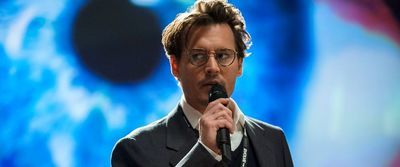
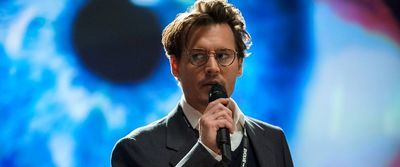
Scout Tafoya’s video series “The Unloved” has already reached into all corners of the cinematic room with pieces on well-known bombs like “Ishtar,” recent disasters like “John Carter,” and even auteur misfired like “Pola X.” This month, Tafoya turns to a film that was just released on Blu-ray and DVD after a disappointing run in theaters earlier this year, Wally Pfister’s directorial debut, “Transcendence.” Critics and audiences were brutal to the film in theaters. Now that it’s available on the home market, Tafoya argues for a reappraisal.

The Unloved – Transcendence from RogerEbert.com on Vimeo.

Source: http://www.rogerebert.com/mzs/the-unloved-part-9-transcendence