Categories
TV & Movies

Beyond Ferguson: Pop Culture through the Lens of Race

Thumb_outrage-in-missouri-town-after-police-shooting-of-18-yr-old-1

For those of us who think about pop culture through the lens of social progress, the events in Ferguson are dispiriting. The growing circle of critics who specialize in placing works of entertainment in political context—such as Alyssa Rosenberg of The Washington Post and Wesley Morris of Grantland —operate under the assumption that politics is downstream of culture, and that representations of social progress in film and television will ultimately lead to real-world change. Why would anyone care about the Bechdel Test unless we assumed the depiction of women onscreen had a significant impact on the ones in the audience? We see pop culture as an expression of our collective values, but we also believe it has the ability to change them.

Over the last few years, there has been a qualitative improvement in the onscreen depiction of some minority groups–women, African-Americans, the LGBT community–while other such as Latinos and Asian-Americans still have a long way to go. Critics have celebrated these advances, as well they should. Studio and network executives may pay the most attention to ticket sales and Nielsen ratings, but critics may have played a major role in these paradigm-shifting victories. As examples they have championed the strong female protagonists in “The Hunger Games” and “Maleficent,” the celebrity of the transvestite “Orange is the New Black” costar Laverne Cox, and Marvel’s recent decision to replace Steve Rogers with a new, black Captain America.

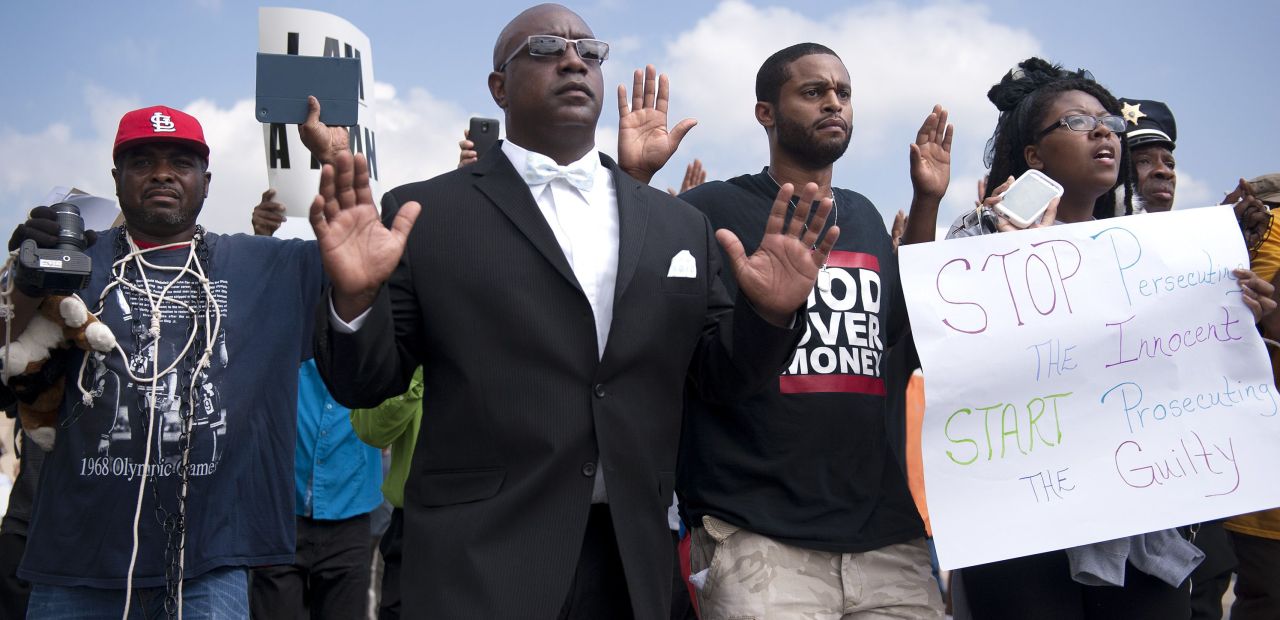
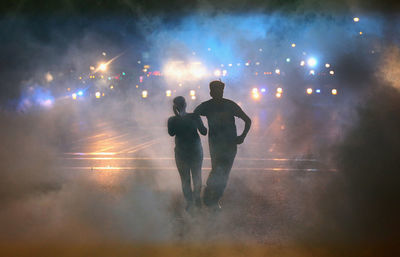
But while we are celebrating these cultural advances, the crisis in Ferguson reminds us of the limits of that approach. Over the last two weeks, we have watched a nearly all-white police department use excessive force to quell the mostly non-violent protests of a largely black community. Racial tension in America may be running higher than at any time since the L.A. riots of 1992.

This wasn’t supposed to happen. Conventional wisdom had it that we were slowly but surely moving towards a post-racial society, and our culture–particularly our pop culture–was leading the way. But the violence in Ferguson is a grim reminder that the stream that carries culture to politics often runs more slowly than we would like.

Film provides the best case study. In the last 25 years, so much has changed in the qualitative representation of the African-American experience onscreen. Back then, the majority of movies about black America focused on gang violence. “Boyz N the Hood,” “Menace II Society,” and “Juice” were crossover hits that offered many Americans a rare and vital look at inner city life, but, taken as a whole, they painted a disturbingly, narrow portrait of black America. Hollywood was only ready to give black filmmakers a chance to tell their story if that story was about drugs and violence.

In recent years, the film industry has let filmmakers expand their imaginative reach, culminating in the great films of 2013, which some called “the year of black cinema.” “12 Years a Slave,” one of the most authentic cinematic representations of slavery, picked up the Oscar for Best Picture, while civil rights stories like “42” and “Lee Daniels’ The Butler” won both critical acclaim and commercial success.

Meanwhile, “The Best Man Holiday” and the solo concert film “Kevin Hart: Let Me Go” showed that movies can feature largely African-American talent in front of and behind the camera without being defined as “racial films.” One filmmaker called 2013 a “Second Harlem Renaissance,” and if that seems like hyperbole, it is only because we were all so thirsty for signs of progress.

Of course, the racial film from 2013 that speaks directly to this cultural moment is Ryan Coogler’s “Fruitvale Station,” which dramatized the killing of Oscar Grant by San Francisco transit police in 2009. The details of the incident are painfully similar to those of Michael Brown’s killing in Ferguson: an unarmed black male killed by a white police officer, who was not charged with a crime or disciplined in any significant way after the incident. “Fruitvale Station” was a hot property coming out of last year’s Sundance Film Festiva; and was considered an Oscar contender, but it ultimately received zero nominations, likely due to the seismic impact “12 Years a Slave” had on the Oscar race. Through the lens of our current crisis, “Fruitvale Station” seems at once more and less relevant now. While a dramatization of this recurring tragedy can serve film’s highest purpose of putting a human face on an emotionally charged, politically divisive situation, it is now painfully clear that pop culture alone cannot prevent these tragedies from recurring.

Of course, what we call culture extends far beyond entertainment. Many of us hoped that the election of an African-American to our nation’s highest office would galvanize our citizenry on issues of race; instead, it seems to have had the opposite effect, causing many to discredit the office of the presidency rather than accept an African-American with a “funny name” as our leader. Perhaps sensing this, President Obama’s rhetoric on issues of race has seemed timid to many, although it hasn’t stopped the vitriol from his opponents. The president was eviscerated by the right-wing media for his mild comments about the arrest of Harvard professor Henry Louis Gates and the shooting of Trayvon Martin. Perhaps as a result, his remarks on Ferguson seem to have been calibrated to seem as even-handed as possible, and all of his actions—including sending the U.S. attorney general to investigate and ordering a federal autopsy on Michael Brown—seem designed to quell the tension without addressing the underlying issues.

Maybe the president understands better than the rest of us just how little impact his words can actually have—that perhaps, in some ways, they can hurt. It is true that black Americans can now look to both the White House and the silver screen for shining examples of people of their color who have transcended their circumstances and achieved success. But without a change in policy that creates opportunity for black Americans, those examples may serve mainly to remind viewers of how little substantive improvement there has been in remedying discrimination and economic disparity. Eugene Robinson of The Washington Post wrote recently that “the tremendous gains achieved by some African Americans have not just left some other behind but made their situation more desperate and hopeless than it was 50 years ago.” Electing a black president was once thought of as a pipe dream that would only become reality once true racial equality has been achieved. But President Obama is in the White House, and our culture of race is as divided as ever, and hope is hard to come by. This, more than anything else, may help explain the situation in Ferguson.

Perhaps we just need to be more patient and continue fighting the battles as they arise. We are all frustrated by this failure to achieve meaningful progress, as well we should be. But that’s probably one reason we celebrate the advances made in film, television, and pop culture. We have been driven through years of inaction to a desperate hope that movies and television can show us an answer. The truth is that they are only a small part of it, and a politically-charged narrative, no matter how eloquent, offers little defense against a guy with a big gun.

Source: http://www.rogerebert.com/balder-and-dash/beyond-ferguson-pop-culture-through-the-lens-of-race


Categories
TV & Movies

Yes, “Life Itself” Is Still In Theaters and On VOD Platforms

Thumb__kevin_horan-2023-19

The summer may be drawing to a close, but “LIFE ITSELF,” Steve James’ acclaimed documentary about Roger Ebert, is still lighting up cinema screens across the country. Here is an updated list of the various venues where the film can be found. You can see “Life Itself” either in theaters, which are all listed below, or on Video on Demand and other online platforms like iTunes. If you have any questions, go to Magpictures.com/LifeItself. Or go to #EbertMovie and #LifeItself at Kartemquin Films.

VOD Platforms:

Amazon
Cablevision
Charter
Comcast
HD On Demand
DirectTV
Dish
FlixFling
Google Play
iTunes
Playstation 3
SuddenLink
Time Warner Cable
Verizon FIOS
VUD
Xbox360
Zune
YouTube

THEATERS NOW PLAYING:

Boulder, CO: Boedecker Theater
Brunswick, ME: Frontier Cafe
Calgary, AB: Plaza Theatre
Chautauqua, NY: Cinema at Chautauqua
Chicago, IL: Beverly Arts Center of Chicago
Evansville, IN: Showplace South 7
Hamilton, NY: Hamilton Movie Theatre
Honolulu, HI: Honolulu Museum of Art
Jefferson City, MO: Capitol City Cinema
Kenosha, WI: University of Wisconsin-Parkside
Lake Worth, FL: Lake Worth Playhouse
Mesilla, NM: Fountain Theatre
Metuchen, NJ: Forum Theatre
New Haven, CT: Criterion Cinemas 7
New London, CT: Garde Arts Center
New Orleans, LA: Indywood Theatre
New York, NY: Symphony Space Inc
Portland, ME: Portland Museum of Art
Portland, OR: Laurelhurst Theatre
Rosendale, NY: Rosendale Theatre
Royal Oak, MI: Main Art Theatre
Spokane, WA: Magic Lantern Theatre
St Johnsbury, VT: Catamount Film & Arts Ctr
Taos, NM: Harwood Museum of Art
Utica, NY: Munson Cinema

OPENING SOON

8/23/2014

Ann Arbor, MI: Michigan Theater
Atlanta, GA: Sandy Springs 8

8/24/2014

Manistee, MI: Vogue Theater

8/25/2014

Downers Grove, IL: Tivoli Theatre

8/28/2014

Indian Lake, NY: Indian Lake Theater
Torrance, CA: Rolling Hills 20

8/29/2014

Blacksburg, VA: Lyric Theatre
Mount Vernon, WA: Lincoln Theatre
Nevada City, CA: Nevada Theatre
Portsmouth, NH: Music Hall

9/2/2014

Lowell, MA: Luna Theater at Mill No. 5
Tacoma, WA: Grand Cinema 4

9/3/2014

Toronto, ON: Bloor Hot Docs Cinema

9/4/2014

Okemos, MI: Studio C!

9/5/2014

Chicago, IL: Gene Siskel Film Center
Grand Rapids, MI: Celebration Cinema Woodland
Jackson Hole, WY: Jackson Hole Twin Cinema
Notre Dame, IN: DeBartolo Performing Arts Center
Center/Browning Cin

9/7/2014

Baton Rouge, LA: Manship Theatre
Shepherdstown, WV: Opera House Theatre

9/8/2014

Seattle, WA: SIFF Film Center
Williamsburg, VA: Kimball Theatre 2

9/10/2014

Wolfville, NS: TIFF Film Circuit

9/12/2014

Ketchum, ID: Magic Lantern Cinemas
Lincoln, NE: Mary R. Ross Film Theater
Winnipeg, MB: Winnipeg Cinematheque

9/13/2014

Bradenton, FL: Lakewood Ranch 6
Edmonton, AB: Metro Cinema
Prescott, AZ: Yavapai College Performing Arts Center

9/16/2014

Tuscaloosa, AL: Bama Theatre

9/17/2014

Oak Park, IL: Lake 7

9/18/2014

Thunder Bay, ON: Thunder Bay SilverCity (TIFF Film Circuit)

9/19/2014

Goshen, IN: Goshen Art House
Lambertville, NJ: ACME Screening Room

9/20/2014

Houston, TX: 14 Pews Theatre

9/21/2014

Gloucester, MA: Cape Ann Community Cinema

9/23/2014

Boulder, CO: International Film Series

9/24/2014

Tunkhannock, PA: Dietrich Theatre

9/25/2014

Cambridge, ON – TIFF Film Circuit
Rehoboth Beach, DE: Rehoboth Beach Film Society

10/3/2014

Ashland, OR: Varsity Theatre 5

10/4/2014

Winchester, VA: Alamo Drafthouse Cinema 8-Winchester

10/9/2014

Bismarck, ND: Grand 15

10/11/2014

Lake Placid, NY: Lake Placid Center for the Arts

10/14/2014

Anapolis Royal, NS: TIFF Film Circuit

10/21/2014

Bloomington, IN: Indiana University Cinema
Macon, GA: Douglass Theatre

10/22/2014

Nyack, NY: Rivertown Film Society

10/29/2014

Salmon Arm, BC: TIFF Film Circuit

11/17/2014

Potsdam, NY: Roxy 4

11/19/2014

Erie, PA: Erie Art Museum

11/24/2014

Duncan, BC: TIFF Film Circuit

2/8/2015

Suttons Bay, MI: The Bay Theatre

Source: http://www.rogerebert.com/life-itself/yes-life-itself-is-still-in-theaters-and-on-vod-platforms


Categories
TV & Movies

Ebertfest Receives Grant From the HFPA

Thumb_jy9it2q03kmhiq-jwwvof0of0jyjq8j4w-pezga2cuw

The Hollywood Foreign Press Association honored the Roger Ebert Overlooked Film Festival known as Ebertfest with a grant at their annual banquet dinner presentation on Thursday, August 14th. Chaz Ebert was on hand to accept the grant on behalf of herself and her late husband, Roger, who founded the festival in Champaign-Urbana 16 years ago. She recalled Roger’s belief that cinema is a machine that generates empathy, and noted that it was his goal with Ebertfest to champion empathy by shedding light on filmmakers who were gifted at universalizing the human experience. “In this time of fractured relationships on an international level,” Chaz said in her speech, “I tell you, more than ever, we need to feel what it’s like to be another person of different abilities, [or of a different] race or religion.”

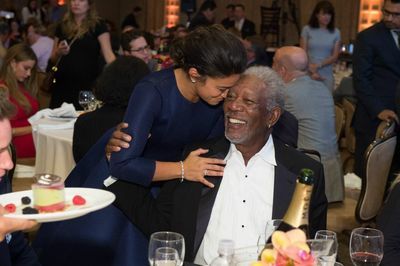
The evening’s one-hour presentation was held at the Beverly Hilton Hotel and featured a roster of all-star speakers detailing the $1.9 million in grants made by the HFPA to non-profit organizations and scholarship programs, while announcing its new officers and directors. The guest list included Morgan Freeman, Patricia Arquette, Channing Tatum, Andy Samberg, Chris Evans, Elle Fanning, Morgan Freeman, Patricia Arquette, Robert Pattinson, Robert Marsden, Haliee Steinfeld, Sofia Vergara, Jason Segel, Jenny Slate, Kerry Washington and Kristen Bell, who sang her famous song, “Do You Want To Build a Snowman?” from “Frozen.”

While the Hollywood Foreign Press is renowned for its star-studded annual award show, the Golden Globes, the night was all about giving rather than receiving as the stars spoke of the worthy recipients of the grants, including the Pablove Foundation that fights childhood cancer and Global Girl Media which empowers young women from under-served communities around the world through new media leadership training.

Grants are also given to help preserve the culture and history of film with The Film Foundation/UCLA Film and Television Archive and the Los Angeles Conservancy among the recipients. Overall the HFPA has distributed more than $20 million in grants, has handed out 948 scholarships and restored 82 films, which include titles like “America, America,” “Breaking Point” and “King Kong.”

HFPA President Theo Kingma said he was thrilled that Ebertfest now joins the list of recipients. “The Hollywood Foreign Press is honored to stand along the legacy of one of the best film critics the world of entertainment has ever known. We are proud to support his legacy,” he said.

“We are thrilled to get the grant.” says Chaz. “For next year’s Ebertfest, I want to do something really special, something that furthers international understanding.”

Earlier in the evening, Chaz spoke with Yahoo about the passing of Robin Williams, and reminisced about her last conversation with the late actor, which took place soon after Roger’s death. Williams had observed that there was a scientific probability that an afterlife existed, thus prompting Chaz to tell the reporter, “Wherever [Robin] is, I hope that he has found the peace and beauty that he deserves.”

View the full program by visiting the Golden Globes site. For more info on Ebertfest, visit its official site.

Additional reporting by Katherine Tulich.

Source: http://www.rogerebert.com/festivals-and-awards/ebertfest-receives-grant-from-the-hfpa


Categories
TV & Movies

Thumbnails 8/22/14

Thumb_james-foley

1.

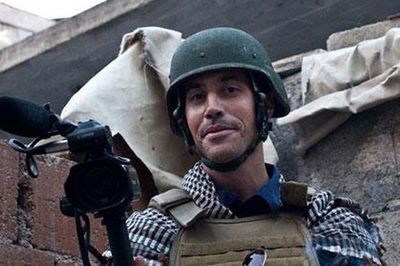
“How journalists like James Foley fall victim to world’s ‘most dangerous conflict’ for reporters”: Powerful commentary from Terrence McCoy of The Washington Post regarding the capture of journalists Foley (who was executed) and Steven Sotloff.

“Their capture and Foley’s apparent execution raise fresh questions about how important conflicts across the globe are covered — and the dangers freelance journalists, eager for bylines, face to report them. The Committee to Protect Journalists called Syria, for example, ‘the most dangerous country in the world for journalists.’ According to the organization’s most recent statistics, 69 journalists have been killed covering the Syrian conflict, many of them Syrian. More than 80 reporters have been kidnapped. Around 20 are currently missing, many of whom are believed to be held by the Islamic State. ‘Missing from the statistics is anything about the kind of journalists who goes to Syria and why,’ journalist James Harkin, who covered Syria as a freelancer, wrote in Vanity Fair earlier this year. ‘After the death of Marie Colvin, in a blizzard of Syrian Army shells in Homs in February 2012, much of the Western media drew back from covering the country. Meanwhile, a lightly resourced, laughably paid, almost wholly uninsured cadre of freelancers, often armed with little more than a notebook and a mobile phone, infiltrated Syria anyway.’”

2.

“11 Things White People Should Stop Saying to Black People Immediately”: An impassioned piece written by Mic.com’s Derrick Clifton in response to the tragedy in Ferguson.

“2. ‘I don’t have white privilege. Stop saying that I have white privilege.’ White privilege isn’t inherently about being raised in an affluent, two-parent home with high educational attainment and markers of upward mobility in American society. White privilege is the many built-in perks afforded to white people by virtue of being born with white skin and white ethnicity in a social and legal system that enforces white supremacy as the rule of law. It’s not having to seriously think about or discuss how the situation in Ferguson will affect friends and relatives or even how a broader justice system will work to protect (or to not protect) the constitutional rights of black people. White privilege is being able to walk away from the conversation, or to stop reading a piece about racism when it stirs up discomfort, rather than wrestling with the subject matter and owning up to personal biases and limits to understanding. White privilege can be used for good too, of course, if those who wield it actively challenge the prejudices of their white friends and reject white supremacy. But as long as white people keep denying their privilege, white officers with badges and institutional power on their side will continue killing blacks with impunity.”

3.

“Remembering Robin”: Marvelous writer and former child star Mara Wilson recalls her memories of Robin Williams when she worked with him on the set of “Mrs. Doubtfire,” at her blog, Mara Wilson Writes Stuff.

“Robin would do anything to make me and the other kids laugh. Those hand puppets that dance alongside the genie in Aladdin‘s ‘Friend Like Me’? That must have been his suggestion, because Robin made those in real life. He’d break them out between takes to entertain us between takes. ‘I don’t like you,’ his left hand would say to his right. ‘You smell like poop!’ I would laugh uproariously — I was five, so poop jokes were the height of hilarity — as his right hand yelled back ‘Well, there’s no toilet paper at my house!’ When he saw me watching him work on his laptop during downtime, he played a sound file of Dorothy from the Wizard of Oz screeching ‘You wicked old witch!’ When we were filming the petting zoo birthday scene, he fed a pony oats out of his hat, then held it out to me and said, ‘Wanna wear it?’ When we were filming the climactic dinner party scene, he would make his carpet bag bark like a dog under the table, then order it to be quiet. He seemed to know instinctively what we would find funny, and never had to resort to saying anything that was inappropriate for children. He was, after all, a father himself.”

4.

“The Big Sleep”: At Ferdy on Films, Roderick Heath provides a sprawling analysis of Howard Hawks’ 1946 Bogart/Bacall classic.

“Of course, ‘The Big Sleep,’ although a mystery and a crime drama, isn’t really about its plot. Its connective tissue is provided by entwined incidents of romance and evil, rather than riddle, with narrative velocity provided by how Marlowe sinks up to his neck in the proliferating consequences of the perversities of a family of American aristocrats who have turned the national dream into an id-inflected nightmare purely by dint of self-indulgence. The animating mood of Chandler’s novels, captured beautifully in this film in spite of its buoyant segues, is one of miasmic corruption and evil welling out of a still-callow, urban America that’s infected with secret appetites fed by feudal princes of the underworld, creating a noxious symbiosis that can only be battled by someone who understands it intimately. Bogart, who had found his real break in cinema playing hood-eyed heels ready to break teeth and plug bellies, was ideal to play such an intimately conversant hero, hard knocks and rude facts impressed upon his persona. Marlowe’s first appearance in the Sternwood Mansion sees him immediately fascinated by effetely competent butler Norris (Charles D. Brown), and the thumb-sucking teenaged seductress Carmen Sternwood (Martha Vickers), who, as Marlowe puts it, tries to sit in his lap whilst he’s standing up.”

5.

“Leonard Maltin’s Movie Guide Ending After 45 Years—Internet Kills Iconic Print Paperback”: A eulogy penned by Pete Hammond of Deadline Hollywood.

“With the recent near-death of film stock, a print book largely covering movies made in that medium is probably, ironically, and sadly, an anachronism. And the Internet with sites like Internet Movie Database, Rotten Tomatoes, Metacritic and their ilk has taken over the sector so why not join them with an online version of the book? Maltin says it all came down to money. ‘We were unable to find an effective way to monetize it on the Internet,’ he said. ‘The iPhone app we had kind of fizzled too. The other answer, though, is these capsule reviews and capsulized information were meant to be in a paperback book. They were designed for this medium, for this format, and weren’t meant to be posted day and date with movie openings. The Internet has a different imperative and a different set of rules. We could conceivably adjust, but simply putting the book online would not be wise,’ he said. Maltin said that he, like everyone else, is an avid user of the web. ‘It’s a fantastic tool. I don’t have my head in the sand about this. We served a real purpose for several decades when there was no other source and I have had tremendous feedback and continue to get tremendous feedback from people who grew up on this book including a lot of filmmakers,’ he said.”

Image of the Day

At The Dissolve, Noel Murray reports that the Tom Cruise would-be blockbuster, “Edge of Tomorrow,” has been renamed for its home video release. The tagline, “Live. Die. Repeat.” has taken over.

Video of the Day

“Last Week Tonight with John Oliver” cements its status as one of the best shows on television with this brilliantly scathing and sobering commentary on the recent events in Ferguson and police militarization.

Source: http://www.rogerebert.com/thumbnails/thumbnails-82214


Categories
TV & Movies

Thumbnails 8/21/14

Thumb_wearethebest01

1.

“We Are the Best!”: Roderick Heath of This Island Rod writes a great piece on Lukas Moodysson’s polarizing picture about pint-sized punk rockers.

“Moodysson’s skill with young actors is evident as he lets his young scamps burst with unruly energy. His familiar thrum of laidback humanism underscores the proceedings as he waggishly offers pint-sized tyros taking on anyone who offends them, starting with hair metal band Iron Fist who hog the practice space in their neighbourhood youth centre: capitalising on a technicality about booking the space and backed up by the centre’s comically officious hippie youth counsellors, they take over the space and the communal instruments after kicking Iron Fist out, and then bash on their instruments with all the abandon of the ‘Lord of the Flies’ kids. When they reach out to Hedvig, they find her surprisingly receptive to their musical obsessions and ambitions. They also offer her friendship, something she lacks, although their attempts to give her a punk haircut results in her mother (Ann-Sofie Rase) threatening to report them to the police, but then giving them a sweet lecture over milk and cookies about the hypocrisy of trying to impose their own standards of in-crowed chic on others when they’ve been avoiding that themselves. A more serious potential for a rift forms when the three girls reach out to a band of slightly older boys who have a band, Sabotage, often featured in the fanzine they read assiduously. The asymmetric hook-up sees the boys in the band, Elis (Jonathan Salomonsson) and Mackan (Alvin Strollo), having recently shed a member, interested in Klara and Hedvig, leaving Bobo, who suffers from low self-esteem, is hurt by the excision. She contacts Elis herself in a naked play for his affection.”

2.

“James Foley, Ferguson, Gawker, ‘NY Post’: The Whiplash of Journalism at Its Best and Worst”: Flavorwire‘s Jason Bailey explores the dangers of modern investigative journalism.

“Meanwhile, in Ferguson, Missouri, journalists from around the world have put themselves in harm’s way to capture images of a militarized police force gone amok, and a community in anguish and anger. And those journalists’ work on the ground helped shine a much-needed light on the events there; the first few nights of protests were barely mentioned in mainstream media, and it took the arrests of ‘The Washington Post’’s Wesley Lowery and Huffington Post’s Ryan J. Reilly to ‘get the mainstream media machine moving,’ per Politico. Since Wednesday, with the eyes of the nation on them, forces in Ferguson have arrested 11 more journalists reporting for outlets around the world, from ‘The Telegraph’ and Getty Images to ‘Sports Illustrated’ to Breitbart News. Cops lobed tear gas at a team from Al-Jazeera America and disassembled their equipment; threatened to ‘shell’ Mustafa Hussein, operator of one of the story’s most vital live streams; and threatened to mace MSNBC’s Chris Hayes. But the journalists haven’t left; Ferguson is an important story, and it’s their job to cover it.”

3.

“Why Exactly Is There a ‘Jarhead 2’? Hollywood’s Secret Sequel Economy”: Grantland‘s Matt Patches discusses the current onslaught of cash grab sequels such as—wait, there’s actually a sequel to ‘JARHEAD’? Seriously?!

“The officially sanctioned ‘Jarhead’ sequel joins a swarm of thought-dead brands revived through cunning straight-to-DVD strategy. Universal Home Entertainment, which is releasing ‘Jarhead 2: Field of Fire’ on Blu-ray, DVD, and VOD platforms, has “non-theatrical” (“direct-to-DVD” being the archaic term) production down to a science. The company releases five to seven titles a year. The annual slates are eclectic: In the past four years, Universal has released ‘The Scorpion King 3: Battle for Redemption,’ ‘Saige Paints the Sky,’ ‘Death Race 3: Inferno,’ ‘Honey 2,’ ‘Blue Crush 2,’ ‘Curse of Chucky’ (the franchise’s sixth installment), and ‘The Little Rascals Save the Day’ (a quasi-continuation of the studio’s 1994 remake). Competitive studios keep their own plates spinning, with Fox Home Entertainment (‘Marley & Me: The Puppy Years,’ ‘Tooth Fairy 2,’ ‘Flicka: Country Pride,’ ‘Wrong Turn 5’ & ‘6,’ and ‘Joy Ride 3’), Paramount Famous Productions (‘Mean Girls 2’), and Warner Premiere (‘Ace Ventura: Pet Detective Jr.’; ‘House Party: Tonight’s the Night’; and DC Comics’ animated output) producing new titles for streaming platforms and Redbox kiosks.”

4.

“Seth Meyers on ‘Late Night,’ Hosting the Emmys, and Getting Tina Fey and Amy Poehler to Write Jokes for Him”: Vulture‘s Jesse David Fox conducts a superb interview with the sardonic comic, asking questions such as, “What is a good episode of late night television to you?”

“The monologue is probably the biggest indicator. I think a good monologue puts you in a good mood for the rest of it. But it is funny because your memory only serves to the last thing you did. If I don’t feel like the monologue went great, but then I go to the desk and we do a piece of comedy there that does work, then you’re sort of like, ‘We’re fine.’ But for us, a really good episode is also dependent on were there good guests? Did you get something out of them? I always want my guests to score. If you have a guest who’s a comedian and they want you to set them up for things, then you have to just set them up for things and get out of the way and don’t put punch lines on their punch lines. And with other people, where it can be an interesting conversation, you want to do the work of watching the source material. At some point, that’s something, when you have kids, you can’t really watch every movie and read every book, but right now I’m trying my best to.”

5.

“Kirk Douglas Remembers Lauren Bacall: She Was My Lucky Charm”: Written by Douglas for The Hollywood Reporter.

“I met Betty when she was 17 and I was 24. We were both studying at the American Academy of Dramatic Arts. I was on my own in New York with meager funds. That winter, Betty saw me shivering in my thin overcoat. She didn’t say anything, but she talked her uncle into giving me one of his two thick coats. I wore it for three years. That sort of unassuming kindness was one of her most endearing characteristics. When I had the honor of presenting Betty with her honorary Oscar in 2009, I told the audience: ‘People said Bacall was ‘tough.’ She’s a pussycat with a heart of gold.’ After World War II ended, I was honorably discharged from the Navy in San Diego. Betty had been discovered by Howard Hawks and was now in Hollywood preparing for her first film, in which she was to star opposite none other than Humphrey Bogart. I wanted to see her before flying back to New York, so I called her, and we arranged to meet for dinner. Of course, she was late. When I stood up to greet her, I noticed that she had the script for To Have and Have Not under her arm. We talked about it, and she read me a few lines: ‘You know how to whistle, don’t you Steve? You just put your lips together — and blow.’ ‘Betty,’ I said, ‘you will be a star.’ My prophecy came true.”

Image of the Day

At Variety, Steven Gaydos celebrates the fifth anniversary of Kino Lorber, the distributor that “finds tomorrow’s classics in today’s fest scene.”

Video of the Day

The trailer for Jason Reitman’s “Men, Women & Children,” features no spoken dialogue and casts an entrancing spell.

Source: http://www.rogerebert.com/thumbnails/thumbnails-82114


Categories
TV & Movies

Love Is Strange

Thumb_loveisstrange-2014-1

“Love Is Strange,” directed by Ira Sachs, and co-written by Sachs and Mauricio Zacharias, has the confidence in its beautiful and emotional story to tell it simply. It’s about many things: growing old, New York real estate, family, work, friendships…but what it is really about is love. Love is not strange at all. It is what we do, if we are lucky.

After 39 years together, Ben (John Lithgow) and George (Alfred Molina) get married. Ben, a painter, is anxious, and struggles with sadness at every moment. George, a music teacher, is there to pep-talk Ben, keep him focused, look on the bright side. We see all that in their behavior as they try to hail a cab in Greenwich Village to get to their own wedding. The behavior between these two actors immediately lets us know who these guys are, and who they are to each other. When they say their vows, the happiness in the small group of friends and family gathered is palpable.

But very soon afterwards, George loses his job as a choir director at a Catholic school (because, with the wedding, he has officially come out). The priest (a wonderful John Cullum) considers George his friend, but the Archdiocese has demanded George be let go, and he can’t say no to his bosses. With the loss of income, Ben and George have to sell their co-op and and crash on people’s couches as they look for new housing in the confusing and brutal New York real estate market. Separately. Their separation is temporary, though. At least that’s what everyone says.

If you have seen Leo McCarey’s 1937 “Make Way For Tomorrow” (a film Orson Welles declared “the saddest movie I have ever seen”) then this set-up will sound familiar. In some respects “Love Is Strange” could be considered an unofficial remake. It has the same bittersweet heart, and the same almost urgent desire or demand that older people be treated with more respect. The couple in “Make Way For Tomorrow” are split up for similar real estate-related reasons, have to bunk with their busy adult children, and find themselves disoriented in a lonely world without their partner.

“Poor Richard” (aka Ben Franklin) observed in his Almanack centuries ago that “Fish and visitors stink after three days.” The people in “Love Is Strange” who take in Ben and George experience that upsetting truth. Ben crashes with his nephew Elliott (Darren E. Burrows), an busy video producer who is rarely home, and his wife, Kate (Marisa Tomei), a novelist struggling with her next book. They have an awkward teenage son named Joey (Charlie Tahan) who only has one friend, a swaggering Russian kid named Vlad (Eric Tabach). Ben is removed from his familiar environment, his partner and his cherished routines, and starts to deteriorate. George has a little bit more emotional resilience, but he begins to fall apart too, staying with a much-younger gay couple (Cheyenne Jackson and Manny Perez) who both work for the NYPD. George tries to sleep on the couch in a party house atmosphere, with “Game of Thrones” marathons and people coming and going.

John Lithgow and Alfred Molina seem so comfortable in their roles that you have no doubt these men have been together for half of their lives. They capture the ease of such a relationship, but also the irritability, the telepathic quick looks, and then the sudden swoons of intimacy (especially when the going gets rough).

Sachs and Zacharias have a great ear for the different rhythms of speech. Joey’s youthful desire for privacy and boundaries is so acute that his language often seems frightened; he does not know how to assert himself, and he feels overrun. Ben tends toward melancholy; his words are contemplative riffs on whatever comes into his head. Kate is self-absorbed and stressed but doing the best she can in the void left by her absent husband. George, shut out of the Catholic Church that he still loves, tries to be practical and positive despite great pain.

“Love Is Strange” is not showily directed, and yet there are touches throughout that help ground us in the characters’ inner lives. George coaches a young music student on her “interpretation” of Chopin (Chopin’s music fills the soundtrack), and as she tries the piece again, the music intensifies his personal drama, and he’s so overcome that he has to turn away to hide his tears. Joey stands on the landing of an apartment stairwell clutching a skateboard, crying by himself. Beyond the window is the green of the courtyard. The camera does not move; neither does the boy. He just stands there, crying for as long as he feels like crying, then getting himself together and continuing on down the stairs. It’s a caesura, potent and powerful, unhurried and true. By that point in the story, we need it as badly as Joey does.

In movies it’s the details that often bring transcendence—everyday moments illuminated by profundity or grace. Filmmakers discover them by observing how people listen to one another, the way they talk and touch, the pauses that settle unexpectedly between them, the silent private moments. It’s a courageous film that’s willing to sit in those moments instead of underlining them or hurrying past them, hoping we get the shorthand. “Love is Strange” is a patient film. The emotions it unleashes are enormous.

Source: http://www.rogerebert.com/reviews/love-is-strange-2014