An unprecedented decline in global air traffic is limiting the data that meteorologists use to predict the weather.
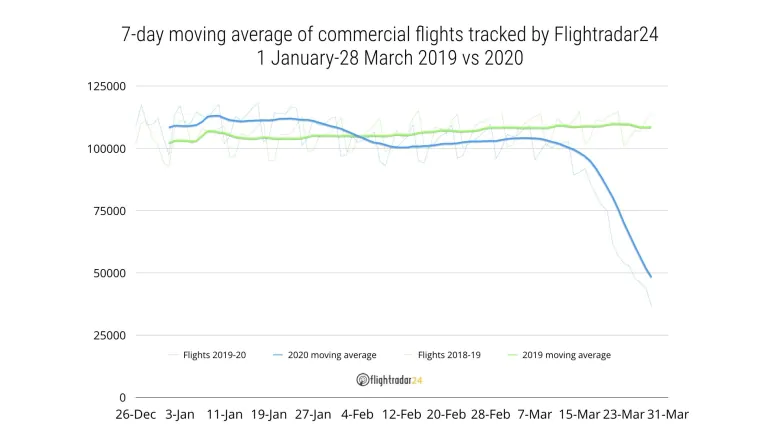
Commercial air traffic shrunk to 41 per cent below 2019 levels during the last two weeks of March, according to Ian Petchenik from Flightradar24, an online global flight tracking service.
“We have seen a precipitous decline in [air] traffic from mid-March until now and it continues to decline,” said Petchenik.
“The second week in March … it is safe to say that the bottom fell out.”
Meteorologists collect data such as wind speed and air temperature from aircraft as they fly overhead.
“One of the most fundamental parts of weather forecasting is getting the initial state of the atmosphere right,” said Tyler Hamilton, a meteorologist with The Weather Network.
According to Hamilton, there are fleets of aircraft circling the planet, generally at 36,000 to 39,000 feet.
Meteorologists get tens of thousands of observations from these flights.
“That wind observation is particularly vital to weather forecasting,” he said.
“We have gone from about 200,000 tracking globally daily to floating around 60 or 70,000. That is about a 70 per cent reduction in the number of flights circulating the planet and it can have an effect on the flight-level data.”
Even the pressure surface levels are affected. “You can see a three or four per cent reduction in accuracy in short-range forecasts,” said Hamilton.
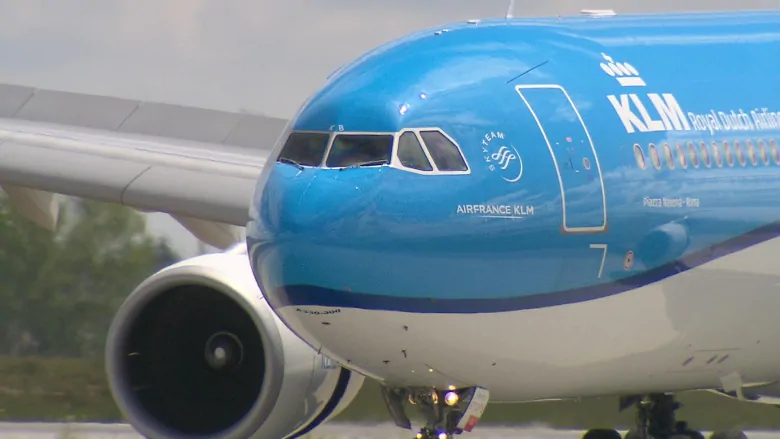
Aircraft like this KLM jet transmit data used for weather forecasting. (CBC)
The jet stream circling the planet is at about the same altitude as a typical flight level, and this is where the lack of information would be missed the most.
Hamilton said other technology can help fill some of those gaps.
“We can rely on a few other sources. One of those sources is satellite observations,” he said, adding that observations on land from weather stations are also not affected.
“We continue to launch weather balloons right around the planet,” he added. “So we can use some of those observations in light of the reduction of flights that are currently taking place.”
Weather balloons are also used to capture important meteorological data. (CBC)
An unprecedented decline in global air traffic is limiting the data that meteorologists use to predict the weather.
Commercial air traffic shrunk to 41 per cent below 2019 levels during the last two weeks of March, according to Ian Petchenik from Flightradar24, an online global flight tracking service.
“We have seen a precipice decline in (air) traffic from mid-March until now and it continues to decline,” said Petchenik.
“The second week in March … it is safe to say that the bottom fell out.”
Meteorologists collect data such as wind speed and air temperature from aircraft as they fly overhead.
“One of the most fundamental parts of weather forecasting is getting the initial state of the atmosphere right,” said Tyler Hamilton, a meteorologist with The Weather Network.
A seven-day moving average of commercial flights tracked by Flightradar24 shows significant drop in activity in the last two weeks of March. (Flightradar24)
According to Hamilton, there are fleets of aircraft that are circling the planet, generally at flight levels of 11 or 12 kilometres above the ground.
Meteorologists get tens of thousands of observations from these flights. “That wind observation is particularly vital to weather forecasting,” he said.
Aircraft like this KLM jet transmit data used for weather forecasting. (CBC News)
“We have gone from about 200,000 tracking globally daily to floating around 60 or 70,000. That is about a 70 per cent reduction in the number of flights circulating the planet and it can have an effect on the flight level data.”
Even the pressure surface levels are affected. “You can see a three or four per cent reduction in accuracy in short range forecasts,” says Hamilton.
Weather balloons are also used to capture important meteorological data. (CBC)
The jet stream circling the planet is at about the same altitude as a typical flight level, and this is where the lack of information would be missed the most.
Hamilton said other technology can help fill some of those gaps.
“We can rely on a few other sources. One of those sources is satellite observations,” he said, adding that observations on land from weather stations are also not affected.
“We continue to launch weather balloons right around the planet,” he added. “So we can use some of those observations in light of the reduction of flights that are currently taking place.”
With Banff shut down to outsiders, its tourism and visitor economy has been “decimated” according to local MLA Miranda Rosin who says the mountain town is experiencing up to an 85 per cent unemployment rate as businesses and people react to ordered closures and self-isolation directives.
“That entire economy has really crumbled in the last couple weeks,” said the provincial representative for Banff-Kananaskis.
“To not have any tourism or any visitors has completely decimated every business in town.”
But in the close-knit community, even hard-hit businesses are trying to help neighbours.
The Grizzly House, an iconic lodge-style building on Banff Avenue had to lay off 56 employees — many of them long-term staff — keeping just eight as the restaurant closed its doors.
The Grizzly House in Banff had to lay off 56 employees when it closed its doors on March 17. The iconic fondue restaurant on the town’s main drag is now delivering 50 meals every two days to vulnerable people in the community like seniors. (Francis Hopkins )
The restaurant has been serving its famous fondue for more than 50 years and on March 17, general manager Francis Hopkins had to close the doors and say goodbye to staff.
“People raised families while working here,” said Hopkins.
Determined to make the best of a bad situation, the GM and owner went to the town to see how the Grizzly House and its fully functional but idle kitchen could help.
The Town of Banff provided Hopkins a list of 50 people, many of them seniors, who would benefit from a comfort food meal delivered every other day.
Sunday night’s supper included roasted pork with stuffing and apple sauce, mashed potatoes and glazed carrots.
Hopkins says they are feeling the love.
“It’s amazing for us, we feel almost selfish for how uplifting and positive it is,” says Hopkins.
Staff at the Grizzly House in Banff pack comfort food meals (two metres apart) to deliver to locals, many of them seniors. (Francis Hopkins)
Restaurants, ski hill, hotels and other businesses in Banff have laid off about 5,000 people, according to Leslie Bruce president and CEO of Banff Lake Louise Tourism.
The Banff Centre for Arts and Creativity, one of the town’s largest employers, laid off 75 percent of its staff — 400 employees.
“This has had an unbelievable, unimaginable impact on people,” says Bruce.
With the community facing an economic shutdown people like Bruce are turning their minds to what a rebuild will look like.
Bruce says travel is a force for good connecting people and she feels strongly, it will come back. But the new culture around connection and physical contact could have long term effects on places like Banff.
“How do we rebuild trust, how do we feel safe to travel, how do we feel safe to share a meal or a cup of coffee again?” says Bruce.
“It’s not just going to be flipping a switch or turning the tap back on, we’re going to have to figure out what’s the best way to do this.”
Local legend helicopter pilot Jim Davies receives a meal from the Grizzly House team. On the menu that day was wild game sausage, pasta, bean salad, a fresh bun and apple crumble. (Francis Hopkins)
‘Elk poop on every sidewalk’
Banff typically attracts about four million tourists a year.
Right now, without visitors and a population of less than 10,000 and orders to stay home, the community, according to Rosin is “completely desolate.”
“It looks like a ghost town.”
But there is an increase in some foot —or hoof — traffic.
The townsfolk say deer, elk and other wildlife are taking over Banff’s main streets.
“There’s elk poop on every sidewalk,” says Hopkins.
Hopkins says he fully intends to re-open the Grizzly House and hire back his staff.
“It’s not the right time for the people of Alberta to come here right now but we look forward to welcoming them back; we can’t wait for hem to come back when the time is right.”
A tiger at the Bronx Zoo has tested positive for the new coronavirus, in what is believed to be the first known infection in an animal in the U.S. or a tiger anywhere, federal officials and the zoo said Sunday.
The four-year-old Malayan tiger named Nadia — and six other tigers and lions that have also fallen ill — are believed to have been infected by a zoo employee who wasn’t yet showing symptoms, the zoo said.
The first animal started showing symptoms March 27, and all are doing well and expected to recover, said the zoo, which has been closed to the public since March 16 amid the surging coronavirus outbreak in New York.
The test result stunned zoo officials: “I couldn’t believe it,” director Jim Breheny said. But he hopes the finding can contribute to the global fight against the virus that causes COVID-19.
“Any kind of knowledge that we get on how it’s transmitted, how different species react to it, that knowledge somehow is going to provide a greater base resource for people,” he said in an interview.
The finding raises new questions about transmission of the virus in animals. The U.S. Department of Agriculture, which confirmed Nadia’s test result at its veterinary lab, says there are no known cases of the virus in U.S. pets or livestock.
Security stands at the entrance for the Bronx Zoo where ambulances are parked on Friday. (Frank Franklin II/Associated Press)
“There doesn’t appear to be, at this time, any evidence that suggests that the animals can spread the virus to people or that they can be a source of the infection in the United States,” Dr. Jane Rooney, a veterinarian and a USDA official, said in an interview.
Small number of animals tested
The USDA said Sunday it’s not recommending routine coronavirus testing of animals, in zoos or elsewhere, or of zoo employees. Still, Rooney said a small number of animals in the U.S. have been tested through the USDA’s National Veterinary Services Laboratories, and all those tests came back negative except Nadia’s.
The coronavirus outbreaks around the world are driven by person-to-person transmission, experts say.
There have been a handful of reports outside the U.S. of pet dogs or cats becoming infected after close contact with contagious people, including a Hong Kong dog that tested positive for a low level of the pathogen in February and early March. Hong Kong agriculture authorities concluded that pet dogs and cats couldn’t pass the virus to human beings but could test positive if exposed by their owners.
Some researchers have been trying to understand the susceptibility of different animal species to the virus, and to determine how it spreads among animals, according to the Paris-based World Organization for Animal Health.
The American Veterinary Medical Association and the federal Centers for Disease Control and Prevention have been recommending that out of an abundance of caution, people ill with the coronavirus should limit contact with animals — advice that the veterinary group reiterated after learning of the tiger’s test result.
In general, the CDC also advises people to wash their hands after handling animals and do other things to keep pets and their homes clean.
Other animals at zoo showing symptoms
At the Bronx Zoo, Nadia, her sister Azul, two Amur tigers and three African lions developed dry coughs, and some of the cats exhibited some wheezing and loss of appetite, said Dr. Paul Calle, the zoo’s chief veterinarian.
The staff figured there could be a relatively routine explanation for the cats’ symptoms but tested Nadia for coronavirus out of “due diligence and an abundance of caution,” Breheny said. Only Nadia was tested because it takes anesthesia to get a sample from a big cat, and she had already been knocked out to be examined.
The seven sickened cats live in two areas at the zoo, and the animals had contact with the same worker, who is doing OK, zoo officials said. They said there are no signs of illness in other big cats on the property.
Staffers who work with the cats will now wear infection-protection garb, as primate keepers have done for years because of the animals’ closer genetic ties to human beings, Breheny said.
For most people, the coronavirus causes mild or moderate symptoms, such as a fever and cough that clear up in two to three weeks. For some, especially older adults and people, it can cause more severe illness, including pneumonia, and can be fatal.
As the COVID-19 pandemic has shuttered libraries and coffee shops, some Toronto students are turning to an online trend to overcome the loneliness of studying by themselves.
It’s called “Gong-bang,” short for “gongbu bangsong” which translates to “study broadcast” — and it’s a growing trend that originated in South Korea, where many students study for up to 18 hours every day to prepare for exams.
Similar to the popular “meokbang” trend, also known as “mukbang” or “eating show,” study broadcasts have also attracted a niche online community — one that includes University of Toronto student Rachel McKenna-Marshall, 24.
She’s been watching these videos daily since her classes shut down.
“With [these videos] and self isolating, you can recreate that feeling of being in the library and having people studying around you,” said McKenna-Marshall, who’s working towards her masters in architecture.
She was already watching these videos once a week to help her study before public health officials mandated physical distancing across Ontario.
While it may not be the most riveting content one can find online, these videos have accumulated millions of views on YouTube — with many channels now solely dedicated to videos of people studying in complete silence for several hours at a time.
Flipping a page or the clicking of a keyboard is often all you can hear in a video. It’s intended to mimic the environment of a library to help viewers concentrate on studying and nothing else.
[embedded content]
Some videos play mellow music, while others have white noise in the background.
Study broadcasts are often recorded live and streamed onto platforms like AfreecaTV, a Korean live-streaming platform, or Twitch, while others are uploaded as videos onto YouTube and are meant to be rewatched at any time.
Studying in intervals
McKenna-Marshall says she finds it hard to focus in her home, but the videos allow her to transform it into a study space.
The pomodoro technique, a commonly used method in these “study-with-me” videos, consists of 30-minute ongoing intervals in which 25 minutes is dedicated to studying with a five-minute break at the end of each interval. It’s intended to instill a sense of urgency and work with the time you have, while also taking a short break throughout.
U of T graduate Nasir Kharma started his own YouTube channel Kharma Medic two years ago to share advice with other students considering applying to medical school.
At first, I’ll be honest, I found it a little bit of a strange concept …– Nasir Kharma
Now studying medicine at King’s College in London, the 24-year-old has grown his channel to 145,000 subscribers and amassed more than seven million views.
Kharma says he had never heard of study-with-me videos until one of his viewers asked him to record one.
He says he had to Google it.
Kharma’s YouTube channel has racked up millions of views and 145,000 subscribers. (Sara Jabakhanji/CBC)
“At first, I’ll be honest, I found it a little bit of a strange concept. I thought, ‘Why would you want to watch somebody else studying if you are studying?”‘ Kharma said.
His first “study with me” video got 170,000 hits, which was more than double the views on his other videos.
“Most of the feedback would be something along the lines of, ‘I haven’t been productive for a week and this really helped me sit down and actually do all the work that I needed to do,’ or you know, ‘I’ve got an upcoming exam and this is perfect,'” he said.
The majority of the students watching his videos are from Canada, the U.S. and India.
[embedded content]
Kharma says this study method doesn’t work for him but he understands why it works for his subscribers.
“If any students are struggling with sort of structuring their time or finding the discipline to sit down and work, then I think the study-with-me video would be a very powerful way to motivate them,” he said.
Connection in a time of physical distancing
It would not be surprising if more people began watching these videos because they “really do help create connection” in this time of physical distancing, said Michelle Cho, an assistant professor in the University of Toronto’s department of East Asian Studies. Her research focuses on popular aesthetics in Korean film, media and popular culture.
Any kind of live streaming that is filmed individually can capture a sense of “togetherness” that appeals to many, Cho said
“If you can connect with other people and know that other people are out there doing the same thing, it creates a kind of sense of solidarity and accountability, even if you are still sitting in your room by yourself.”
Governments have released models with dire projections about how many people could die from COVID-19 to help get people onside with physical distancing measures. But experts caution models aren’t a crystal ball.
On Friday, Ontario released a model projecting 3,000 to 15,000 people in Ontario could die in a pandemic that may last two years. It came on the heels of projections released by the U.S government and British Columbia. There are also calls for the federal government to do so, and some other provinces are also planning to release their projections.
What do they all mean? Here are some basics to help interpret the modelling headlines.
What is a disease model?
Models are mathematical representations that are often simplified to help us understand complexity, from weather forecasts to trends in the economy.
Epidemiologists look at how and why a disease like COVID-19 passes from person to person to control infectious diseases.
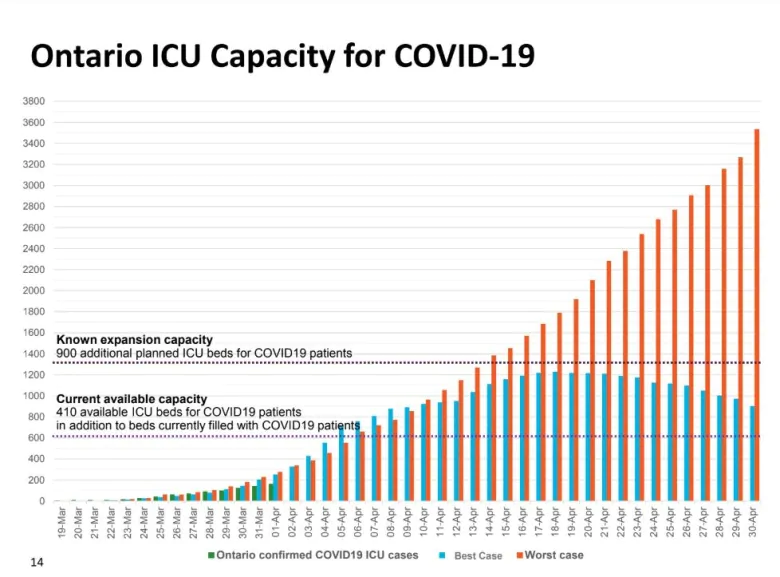
(Ontario Ministry of Health and Long-Term Care)
Dr. Ross Upshur, a professor in the Dalla Lana School of Public Health at the University of Toronto, said disease models are only as good as the data fed into them.
Disease models rely on strong public health surveillance to identify cases of infection quickly, isolate and treat them and then carefully trace who patients have been in contact with to smother any sparks of disease transmission from igniting into a blaze.
What data goes into the model?
Ontario’s model included cases and deaths by age group to estimate the case fatality ratio, as well as observed data from other countries.
Good data exists on some aspects, such as how long people are sick if they show symptoms. Others, such as the transmission rate when someone has symptoms that are too mild to seek medical care, are less solid.
What’s the goal of COVID-19 disease models?
Chris Bauch, a professor of epidemiology at the University of Waterloo who uses mathematical and computer models of infectious disease outbreaks, said the goal is to predict how many cases and deaths of COVID-19 could occur under different scenarios.
Ontario’s worst-case scenario projects 100,000 deaths over the course of the pandemic if nothing had been done.
With strong public health measures like physical distancing and self-isolation, projected deaths fall to 3,000 to 15,000.
WATCH | How Ontario can slow the spread of COVID-19:
Dr. Peter Donnelly, president and CEO of Public Health Ontario, describes how the spread of COVID-19 will eventually falter if residents maintain physical distancing measures. 1:37
The statistics help predict the outbreak’s path, ferocity and impact as measured by the number of people sickened, hospitals overwhelmed and lives lost.
What cautions should we keep in mind?
The models use estimates of cases, intensive care capacity and deaths that include wide ranges.
That’s because they include assumptions and uncertainty, which increases the further into the future that the projections are made.
Just how accurate are the models?
While the accuracy varies, models of previous epidemics have helped to inform public health policy.
The classic example is Dr. John Snow’s map of cholera cases in London in 1866. He showed a link between the infectious disease and contaminated drinking water traced to a particular water pump.
Combining different models from different researchers can be more reliable than the results of a single model.
People practise physical distancing as they look over the City of Montreal from Mount Royal Park. (Paul Chiasson/The Canadian Press)
Bauch said that with time, researchers will also gain a better sense of the COVID-19 death rate and incubation period (the time between when an infection occurs and symptoms start). This will help researchers refine their models.
How useful are they?
Even with uncertain data, modellers could come up with useful estimates, Bauch said, such as whether the number of cases will exceed capacity in intensive care units. That’s important because so many resources are scarce, such as personal protective equipment like masks, gloves and gowns as well as specialized equipment like ventilators and the highly trained healthcare professionals that know how to administer them.
The Ontario model suggests that under the best case scenario, the number of cases will be under the province’s planned capacity. But in a worst case scenario, Ontario’s capacity will be exceeded, bringing Italy-scale problems.
“Even though models aren’t a crystal ball, the models are based on the best epidemiological knowledge that we have, and they indicate that physical distancing is likely having an effect and preventing more deaths than would otherwise be the case,” Bauch said.
What’s missing?
Raywat Deonandan, an epidemiologist and associate professor in the Faculty of Health Sciences at the University of Ottawa, said it’s important for governments to be transparent with data models, he said, because letting the public know when to expect peak cases and deaths to occur is useful.
“Citizens are part of this process. If they don’t feel as though they’re part of this process, they won’t co-operate with doing their part,” he said.
He said the best ways to allow society to return to normalcy are deploying rapid, frequent, public testing at a national scale, such as what’s happening in Iceland, along with strong physical distancing measures and shuttered businesses as in the Institute for Health Metrics and Evaluation’s state models.
Deonandan said Canadian health officials haven’t answered how long physical distancing measures will be in effect. The more lax they are, the longer it will take for the disease to get under control.