Categories
Tech

Atomic bomb tests help reveal age of world's biggest fish


Scientists have figured out how to calculate the age of whale sharks — Earth’s largest fish — with some guidance from the radioactive fallout spawned by Cold War-era atomic bomb testing.

By measuring levels of carbon-14, a naturally occurring radioactive element that also is a by-product of nuclear explosions, the researchers determined that distinct bands present inside the shark’s cartilaginous vertebrae are formed annually, like a tree’s growth rings.

It was already known that these bands existed and increased in number as a shark aged. But it was unclear whether new rings appeared yearly or every six months.

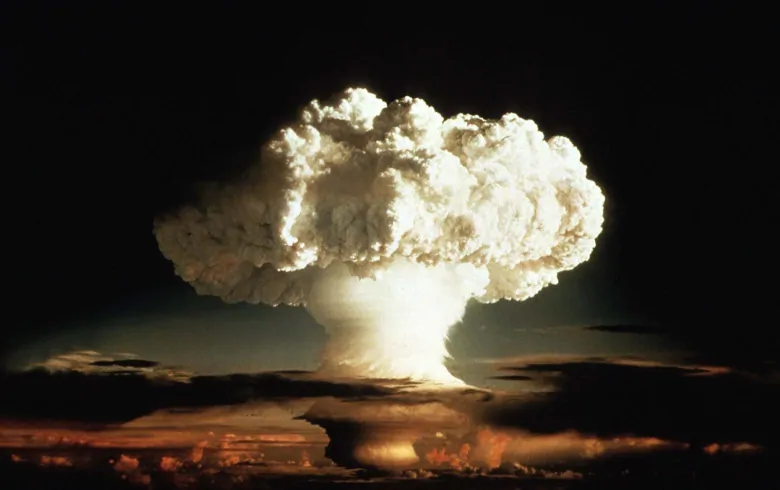
The mushroom cloud of the first test of a hydrogen bomb, “Ivy Mike” looms over the Pacific Ocean in 1952. Scientists figured out whale sharks’ ages by comparing carbon-14 levels in their cartilage to data on fluctuations in its global presence during the busy years of atmospheric nuclear tests in the 1950s and 1960s. (Reuters)

The researchers compared carbon-14 levels in the rings to data on fluctuations in its global presence during the busy years of atmospheric nuclear tests in the 1950s and 1960s.

“These elevated levels of carbon-14 first saturated the atmosphere, then oceans and moved through food webs into animals, producing elevated levels in structures such as the vertebrae of whale sharks,” said marine ecologist Joyce Ong of Rutgers University in New Jersey, lead author of the study published this week in the journal Frontiers in Marine Science.

Scientists now will be able to calculate a whale shark’s age after its death — one ring equals one year. But just as importantly the study established that these endangered marine giants possess a very slow growth rate.

Critical for conservation

“For the management of any marine species, knowledge of growth rate is critical as it determines the resilience of populations to threats such as fishing. Fast-growing species have fast rates of replacement and can withstand relatively high losses, whereas slow-growing species have low rates of replacement and are much less resilient,” said marine biologist and study co-author Mark Meekan of the Australian Institute of Marine Science in Perth.

Snorkelers swim with a whale shark, the world’s largest fish, at Maldives’ South Ari Atoll August 27, 2012. The oldest shark tested by the researchers was 50 years old, but it is much smaller than the biggest one known, suggesting whale sharks can live to be 100. (David Loh/Reuters)

Whale sharks are filter feeders, swimming great distances through the world’s tropical oceans to find enough plankton to sustain themselves. They have a brownish-grayish color on the back and sides with white spots, with a white underside.

The researchers tested carbon-14 levels in long-dead whale sharks whose remains were stored in laboratories. The oldest one tested, stored in Pakistan, had lived 50 years.

“We thought that it was possible that they could reach ages of as much as 100 years, but we weren’t really sure as we had no validated data on age,” Meekan said. “We still can’t say for certain if these sharks live to be 100 years old, but it now seems much more likely given that our largest shark was 50 years old at 10 metres (33 feet) in length and it is well documented that these sharks can get almost double this size, to around 18 metres (59 feet) in length.”





Source link

Categories
Tech

Supermoon brightens night skies around the world


The largest, brightest supermoon of 2020 rose in the night sky on Tuesday. Here’s a look at the supermoon as seen from different parts of the world, beginning with St. Petersburg, Russia, where it rose behind the famous Chariot of Glory sculpture.

(Anton Vaganov/Reuters)

Halifax

If the moon is within 10 per cent of its closest distance to the earth while full, it is considered a supermoon, according the Royal Observatory in Greenwich, U.K. Robert Abraham was able to photograph details of the moon from a balcony overlooking the North Common in downtown Halifax.

(Robert Abraham)

Inukjuak, Que.

Health-care worker Pierre-David Habel took this photo of the supermoon near Inukjuak, a northern village located on Hudson Bay in northern Quebec.

(Pierre-David Habel)

New York City

From a vantage point in Hoboken, N.J., the supermoon rises behind the Empire State Building, lit red in a show of solidarity with those infected with the coronavirus.

(Eduardo Munoz/Reuters)

Rocky Harbour, N.L.

Stan Collins of Rocky Harbour, N.L., captured this photo of the “pink moon.” The term refers to any full moon during the month of April, just as a full moon in October is known as a harvest moon.

(Stan Collins)

WATCH: Spectacular supermoon seen gracing the night sky around the world

Brightest supermoon of the year seen from locales across the globe as it becomes full while orbiting closest to the Earth.   1:52

San Francisco

Below, photographer Jason Lanier takes shots of model Emily Rinaldo during a fashion shoot while the supermoon rises through the clouds at Golden Gate Bridge View Vista Point, across from San Francisco.

(Shannon Stapleton/Reuters)

Las Vegas

A supermoon rises behind the large-scale desert sculpture Seven Magic Mountains, by artist Ugo Rondinone, near Las Vegas. 

(John Locher/The Associated Press)

Athens

The supermoon rises in front of the Temple of Apollo, southwest of Athens. All Greece’s archeological sites and museums have been closed for weeks as part of the country’s measures to contain the spread of COVID-19.

(Petros Giannakouris/The Associated Press) 

Bangkok

The supermoon rises above Wat Saket Temple, also known as Golden Mountain, in Thailand’s capital.

(Jorge Silva/Reuters)

Beijing

Below, the supermoon shines over the Central Business District as cars move along a thoroughfare during evening rush hour in Beijing. Watching was local resident Ding Linlin, who told Reuters, “The epidemic situation in China is getting better and better. This may represent something good … I’m happy when I see it.” 

(Peter Thomas/Reuters)


Source link

Categories
Tech

Giant pandas finally mate after park closed due to coronavirus


Hong Kong giant pandas residing in Ocean Park “successfully” mated naturally for the first time on Monday after a decade of attempts, the theme park announced.

Ocean Park had tried to get the 14-year-old female and male giant pandas, Ying Ying and Le Le, to mate naturally since 2010 but with no success.

The park said if Ying Ying is pregnant, the signs may be observed as early as late June.

The pair, which came to Hong Kong in 2007, joined a national breeding programme in China in 2015, as artificial insemination and efforts to encourage mating have failed. Ying Ying was subsequently confirmed pregnant but miscarried.

There were several false alarms afterwards.

The theme park has been closed since late January to prevent the spread of the coronavirus pandemic.


Source link

Categories
Tech

Zoom sued for overstating, not disclosing privacy, security flaws


Zoom Video Communications Inc. was slapped with a class-action suit by one of its shareholders on Tuesday, accusing the videoconferencing app of overstating its privacy standards and failing to disclose that its service was not end-to-end encrypted.

Shareholder Michael Drieu claimed in a court filing that a string of recent media reports highlighting the privacy flaws in Zoom’s application have led to the company’s stock, which had rallied for several days in the beginning of the year, to plummet.

The company’s shares closed down about 7.5 per cent at $113.75 US on Tuesday. They have lost nearly one-third of their market value since touching record highs in late-March.

Zoom chief executive officer Eric Yuan last week apologized to users, saying the company had fallen short of the community’s privacy and security expectations and was taking steps to fix the issues. 

Zoom has been trying to plug security issues as it signs up millions of new users from across the world as people are forced to work from home after lockdowns were enforced to slow the spread of the coronavirus.

However, the company is facing a backlash from users worried about the lack of end-to-end encryption of meeting sessions and “zoom-bombing,” where uninvited guests crash into meetings.

Elon Musk’s rocket company SpaceX recently banned its employees from using Zoom, citing “significant privacy and security concerns.” 

Zoom did not respond to a Reuters request for comment, after market hours.

The case number is 5:20-cv-02353 and it was filed in the U.S. District Court for the Northern District of California.


Source link

Categories
Tech

Doctors investigate rare COVID-19 symptoms in effort to move quickly from anecdotes to science


Dry cough, fever and difficulty breathing are the most common symptoms of COVID-19, but specialists are starting to learn more about less common potential symptoms such as loss of one’s sense of smell, disorientation and even seizures.

Some doctors are trying to understand how widespread these symptoms are in order to assist with diagnosing patients.

Dr. Sherry Chou, a Canadian neurologist at the University of Pittsburgh Medical School with training in critical care and strokes, said it’s important to know whether a small portion of patients with COVID-19 present with neurological symptoms rather than fever or cough.

“We need to figure that out as quickly as we can because we need to know to screen those patients for COVID-19,” Chou said.

Effective screening is an important way to slow the spread of the virus, which has killed more than 420 Canadians

Patients with neurological symptoms would also require different treatment than those with respiratory symptoms, Chou said.

What a team of specialists is looking for

To learn more, Chou is leading a team of investigators from the Neurocritical Care Society, an international organization of health-care providers based in Chicago whose goal is to improve outcomes for patients with life-threatening brain and spinal cord injuries.

The specialists caution the research is at an early, hypothesis stage and they still need to find out specifically how the pandemic virus affects the neurological system, or whether, for example, such symptoms simply result from low oxygen levels in the blood.

Deborah Copaken, an author in New York, has been sick with COVID-19 since March 18. Her main symptom is not being able to take a deep breath. She said she’s exhausted and was prescribed a nebulizer and inhaler to help with her breathing.

Then, on March 23, Copaken decided to reorganize her spice rack.

“I started taking the spices out of their old containers and putting them in new containers and I realized I had to label the containers quickly because I couldn’t smell anything,” Copaken recalled in an interview. “I couldn’t differentiate between, say, basil and herbs de Provence. All the green spices smell the same.”

Her husband and youngest son were also infected. Their symptoms were a bit different.

Copaken said her husband endured three days of intense fever and was unable to get out of bed. He also had diarrhea — another of the less common symptoms that have caught the attention of researchers.

Her 13-year-old son lost his senses of taste and smell and ate less than normal for a few days but was otherwise fine, she said.

WATCH | B.C. patient with COVID-19 describes her breathing troubles:

B.C. resident Erin Leigh, 38, is recovering from the novel coronavirus in hospital. She told CBC News she had never experienced an illness like COVID-19. 7:00

In another case, Kym Murphy of New Brunswick experienced a painful headache and fatigue.

“I was shocked that it came back positive,” Murphy said of her COVID-19 test in Saint John. “I didn’t have the fever. I didn’t have the shortness of breath. I didn’t have the coughing, but I just felt that there was something not right.”

In Italy, where there have been more than 135,000 cases, physicians set up separate units to treat patients with COVID-19 who also have neurological symptoms that resemble a type of encephalitis, which is an inflammation of the brain that is more common as a rare complication of influenza or flu in children.

Encephalitis can have many underlying causes such as viral or bacterial infections. 

Chou cautioned it is too soon to comment on what neurologists are seeing with COVID-19 because the numbers are so small.

CT scan for stroke 

Dr. Erin O’Connor is an emergency room physician at Toronto General Hospital, where she said they’re seeing some suspected COVID-19 patients who have respiratory symptoms as well as nausea and other stomach discomfort and difficulty with their senses of smell and taste.

WATCH | Ontario man describes his hospitalization and recovery:

The sight of his wife after his experience in hospital gave Rene Segura ‘more of a spark to continue.’ 3:55

“It seems to be more of a loss of sense of smell without having the runny nose and the blocked nose at the same time,” O’Connor said. 

She said there are anecdotes circulating in the medical community about how stroke-like symptoms could also be an indication of COVID-19 as well.

“All of our patients who present with stroke symptoms we’re testing and we’re actually doing … CT scans on their test as well to look for signs of COVID infections,” O’Connor said.

The U.S. Centers for Disease Control and Prevention lists emergency warning signs associated with severe cases of COVID-19 that warrant immediate medical attention. They include:

The agency cautioned the list is not all inclusive and people are advised to consult a health-care provider for any other symptoms that are severe or concerning.


Source link

Categories
Tech

Fossil teeth yield oldest genetic material from extinct human species


Scientists have extracted from dental enamel the oldest human genetic material ever obtained, helping clarify the pivotal place in the human evolutionary lineage of a mysterious extinct species called Homo antecessor known from Spanish cave fossils.

The researchers said they obtained genetic material from an 800,000-year-old Homo antecessor molar unearthed near the village of Atapuerca in northern Spain and from a 1.77 million-year-old molar of another extinct human species called Homo erectus found near the town of Dmanisi in Georgia.

They retrieved the ancient proteins from fossilized teeth using a method called palaeoproteomics that can find genetic material in fossils too old to contain DNA because of its chemical degradation over time.

“Protein sequences are determined by the DNA sequence of our genomes, and therefore these ancient protein sequences provide some evolutionary information. We have previously shown we are able to extract ancient proteins even from 2 million year old animal fossils,” University of Copenhagen molecular anthropologist Frido Welker, lead author of the research published in the journal Nature, said on Monday.

The Gran Dolina site preserves a long-term record of Pleistocene hominin populations near the village of Atapuerca in northern Spain (Prof. José María Bermúdez de Castro. )

Until now, the oldest genetic material from an extinct human species was dated to about 420,000 years ago.

‘Emerging new humanity’

The Homo antecessor genetic material was especially illuminating, the researchers said, after comparing it to more recent genetic data from our species and extinct human species.

It showed Homo antecessor was closely related to the last common ancestor of the evolutionary lineage that led to Homo sapiens and two extinct cousins: the Neanderthals and the lesser-known Denisovans.

Teeth from the extinct human species Homo antecessor unearthed at the Gran Dolina site in Spain are seen in this undated handout photo. Researchers retrieved the ancient proteins from fossilized teeth using a method called palaeoproteomics that can find genetic material in fossils too old to contain DNA because of its chemical degradation over time. (Jose Maria Bermudez de Castro via REUTERS)

“It confirms that Homo antecessor may be at the base of an emerging new humanity, probably appearing around a million years ago in Southwest Asia, particularly in the Levantine Corridor (in the Middle East),” said paleoanthropologist and study co-author José-María Bermúdez de Castro of the National Center for Research on Human Evolution in Burgos, Spain.

“That region was an important refuge for biodiversity during the ice ages,” he added, helping foster the appearance of new species.

The analyzed tooth was found in 2003 and belonged to a male individual. While many aspects of Homo antecessor remain unclear, researchers previously cited evidence suggesting the species engaged in cannibalism.

A digital reconstruction using computerized microtomography (micro-CT) techniques shows the jaws of the Homo antecessor specimen ATD6-69. (Laura Martín-Francés)

The researchers said palaeoproteomics could help decipher human evolution, augmenting knowledge obtained through the study of the shape and the physical structure of skeletal fossils.

Our species first appeared in Africa roughly 300,000 years ago. Scientists have sought greater understanding of the human family tree including the immediate ancestors of the lineage that produced Homo sapiens, Denisovans and Neanderthals.

“Molecular data,” Welker said, “provides an independent source of evolutionary information.”


Source link