NASA and SpaceX have picked May 27 for resuming astronaut launches from the U.S. after nine years of complete Russian dependence.
NASA Administrator Jim Bridenstine announced the launch date last Friday. Astronauts haven’t launched into orbit from the U.S. since NASA’s last space shuttle flight in 2011. SpaceX aims to end the drought by sending two NASA astronauts to the International Space Station as part of its Crew Demo-2.
“On May 27, NASA will once again launch American astronauts on American rockets from American soil!” Bridenstine tweeted.
BREAKING: On May 27, <a href=”https://twitter.com/NASA?ref_src=twsrc%5Etfw”>@NASA</a> will once again launch American astronauts on American rockets from American soil! With our <a href=”https://twitter.com/SpaceX?ref_src=twsrc%5Etfw”>@SpaceX</a> partners, <a href=”https://twitter.com/Astro_Doug?ref_src=twsrc%5Etfw”>@Astro_Doug</a> and <a href=”https://twitter.com/AstroBehnken?ref_src=twsrc%5Etfw”>@AstroBehnken</a> will launch to the <a href=”https://twitter.com/Space_Station?ref_src=twsrc%5Etfw”>@Space_Station</a> on the <a href=”https://twitter.com/hashtag/CrewDragon?src=hash&ref_src=twsrc%5Etfw”>#CrewDragon</a> spacecraft atop a Falcon 9 rocket. Let’s <a href=”https://twitter.com/hashtag/LaunchAmerica?src=hash&ref_src=twsrc%5Etfw”>#LaunchAmerica</a> ?? <a href=”https://t.co/RINb3mfRWI”>pic.twitter.com/RINb3mfRWI</a>
Astronauts Doug Hurley and Bob Behnken will blast off atop a SpaceX Falcon 9 rocket, departing from the same Kennedy Space Center launch pad used by shuttle Atlantis in July 2011, as well as the Apollo moonshots a half-century ago. Hurley served as pilot on that last shuttle mission and will be the spacecraft commander for SpaceX’s Dragon crew capsule.
Launch day will be a Wednesday, with a liftoff time of 4:32 p.m. ET. It’s too soon to know whether the coronavirus pandemic will prompt crowd restrictions.
Only three countries have launched people into orbit since 1961: Russia, the U.S. and China, in that order. SpaceX would be the first company.
SpaceX successfully conducted its first test flight of a Dragon crew capsule a year ago, sending the capsule — minus a crew — to the space station. The returned capsule was accidentally destroyed during ground testing at Cape Canaveral, further delaying the astronaut launch.
This photo shows a life-size test dummy (named Ripley after the character in the Alien movie franchise) along with a toy used to illustrate weightlessness in the Crew Dragon Demo-1 launch on Saturday, March 2, 2019. (SpaceX via AP)
With the space station crew now down to three, Hurley and Behnken will spend weeks, perhaps months, helping to maintain the orbiting lab. The length of their mission is still under review, according to NASA.
NASA, meanwhile, is in the process of buying another seat on a Russian rocket, estimated to cost roughly $86 million US. Russian Soyuz capsules have been the sole means of crew transportation to and from the space station since 2011.
SpaceX has been using Falcon 9 rockets to launch cargo to the space station in the company’s original Dragon capsules since 2012. NASA turned to private companies for deliveries once the shuttle program ended.
Researchers say hand-held ultraviolet light devices being sold online with claims they can disinfect groceries and clothing can be unreliable and dangerous if mishandled.
The UV light sanitizers are being advertised as the panacea for the COVID-19 pandemic, able to disinfect everything from dinner vegetables to doorknobs.
Many different models are being sold online, ranging in price from $25 to $200. An online search for those listed as top products on business and tech sites list 17 as sold out or “in high demand.”
They look like a small flashlight or flat curling iron and often claim to kill 99 per cent of germs. In Canada such claims require scientific proof.
“If a company cannot provide scientific evidence [then] do not buy their product,” said Taylor Mann, founder and CEO of CleanSlate UV in Toronto.
Mann said his UV supply business has exploded in popularity in the pandemic. He’s moving manufacturing from China to Ontario, and pushing for tougher UV industry standards.
Hand-held UV flashlights are sold commonly online. Some purport to disinfect ’99 per cent of germs,’ but UV light experts have their doubts. (CBC )
“There’s a lot of devices out there that are very concerning,” said Mann.
Canadian scientists researching the effectiveness of UV light as a disinfectant say the at-home technology is a poor defence against the coronavirus that causes COVID-19.
Ottawa researcher Richard Webster said the key to destroying pathogens is the intensity of the light, and he doubts consumer-grade devices are, in many cases, strong enough to disinfect within seconds, as some claim to do.
“We think the amount of UV you need is about 20,000 joules per metre squared and you probably aren’t going to get that in your hand-held little device,” Webster said.
His prototype device uses between 240 to 480 watts to achieve that dose of light.
Dubious claims
Webster is with a research team at Ottawa’s CHEO Research Institute that reviewed 1,000 studies of UV light decontamination and is working on a way to disinfect medical masks so they can be reused.
He said industry and hospitals are collaborating on prototypes of UV light sanitizing devices across Canada. But he says those devices are not available, or recommended, for home use.
They are big and combine multiple strips of LED lights — more than could be housed in a handheld wand — that deliver a powerful blast of UV light.
Ayman Yaghi, left, stands with colleagues from Arkalumen, holding the prototype UV mask disinfection device they just invented to harness UV light to recycle medical respirators. (Arkalumen)
The wavelength of the light emitted is potentially dangerous, so such sanitizers are usually housed in a box or cabinet and aren’t turned on until they are fully enclosed. Although smaller versions often use the same LED lights as the hospital-grade versions, it’s difficult to test their power, Webster says.
Claims that disinfection happens in seconds are questionable, Webster said, because it takes time to kill certain pathogens.
“I wouldn’t use those as my first line of defence,” said Webster.
It also takes shortwave UV-C light — with a wavelength of around 250 nanometres — to disinfect. Many of the consumer-grade models advertise that they do use that wavelength, but that in itself is a potential danger: UV light of that intensity can burn skin, damage eyes and cause skin cell mutations.
Ayman Yaghi, general manager of Arkalumen, the Ottawa company that built the prototype device designed to disinfect medical masks, says a hand-held consumer sanitizer using UV light is possible — but he would be reluctant to put one into service.
A mild bleach solution and simple soap and water are recommended to protect against COVID-19. (CBC News)
“The main concern is that the average consumer doesn’t have the knowledge or skills to use the device effectively or safely,” said Yaghi, who added that different viruses require different lengths of exposure to be neutralized.
He said he’s wary of the specifications, claims and testimonials for the sanitizers sold online, some of which include images of the product being used to disinfect groceries and even masks.
Yaghi said he worries the devices will give a false sense of security to users.
“It’s amazing that people in the comments on these products say that it works so well, but they don’t really have a way to verify that it works on their groceries,” said Yaghi.
Webster said grocery disinfection is best done with soap and water — or by just washing your own hands after touching packaging.
If a consumer does opt to wave an unproven UV light product over a cereal box for safety, Mann said the best-case scenario is it won’t do anything..
“Worst-case scenario, you could be buying a product that is actively harming you. Realistically you should not be exposed to UV-C light that is powerful enough to make any kind of difference.”
Grocery shopping and unpacking is another potential infection point for the novel coronavirus, so some people look for ways to disinfect their fruits, vegetable and packaging. (Shutterstock / Atstock Productions)
Astronomers in Chile using one of the world’s largest telescopes have found a star “dancing” around a black hole in the Milky Way just as Albert Einstein might have predicted more than a century ago.
Einstein’s General Theory of Relativity, published in 1915, is a foundation of modern physics. It has long helped scientists understand the forces of gravity.
But Thursday’s announcement from the European Southern Observatory (ESO), an intergovernmental group of European astronomers that operates in Chile, proves the theory applies even to a star some 26,000 light years from the Sun.
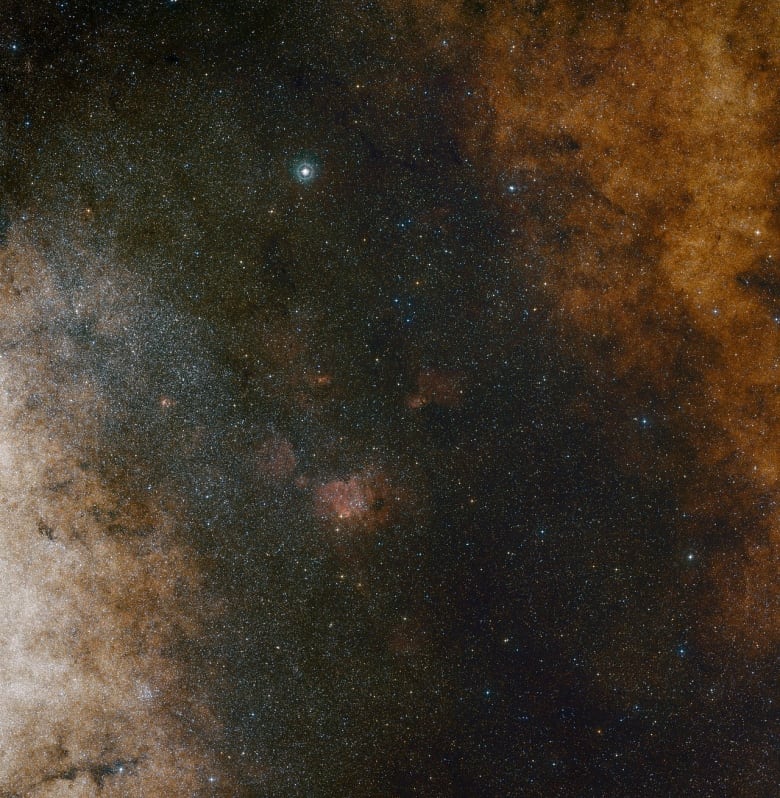
This visible light wide-field view shows the rich star clouds in the constellation of Sagittarius (the Archer) in the direction of the centre of our Milky Way galaxy. The entire image is filled with vast numbers of stars — but far more remain hidden behind clouds of dust and are only revealed in infrared images. This view was created from photographs in red and blue light and forming part of the Digitized Sky Survey 2. The field of view is approximately 3.5 degrees x 3.6 degrees. (ESO and Digitized Sky Survey 2)
Nearly 30 years of measurements, ESO scientists said in a statement, allowed them to follow the star as it traced a rosette-shaped orbit around the “supermassive” black hole in the Milky Way. Their discovery proved Einstein, and not his predecessor Isaac Newton, was right. Newton believed it would travel in an ellipse-like pattern.
“This long-sought-after result was made possible by increasingly precise measurements over nearly 30 years, which have enabled scientists to unlock the mysteries of the behemoth lurking at the heart of our galaxy,” the observatory said in a statement.
WATCH | Star dances around a black hole
Rosette-shaped orbit predicted by Einstein’s theory of general relativity 1:37
More evidence of black hole’s existence
The discovery also provides further evidence of the existence of a black hole called Sagittarius A*, which is believed to have 4 million times the mass of the Sun, the statement said.
This simulation shows the orbits of stars very close to the supermassive black hole at the heart of the Milky Way. (ESO/L. Calçada/spaceengine.org)
The ESO’s Very Large Telescope, pivotal in the finding, sits atop a mountain at nearly 2,700 metres in Chile’s vast and sparsely populated Atacama desert.
The region’s low humidity and smooth airflow create unrivaled visibility for the high-tech telescopes that scientists use to shed light on the formation of the universe and the possibility of extraterrestrial life.
In the past 30 years, Chile has carved out a niche as the global hub for observational astronomy.
A newly discovered cave in a remote valley in British Columbia might be the country’s largest.
The feature, in the northeastern area of Wells Gray Provincial Park, was spotted by a helicopter crew from the province’s Ministry of Environment and Climate Change in March while they were conducting a caribou census.
Geologist Catherine Hickson, who first went to the cave in September, said the discovery promises a dramatic new chapter in the story of Canadian cave exploration.
“It was absolutely amazing,” she said. “I immediately recognized that this was very significant.”
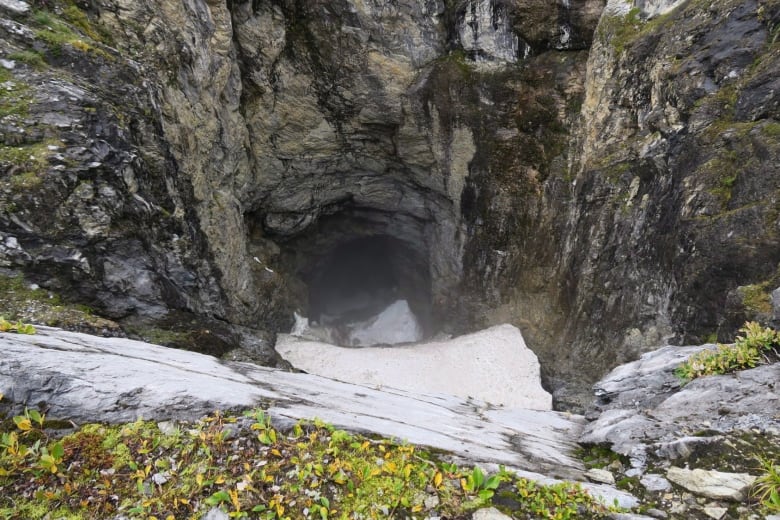
‘It’s about the size of a soccer field,’ geologist Catherine Hickson said. ‘So, if you think of a soccer field and you put that soccer field on its end so you have this pit going down.’ (Catherine Hickson/Tuya Terra Geo Corp.)
Before making the trip, Hickson and fellow researchers, including cave expert John Pollack, spent months studying satellite imagery and rocks in the area, she said.
The entrance pit to the cave is about 100 metres long and 60 metres wide. While its depth is hard to measure because of the mist from a waterfall, initial examinations show it is at least 135 metres deep.
It’s an important landmark — an important feature for Canadians to be proud about.– Geologist Catherine Hickson
“It’s about the size of a soccer field,” Hickson said. “So, if you think of a soccer field and you put that soccer field on its end so you have this pit going down. Think about this giant circular or oval hole that just goes down and down and down. It is truly amazing.”
Aerial view of the massive cave and its entrance
The cave is about the size of a soccer field and might be the largest ever found in Canada. 0:31
The cave is the largest known of its type, a variety of “striped karst,” which is marble interspersed with other types of ancient ocean rock, she said.
“It’s in an area where this size of a cave is unusual,” she said. “It’s an important landmark — an important feature for Canadians to be proud about.”
The people who first spotted the cave from the helicopter named it Sarlacc’s Pit, because of its similarity to the lair of the sarlacc, a creature from Star Wars: Return of the Jedi.
A formal naming of the cave will happen after consultations with First Nations, she said.
The feature was formed underneath glaciers for potentially tens of thousands of years, so there is no way of knowing the real age of the cave right away, Hickson said.
“Right now, because of the recession of the glaciers, it is open to the sky,” she said, adding that as ice retreats from the landscape due to climate change, more such features might be discovered.
Although the cave is in a remote, rugged valley covered with snow and ice for the greater part of the year, Hickson said researchers are keeping the exact location a secret so as to preserve the unique area.
Hickson said further investigations and research of the cave and its unique geography will likely be carried out in 2020, depending on funding.
“We think everything is known and everything has been discovered,” she said. “But here’s a major discovery that is made in today’s world and likely has never been seen before and certainly not explored before.’
“It’s just a message that there is still stuff out there yet to do and yet to be discovered.”
Hello, people! This is our weekly newsletter on all things environmental, where we highlight trends and solutions that are moving us to a more sustainable world. (Sign up here to get it in your inbox every Thursday.)
Note: Next Wednesday marks the 50th anniversary of Earth Day. Check out Earth Day Canada’s website for tips on how to mark the occasion this year (#EarthDayatHome).
This week:
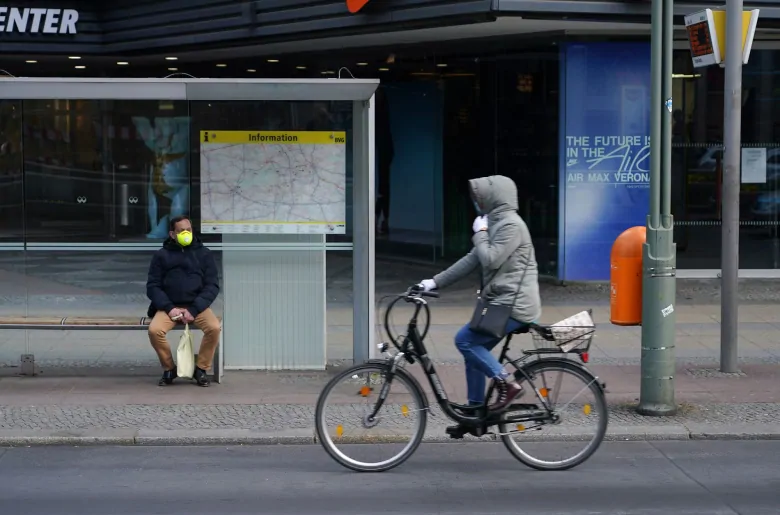
Keeping a distance: How safe are running and cycling amid COVID-19 measures?
Carbon farming: Putting soil to work to capture carbon
Is our response to the novel coronavirus indicative of our ability to fight climate change?
Keeping a distance: How safe are running and cycling amid COVID-19 measures?
The study, which hasn’t yet been peer reviewed, did computer simulations of droplets coughed, sneezed or exhaled around someone walking quickly, jogging and cycling, based on wind tunnel measurements in a previous study.
However, in a Q & A on Medium, the researchers, Bert Blocken and Thierry Marchal, noted:
The study doesn’t draw any conclusions on the infection risk associated with particular distances or droplet exposure.
People shouldn’t stop exercising outside, as that’s important for mental and physical health.
In an interview about the study on CBC’s Toronto radio show Metro Morning on Tuesday, Dr. John Presvelos, a physician with the sports medicine clinic Athlete’s Care who was not involved in the study, said the physics seemed interesting.
But does it mean the droplets shown in the study’s graphics could cause infection?
“I personally don’t think so,” Presvelos said, noting that particles tend to be more dispersed outside and subject to humidity, wind currents and temperatures that might hinder transmission.
Even so, he said, “Personally, I’d be more inclined to leave a larger amount of distance — 10 metres, if possible.”
Linsey Marr, an expert in airborne transmission of viral diseases and a professor of civil engineering at Virginia Tech, told WIRED magazine that it’s still not known whether people can become infected from cyclists and runners. The magazine noted that so far, there are no published studies of person-to-person spread of COVID-19 outdoors.
Emmanuel Stamatakis, a professor of physical activity, lifestyle and population health at the University of Sydney, wrote in The Conversation on Wednesday that it would be “irresponsible” to give advice to the public about exercise outdoors “based on a computer simulation that has not been checked for even its theoretical scientific rigour.”
Stamatakis noted that maintaining a five- to 20-metre distance when walking, running or cycling outdoors would make it almost impossible to exercise in some cities. It could discourage some people from going out at all and could “generate conflict and friction between people who think others are not heeding the advice to stay safe.”
“Stick to official advice,” Stamatakis said, “and do not rush to make any new lifestyle decisions.”
— Emily Chung
Reader feedback
In light of physical distancing measures during the coronavirus pandemic, some stores have insisted on using plastic bags to carry groceries, insisting they are safer than reusable bags brought from home. Some of our readers are not convinced.
Joan Thompson writes, “It’s interesting that some people (and governments) feel that reusable shopping bags can help spread COVID-19. I have stopped going to the one store I know which refused to let me put my groceries into my own bag and imposed a plastic bag on me. The others have no problem. The items are placed on the counter, charged and pushed to the other end, where the customer puts them in his/her bag. The cashier never touches the bag. It’s true that the packers who work in big chains touch these bags, but perhaps we could think of the environment while trying to reduce contamination.”
Roger Payne writes, “We are just putting our groceries back into the cart after checking through and taking them out to our car to bag them in our reusable bags. It makes going through the cashier line quicker and does not put you in a position of arguing with the cashier — which no one should be doing at this time.”
There has been a lot of talk in recent years about accelerating tree-planting initiatives around the world, given that trees are excellent at carbon storage. Less has been written about soil, which can also sequester carbon. But there are signs it’s getting a closer look — for example, a fund led by U.S.-based commodities trader Cargill will pay American farmers to capture carbon in their field soil (and then sell those carbon credits to polluting companies and municipalities). A study published in October found that if farmers maximized the health of their soil, it could sequester as much as 4.5 gigatonnes of carbon worldwide every year. That’s a lot, but to put that in context, it’s still only a fraction of overall emissions, which reached 39 gigatonnes in 2019.
(CBC)
Hot and bothered: Provocative ideas from around the web
On April 22, 1970, millions of Americans took to the streets for the first Earth Day to raise awareness of the ways we are harming the environment. Since then, the campaign has met with resistance from companies that say that regulating toxic industrial practices is prohibitively costly. This article looks back at the legacy of Earth Day and shows that regulatory changes to everything from recycling to emissions reporting have not only improved health, but have also been good for jobs and the bottom line.
Reducing plastic pollution seems like an insurmountable challenge, but a French company has come up with a concept that could take a bite out of the problem. It’s a mutant enzyme that digests old plastic bottles — within a few hours, in fact — and leaves the basic chemical ingredients to make new plastic. (The journal Nature recently did a study confirming that the process works.)
China’s rise as an economic powerhouse is partly attributable to its massive agriculture sector. In the process of growing all that food, China has used a lot of fertilizer. The country has come to recognize the environmental harms of fertilizer (including soil contamination and algae blooms), and through a concerted effort to revise its cultivation practices, now ranks as a world leader in organic farming.
Oslo, Norway, has a construction site that is completely emissions-free. It includes a battery-powered electric excavator that can charge in an hour.
Is our response to COVID-19 indicative of our ability to fight climate change?
(David Mercado/Reuters)
Last week, business columnist Don Pittis wrote about what the slow response of most countries to the novel coronavirus has in common with action on climate change.
Now that the COVID-19 threat is upon us, scientists and innovators are pulling out the stops to find ways of coping. That rush of invention is no surprise to historians.
In the 1620s, living through the plague inspired economist and polymath William Petty to devise a system to count the cost of future calamity. Part of the “political arithmetic” he invented includes concepts we use today to try to imagine how much it’s worth spending now to prevent something worse from happening several years down the road, said Canadian economist Aidan Vining.
Unfortunately, our failure to prepare for an outbreak that epidemiologists have repeatedly warned was coming is a reminder that humans are not very good at thinking themselves into the future.
Society’s blinkered approach to the future risk of disease provides a lesson for our failure to address the potentially catastrophic effects of climate change. In fact, history shows that the people who do think ahead are often ridiculed.
Vining said that in the 1840s, one follower of Petty’s cost-benefit analysis, Edwin Chadwick, was known as “the most hated man in England,” for promoting public health spending that Chadwick insisted would save lives and improve living conditions for millions.
“Why? Because he wanted to build sewer systems, and the elite were so opposed because of the public spending it would involve,” said Vining, professor emeritus at Simon Fraser University.
Chadwick lived to see his plans put in place, helping to lead a global public health movement that ultimately saved lives and money. But apart from people like Chadwick, behavioural economists have shown that even when we know we would benefit from worrying a bit more about our long-term future, humans are hard-wired for short-term thinking.
Economists have long noted our preference for having something now rather than later, which is one of the justifications for interest rates. You can have that car or house today, but it will cost you — in large monthly interest payments.
In economics, a calculation of something called the social discount rate is an attempt to apply interest rates to show how much it is worth spending today to prevent something horrible from happening in the future.
Canadian economist David Burgess said it’s pretty clear no government in the world had invested enough in preparations for the current pandemic. Despite the lessons of SARS, we did not have stockpiles of essential equipment, and many governments had made tax-saving cuts to medical services.
Burgess said that while social discount rate analysis works for deciding how much governments should spend on things like roads or bridges, it may not be appropriate for problems like epidemics and climate change. That’s because the future costs are so difficult to measure in dollar terms. He calls it “a big bag of uncertainty.”
That hasn’t stopped some economists from trying — in the case of climate change, by estimating various amounts for how much is worth spending now to prevent future economic fallout.
According to economist Carolyn Fischer, who works with the University of Ottawa’s Smart Prosperity Institute, another difficulty is calculating the present value of the risk of planetary devastation. If a future plague could lead to complete societal and economic breakdown similar to what happened during the Black Death, Fischer said it may be worth spending a lot to prevent it from happening — even if we cannot be sure if or when it will occur.
Fischer said the same thing applies to climate change.
If science tells us that economic ruin is the eventual result, it may be the job of governments to compensate for our natural tendency to worry about the short term and ignore the future.
Said Fischer, “Maybe we can draw some lessons from this [crisis] for what happens when you react too late.”
Stay in touch!
Are there issues you’d like us to cover? Questions you want answered? Do you just want to share a kind word? We’d love to hear from you. Email us at whatonearth@cbc.ca.
Sign up hereto get What on Earth? in your inbox every Thursday.
The Pentagon’s process for awarding a highly lucrative cloud computing contract to Microsoft instead of Amazon was in line with legal and government purchasing standards, a U.S. government watchdog agency said Wednesday.
The Defence Department inspector general found no evidence of White House interference in the contract award process. But the report said investigators could not fully review that aspect of the matter because the White House would not allow unfettered access to witnesses.
The contract, potentially worth $10 billion US, was awarded to Microsoft last October, prompting tech rival Amazon to cry foul.
Amazon Web Services, a market leader in providing cloud computing services, had long been considered a leading candidate to run the Pentagon’s Joint Enterprise Defence Infrastructure project, known as JEDI. The project will store and process vast amounts of classified data, allowing the U.S. military to improve communications with soldiers on the battlefield and use artificial intelligence to speed up its war planning and fighting capabilities.
Lawsuit halts work
Amazon sued the Pentagon after Microsoft won the contract. Work on the project has been halted as the lawsuit proceeds.
The judge presiding over the bid protest in the U.S. Court of Federal Claims said in March that Amazon’s challenge likely had merit on some technical grounds involving pricing.
The review released Wednesday by the Defence Department’s inspector general did not draw a conclusion about whether the Redmond, Wash.,-based Microsoft Corp. was appropriately declared the winner. Rather, it looked at whether the decision-making process was proper and legal. It also examined allegations of unethical behaviour by Pentagon officials involved in the matter and generally determined that any ethical lapses did not influence the outcome.
The review also sought to determine whether the White House influenced the Pentagon’s decision, as Amazon has alleged. The report said that although it appears there was no such White House pressure, the reviewers could not definitely determine the full extent of White House interactions with the Pentagon’s decision makers.
“We could not review this matter fully because of the assertion of a ‘presidential communications privilege,’ which resulted in several DOD witnesses being instructed by the DOD Office of General Counsel not to answer our questions about potential communications between White House and DOD officials about JEDI,” the report said.
“As a result, we could not be certain whether there were any White House communications with some DOD officials which may have affected the JEDI procurement,” it said.
“However, we believe the evidence we received showed that the DOD personnel who evaluated the contract proposals and awarded Microsoft the JEDI cloud contract were not pressured … by any DOD leaders more senior to them, who may have communicated with the White House,” the report said.
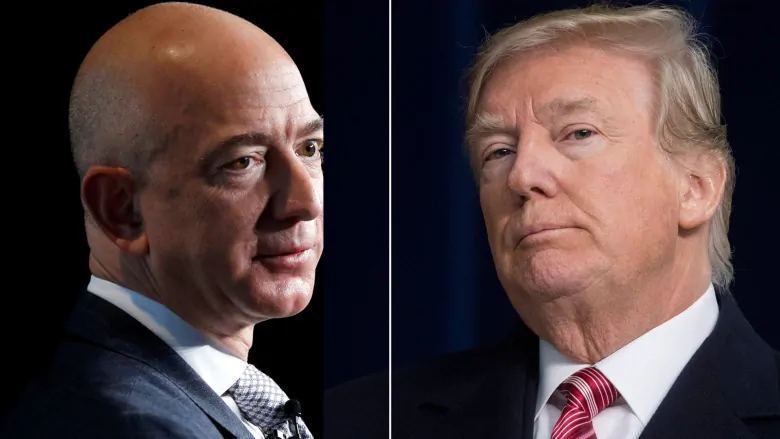
Amazon has asserted that the bidding for a $10 billion US Pentagon cloud computing contract was improperly influenced by U.S. President Donald Trump’s dislike of Amazon and its CEO, Jeff Bezos. (Joshua Roberts/Reuters and Saul Loeb/AFP/Getty)
Amazon has asserted that the bidding was improperly influenced by President Donald Trump’s dislike of Amazon and its CEO, Jeff Bezos. Bezos owns The Washington Post, a news outlet often criticized by Trump.
Frank Shaw, Microsoft’s vice-president for communications, said in response to the inspector general’s report: “It’s now apparent that Amazon bid too high a price and is seeking a do-over so it can bid again. As the IG’s report indicates, Amazon has proprietary information about Microsoft’s bid that it should never have had.”
Amazon fires back
Late Wednesday, Amazon issued a statement saying, “It’s clear that this report couldn’t assess political interference because several DoD witnesses were instructed by the White House not to answer the IG’s questions about communications between the White House and DoD officials.”
“The White House’s refusal to co-operate with the IG’s investigation is yet another blatant attempt to avoid a meaningful and transparent review of the JEDI contract award.”
The Project on Government Oversight, a private watchdog group, said it was alarmed by the White House’s use of presidential privilege to limit the inspector general’s access to witness information.
“Executive privilege is designed to protect national security and the president’s candid conversations with close advisers, not to block agency officials from discussing a large government contract that does not call for direct presidential decision-making,” the group’s top lawyer, Scott Amey, said in a statement.
A Pentagon spokesperson, Lt.-Col. Robert Carver, said the inspector general’s report shows that the contract award process was fair and legal.
“This report should finally close the door on the media and corporate-driven attacks on the career procurement officials who have been working tirelessly to get the much needed JEDI cloud computing environment into the hands of our frontline warfighters while continuing to protect American taxpayers,” Carver said.