Categories
Tech

A computer 'the size of a credit card' could help doctors monitor COVID-19 patients remotely


A team from the University of Toronto has created a new way for health-care workers to monitor COVID-19 patients — without having to set foot in their hospital rooms. 

It all began about two weeks ago when a call came from Mount Sinai Hospital asking the university’s engineering department to figure out a way to monitor vital signs both continuously and remotely. 

“The solution is quite simple,” said Professor Willy Wong, who led the project. “When we heard about this opportunity, we were very happy to jump into this.”

Jump in they did: working with three PhD candidates, it took Wong just a few days to develop a concept.

They attached a standard fingertip probe, already in use in hospitals to monitor vital signs, to a “very, very small computer about the size of a credit card,” explained Wong.

That simple computer, called a Raspberry Pi, can then connect to the internet — allowing health-care workers to check on patients from any nursing station computer, or on their smartphone.  

A still from a demonstration video created by Wong shows the fingertip probe, at the bottom of the photo, attached to the Raspberry Pi computer. (Submitted by Willy Wong)

“It’s about taking these off-the-shelf components that are already designed by others and being able to put this together very, very quickly,” Wong said. 

Remote monitoring can conserve PPE

The device has two benefits, he says: it gives doctors the ability to monitor their patients constantly, and allows health-care workers to conserve personal protective equipment because they can avoid going into hospital rooms and getting close to patients. 

So far, several prototypes are being used in a trial at Mount Sinai.

“The feedback that we’ve heard is that this is a no-brainer,” said Wong.  

He says he can imagine their solution making a big difference in places like field hospitals and long-term care homes —and a retirement home has already been in touch to ask about using the device. 

“Certainly, I’m hoping that as the word gets out here that there are more organizations that perk up and say, ‘Hey, this important here,'” said Wong.

“We can use this as a way to monitor a large group of people in these sorts of settings where they are trying to battle COVID-19.” 



Source link

Categories
Tech

Pandemic will drive biggest drop in CO2 emissions since WW II, World Meteorological Organization says


The coronavirus pandemic is expected to drive carbon dioxide emissions down six per cent this year, the head of the World Meteorological Organization (WMO) said on Wednesday, in what would be the biggest yearly drop since World War II.

“This crisis has had an impact on the emissions of greenhouse gases,” WMO Secretary General Petteri Taalas told a virtual briefing in Geneva.

“We estimate that there is going to be a six per cent drop in carbon emissions this year because of the lack of emissions from transportation and industrial energy production.”

But the WMO warned that past economic recoveries had been associated with even higher emissions growth than before the crises.

“COVID-19 may result in a temporary reduction in greenhouse gas emissions, but it is not a substitute for sustained climate action,” the Geneva-based agency said in a statement released on the 50th anniversary of Earth Day in 1970.

“We need to show the same determination and unity against climate change as against COVID-19,” Taalas said.

The statement urged governments to consider stimulus packages that helped the transition to a green economy, adding to similar calls from some governments.

‘We need to show the same determination and unity against climate change as against COVID-19,’ said World Meteorological Organization Secretary-General Petteri Taalas, seen in a December 2019 photo. (Susana Vera/Reuters)

In a sombre reminder of the changes to the planet since 1970, the WMO said carbon dioxide levels were up 26 per cent since then and the global temperature was 0.86 C higher on average.

The WMO also published on Wednesday the final version of its report on the global climate, which confirmed a preliminary finding that 2015-2019 was the warmest five-year period on record, with the global average temperature having increased by 1.1 C since the pre-industrial period.


Source link

Categories
Tech

Facebook wants federal court to overturn privacy commissioner's ruling on abuse of personal data


Facebook wants a judge to toss out the federal privacy watchdog’s finding that the social media giant’s lax practices allowed personal data to be used for political purposes.

Privacy commissioner Daniel Therrien’s probe “was neither impartial nor independent, and lacked procedural fairness,” Facebook alleges in a submission to the Federal Court of Canada.

The company’s application comes two months after Therrien asked the same court to declare Facebook broke the law governing how the private sector can use personal information.

A 2019 investigation report from Therrien and his British Columbia counterpart cited major shortcomings in Facebook’s procedures and called for stronger laws to protect Canadians.

The probe followed reports that Facebook let an outside organization use a digital app to access users’ personal information, and that some of the data was then passed to others. Recipients of the information included the firm Cambridge Analytica, which was involved in U.S. political campaigns.

The app, at one point known as “This is Your Digital Life,” encouraged users to complete a personality quiz but collected much more information about the people who installed the app as well as data about their Facebook friends, the commissioners said.

About 300,000 Facebook users worldwide added the app, leading to the potential disclosure of the personal information of approximately 87 million others, including more than 600,000 Canadians, the report said.

The commissioners concluded that Facebook broke Canada’s privacy law governing companies by failing to obtain valid and meaningful consent of installing users and their friends, and that it had “inadequate safeguards” to protect user information.

Facebook disputed the findings of the investigation and refused to implement its recommendations.

Facebook says probe was too broad

The company has said it tried to work with the privacy commissioner’s office and take measures that would go above and beyond what other companies do.

In its filing with the Federal Court, Facebook says the commissioner’s office improperly embarked on a broad audit of the company’s privacy practices in the guise of an investigation into complaints about a specific breach of the law.

There was no evidence that any Canadian’s personal information had been improperly used, the notice says. “The [commissioner] should never have investigated the complaint or should have discontinued it once the investigation failed to turn up the required Canadian nexus.”

In addition, Facebook alleges the privacy watchdog’s office “did not disclose the true, sweeping scope” of the probe until just before the 2019 report’s release. “Consequently, Facebook did not know the allegations it had to meet and was denied a fair opportunity to respond to the investigation.”

Given that the issue is before the courts, “we are not in a position to offer comment,” Vito Pilieci, a spokesman for the commissioner’s office, said Monday.

In its notice to the Federal Court, filed in February, the commissioner’s office said Facebook had not provided sufficient evidence to satisfy the commissioner it was complying with the Personal Information Protection and Electronic Documents Act, which covers private-sector organizations.

Until Facebook amends its practices to comply with the law, “there is, and will continue to be, an ongoing risk” that Canadians’ personal information will be disclosed by the company to apps or other third parties and used in ways that users do not know or expect, the notice added.

The commissioner has asked the Federal Court for a declaration that Facebook contravened the law. It also wants an order requiring the company to implement measures to obtain, and ensure it maintains, meaningful consent from all users.


Source link

Categories
Tech

Scientists cut peer-review corners under pressure of COVID-19 pandemic


The novel coronavirus was engineered in a lab using HIV. Stem cells are a potent weapon against the new pandemic. People with blood type A are more susceptible to COVID-19.

None of these “discoveries” have been proven. But all have been widely disseminated.

They’re examples of what many scientists are beginning to fear is an erosion of traditional safeguards against bad science under the pressing need for answers to the wave of sickness sweeping the globe.

“We are getting a firehose of research-based data coming out at us, because we need it,” said Rees Kassen, a University of Ottawa scientist who has just published a paper with the World Economic Forum about the concern.

“That’s good, but it has to come with strong caveats.”

The speed and volume of research into the novel coronavirus is unprecedented. During the 2003 SARS crisis, a French study found that 93 per cent of papers about the virus were published after the epidemic subsided.

Not this time. LitCovid, a hub for papers on COVID-19, says more than 1,600 on the topic were published last week alone.

But many are so-called “preprints” — untested research hot out of the lab.

Normally, a scientist with new findings writes them up and submits them to a journal. An editorial committee looks for problems, checks the findings against other research and puts them through the kind of scrutiny that leads to stronger work.

Peer review, however, takes months or even years. COVID-19 isn’t giving us that much time.

Increasingly, medical scientists have turned to preprint sites, where work is posted within days.

‘Buyer beware’

“They’re not peer-reviewed,” said Jim Woodgett, director of Toronto’s Lunenfeld-Tanenbaum Research Institute, who’s also affiliated with one of the main preprint sites.

“What we do is quite superficial in terms of checking that submitted manuscripts are actually scientific and they’re not just garbage and they’re not dangerous. It’s buyer beware.”

Preprint sites have busy comment sections and bad science is quickly called out. The COVID/HIV paper, for example, has been withdrawn.

Many scientists worry that weak preprints will still spread misinformation. Despite its flaws, the paper on blood types was featured in the New York Post.

Both the public and the reporters who write for them will have to be more careful of their sources, said Jim Germida, a University of Saskatchewan biologist.

He oversees Canadian Science Publishing, which prints more than 20 scientific journals.

“There’s a lot of good science that goes into preprints. But you have to be cautious.”

Traditional journals are doing their best to meet the demand for the latest COVID-19 research.

“Many, many reputable journals have expedited their review process,” Germida said.

As well, most of the major journals have made their archives free and opened access, providing decades of top-quality research to whoever needs it.

‘Some drop in standards’

Woodgett said reputable journals are feeling pressure to get useful information out there, even if flawed or incomplete. And with universities closed, many researchers may not be able to get back to their labs to dot those final i’s.

“There has been some drop in standards.”

Science has never been perfect, he added. Bad papers were published before COVID-19; new findings supplant the old.

Kassen points out the fatality rate of COVID-19 was first thought to be as high as 15 per cent. It’s now considered to be about one per cent.

“The best we can do is work with uncertainty.”

It’s a new world for science publishing. Woodgett offers advice to sort it out that will sound familiar to anyone who’s researched an article or bought a used car.

“If someone tells you something remarkable, you need to find something else to back it up.”


Source link

Categories
Tech

Interstellar gatecrasher 2I/Borisov is no ordinary comet


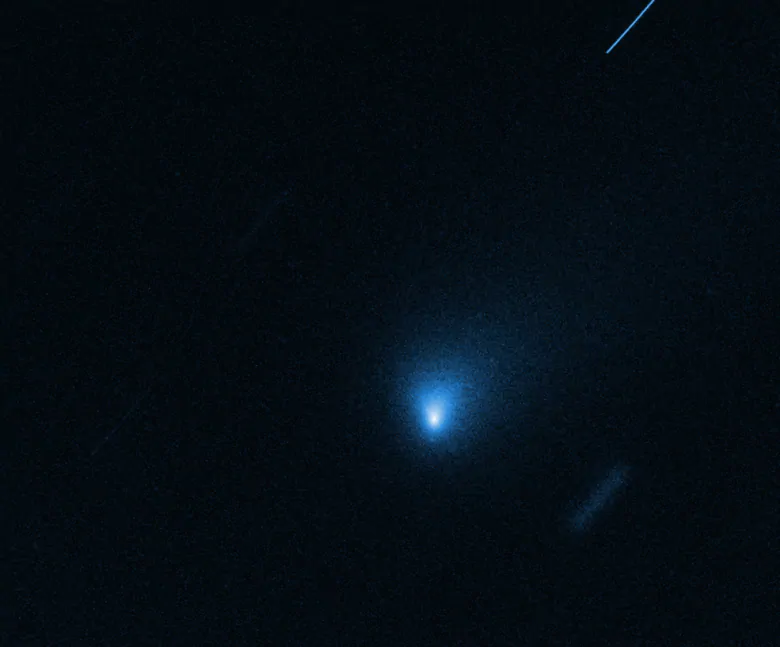
Scientists have discovered that a comet called 2I/Borisov — only the second interstellar object ever detected passing through the solar system — is surprisingly different in its composition from comets hailing from our celestial neighbourhood.

Gas coming off 2I/Borisov contained high amounts of carbon monoxide — far more than comets formed in our solar system — indicating the object had large concentrations of carbon monoxide ice, researchers said on Monday.

Carbon monoxide, poisonous to humans, is common as a gas in space and forms as ice only in the most frigid locations. The presence of so much carbon monoxide, the researchers said, suggests 2I/Borisov formed in a different manner than comets in our solar system — in a very cold outer region of its home star system or around a star cooler than the sun.

Comets essentially are dirty snowballs composed of frozen gases, rock and dust that orbit stars.

“We like to refer to 2I/Borisov as a snowman from a dark and cold place,” said planetary scientist Dennis Bodewits of Auburn University in Alabama, lead author of one of two 2I/Borisov studies published in the journal Nature Astronomy.

“Comets are leftover building blocks from the time of planet formation. For the first time, we have been able to measure the chemical composition of such a building block from another planetary system while it flew through our own solar system.”

Ejected from original star system

The comet, detected in August 2019 by amateur astronomer Gennady Borisov and estimated to be about one kilometre wide, has zoomed through interstellar space after being ejected from its original star system.

It was born long ago in a rotating disc of gas and dust surrounding a newly formed star in a place that must have been rich in carbon monoxide, Bodewits said. That star may have been what is called an M-dwarf, far smaller and cooler than the sun and the smallest type of star that is known, Bodewits said.

This is a time-lapse sequence compressing Hubble Space Telescope observations of comet 2I/Borisov, spanning a seven-hour period. As the second known interstellar object to enter our solar system, the comet is moving at a breakneck speed of 180,000 km/h. (NASA, ESA and J. DePasquale/STScI)

Scientists initially concluded last year that 2I/Borisov was similar to comets from our solar system, but data from the Hubble Space Telescope and an observatory in Chile revealed its differences.

The researchers also found an abundance of hydrogen cyanide at levels similar to comets from our solar system.

“This shows that 2I/Borisov is not a completely alien object, and confirms some similarity with our ‘normal’ comets, so the processes that shaped it are comparable to the way our own comets formed,” said Martin Cordiner, an astrobiologist working at NASA’s Goddard Space Flight Center in Maryland and lead author of the other study.

The only other interstellar visitor discovered in our solar system was a cigar-shaped rocky object called ‘Oumuamua spotted in 2017.


Source link

Categories
Tech

Potentially habitable Earth-like planet found hidden in old satellite data


About 300 light-years from Earth lies a planet that is unlike any other ever discovered: one that is similar to our home both in terms of size and temperature and that lies within its host star’s habitable zone.

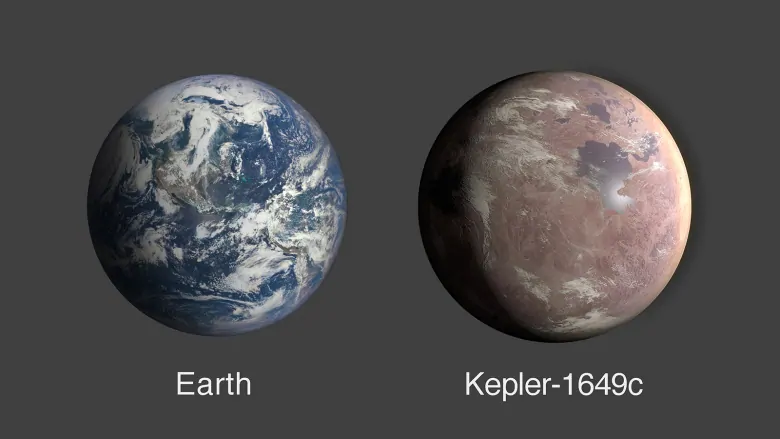
The planet is called Kepler-1649c. It is just 1.06 times larger than Earth and receives about 75 per cent the amount of sunlight our own planet receives. It orbits a small red dwarf star (Kepler-1649) so closely that one year is just 19.5 Earth days. 

Because it lies within the habitable zone — a region around a star where liquid water could exist on a planet’s surface — it could be an intriguing candidate for potential life.

The planet was found orbiting a medium-sized M-class red dwarf star, the most common type of star in the galaxy, which gives added importance to this particular finding. Our own sun is a yellow dwarf star.

“[A] very interesting point raised by this paper is that we think medium-sized M-dwarfs might have more habitable planets compared to the early M-dwarfs, the ones that are slightly larger,” said Chelsea Huang, a postdoctoral scholar at the MIT Kavli Institute for Astrophysics and Space Research and corresponding author of the paper published in the journal Astrophysical Journal Letters.

“This is quite interesting because there are more small M-dwarfs than larger M-dwarfs in the galaxy.”

Kepler-1649c is similar in size to Earth, compared here in this artist’s illustration. (NASA/Ames Research Center/Daniel Rutter)

But more than that, it also says something specifically about Earth-like planets in our galaxy.

“It tells us that these potentially Earth-like planets — the ones that are the same size, same temperature — might be more common than we thought around the smallest stars in our galaxy,” said Andrew Vanderburg, another corresponding author of the paper and a NASA Sagan Postdoctoral Fellow at the University of Texas at Austin.

Challenges for life

Though these types of stars are numerous, they pose a problem when searching for potentially habitable planets. Red dwarfs are much smaller than our sun, but are incredibly active, releasing harmful ultraviolet radiation that could strip away a planet’s atmosphere, thus making it unsuitable for life as we know it.

However, when it comes to the star in this system, no UV eruptions have been observed, though that doesn’t necessarily mean it doesn’t ever release any radiation. As well, these stars have incredibly long lifetimes, lasting potentially 100 billion years. So early on in Kepler-1649’s lifetime, it would have likely been far more active.

This artist’s concept shows exoplanet Kepler-1649c orbiting its host red dwarf star. This exoplanet is in its star’s habitable zone (the distance where liquid water could exist on the planet’s surface) and is the closest to Earth in size and temperature found yet in Kepler’s data. (NASA/Ames Research Center/Daniel Rutter)

“The star is not particularly active compared to other stars that are similar in size to this one, but that doesn’t mean it wasn’t always the case,” said Vanderburg. 

That raises a couple of questions, he said. Could an atmosphere survive millions of years of UV bombardment? And if not, if Kepler-1649c was stripped of its atmosphere, could a new atmosphere form?

Astronomers aren’t sure.

Surprising discovery

NASA’s Kepler space telescope was launched in 2009 with the sole purpose of searching for planets orbiting other stars. The telescope went out of service in 2018 after experiencing multiple issues. However, before it was decommissioned, it had found thousands of confirmed exoplanets.

But there is still an incredible amount of data left to pore through. Astronomers had written software — called Robovetter — that could go through that data and identify potential planets. However, there was always the possibility the algorithm could miss the data, so a team of roughly a dozen astronomers are going manually through rejected data.

And that’s how they found Kepler-1649c. 

The error occurred because the star in the system moves quite fast through the galaxy. So the telescope wasn’t aimed perfectly at the star, which created a lot of “noise” in the data, which Robovetter dismissed. 

Though Kepler-1649c is roughly the same temperature as Earth, it’s still unknown whether or not it has an atmosphere. It might take some time to determine that, but for now, it’s extremely promising, the researchers said.

“The way I kind of think of it is that this was kind of an intelligence report,” Vanderburg said. “We found this planet. We’ve now used it to update our measurements of how common planets like this are around the very smallest stars.

“And it gets … better and better for the prospects of us finding similar planets around stars are much closer to us.”


Source link