A private startup company called Spinlaunch could be the first to throw a payload into space rather than use a rocket for primary propulsion.
The company has said that it’s received millions of dollars in funding, and a prototype launch contract from the U.S. Department of Defence for its technology.
The company is apparently developing a kind of spinning slingshot that will hurl projectiles up from the ground at high velocity in an attempt to lower the cost of spaceflight.
Spinlaunch was founded several years ago, and has been remarkably secretive about its technology. The small amount of information they’ve released indicates that they will use a “mass accelerator” to fling a dart-shaped vehicle at incredible speeds into the sky. A chemical rocket would then be ignited to finish boosting the vehicle into space.
It is, in essence, the same principle used by ancient hunters who swung a sling around their head faster and faster then released it at the right moment so their projectile stone would fly off at great speed toward their intended prey.
There are many technologies they could be using, but the company hasn’t said what they are. It could be a circular electromagnetic rail gun, or some kind of giant rotating centrifuge. Whatever the mechanism, the idea is to reduce the cost of delivering payloads to space through the use of a new technology.
This will not be for human spaceflight. The g-forces involved spinning an object that fast would be far beyond what the human body could withstand. Most likely this will be appropriate for small (and presumably pretty robust) satellites.
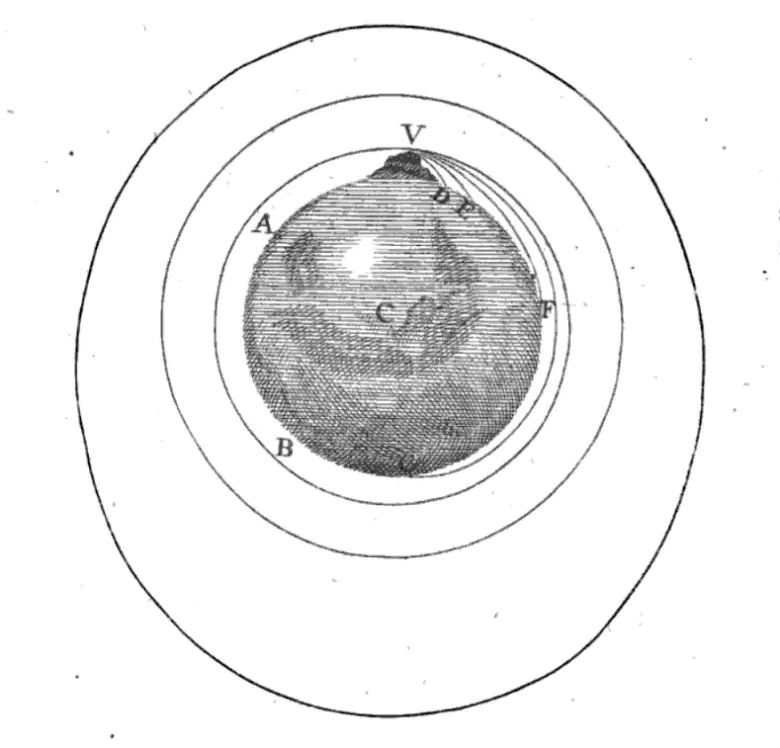
The idea of reaching space without a rocket is not new. In 1686, Isaac Newton’s famous book Principia he envisioned a cannon on a mountaintop to demonstrate the principle of achieving orbit. If a cannon could be fired at high enough speed, the curve that the cannonball follows would match the curve of the Earth so it would fly all the way around the planet and return to strike the back of the cannon an hour and a half later.
Illustration of Newton’s “orbital cannon” concept from his ‘A Treatise of the System of the World’ (Isaac Newton)
Newton wasn’t proposing this method for spaceflight, but he did demonstrate how the laws of gravity and ballistics could be used to reach orbit by giving an object a mighty initial push, rather than using the more constant propulsion of a rocket..
Later, in 1865, science fiction writer Jules Verne wrote From the Earth to The Moon in which an enormous cannon dug straight into the ground blasts a capsule containing three passengers all the way to the moon. Interestingly, he located the launch site in Florida, where the actual moon launches took place and Verne’s capsule closely resembled the Apollo Command Module which also carried 3 astronauts.
One hundred years later, the U.S. and Canadian defence departments cooperated on a project called HARP (High Altitude Research Project) to study the ballistics of spacecraft re-entry. They used modified naval guns which fired massive 402 mm diameter projectiles to high altitudes.
Fired from a test site in Yuma, Ariz., one of their shells reached a record altitude of 180 kilometres, which qualifies as space, but it was not travelling fast enough to reach orbit. The project was eventually cancelled but the remains of one of the guns used in the tests can still be seen in Barbados today.
The biggest problem facing projectiles launched from the ground is that they have to be launched at very high initial speed, on the order of many thousands of kilometres per hour and many times the speed of sound, to reach space. And to stay in space, they have to go even faster. In fact, to achieve low Earth orbit, they have to make it to space still travelling at about 28,000 km/h.
That means they have to launch at even higher speeds. The projectile passes through the thickest part of the atmosphere as soon as it leaves the device, when it is travelling at its highest velocity. So air resistance and air friction are at their peak right at the beginning of the flight, slowing the projectile down and heating it up almost instantly.
As a result, any payload inside the projectile must withstand tremendous G-forces at launch and temperatures of thousands of degrees before it even reaches space.
Spinlaunch recently obtained funding to break ground at Spaceport America in New Mexico, home to the space tourism company Virgin Galactic.
There are tremendous obstacles to overcome if they want to throw an object into space from the ground. However, given how complex and expensive conventional rockets are, if it works, this simpler slingshot method could cut the cost of putting a small satellite into orbit considerably.
It is interesting that an old idea of simply throwing an object really fast and really high might still be used to get off the planet.
At 6:45 a.m. on June 1, 2018, Monique Richard called Parks Canada for help.
The Quebec mountaineer was in her tent, 5,550 metres up on Mount Logan. The batteries on her communication device were getting low, and she was running out of food and fuel.
Richard was cold and exhausted. She hadn’t slept since reaching the summit two days before.
She was the first woman to reach Canada’s highest peak on her own — and may have been Mount Logan’s last solo climber.
This winter, Parks Canada put a moratorium on solo climbing expeditions on the mountain, citing dangerous and expensive rescue missions.
Documents obtained by CBC News through an access to information request detail what happened behind the scenes of Richard’s rescue in 2018.
The mountain
Mount Logan is located deep in Kluane National Park and Reserve in Yukon.
All climbers need to apply for a permit. The application form says mountaineers need to prepare for extreme conditions, including storms, strong winds, zero visibility and temperatures below –40 C.
The form says between 1973 and 2015, about 4,000 climbers and skiers visited Kluane’s icefield ranges, and 15 people died.
Richard is an experienced climber who’s completed the Seven Summits — meaning she’s summitted the highest peak on each continent.
Monique Richard was the first woman to reach Canada’s highest peak on her own. (Submitted by Monique Richard)
In a written statement to CBC, she called Logan her most significant achievement as a mountaineer. But something went wrong on her descent.
One note in Parks Canada’s rescue incident report says she “gave up.” Another internal email cited fatigue.
June 1, 2018, 6:45 a.m.
After Richard called for help, rescue plans quickly formed. Kluane officials called for back up to Denali National Park and Preserve in Alaska and Banff National Park in Alberta.
A few hours after the initial call, an update on Richard’s condition came through her agent Francois Masse. She reportedly had no fuel, one bar of food and one litre of water.
The forecast showed stormy weather coming in, making any rescue attempt by helicopter difficult.
The ice fields of Kluane National Park with Mount Logan in the distance. (Cheryl Kawaja/CBC)
Parks Canada staff decided to first drop a bag with food, fuel, medication for acute mountain sickness, and a radio to Richard. Then they’d find a way to return and pick her up, either by a long line or basket.
Richard was not willing to move from her spot.
June 1, 2018, 3:00 p.m.
The bag-drop mission that afternoon failed when weather forced the helicopter to turn back.
The incident team’s notes from the call say Richard was trying to descend, but couldn’t. She wasn’t feeling sick, but her face and lips were cracking from the wind and sun. She was feeling discouraged.
The helicopter team set up a base at Logan Cabin, 25 kilometres north of Richard’s waiting spot at Prospector’s Col. The team prepared for the bag drop and looked for Richard’s tent.
They couldn’t see it. They were looking for a green tent — the colour listed on Richard’s expedition application — but in fact her tent was red.
Rescuers help lower Richard to safety at Logan Cabin. (Parks Canada/M. Trotter)
Eventually they spotted her and dropped the bag. They reported seeing her leave her tent to get it.
Meanwhile, two other climbers had become involved in the rescue — and would be instrumental in its success.
Earlier in the day, Parks staff had contacted Stephane and Guillaume Gagnon. The father-and-son team were at Camp 3 on Mount Logan. At an elevation of 4,800 metres, they were closest to Richard.
The Gagnons made it to Camp 4, at 5,200 metres, but they were freezing and not acclimatized so they were told to stay put.
June 2, 2018, 6:00 a.m.
Early the next morning, Francois Masse, Richard’s agent, told the incident team that he talked to Richard the night before. He said Richard was quite weak and it was stormy all night. He said it was too windy for her to use her stove.
“Panicked at first when start talking then calms down,” is how Richard is described at this point in the incident report.
Her mental state is getting worse (she sounds worse)– Notes from rescue incident report
At 10:30 a.m., Richard called Parks staff.
“Very low energy levels today. Likely unable to put on screamer suit today,” the notes say, referring to the full-body harness used in a helicopter rescue.
“Have to eat and drink. Rationing food and water because worried about long term. Afraid to eat because she doesn’t want to go to bathroom. Her mental state is getting worse (she sounds worse),” say the incident report notes.
Eventually the Gagnons reached Richard and helped get her down to Camp 4, but they weren’t sure she could make it further.
The Parks Canada team planned a helicopter rescue involving either a full-body harness or a basket from Denali.
Richard is carried to safety. (Parks Canada/M. Trotter)
“Big relief. Pressure off now,” Gagnon told Parks Canada over the phone.
The incident report says Richard at that point was “no longer resistant to moving. Feels like she wants to play along now.”
An internal email says that at around 8 p.m., the helicopter picked up Richard from Camp 4 on a long line and landed at Logan Cabin. Two hours later, she was back in Haines Junction, safe and sound.
The debrief
The Parks Canada team debriefed the following morning and discussed lessons from the rescue.
Some of the suggestions included buying a rescue basket, and putting a rescue cache at 5,200 metre elevation, like what’s done on Denali.
There’s one bullet point that stands out in the incident report: “No solo climbers.”
In a written statement this week, Parks Canada says the moratorium was not due to Richard’s rescue, but for the safety of its staff and visitors.
It also says a rescue basket has been purchased.
Richard declined an interview with CBC News this week, but offered a written statement on why she “had to seek help.”
“Mountaineering presents significant and unique challenges and dangers, and things do not always go as planned and there is always an element of unpredictability, even for the most experienced and well-prepared mountaineers,” it reads.
Richard thanked the Gagnons and staff from Parks Canada and Horizon Helicopters for their help. She said she hoped the moratorium on solo climbs of Mount Logan will be temporary.
Reports that the United Kingdom plans to limit the use of Huawei equipment to less critical parts of Britain’s 5G networks is the most “pragmatic position” for the country, a British cybersecurity expert says.
Sources revealed to Reuters this week that senior government officials settled on the recommendation Wednesday, though a final decision is expected to be made at a meeting held by Britain’s National Security Council next week.
“The U.K.’s position is that it will exclude Huawei from the most sensitive parts of the 5G network, but it’s going to allow it to supply components to what’s called the ‘edge’ of the network,” explained James Sullivan, a researcher at the Royal United Services Institute, an independent defence and security think tank based in London.
The risk of a privacy breach is less likely in that part of the network, Sullivan told CBC Radio’s The House.
5G technology will vastly improve data connection speeds, but experts have long warned that China could pressure Huawei into accessing users’ personal information, with Sullivan acknowledging that the company has “a lot more software flaws” than other vendors.
Canada’s decision pending
The British government’s move is set to leave Canada as the only undecided nation within the Five Eyes intelligence-sharing network, at a time when the country is grappling with its strained relationship with China.
The first phase of extradition hearings for Huawei CFO Meng Wanzhou concluded in Vancouver this week, while across the country a House of Commons committee on Canada-China relations held its first meeting.
But Sullivan exercised caution when it came to suggesting whether the U.K.’s middle-of-the road approach could work here.
“One of the reasons why I think the Huawei decision in the U.K. is actually pretty strong is because the U.K. has examined this equipment. The [National Cyber Security Centre] works really closely with Huawei and it identified a lot of what it called ‘shoddy’ engineering,” Sullivan said.
“It’s professional judgment was that Huawei was not deliberately manipulating this equipment…so Canada should really rely on its own technical authorities to make that assessment.”
Public Safety Minister Bill Blair said Tuesday that there are “a number of other significant economic and even geopolitical considerations that are under consideration” regarding Canada’s decision. (Adrian Wyld/The Canadian Press)
The Canadian government has been debating whether or not to allow Huawei equipment in Canada’s 5G networks for more than a year, with Public Safety Minister Bill Blair saying Friday that talks remain ongoing.
“The conversation that we’ll have with our Five Eyes partners is important, but my first and only real priority is the safety and security of Canadians and the security of our digital environment,” Blair said. “That’s what we’re focused on and those are the issues which will inform our decision.”
Sullivan: U.K defying Trump a ‘mischaracterization’
In response to whether the Trump administration — which has pressured the U.K. into endorsing a total ban — would view the position as a bold move, Sullivan disagreed.
“I think [it’s] a real mischaracterization from many about what the U.K. has actually done, because it has limited Huawei access to U.K. networks dramatically,” he said. “This debate has come down to something like it’s all or nothing. It’s very binary.”
Sullivan said that while focusing discussions about Huawei equipment on political arguments is necessary and understandable, it’s taken away from the technical conversation underpinning the debate.
“I think a lot of people are playing quite a zero-sum game here, that just banning Huawei is the golden ticket to securing 5G networks,” he said. “That’s just simply not true.”
A team of American researchers has developed a new kind of biological concrete that could redefine what we mean by “green buildings.”
The concrete, developed by researchers at the University of Colorado, Boulder, uses bacteria as a binder. This leads to a material that can grow and even heal itself — much like a living organism.
“When we finally hit on a solution that brought the brick to life it really was an ‘aha’ moment,” said Wil Srubar in an interview with Bob McDonald on Quirks & Quarks.
Srubar is an assistant professor of engineering at the University of Colorado at Boulder, and led the work.
Bringing bricks to life
Concrete is the most widely used man-made material on Earth, but its production has a massive carbon footprint. Cement making is extremely energy intensive and releases large amounts of carbon dioxide. The United Nations Environment Agency has called out for “dramatic action” to reduce this footprint in order to limit global warming.
“In our system, we’re using no cement and we’re actually using an organism that thrives on carbon dioxide to manufacture the materials,” said Srubar.
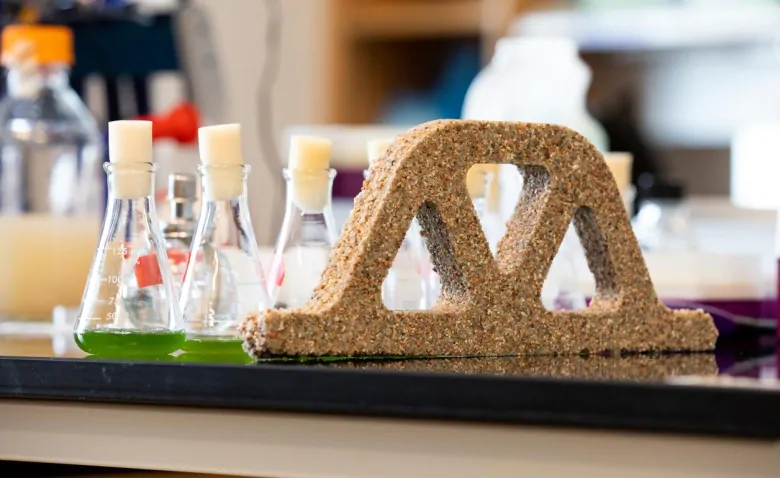
An arch made from living building materials, next to the bacteria used to make it. (CU Boulder College of Engineering & Applied Science)
In traditional concrete, sand and aggregate are bonded together with cement.
In this biological concrete, photosynthetic cyanobacteria take the place of cement. The bacteria use carbon dioxide from air to produce a material similar to limestone that glues together sand particles, making robust building blocks.
“The photosynthetic cyanobacteria that we use takes CO2, and some nutrients, and they biomineralize,” said Srubar. “It’s similar to a process of making seashells in the oceans.”
“And so it, in effect, creates tiny limestone particles as the glue in our brick.”
Srubar’s process was a little more complicated than simply mixing up a batch of sand and a bacterial culture. The team had to find the right growing conditions for the bacteria, which included appropriate levels of moisture and important nutrients, but still the process was slow.
The ‘living bricks’ seen in their mould. (CU Boulder College of Engineering & Applied Science)
The ultimate key turned out to be adding a jello-like polymer that increased the rate at which the bacteria grew and produced the limestone glue.
A new way to manufacture building materials
Another benefit of using bacteria for concrete is that it can be self-healing, and can replicate itself. Srubar’s team found that when they split a brick in two, they could cause the broken brick to grow in a mould by adding more sand and nutrients — the cyanobacteria would proliferate by themselves. They were able to continue to “grow” new bricks from broken fragments of their biological bricks.
“So really, what we were demonstrating is a new way to manufacture building materials,” said Srubar.
“Why not leverage something that grows at an exponential rate that self multiplies and use that to manufacture the materials we choose to build?’
A worker pours concrete. Cement is a carbon-intensive industry. (Behrouz Mehri/AFP via Getty Images)
Since traditional cement production is responsible for about six per cent of greenhouse gas emissions, the researchers hope that, by not only substituting this biological cement might some day make a significant dent in how much building materials contribute to global warming.
Srubar also sees a potential future use of his technology being used to build infrastructure on other planets.
“If we had to build a brand new world, we wouldn’t be burning the limestone to make the cement and we wouldn’t be melting the sand to make the glass. I think we would turn to biology to help us grow the materials with which we choose to build.”
Researchers say they’ve mimicked the voice of a 3,000-year-old Egyptian mummy by recreating much of its vocal tract using medical scanners, 3D printing and an electronic larynx.
The eerie tone is unlikely to be a precise reflection of the speech of Egyptian priest Nesyamun, whose mummified body the researchers worked with, because the tongue has lost much of its bulk over three millennia.
“We have made a faithful sound for his tract in its current position, but we would not expect an exact speech match given his tongue state,” said co-author David M. Howard of London’s Royal Holloway college.
The model alone also isn’t enough to synthesize whole words or sentences, the authors said, noting that this would require the ability to calculate the audio output from the vocal tract as its shape is being changed.
“But this is something that is being worked on, so it will be possible one day,” said Howard.
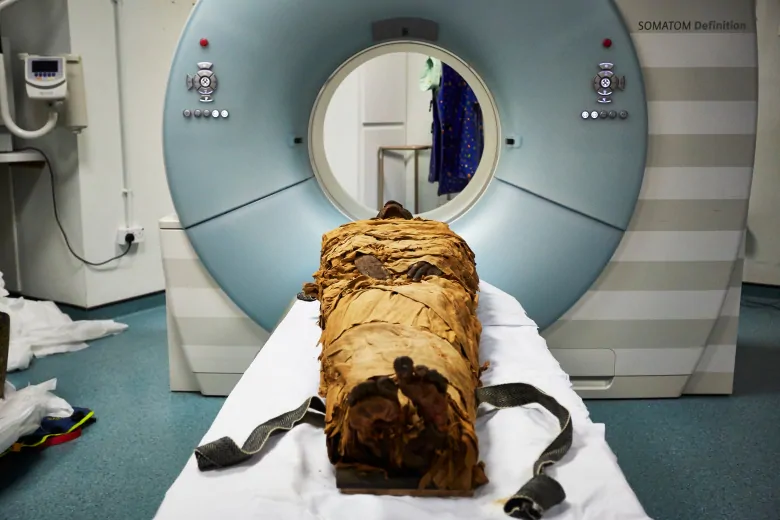
Using precise measurements taken using detailed Computed Tomography (CT) scanning of the mummy, the team of experts was able to create a 3D printed version of his vocal tract. (Leeds Museums and Galleries)
Thorax reconstruction expert skeptical
Rudolf Hagen, an ear, nose and throat expert at the University Hospital in Wuerzburg, Germany, who specializes in thorax reconstruction and wasn’t involved in the study, expressed skepticism. Even cutting-edge medicine struggles to give living people without a thorax a “normal” voice, he said.
Co-author John Schofield, an archaeologist at the University of York, said the technique could be used to help people interpret historical heritage.
“When visitors encounter the past, it is usually a visual encounter,” said Schofield. “With this voice we can change that, and make the encounter more multidimensional.”
“There is nothing more personal than someone’s voice, so we think that hearing a voice from so long ago will be an unforgettable experience, making heritage places like Karnak, Nesyamun’s temple, come alive,” he said.
Hello, people! This is our weekly newsletter on all things environmental, where we highlight trends and solutions that are moving us to a more sustainable world. (Sign up here to get it in your inbox every Thursday.)
This week:
Microgrids: An idea whose time has come?
Oil and gas firms say they’re investing in green tech. What do the numbers say?
How to heat your home without fossil fuels
Microgrids: An idea whose time has come?
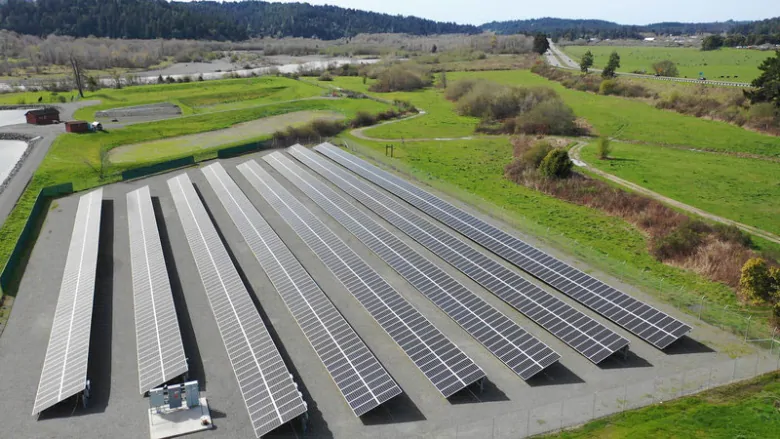
(Blue Lake Rancheria)
As the global population grows, so does the demand for electricity. But there are challenges, even now. More than a billion people around the world don’t have access to power grids. According to the Canada Energy Regulator, 200,000 people in Canada are not connected to the North American electrical grid and natural gas distribution pipeline systems.
We’re also seeing natural disasters and major weather events disrupt power supply, causing mass blackouts for days at a time. And when one part of the transmission system breaks down, it can paralyze the whole grid.
Enter the microgrid. A concept that’s been growing in popularity, it’s a power system that can operate independently or work in connection with bigger grids.
A microgrid “contains everything that it needs to provide power to a community,” said Lynn Côté, cleantech lead at Export Development Canada. “You’re not building a system for a million people. You’re building a system for maybe a thousand people, 500, maybe 250.”
Big electrical grids connect buildings to central power sources, such as coal, nuclear and gas plants. When main components stop working, everything can be affected.
A microgrid operates as an island, which can be beneficial during times of crises like storms or outages (or for other reasons). Many are powered by a mix of renewable energy and batteries, with natural gas for backup. Microgrid power isn’t necessarily more reliable, but in communities far from a larger power source, microgrids can alleviate complications because the electricity is stored, owned and controlled locally.
One of the older examples is a microgrid built more than a decade ago in Sendai, Japan, which is powered by a mix of solar, gas and battery. According to Berkeley Lab, which does research on behalf of the U.S. Department of Energy, during blackouts caused by the 2011 tsunami and earthquake, the microgrid in Sendai provided power and heat to the teaching hospital of Tohuku Fukushi University.
“Widespread power outages cause a lot of social and economic damage and destruction. And the climate crisis is making all of this worse,” said Jana Ganion, energy director for Blue Lake Rancheria, an Indigenous reserve in California that launched a solar microgrid in 2015.
Millions of people in California had their power shut off last fall because of wildfire risk. Meanwhile, the Blue Lake Rancheria microgrid provided electricity to thousands nearby.
Setting up a microgrid can be an expensive undertaking, especially in dense urban or suburban areas with existing infrastructure. Consumers typically stick with what works, said Côté, and for the majority of Canadians, that means hydroelectric power (nuclear and coal are the next-biggest power sources).
“It’s really hard for certain countries to raise the kind of capital you need [to build a power plant],” said Côté, who has researched microgrids in remote Canadian communities. She said the “autonomy” a microgrid provides “is really important.”
There are nearly 300 remote communities across Canada, many of which rely on diesel-powered microgrids for electricity generation. Over the last decade, the federal government has worked with regional entities to create greener options.
In August, Gull Bay First Nation, north of Thunder Bay, Ont., co-developed a community microgrid that uses solar, battery storage and automated control technology to help reduce diesel use, according to Ontario Power Generation. It’s the first of its kind in Canada.
Côté said that in addition to making remote areas more self-sufficient, microgrids could help communities access clean drinking water by providing the power to treat it.
— Isabel Terrell
Reader feedback
Our story on e-bikes from a couple of weeks back continues to fuel discussion. Some readers doubted the possibility of biking year-round in a country as seasonally variable as Canada. Other readers weren’t having it.
Colin Lee wrote, “The fact is that many people bike year-round and have done so for decades in Canadian cities. I have lived in Waterloo, Toronto and Halifax and biked in winter in all three cities. The only way we’re going to get more people doing so is by building more and safer infrastructure.”
Deborah Baxter: “Don’t tell me that we cannot bike year-round in Canada! It is done in Iceland, and it sure as hell can be done in Canada!” Baxter describes herself as “a 62-year-old retired professional woman who chooses to work full-time.” She works within a two-kilometre radius of her home. “I work late afternoon until almost midnight. And my sole means of transportation has been bicycle, apart from a very occasional cab ride.” She concluded by saying, “I hope my two years of riding a bike year-round, largely at late night in Maritime Canada, entices many more to do so.”
Kelvin Sams: “I live in Halifax and … I have been commuting to work on an electric fat bike. An excellent choice for icy snowy conditions. Wearing some ski goggles, a winter helmet and other suitable clothing I have been quite comfortable riding to work and more often find myself over-dressing. I have never before commuted to work by bicycle. For the first time I believe a significant portion of Canadians can commute by e-bike 12 months of the year.”
Karla Braun: “I live in Winnipeg and I’m a year-round cycle commuter.”
Finally, this from Judi Varga-Toth: “It is time to reject the myth that Canada cannot be and never will be a cycling nation. Not only can we be, but we must be. Cycling is a simple solution to many of the world’s most complex problems, ranging from chronic disease and obesity prevention to mental health and productivity gains, from lowering GHGs to improving air quality, to reducing congestion and boosting the local economy.”
The Big Picture: Oil and gas company investments in green tech
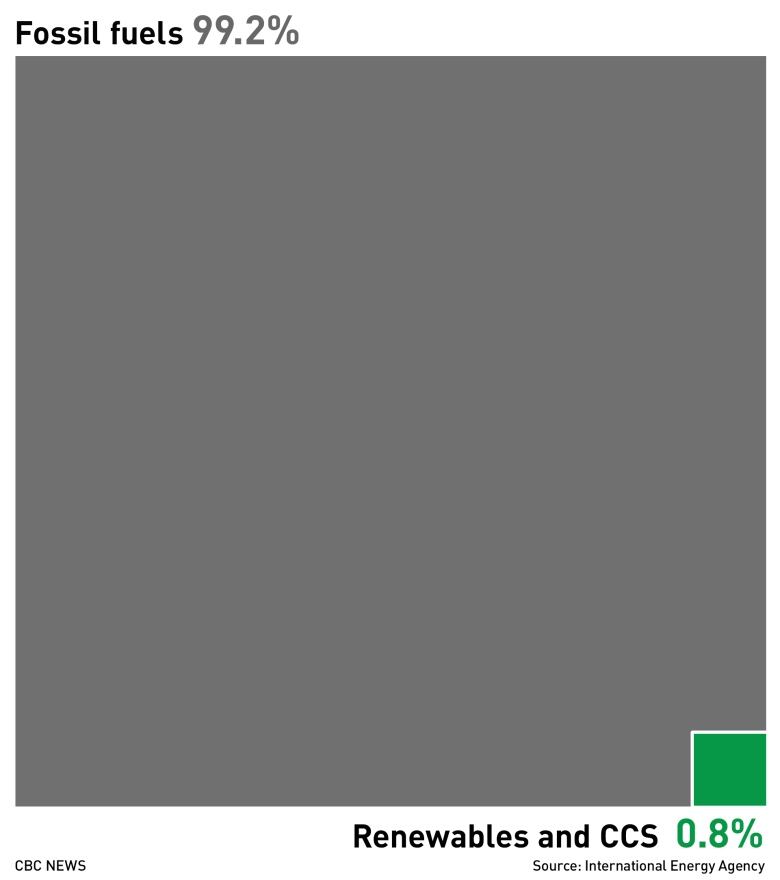
In the face of a growing consensus about the causes and effects of climate change, many of the world’s biggest fossil fuel companies (such as Shell and Exxon) have touted their investments in green energy and carbon capture and storage (CCS) technology. But a recent report by the International Energy Agency (IEA) found that those promises are not backed up by action. The IEA found that on aggregate, these companies spent less than one per cent on “low-carbon businesses.”
(CBC)
Hot and bothered: Provocative ideas from around the web
As climate change evolves, it will affect different parts of the world in different ways. (As we’ve seen from recent events, for example, Australia and Indonesia have been hit by wildfires and floods, respectively.) Extreme weather will lead some people to move elsewhere. This week, the UN’s human rights committee ruled it is illegal for governments to send people back to countries that face climate risks.
As the world weans itself off oil, particularly in transportation, there are indications the fossil fuel companies are turning to another option: producing more plastic.
Nearly 70 per cent of the energy used in the residential sector comes from fossil fuels, a 2014 study estimated. Forced air furnaces and hot water or steam boilers with radiators, which most often burn fossil fuels such as natural gas, make up a majority of the primary heating systems in Canada, Statistics Canada reports.
Buildings heated with fossil fuels can cut some of their emissions by reducing the need for heating through things like better insulation and reusing “waste” heat.
If your home is hooked up to a district heating system, where a utility supplies heat directly, you may be able to tap into a variety of greener energy sources.
But if your home relies on its own individual heating system, as most do, what are the alternatives to fossil fuels — and will they work in the colder parts of this country?
“The only fuel that we can truly make 100 per cent carbon neutral is electricity,” said Fin MacDonald, program manager of the Zero Carbon Building program at the Canada Green Building Council.
In provinces with an electrical grid based mostly on hydro, nuclear or other zero-emission energy sources, such as Ontario, Quebec and B.C., replacing a gas-burning furnace with an electrical heating system can nearly eliminate a home’s emissions.
Baseboard heaters are the most common option in use across Canada. They’re powered by electrical resistance heating, just like your toaster and oven. Electric forced air furnaces, electric convection heaters and electric radiant floors also use electrical resistance heating.
Baseboard heaters are popular because they’re cheap and easy to install, but
electrical resistance heating is generally inefficient, said Brady Faught, green buildings engineer with the City of Vancouver.
“They’re just like having a toaster running in your house all day … resulting in high electric bills.”
Heat pumps are far more efficient because they simply move heat into your home, rather than generating heat. There are two kinds:
Air source heat pumps, which draw heat from the air. (Yes, it can work even when it is very cold outside, just as your freezer can use its heat pump to cool itself to -18 C in a 20 C kitchen.)
Ground source heat pumps, which draw heat from the ground and are sometimes referred to as geo-exchange or geothermal heat pumps. (MacDonald said the industry is trying to move away from calling it geothermal, as it gets confused with geothermal power generation.)
Both MacDonald and Faught said it’s possible to get 300 per cent efficiency from a heat pump — that is, you can get three kilowatts of heat for every kilowatt of electricity you put in. They’re especially efficient in spring and fall.
But MacDonald said heat pumps tend to produce a lower temperature heat than burning fossil fuels, and therefore don’t heat a building as quickly.
Faught said air source heat pumps can warm an airtight, well-insulated home to a comfortable temperature until it gets to about -10 C outside. In places with colder winters than that, supplementing with baseboard heaters may be necessary with conventional air source heat pumps. (Some manufacturers have brought cold climate heat pumps on the market that they say can deal with outside temperatures down to -25 C or -30 C.)
In provinces like Alberta and Saskatchewan, where power right now is largely generated by burning fossil fuels, homeowners who want to cut heating emissions need to go beyond electrification and also install green power generation, such as solar panels.
David Turnbull, a manager at Enerspec, which does energy consulting and home inspections, warns that before investing in a heat pump, homeowners should make sure their place is as airtight and well-insulated as possible.
“The investment in these things doesn’t necessarily pay off unless you’ve low-enough heat loss in your home to make one of these things worth it.”
— Emily Chung
Stay in touch!
Are there issues you’d like us to cover? Questions you want answered? Do you just want to share a kind word? We’d love to hear from you. Email us at whatonearth@cbc.ca.
Sign up hereto get What on Earth? in your inbox every Thursday.