Categories
Tech

After Jeff Bezos hack, calls for greater controls on hacking tools


The recent revelation that Amazon founder and Washington Post owner Jeff Bezos fell victim to smartphone hacking — allegedly involving Saudi Arabia’s crown prince — has cast a light on the shadowy world of cyber weapons sales.

Organizations as prominent as the United Nations and Amnesty International have demanded better controls be implemented over the way digital arms and private surveillance tools are sold.

But those calls have come before, and experts say the attack on Bezos, one of the wealthiest people in the world, highlights how journalists and free speech activists, among other groups, remain at risk.

“These allegations demonstrate that nobody is safe from the use of this kind of technology,” the UN’s point person on free speech, David Kaye, told CBC News in an interview. He warned that people “should understand the reach of the private surveillance industry.”

Kaye and Agnès Callamard, both UN special rapporteurs, on Wednesday published details of the Bezos hack, stemming from a private consulting firm’s forensic analysis of the billionaire’s iPhone. 

The company, hired by Bezos, assessed with “medium to high confidence” that his device had been infected with spyware when he received a video file from the account of Saudi Crown Prince Mohammed bin Salman on the Facebook-owned instant messaging service WhatsApp.

The analysis found “unprecedented” data transmission from the iPhone began within hours of Bezos receiving the suspect video — apparently allowing hackers to steal gigabytes of files from his device over “some months.”

Amazon CEO Jeff Bezos is seen with Hatice Cengiz, fiancée of murdered Washington Post columnist Jamal Khashoggi. (Umit Bektas/Reuters)

The incident, on May 1, 2018, came months ahead of the killing of Jamal Khashoggi, a prominent critic of the Saudi regime — and columnist for Bezos’s newspaper — at the Saudi consulate in Istanbul. The hack also came before the National Enquirer tabloid obtained private texts and photos revealing Bezos’s extramarital affair. His longtime wife later filed for divorce.

Norway-based human rights activist Iyad el-Baghdadi, a friend of Khashoggi’s, told CBC hacking tools are being handed “to governments that are simply irresponsible.”

“Given the current state of affairs, I think we need a moratorium on the sale and transfer of this technology,” he said.

Saudi officials called claims of the Kingdom’s involvement in the hack “absurd.”

The UN report calls for national and international authorities to institute export control regimes on private surveillance technology. Conventional weapons, by contrast, are subject to worldwide agreements such as the UN-brokered Arms Trade Treaty. Involving more than 100 countries, the treaty sets norms for cross-border arms sales and seeks to prevent human rights abuses.

The NSO Group logo is seen on a building in Herzliya, Israel, in 2016. (Daniella Cheslow/The Associated Press)

How’d they do it?

Although analysts found no malware in Bezos’s smartphone, experts said it’s possible the malicious code could have hidden its own tracks after the infection. The UN report pointed to two types of spyware “that can hook into legitimate applications to bypass detection and obfuscate activity.”

The first, known as “Pegasus,” created by the Israeli-based NSO Group, was suspected of being used by Saudis before, to spy on critics abroad. The second “less likely” option, according to the report, is that hackers employed Galileo, otherwise known as “Remote Control Service,” developed by the Hacking Team. The Milan-based group was reported to have sold cyber tools to the FBI in the past.

Hacking Team did not reply to a request for comment. NSO, however, vigorously defended its work in an emailed statement, saying “our technology was not used in this instance … our products are only used to investigate terror and serious crime.”

Saudi Arabia was previously reported to have spent $55 million US on Pegasus.

The hack targeting Bezos involved the WhatsApp account tied to Saudi Crown Prince Mohammed bin Salman, according to a UN report. (Bandar Algaloud/Courtesy of Saudi Royal Court via Reuters)

The Israeli firm, though, claimed this week its tools cannot be used on U.S. phone numbers. It did not explain whether the apparent measure was included in its code, or whether it could be modified by a client after its sale.

Challenged in court

It’s not the first time NSO distanced itself from similar allegations.

In October, WhatsApp sued the firm in U.S. federal court, claiming NSO had helped governments spy on 1,400 users around the world. NSO said at the time it denied the allegations and vowed to “vigorously fight them.”

Separately, WhatsApp’s developers recently said they had fixed a bug that allowed for malicious code to be inserted into an MP4, the same type of video file believed to have been sent to Bezos.

The alleged targets were not named in court. Quebec resident Omar Abdulaziz, however, is among Saudi Arabia’s critics believed to have been hit with spyware — likely NSO’s Pegasus, according to research carried out by the Citizen Lab at the University of Toronto.

New York Times journalist Ben Hubbard, who wrote a book on the Saudi crown prince, also said on Twitter this week that “operators linked to Saudi Arabia” tried to hack his phone a month after the attack on Bezos. He thanked Citizen Lab for having “checked it out.”

This week’s UN report said Saudi Arabia targeted Bezos principally in his role as owner of the Post, which published Khashoggi’s criticism of the regime.

‘Global security problem’

Ronald Deibert, the director of Citizen Lab, said the Bezos case serves as “a reminder that the proliferation of commercial spyware is a global security problem for all sectors, from government and businesses to civil society.”

He said his group had identified “hundreds of journalists, human rights defenders, politicians, and others who have been targeted with these technologies.”

Citizen Lab stressed it was not part of the private analysis of Bezos’s iPhone, but published recommendations for how the consulting firm could further investigate the source of the hack.

Amnesty International is also involved in court action in Israel, where activists are attempting to get the country’s defence ministry to block NSO from exporting its products.

A legal team attends a court hearing on Amnesty International’s legal bid to have Israel revoke the export licence of the NSO Group. (Corinna Kern/Reuters)

“NSO continues to profit from its spyware being used to commit abuses against activists across the world and the Israeli government has stood by and watched it happen,” said Danna Ingleton, deputy director of Amnesty’s tech division.

Kaye, the UN special rapporteur, said Citizen Lab’s work has shown spyware is all too often used by rogue regimes to silence or intimidate activists, dissenters and reporters.

He said it’s been illustrated so many times it’s “no longer surprising, but still shocking.”


Source link

Categories
Tech

Doomsday clock announcement to be made at 10 a.m.


In its annual announcement, the Bulletin of the Atomic Scientists will reveal the status of the Doomsday Clock at 10 a.m. Thursday morning.

The clock was introduced in 1967 and is a symbolic representation of how close humanity is to destroying civilization. Typically, the hands are moved forward or back depending on how vulnerable the world is. Midnight represents a catastrophe.

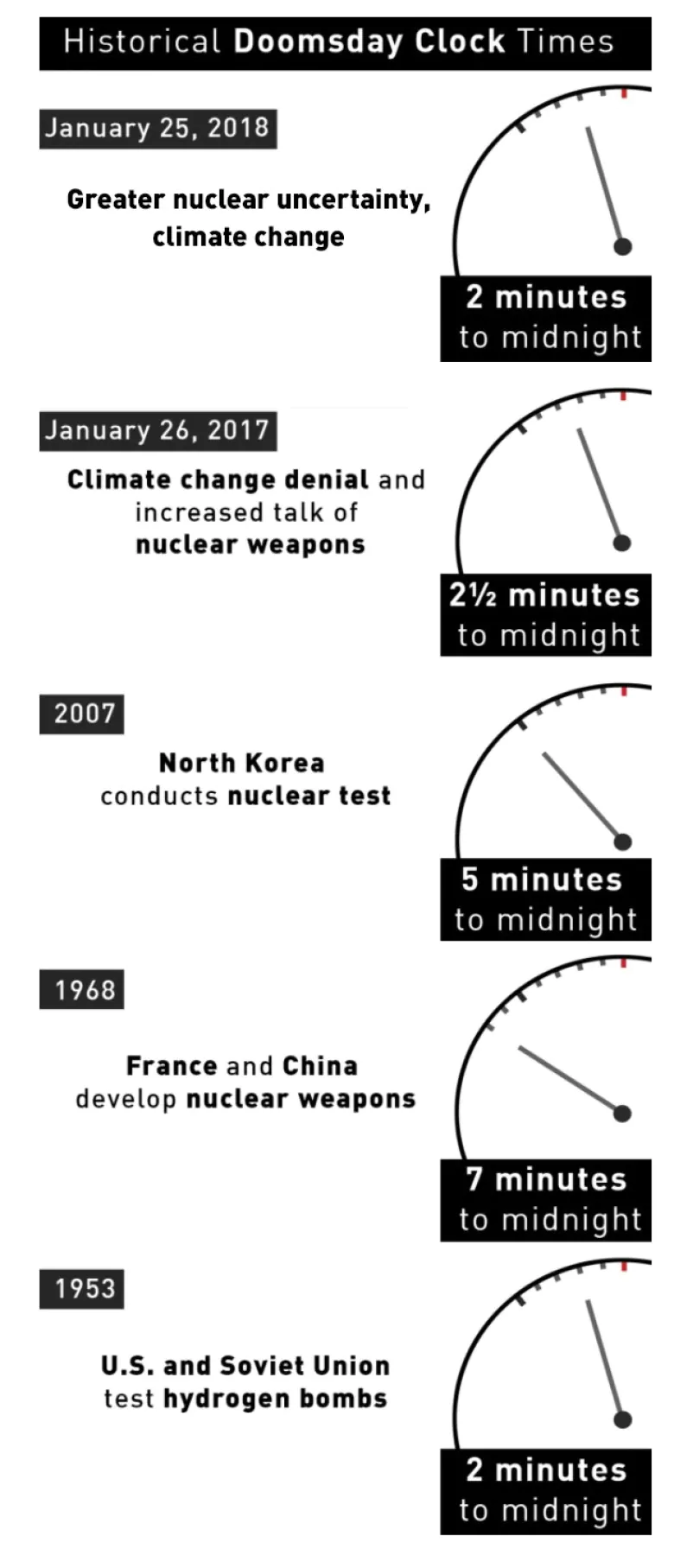
While the hands of the clock typically move a minute at a time, the Bulletin of the Atomic Scientists moved it by 30 seconds in 2017 and 2018. It remained unchanged in 2019, and is currently at two minutes to midnight.

The only time the hands were this close to midnight was in 1953, when the U.S. and Soviet Union began rigorously testing nuclear weapons.

The clock takes into account issues such as the threat of dangerous weapons, like technology and nuclear missiles, the political climate and climate change.

The farthest the clock’s hands have been from midnight was 17 minutes in 1991, at the end of the Cold War. 

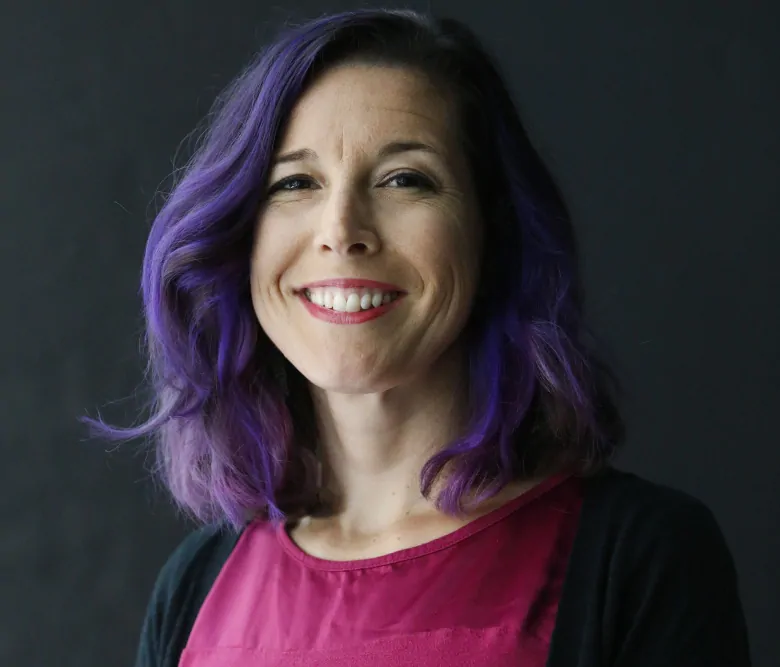
The announcement will be made by Rachel Bronson, president and CEO of the Bulletin of the Atomic Scientists, as well as former California governor and the current executive chair at the Bulletin, Jerry Brown. They will be joined by Ban-Ki moon, the former UN secretary general, and others at the National Press Club in Washington, D.C.


Source link

Categories
Tech

What impact do private jets and celebrity lifestyles have on the fight against climate change?


The CEO of a company that sells private jets to corporations says his clients are concerned about climate change, but ultimately they “still have to conduct their business.” 

“We are still living in the 21st century and people do have to understand that,” said Steve Varsano, founder of The Jet Business.

“We’re not in the Stone Age, and as much as people want to be able to save the earth, you still have to survive, you have to live, and you have to produce revenue for your shareholders.” 

Despite that, Varsano told The Current’s Matt Galloway that the topic of climate change is coming up “more and more” in his luxurious showroom in London, U.K.

“People are becoming more conscious of it and they do want to do something about it,” he said.

Steve Varsano, founder of CEO of The Jet Business, in the company’s showroom in London. (Submitted by The Jet Business)

“There are some companies and programs that you can easily buy carbon footprint offsets, and it’s not that expensive, believe it or not.” 

Carbon offsetting works by calculating the emissions generated by a flight you take, for example, then paying someone to plant enough trees to remove that carbon from the atmosphere. 

Every flight’s emissions add up: prof

The Intergovernmental Panel on Climate Change estimates that domestic and international aviation accounts for approximately two per cent of global CO2 emissions produced by people

Varsano argued that due to the relatively small number of private jets in the world, the carbon emissions involved are quite small.

But Stefan Gössling, a professor of tourism, said it could be argued that every individual emission is irrelevant, until they start to add up.

“The question is how does each and every individual in the world contribute to climate change? And that should be the point of measurement,” said Gössling, who works at Linnaeus University in Sweden.

Gössling also questioned the wisdom of carbon offsetting by planting trees, due to widescale wildfires in recent years. 

Look at Australia, look at California. I think everybody would realize that is not a really safe way of storing carbon,” he said.

Gössling has published research exploring how the lifestyles of the rich and famous affect social attitudes to flight and travel.

He tracked the movements of 10 celebrities in 2017, including Bill Gates and Paris Hilton, mining their social media to estimate their travel itineraries and associated carbon emissions.

Stefan Gössling studied the travel itineraries of 10 celebrities, including Paris Hilton. He estimated their flight-related emissions were 10,000 higher than the average person. (Amy Sussman/Invision/AP)

He found their flight-related emissions could be 10,000 greater than the average person — but he thinks the problem goes further.

“The issue with the celebrities we studied in our paper is that they are obviously famous people who live specific lifestyles that they are admired for,” he said.

Fans and followers may then aspire to, or imitate, their jet-setting lifestyles, he explained.

“That becomes something that is problematic because we need the opposite. … We need a social norm change towards people being more critical about flying and travel.”

The Intergovernmental Panel on Climate Change estimates that domestic and international aviation accounts for approximately two per cent of global CO2 emissions produced by people. (David Gray/Reuters)

A private jet is ‘a time machine’: Varsano

Varsano said a pre-owned jet will sell for between $10-$30 million US — depending on size — and is equipped to fly 14 passengers up to 14 hours. A new jet can sell for $100 million US. 

One of his famous clients includes motivational speaker Tony Robbins, but he said the worldwide ownership of private jets is split between state-owned planes, and business jets owned by big corporations.

While he understands people see private jets as luxury items, Varsano said they’re also business tools, describing his product as “a time machine.”

“You have flexibility in your schedule, you have security, you have confidentiality. So there’s a lot of things that you benefit from from being in a corporate jet besides just the pure fact of being in a luxurious atmosphere,” he said.

The time that a frequent-flier executive saves — not lining up at airport security, for example — can be used to grow their business, he said. 

“There’s no value you can put that, you know, in a dollar term.”


Written by Padraig Moran. Produced by Alison Masemann.


Source link

Categories
Tech

World needs to prepare for millions of climate displaced, UN says


The world needs to prepare for millions of people being driven from their homes by the impact of climate change, the United Nations High Commissioner for Refugees said on Tuesday.

Speaking to Reuters at the World Economic Forum, Filippo Grandi said a UN ruling this week meant those fleeing as a result of climate change deserved international protection, and that it had broad implications for governments.

The UN Human Rights Committee made the landmark ruling on Monday in relation to Ioane Teitiota, from the Pacific nation of Kiribati, who brought a case against New Zealand after authorities denied his claim of asylum.

We must be prepared for a large surge of people moving against their will.– Filippo Grandi,  UN High Commissioner for Refugees

“The ruling says if you have an immediate threat to your life due to climate change, due to the climate emergency, and if you cross the border and go to another country, you should not be sent back, because you would be at risk of your life, just like in a war or in a situation of persecution,” Grandi said.

“We must be prepared for a large surge of people moving against their will,” he said. “I wouldn’t venture to talk about specific numbers, it’s too speculative, but certainly we’re talking about millions here.”

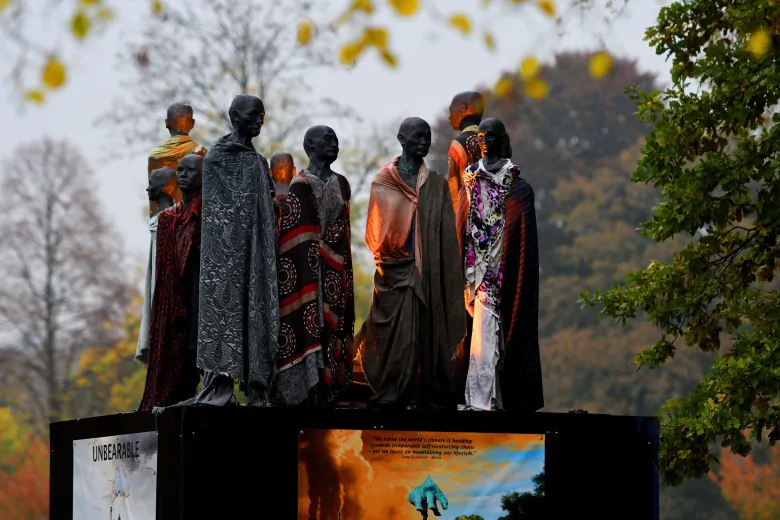
A sculpture featuring climate refugees created by Danish artist Jens Galschiot is seen at Rheinaue park during the COP23 United Nations Climate Change Conference in Bonn, Germany, in 2017. The UN says the world needs to prepare for millions of people being driven from their homes by the impact of climate change. (Patrik Stollarz/AFP via Getty Images)

Potential drivers include wildfires like those seen in Australia, rising sea levels affecting low-lying islands, the destruction of crops and livestock in sub-Saharan Africa and floods worldwide, not least in parts of the developed world.

Whereas for most of its 70 years UNHCR, the UN’s refugee agency, has worked to assist those fleeing poorer countries as a result of conflict, climate change is more indiscriminate.

“It is further proof that refugee movements and the broader issue of migration of populations … is a global challenge that cannot be confined to a few countries,” said Grandi.

70 million displaced

Yet the convention relating to the status of refugees, signed in 1951, made no provision for climate change as a reason for people to flee their country and seek asylum elsewhere. As climate impacts grow, legal questions become more complicated.

UNHCR, whose budget has risen from $1.3 billion Cdn a year in the early 1990s to $11 billion in 2019 as conflicts in Iraq, Afghanistan and Syria have forced civilians to flee, now assists more than 70 million forcibly displaced people.

Demonstrators shout slogans in support of Syrian refugees during a protest against Turkish government’s recent refugee policies in Istanbul in July 2019. (Murad Sezer/Reuters)

Turkey is the largest recipient, with more than 4 million refugees and asylum seekers, the vast majority from Syria. That has strained Turkey’s public finances and led President Tayyip Erdogan to demand more assistance from Europe.

Last November, Erdogan threatened to open the door for Syrian refugees to head to Europe unless the European Union stepped up, and he is now calling for the “resettlement” of up to 1 million Syrians in the north of their homeland.

Grandi said European governments needed to think hard about solutions to the migrant crisis, which has affected them since 2015, but also show more understanding of Turkey’s situation.

“We must recognize that, for the past several years (Turkey)has been hosting the largest refugee population in the world,” he said. “There’s a lot of political talk. I concentrate on the substance of this, which is ‘let’s strengthen Turkey’s ability to host refugees until they can go back safely, voluntarily to their countries’.”


Source link

Categories
Tech

UN experts call for investigation after Saudis linked to Jeff Bezos phone hack


Saudi Crown Prince Mohammed bin Salman may have been involved in a plot to hack the phone of Amazon’s billionaire boss Jeff Bezos, United Nations experts said on Wednesday.

The UN special rapporteurs, Agnes Callamard and David Kaye, said they had information pointing to the “possible involvement” of the prince in the alleged 2018 cyberattack. Saudi officials have dismissed the allegations as absurd.

Cybersecurity experts hired by Bezos, the world’s richest man, concluded his phone was probably infiltrated by a video file sent from a WhatsApp account purportedly belonging to the prince in 2018, according to a person familiar with the matter.

They said the device began leaking massive amounts of data about a month afterward, the source said.

Callamard, the special rapporteur for extrajudicial killings, and Kaye, special rapporteur for free expression, said the allegation of Saudi involvement “demands immediate investigation by U.S. and other relevant authorities.”

Outside experts consulted by the UN agreed that while the case was not airtight, the evidence was strong enough to warrant a fuller investigation.

But the UN said the case illustrated the dangers “from the unconstrained marketing, sale and use of spyware.”

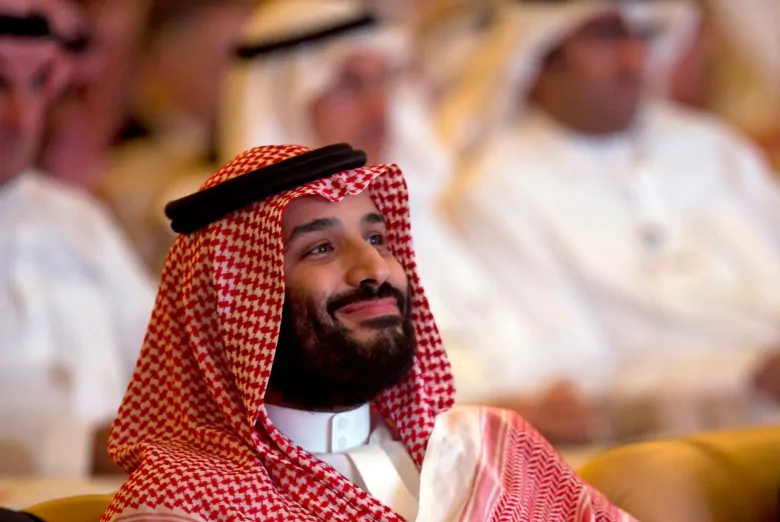
Saudi Crown Prince Mohammed bin Salman is shown in late 2018 at a Riyadh investment conference. (Amr Nabil/The Associated Press)

Saudi Foreign Minister Prince Faisal bin Farhan Al Saud dismissed the charges.

“I think ‘absurd’ is exactly the right word,” he told Reuters in an interview in Davos. “The idea that the crown prince would hack Jeff Bezos’s phone is absolutely silly.”

The alleged cyberattack is said to have taken place months before the 2018 murder of Saudi journalist Jamal Khashoggi, a fierce critic of the Saudi government and a columnist for the Bezos-owned Washington Post.

“At a time when Saudi Arabia was supposedly investigating the killing of Mr. Khashoggi, and prosecuting those it deemed responsible, it was clandestinely waging a massive online campaign against Mr. Bezos and Amazon targeting him principally as the owner of The Washington Post,” Callamard and Kaye said in their statement.

Leaked personal messages

Prince Mohammed, or MBS as he is familiarly known, said last year that the Khashoggi killing was carried out by rogue operatives and that he did not order it.

Callamard led a UN inquiry into the Khashoggi killing.

“The evidence points overwhelmingly — and, in fact, in only one direction — which is that the killing was the state killing,” she told CBC News in December.

The Guardian newspaper first reported the crown prince’s alleged involvement in the Bezos phone incident.

Listen: Callamard speaks to CBC about Khashoggi murder investigation

The sentencing of eight men for Jamal Khashoggi’s murder is a “travesty of justice” because the people who masterminded the killing have walked free, says UN special rapporteur Agnes Callamard. 6:59

The relationship between the Amazon chief executive and the Saudi government had soured since early last year after he alluded to Saudi Arabia’s displeasure at the Washington Post’s coverage of the murder of Khashoggi.

In a previous flashpoint, Bezos’s security chief said last year that the Saudi government had gained access to the Amazon CEO’s phone and leaked messages to U.S. tabloid the National Enquirer between Bezos and Lauren Sanchez, a former TV anchor who the newspaper said he was dating.

A month before, Bezos had accused the newspaper’s owner of trying to blackmail him with the threat of publishing “intimate photos” he allegedly sent to Sanchez.

The Saudi government has denied having anything to do with the National Enquirer reporting.

Amazon declined to comment.


Source link

Categories
Tech

The end of anonymity? Facial recognition app used by police raises serious concerns, say privacy advocates


Read Story Transcript

A secretive facial recognition software used by hundreds of police forces is raising concerns after a New York Times investigation said it could “end privacy as we know it.”

Clearview A.I. has extracted more than three billion photos from public web sites like Facebook, Instagram, employment sites and others, and used them to create a database used by more than 600 law enforcement agencies in the U.S., Canada and elsewhere, according to Times reporter Kashmir Hill.

“It is being used to solve many murder cases, identity fraud cases, child exploitation cases,” Hill told The Current’s host Matt Galloway. 

Police officers who spoke to Hill said the app was a far more powerful tool for cracking cases than any government database they had used before. The company claims their software finds a match in three out of four cases.

The software is so effective, Hill said, that even when she covered her face and mouth for a photo, it still pulled up seven images of her.

“I was just shocked at how well this face recognition algorithm works,” she said.

Kashmir Hill investigated Clearview A.I. for the New York Times. (Submitted by Kashmir Hill; Earl Wilson/New York Times)

The end of anonymity?

Hill said investors and police officers she interviewed expect this software, or another similar technology, to be available to the public within the next five years.

“If you were in a restaurant having a sensitive conversation about family secrets or work secrets, a stranger next to you could snap your photo and know who you are, and understand that conversation in context,” she said.

What you lose, if this technology gets out into the wild, is the possibility of any anonymity in public ever.– Brenda McPhail, Canadian Civil Liberties Association

“You can imagine stalkers using this tool — just really malicious use cases.”

The potential uses for this kind of software is ringing alarm bells for privacy advocates.

“What you lose, if this technology gets out into the wild, is the possibility of any anonymity in public ever. That’s something that we need to think about,” said Brenda McPhail, director of the Canadian Civil Liberties Association’s Privacy Technology and Surveillance Project.

McPhail said this kind of facial recognition technology could also make it easier for governments to monitor protesters.

“It’s a threat to the fundamental freedoms that we value in a democracy,” she said.

A secretive company

When Hill started looking into Clearview, she initially came up against a lot of dead ends.

Its website was only accessible to law enforcement, and their listed New York address led her to a building that didn’t exist. For a long time, the company declined to speak to her.

But they did find her.

While interviewing police officers about the app, she would ask them to scan a photo of her, to see how the software worked. 

“The police officers would then get a call from the company saying, ‘Are you talking to the media?’ So they were actually tracking who was talking to me while they weren’t talking to me,” she said. 

“So I found that a bit disturbing.”

Hill said that Clearview’s secrecy, and their willingness to use their software to track a reporter, raised concerns about police departments’ willingness to share sensitive information about suspects and victims with the little-known company.

“Most of the departments had done no vetting of them … and the company has this vast database of everyone that the police department is interested in,” she said.

Reported use by Canadian law enforcement

McPhail said she was also concerned by allegations in Hill’s story that Canadian police forces are using Clearview A.I.’s software. 

“The way the data is collected is probably against Canadian law,” said McPhail.

“We’ve got law enforcement agencies using it without confirming that the use of the tool is compliant with Canadian law. That’s a big problem.”

Hill interviewed Canadian police officers about the app on condition of anonymity, so The Current reached out to several police forces across the country.

The Vancouver Police Department said it has never used the software and has no intention of doing so. The Toronto Police Service says it does use facial recognition, but not through Clearview A.I.

We’re deluding ourselves if we think that we have any privacy whatsoever.– Michael Arntfield

Ontario Provincial Police say they have used facial recognition technology, but wouldn’t specify which products they use.

“Generally, the RCMP does not comment on specific investigative tools or techniques,” an RCMP representative said in a statement.

The Current also requested comment from Clearview A.I. but did not receive a response.

In the public interest

Michael Arntfield, a Canadian criminologist and former police officer, believes concerns about the technology are overblown.

“The upsides far outweigh the downsides and are in the public interest, quite frankly,” he said.

He believes the amount of information Clearview can glean from even billions of images pales in comparison to the “troves” of personal data gathered and sold to advertisers by companies like Google and Facebook

“We’re deluding ourselves if we think that we have any privacy whatsoever,” he said.

“Now we can actually use this [technology] for a productive purpose, for a public safety purpose … why is the alarm being sounded now?”


Written by Allie Jaynes. Produced by Ines Colabrese, Ben Jamieson and Joana Dragichi.


Source link