Twitter said on Tuesday it would start applying a label to tweets containing synthetic or deceptively edited forms of media, as social media platforms brace for a potential onslaught of misinformation ahead of the 2020 presidential election.
The company also said it would remove any deliberately misleading manipulated media likely to cause harm, including content that could result in threats to physical safety, widespread civil unrest, voter suppression or privacy risks.
Social media companies have been under pressure to tackle the emerging threat of “deepfake” videos, which use artificial intelligence to create hyper-realistic but fabricated videos in which a person appears to say or do something they did not.
Alphabet Inc’s YouTube said earlier this week it would remove any content that has been technically manipulated or doctored and may pose a “serious risk of egregious harm,” while TikTok, owned by China’s ByteDance, issued a broad ban on “misleading information” last month.
Facebook said last month it would remove deepfakes and some other manipulated videos from its websites, but would leave up satirical content, as well as videos edited “solely to omit or change the order of words.”
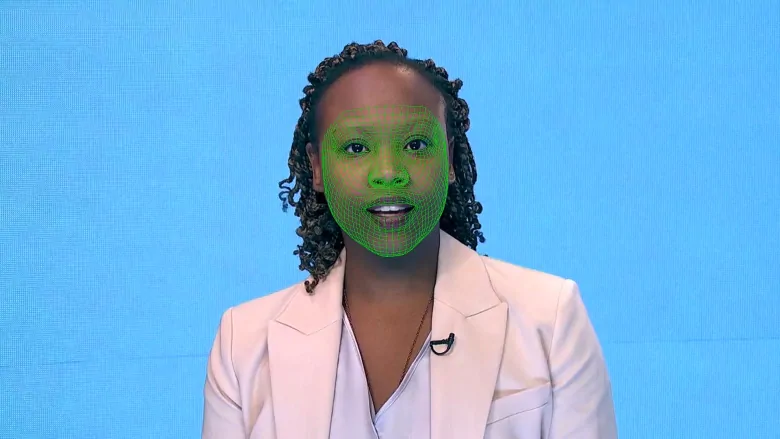
A green wireframe model covers an actor’s lower face during the creation of a synthetic facial re-animation video, known alternatively as a deepfake. (Reuters TV via Reuters)
The company sparked outrage among U.S. lawmakers when it said the new policy would not be applied to a heavily edited video that circulated widely online and attempted to make U.S. House of Representative Speaker Nancy Pelosi seem incoherent by slurring her speech.
Facebook said it would label the video as false, but that it would continue to be allowed on the platform as “only videos generated by artificial intelligence to depict people saying fictional things will be taken down.”
Twitter under its new policy will similarly apply a “false” warning label to any photos or videos that have been “significantly and deceptively altered or fabricated,” although it will not differentiate between the technologies used to manipulate a piece of media.
“Our focus under this policy is to look at the outcome, not how it was achieved,” Twitter’s head of site integrity, Yoel Roth, said on a phone call with reporters along with Del Harvey, the company’s vice president of trust and safety.
Roth said Twitter would generally apply a warning label to the Pelosi video under the new approach, but added that the content could be removed if the text in the tweet or other contextual signals suggested it was likely to cause harm.
The two executives declined to answer questions around the resources the company would put toward spotting manipulated media, saying Twitter would consider user reports and build relationships with “third party experts” to identify content.
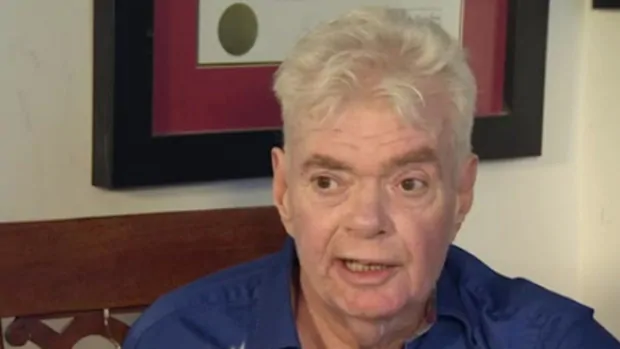
World-renowned scientist Dr. Frank Plummer has died, CBC News has learned.
No confirmed cause of death has yet been released.
Plummer, 67, was in Kenya, where he was a keynote speaker at the annual meeting of the University of Nairobi’s collaborative centre for research and training in HIV/AIDS/STIs.
Plummer was born and raised in Winnipeg, where he headed up Canada’s National Microbiology Laboratory for several years.
As a specialist in infectious diseases, Plummer’s work influenced international public health policies.
“Frank dedicated decades of his time to Africa and led world-changing breakthroughs in HIV prevention,” Matthew Gilmour, director general of the National Microbiology Lab, wrote in an internal email to staff of the Public Health Agency of Canada on Tuesday.
“Of course, the most noteworthy breakthrough that he and his team made was the finding of female sex-workers who were resistant to HIV. The gift these women have given science in the years since has been unparalleled.
“Frank had just had a joyful reunion with many of them a couple days before his passing.”
Plummer was most recently living in Toronto, where he underwent experimental brain surgery to fight alcoholism.
He was believed to be the first person in North America to undergo deep brain stimulation for that purpose.
“Frank was bigger than life. His physical presence and intelligence contradicted the fact that he was actually a fairly quiet and shy guy,” Gilmour’s memo says.
“Science will continue to build on his accomplishments and improve public health in the world for many years to come.”
Plummer was in Kenya with his wife, Jo Kennelly, and his stepdaughter Imogen and the family had just enjoyed time on safari, Gilmour’s memo says.
Conservative leadership candidate Peter MacKay says Canada’s Paris climate targets are a “dream” — but he’s not ready to abandon them or conclude they’re unachievable.
Under the 2015 multinational Paris agreement, Canada committed to reducing greenhouse gas emissions by 30 per cent by 2030 compared to 2005 levels, a target that was first set by Stephen Harper’s government.
In an interview with CBC News Monday, MacKay said the emissions reduction targets are “aspirational.”
“But what we can’t afford,” he added, “is to be hypocrites, and we can’t afford to say we’re going to do things and then not even come close, which is the case right now.
“We’ve got to be realistic. We have to be grounded in ways in which we can actually lower our greenhouse gas emissions.”
MacKay said he isn’t ready yet to roll out his own climate policy — although the polls are telling him clearly he needs one.
A ‘thoughtful, costed, workable plan’
A United Nations Emissions Gap Report released last November said Canada is on track to miss its 2030 emissions reduction target by 15 per cent.
A recent poll by Abacus Data said 41 per cent of Canadians believe “a serious plan to combat climate change” is a “must-have” for the new Conservative leader. That figure drops to 18 per cent among Conservative voters and 22 per cent among “likely” Conservative voters.
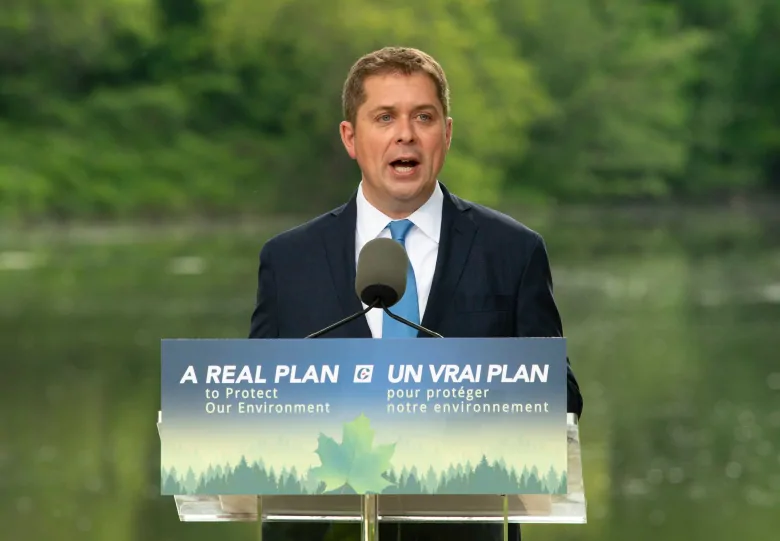
Conservative Leader Andrew Scheer delivers a speech on the environment in Chelsea, Que., on Wednesday, June 19, 2019. (Adrian Wyld/The Canadian Press)
“It’s absolutely critical that we have a thoughtful, costed, workable plan for the environment and I’m committed to that.,” MacKay said. “I’ve talked to a lot of Conservatives who very much feel the same. And for a whole generation of Canadians, this is a primary issue. And so, we have to be able to deliver a solution.”
Outgoing leader Andrew Scheer’s climate platform was condemned by environmental activists as too vague. MacKay said his own plan “may very well be” quite different from the one Scheer offered — but it also might incorporate “elements” of it.
“There are elements of it, I think, that are are workable, especially around the technologies … we are making huge advances in technology,” MacKay said.
“I favour following science. I favour seeing the research and development in this area continue to grow,” he said, adding the plan will combine emissions reduction efforts “with our energy export capacity and our ability to use our own energy.”
One thing MacKay’s plan won’t include is a carbon tax — a policy measure widely opposed within the party. “The carbon tax system is not working,” he said. “It’s failing in a catastrophic way.”
MacKay seems to be leaning toward technological fixes. He said he supports getting more electrical vehicles on the road — “That’s going to happen as a matter of course because the price of these vehicles is coming down … ” — and sees promise in carbon capture technology.
“We’re looking at what other provinces are doing right now including carbon capture and storage, which is happening in Saskatchewan.”
Encased in a metal exoskeleton, a construction worker looking like a robot wields a motorized chipper to remove tiles from a wall.
Despite the weight of the tool and its intense vibrations, the worker never tires or loses their grip.
They are a new breed of construction worker in Canada, using wearable machinery to do work faster and with less fatigue.
The hope is this technology will attract younger workers and allow older employees to stay on the job longer, which would benefit an industry facing a labour shortage.
BuildForce Canada, an organization that studies the construction industry and creates labour forecasts, said a quarter of the construction workforce is expected to retire between 2018 and 2027. It will create a demand for 42,000 workers by 2027.
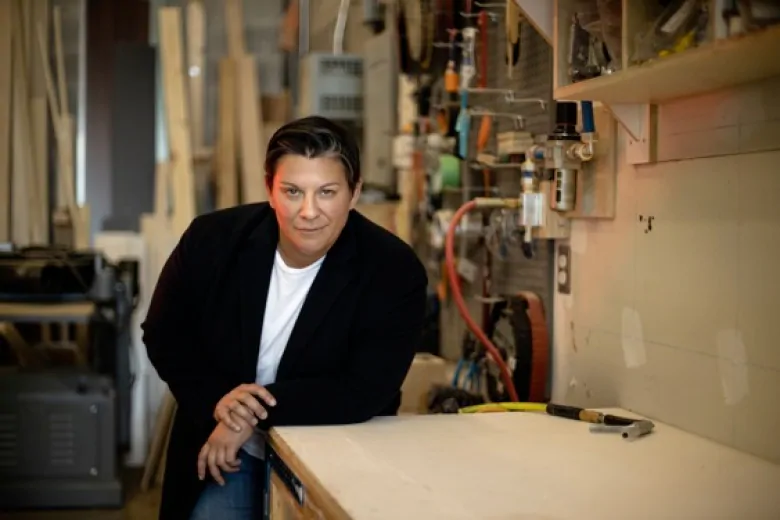
Mandy Rennehan is the founder and CEO of Freshco.ca. (Submitted by Mandy Rennehan)
The Canadian Construction Association said baby boomers are retiring and younger people aren’t entering the industry.
An exoskeleton’s frame eases the strain of heavy lifting or repetitive tasks. It protects a person’s joints and muscles from injury.
Many in the industry say the days of workers damaging their bodies to make a buck could soon be over as exoskeletons become more common on construction sites.
Some of the suits work like a lever, using counterweights to lift objects.
The latest version is a fully powered motorized suit that can enhance a user’s strength and stamina.
Exosuits are seen as a way to open the construction industry to more workers. (Freshco.ca)
Many construction companies in Canada haven’t tried the technology yet, let alone put it into regular use.
But a handful of companies have made the leap.
Freshco.ca is one of them. It’s a construction company that builds and remodels retail spaces across Canada and the eastern United States.
It was started in Halifax and was founded by Nova Scotian Mandy Rennehan, who still runs it.
The company uses two exosuits.
“This is something that’s a game-changer,” said Rennehan.
“People can literally hold these chippers for maybe 10-15 minutes at a time, then they’ve got to rest for 15 or 20 minutes.”
This next generation exoskeleton is called the Guardian XO. (Sarcos Robotics)
Rennehan can’t use the devices for all the work her company does, but said they can be used for about 40 per cent of the most fatiguing jobs.
Freshco.ca’s exosuits were made by Lockheed Martin. The suits can cost up to $80,000 US.
They have a single large arm to hold large power tools. The suit offsets the weight of tools, making it easier for the wearer to lift them.
Some of the tools can weigh up to 28 kilograms.
Rennehan said it could take a team of three people up to four days to chip away tiles in a washroom at a retail store. With the help of exosuits, two people can do the same work in two days “with 90 per cent less fatigue.”
That means people finish their work faster and can move onto other jobs without being exhausted. It also means workers have more energy for their off hours.
The exosuits also level the playing field, making it easier for anyone to enter the construction industry, said Rennehan.
People who didn’t think they had the strength to do the work, or were worried about the physical strain, are now free to participate.
The Guardian XO exoskeleton uses a high powered battery to run the motorized suit. This exoskeleton allows the wearer to lift and carry up to 200 pounds for up to eight hours. (Dan Escobar/Sarcos Robotics)
She said that’s especially important for women who may have thought they didn’t have the strength to keep up with men at the jobsite.
Rennehan hopes it will also allow older workers to stay on the job longer.
She is so impressed by the exosuits that she plans to buy two more in the next three years.
Darryl Wiebe, president of the Alberta-based construction company Kerr Interior Systems, has high hopes for the technology as well. But he wasn’t blown away by the units his company bought.
It purchased two vests. The vests, which cost $5,000 each, are connected to a set of braces that go over a worker’s arms.
Workers used them for a variety of tasks including drywall installation and roofing. Wiebe said workers got some relief but the vests had some major drawbacks, too.
Kerr Interior Systems tried these exovests on the job for six months, but found the drawbacks outweighed the benefits. (Submitted by Darryl Wiebe)
Range of motion was one issue and it made it difficult to wear a safety harness or tool belt.
“We’re not using them at the moment,” said Wiebe, “but we’re waiting for the next generation to come out where they hopefully improve some of those things.”
The next generation is on its way.
Sarcos Robotics of Salt Lake City has built a fully powered exoskeleton called Guardian XO. It takes all the strain off its user.
Martindale said exoskeletons are very attractive to younger generations and could draw more of them into the construction industry. (Dan Escobar/Sarcos Robotics)
Workers step into the thick frame of the battery-powered suit and guide it with their movements.
The wearer can lift and carry up to 90 kilograms for up to eight hours. The motorized suit does all the work.
It can solve many problems at a worksite, according to Kristi Martindale, a Sarcos executive.
She said exosuits could also help solve the construction industry’s labour woes by attracting a new wave of young people.
“There are many, many young people that are very excited about the technology,” she said, “It’s a little more exciting because of the robot, and they don’t have to worry so much about how they’re impacting their body long term.”
Kristi Martindale is an executive with Sarcos Robotics. (Sarcos Robotics)
The Guardian XO will be on the market at the end of this year. Sarcos will lease them for between $100,000 and $150,000 per year.
Despite the high cost, Rennehan said other construction companies need to jump on board.
“I’m really out there encouraging companies to invest in this equipment for their employees, for their bottom line and … to encourage more people to be knocking on their door wanting to be employed by them.”
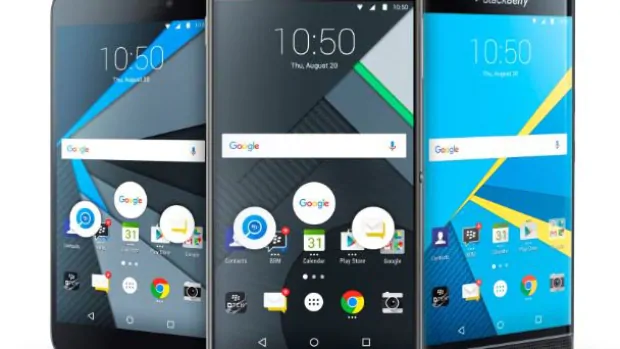
BlackBerry Mobile says TCL Communication will no longer be making or selling BlackBerry-branded mobile devices.
The company signed a brand licensing and technology support deal with TCL Communication in December 2016 as part of its plan to stop making smartphones and focus on software.
Under the terms of that agreement, BlackBerry licensed its security software and service suite, as well as related brand assets to TCL Communication.
However, BlackBerry tweeted today that TCL Communication will no longer sell BlackBerry-branded mobile devices as of Aug. 31.
TCL Communication also has no further rights to design, manufacture or sell any new BlackBerry devices.
However, the company will continue to provide support for the existing portfolio of mobile devices until Aug. 21, 2022 or as long as required by local laws where the device was purchased.
The Vancouver-based mining company proposing to build the massive Frontier oilsands mine in northeastern Alberta has set a target to be “carbon neutral” by 2050.
Teck Resources Ltd., which is awaiting a decision from the federal government on Frontier, says it will try to achieve its goal by first avoiding creating emissions and then eliminating or minimizing them.
It says it will look at alternative ways of moving materials at its mines, using cleaner power sources and implementing efficiency measures.
Teck is also vowing to produce more metals needed for the transition to a low-carbon economy, including copper for electric vehicles and renewable power generation.
Teck separately announced Monday it and its partners have signed a long-term power purchase agreement for their new copper mining project in Chile which will result in about half of its operating power needs being satisfied by renewable energy sources.
The Frontier oilsands mine is a proposed open-pit operation, located between Fort McMurray and Fort Chipewyan, pictured above, in northeast Alberta. (Jeff McIntosh/CP)
Last week, Teck CEO Don Lindsay said winning federal approval for the Frontier project doesn’t necessarily mean it will be built — the company will also need adequate pipeline access, the right commodity prices and a partner to share the costs.
“Setting the objective to be carbon neutral by 2050 is an important step forward in our commitment to reducing emissions and taking action on climate change,” Lindsay said Monday in a news release.
“Climate change is a global challenge that our company and our industry need to contribute to solving. We will pursue the technologies and measures necessary to reduce carbon emissions across our business, while continuing to responsibly provide the metals and minerals necessary for the world’s transition to a low-carbon economy.”
Teck owns 21.3 per cent of the Fort Hills oilsands mining project operated by Suncor Energy Inc.