The Labrador Sea in the North Atlantic is known as one of the lungs of the ocean, absorbing vast quantities of oxygen that sink up to two kilometres and then flow slowly around the world.
It turns out the Labrador Sea is taking a much bigger breath than anyone realized.
New research from Canadian and American scientists estimates the ocean between Labrador and Greenland is absorbing up to 10 times more oxygen than previous climate models predicted.
The oxygen is being transferred through a seasonal “trap door” that opens in winter and injects air bubbles created in winter storms.
Research shows that 60 per cent of dissolved oxygen sinks during the 40-day winter window.
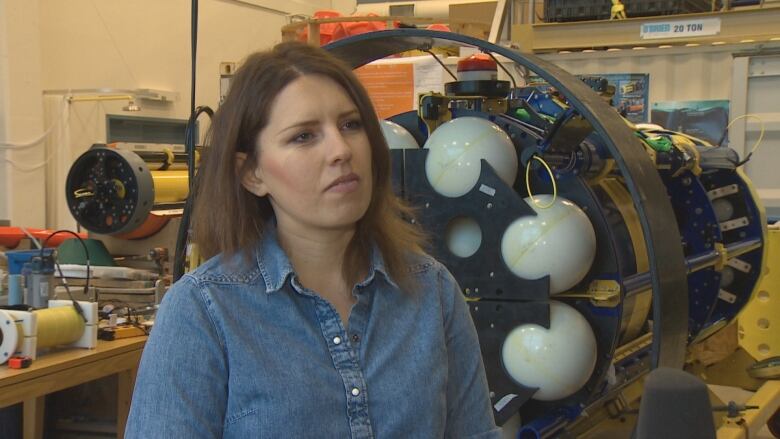
Dariia Atamanchuk, a research associate in Dalhousie University’s oceanography department, is the lead author of the study. (CBC)
Researchers from Dalhousie University in Halifax and the Scripps Institution of Oceanography in California used an advanced sensor system that spent a year anchored to the bottom of the Labrador Sea taking chemical measurements in the water column.
“We found the transfer of gases and particular oxygen is much greater than we thought,” said Dariia Atamanchuk, a research associate in Dalhousie’s oceanography department and the lead author of a study containing the findings published this week in the journal Nature Geoscience.
“The reason for that is a transfer mediated by bubbles. What happens is the breaking waves create bubbles and these bubbles get trapped. And as water sinks, these bubbles are being basically drawn down to 2,000 metres.”
The higher-than-expected intake of oxygen suggests fish and other organisms in the deep sea require more oxygen than previously thought, leaving the ecosystem more vulnerable to climate change.
Why oxygen transfer in Labrador Sea is vulnerable
The melting of Greenland and Arctic ice sheets will put more lighter freshwater into the Labrador Sea, impeding the oxygen transfer.
“The surface water is less dense. It’s harder for it to sink to greater depths. It will sink, but it will sink shallower, so the breathing becomes shallower,” Atamanchuk said.
The SeaCycler spent a year stationed in the Labrador Sea at a depth of 150 metres to take chemical measurements in the water column. (Kat Fupsova)
It takes hundreds of years for deepwater formed in the Labrador Sea to to reach the North Pacific.
“There is no immediate threat even if the breathing will become shallow tomorrow,” Atamanchuk said. “It is important that we get all these processes right and to predict what will happen in the future with the deep-sea ecosystems.”
The key to the research was the May 2016 deployment of the SeaCycler from the Maria S Merian, a German research vessel.
The SeaCycler will be returning to the Labrador Sea in September to measure zooplankton, nitrates and phosphates. (Emmo Reize)
The device, which cost $1 million, spent a year stationed in the Labrador Sea at a depth of 150 metres, where it deployed an instrument float that measured oxygen and carbon dioxide as it rose to the surface.
Every 20 hours, a separate communication float popped to the surface to transmit data to a satellite.
SeaCycler was originally developed by the Department of Fisheries and Oceans at the Bedford Institute of Oceanography, in conjunction with the Scripps Institution.
In addition to the vessel, the German marine research centre Geomar was also involved.
It’s going back to the Labrador Sea in September armed with a raft of new sensors that will measure zooplankton, nitrates, phosphates and take video images of underwater particles.
Atamanchuk said a second SeaCycler will be built at Dalhousie with support from the Ocean Frontier Institute and Canada, with a goal of establishing a permanent ocean observatory in the Labrador Sea.
Many bumblebee species have vanished from places where they were once common. Now a new Canadian-led study finds that hotter temperatures during heat waves are to blame, and uses it to predict which bumblebees are most likely to face local extinction as the climate warms.
The researchers say the technique that could also be used to make predictions for other species at risk from climate change.
In recent years (between 2000 and 2014), your chance of seeing a bumblebee at a given location declined by nearly half (46 per cent) in North America compared to in the 20th century (between 1901 and 1974), reports the study by researchers at the University of Ottawa and University College London.
“These are really severe declines,” said Peter Soroye, a PhD candidate at the University of Ottawa and the study’s lead author.
Peter Soroye, a PhD candidate at the University of Ottawa, is the lead author of the new study, which found that heat waves are linked to the huge decline in the bumblebee population across North America and Europe in recent decades. (University of Ottawa)
And that’s not just bad news for bumblebees — they’re crucial for pollinating agricultural crops from squash to berries to tomatoes, along with other flowers and plants that add colour to world, Soroye said.
“They’re probably among the best pollinators we have… they’re also really beautiful little animals,” he said. “We’d be missing a lot if they were to decline more than they have already.”
Not keeping up with climate change
Soroye’s supervisor, University of Ottawa biology Prof. Jeremy Kerr, led a previous study showing that bumblebee species have been squeezed out of warmer parts of their habitats by climate change since 1975.
“They’re not able to keep up with these changes in temperature,” said Soroye, whose followup study with Kerr echoes those results.
The fact that they were disappearing from the south pointed to climate change as a factor. But the researchers wanted to know exactly what aspect of climate change was to blame — changes in temperature, precipitation, or both?
In order to do that, they turned to a database of 550,000 bumblebee sightings from 66 species in North America and Europe between 1900 and 2015 from museum and research collections, along with sightings from citizen scientists.
The new study found that bee declines were specifically linked to hotter maximum temperatures, Soroye said.
“It’s kind of these extremes of climate throughout the year that climate change is causing.”
Bombus ternarius, commonly known as the orange-belted bumblebee, is shown on flower on Manitoulin Island, Ont. By looking at climate data and the historical range of different bumblebees, the researchers were able to predict their risk of local extinction in some parts of their range. (Peter Soroye)
While that link was clear, he also noted that bees face a lot of other challenges, such as habitat loss and pesticide use. The researchers weren’t able to determine specifically how much of the bees’ decline was due to climate change.
Nor did they know exactly how extreme heat causes bee declines. It may either cause the bees’ death directly, or it could impact the plants and flowers they rely on for food.
By looking at the highest monthly maximum temperatures at different locations over time and comparing them to bees’ historical ranges, however, the researchers could identify the temperature limits that each species could withstand, and take things a step further.
“We found we were able to predict [local] extinctions in bumblebees really well,” Soroye said.
He suggested the technique could also be used to predict where climate change will put other species at risk, including birds, mammals and reptiles.
What you can do for bees
While most bumblebees appeared not able to move into cooler areas to adapt to climate change, and few seemed to thrive in warmer temperatures, there were some exceptions.
Soroye said he and his colleagues hope to figure out why and use that information to hopefully reduce or reverse declines in other species.
In the meantime, the findings also suggests ways anyone can help bees — by providing “little refuges” from extreme temperatures in the form of fallen logs, leaf litter and plants of different heights in their gardens, Soroye said.
A bumblebee lands on a flower on Vancouver Island, B.C. Researchers say the public can help bees by providing refuges for them that include flowers that bloom at different times of year and shade where they can take shelter when it’s very hot. (Peter Soroye)
Victoria MacPhail, a PhD candidate at York University, led a 2019 study that found that by 2016, one bumblebee species, the American bumblebee, had disappeared from 70 per cent of its range and lost 89 per cent of its population compared to the period between 1907 and 2006. That suggests it has become critically endangered.
MacPhail, who was not involved in Soroye’s study, said this latest research reinforces what she and other bumblebee researchers have also found.
“The majority of our bumblebee species will drastically decline in population size and range, and some may even become extinct,” she said.
The idea that those declines are linked specifically to extreme heat adds a new piece of the puzzle, she said.
“The question is how we can help.”
MacPhail thinks the results will help identify areas to prioritize for bumblebee conservation, such as places where multiple species live or the edges of species’ ranges, where they’re under the most stress.
She agrees that what the bees need most is somewhere they can find refuge to withstand hotter temperatures, and that people can help by restoring and managing bee habitat. That may include making sure they have flowering plants to feed on from spring through fall that places where they nest or spend the winter are protected.
But MacPhail thinks efforts need to go beyond bee conservation too.
“We need to take these findings seriously and increase our actions to keep global warming to 1.5 C above pre-industrial levels,” she said.
An unusual galaxy that formed at the dawn of our universe has left astronomers scratching their heads.
An international team of astronomers has found a massive galaxy that existed just 1.8 billion years after the big bang — called XMM-2599 — that has stopped forming stars.
While it’s known that galaxies can eventually stop stellar formation, what’s particularly interesting about this galaxy is that it doesn’t jibe with what astronomers theorize happens in a galaxy so young or so massive.
“It’s the most massive galaxy that’s not forming stars any longer in this early time in the universe, and that’s something that has not been predicted,” said Benjamin Forrest, a post-doctoral researcher at the University of California, Riverside, and also the lead author of the paper published in the Astrophysical Journal.
The nascent universe
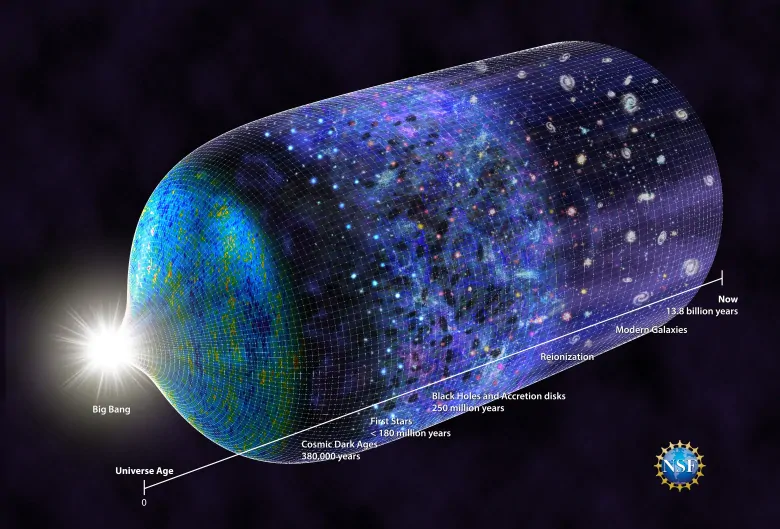
Roughly 13.8 billion years ago, in a moment of rapid expansion, the universe as we know it came to be. At first it was hot and opaque, and then, eventually, dark and cold. After about 400,000 years, stars began to form, as did massive galaxies.
It’s believed that stars in young, massive galaxies like XMM-2599 should have stopped forming when the galaxies were roughly three billion years old. Instead, XMM-2599 was just 1.8 billion years old when it slammed the brakes on stellar formation.
A timeline of the universe. (N.R.Fuller, National Science Foundation)
“At some point in time, this was the best place to make stars, and all of a sudden — a snap of the fingers later — it became the worst place in the universe to form stars,” said Adam Muzzin, assistant professor at York University’s department of physics and astronomy in Toronto.
“It really just defies the logic of what we think about how galaxies form.”
Strange, but true
When astronomers say XMM-2599 is massive, they’re not exaggerating: it is roughly 310 billion times more massive than the sun (in terms of stellar mass). For comparison, our Milky Way galaxy is 100 billion times the mass of the sun.
Though it may be massive, finding XMM-2599 was no walk in the park.
First, astronomers had to identify candidates for these “monster galaxies” in large galaxy surveys, as co-author Cemile Marsan, a postdoctoral science fellow at York explained. She was then part of a team that used the W.M. Keck Observatory in Maunakea, Hawaii, for followup observations.
This image set shows the possible evolution of XMM-2599, from a massive, dusty, star-forming galaxy (left), to an inactive red galaxy (center), and then perhaps turning into a bright cluster galaxy (right). (NRAO/AUI/NSF, B. Saxton; NASA/ESA/R. Foley; NASA/ESA/STSCI, M. Postman/Clash)
In order to merit further investigation, the galaxy had to tick off three boxes: it had to be bright, massive and very distant, something that XMM-2599 definitely was.
A piece of the puzzle
“What’s really exciting for me is, how do these massive things get so monstrous? How is it that they shut off their star formation?” said Cemile Marsan, a post-doctoral science fellow at York and co-author of the study.
“It’s like there’s some party going on and all of a sudden the party’s over.”
“It’s like shooting a fire extinguisher all over the galaxy,” said Muzzin.
But, he added, in order for that to happen, you need a supremely massive black hole.
“If that’s what’s happening with XMM-2599, how do you get a ridiculously big black hole at the centre of that thing? Also, in almost no time at all, since black holes take time to grow as well.”
There will be more followup observations with the Atacama Large Millimeter/submillimeter Array in northern Chile. The astronomers are also hoping to use the James Webb Space Telescope — the planned successor to the Hubble Space Telescope due to launch in 2021 — to take even more precise measurements.
In the meantime, Muzzin said he’s thrilled to be able to look back in time and find another piece of the puzzle that sheds some light onto the beginning of everything we have come to know.
“I mean, you live in this big, beautiful galaxy — the Milky Way — you go outside, you look at it, you think about the fact that we’re these little specks floating around this single star, and you wonder how all this stuff got here,” he said.
“We want to figure out how all galaxies got here.”
To town councillors in Essex, Ont., it sounded like an expensive, if necessary, proposal.
At a public meeting last August, the town’s insurance provider pitched a new type of policy that he said a growing number of municipalities are buying: coverage against cyberattacks.
“By purchasing this layer of protection, you can have a little peace of mind,” Wally McNeilly, of Aon Risk Solutions, told the councillors.
Spurred by reports of criminals hijacking computer networks and demanding payment, more and more local governments and companies are purchasing specialized insurance coverage against these high-tech crimes. However, some security experts warn that insuring against attacks — and, in particular, paying ransoms — is likely to embolden hackers by increasing their confidence they can get paid.
A laptop displays code, part of the Petya strain of ransomware, in Kyiv, Ukraine, in 2017. (Valentyn Ogirenko/Reuters)
In Essex, near southwestern Ontario’s border with Michigan, the insurer offered a $15,000 plan for the remainder of the year, covering a variety of expenses that could be incurred in the event the town’s computer network were infected with malicious code: legal costs, regulatory fees, IT assistance and a ransom payment of up to $1 million.
Some officials questioned the price of the coverage. Considering the additional $5,000 deductible, Coun. Chris Vander Doelen pointed out that, in Essex, a town of 20,000 people, “that’s about a dollar per head.”
Still, council approved the coverage, perhaps fearing what happened in Wasaga Beach, Ont., in 2018. McNeilly described how the town was forced to pay a $35,000 ransom when its network was held hostage, on top of $250,000 in additional costs from the attack, including overtime for staff.
“There’s no industry that’s not picked on anymore when it comes to cybercrime,” he said.
The recent case of an unnamed Canadian company paying a $950,000 US ransom through its U.K.-based insurer has only highlighted the problem further. Other victims, including the Nunavut government and a Prairie-wide insurance firm, have publicly refused to pay a ransom, despite being locked out of their computers, resulting in losses of productivity and, in some cases, data.
Insurance coverage on the rise
In a 2019 global survey carried out for Microsoft and insurance broker Marsh, 47 per cent of businesses said they carry cybercrime insurance, up from 34 per cent in 2017.
Premiums collected by this country’s insurance industry for such coverage have also been growing in recent years, said Ryan Stein, the Insurance Bureau of Canada’s executive director of policy, though he didn’t cite exact figures. He recommends all companies talk to their provider “about their cyber risk and make sure they’re properly covered for it.”
But as the insurance industry makes more money from the policies, criminal networks appear to be profiting, too, by demanding more expensive ransoms.
The Ryuk strain of malware is known to store a ransom note in infected computers. (Thomas Daigle/CBC)
Criminals making more money, too
In the fourth quarter of 2019, the average ransom payment cost $84,116 US — more than double the amount in the previous quarter ($41,179 US), according to Coveware, a Connecticut-based firm that negotiates ransom payments and ensures data recovery.
“The sophistication of the attackers has gone up and they’ve been going after larger and larger companies,” said Coveware CEO Bill Siegel.
He said hackers are now penetrating computer networks and surveilling organizations to gauge their ability to pay, all before encrypting any data.
A group called Maze has even taken to posting a list of its ransomware victims online, threatening to share the firms’ stolen information if they don’t pay up. Multinational construction firm Bouygues was recently targeted with a data dump, months after one of its Canadian offices was compromised by malicious code.
‘They’re completely emboldened’
Security experts have warned that some insurance firms may be too quick to pay ransom — judging that it’s faster and cheaper (and more likely to work) than attempting to manually recover data with technical expertise. The problem is paying only encourages hackers to spread more malware, experts say.
The quick payments have “created a very unhealthy growth pattern in these cybercriminal syndicates … they’re completely emboldened,” Theresa Payton, a former chief information officer in the George W. Bush White House, said in a telephone interview.
Now the CEO of U.S. cybersecurity firm Fortalice Solutions, Payton said she’s seen cases where a company pays the ransom and receives the hackers’ decryption keys as promised, only to discover the tools don’t release all the locked files.
Law enforcement agencies, including the RCMP, generally advise against paying ransom, but they understand that in some circumstances — such as when companies don’t have critical data backed up — an alternative solution can be hard to find. If a ransom is paid, they urge victims to notify police.
Theresa Payton speaks on Capitol Hill during her time as the White House’s chief information officer in 2008. (Manuel Balce Ceneta/The Associated Press)
“If the insurance companies would lock arms with the rest of us” and make efforts not to pay, Payton said, “we could turn the tide.”
Payton doesn’t fault the organizations that feel the need to pay to restore their systems quickly, but she said insurers should agree to avoid paying if at all possible. She also does not discourage firms from buying insurance coverage.
There are some alternatives. For instance, the No More Ransom Project, involving the European police agency Europol and antivirus makers, collects decryption tools and provides them to ransomware victims for free. But that doesn’t always work.
There’s been no indication the town of Essex has been targeted in any cyberattack, or otherwise had to use its new insurance. The municipality’s IT manager didn’t respond to a request for comment.
At the council meeting last summer, Coun. Sherry Bondy summed up the dilemma facing Essex, as well as other towns and companies. She said she didn’t mind paying for the insurance.
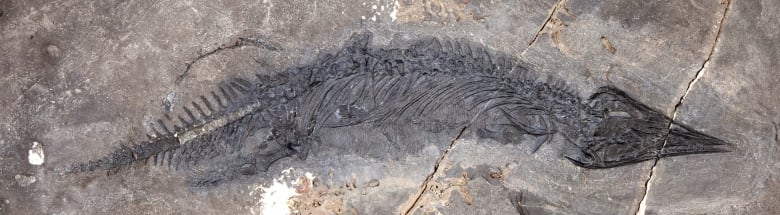
An iguana-like creature with a needle-sharp snout has been confirmed from a fossilized skeleton as a species of the marine reptile thalattosaur previously unknown to science that roamed the coast of what is now Alaska some 200 million years ago.
Dating from the Triassic period and identified from a lone fossil found in the Tongass National Forest in Alaska, the new creature has been named Gunakadeit joseeae, after a Tlingit name for a legendary sea monster, according to an article published on Tuesday in the journal Scientific Reports.
This fossil of Gunakadeit joseeae was found on an island in southeast Alaska. About two thirds of the tail had already eroded away when the fossil was discovered. (Alaska Museum of the North)
It is the only intact thalattosaur fossil ever found in North America, said paleontologist Pat Druckenmiller, director of the University of Alaska Museum of the North and lead author of the study.
“This animal is striking because it’s got this super-sharp pointed snout. Literally, it’s needle-like,” Druckenmiller said, describing the creature as “weird.”
The snout and the fine bones in its throat suggest a reptile that dug into cracks in submerged reefs to suck out food, mostly small crustaceans and squid.
Lucky low-tide find
The fossil was uncovered through a stroke of luck, when an extremely low tide in 2011 exposed the typically submerged rock where it was embedded on an island beach as scientists happened to be surveying the area.
From left, Gene Primaky, Jim Baichtal and Patrick Druckenmiller stand in rising tidewater after the last of the two blocks was removed. Minutes later, the tide submerged the excavation site. (Kevin May/University of Alaska Museum of the North)
Fully separating the fossil from rock took years, said U.S. Forest Service geologist Jim Baichtal, one of the scientists who found the specimen.
Positively identifying it as a new species included a trip by Druckenmiller to China, one of the few places where intact thalattosaurs have been discovered.
That work confirmed what was obvious to those who saw the fossil’s skull and snout in 2011, Druckenmiller said: “We knew right away that it was totally different.”
At the time Gunakadeit joseeae was living, what is now the rugged temperate rainforest of southeast Alaska was a much warmer place — a coastal region only about 10 to 20 degrees north of the equator, Druckenmiller said.
That territory migrated northward, pressing into North America and creating the paleontologically interesting terrain of Alaska’s southeast panhandle.
The new species is named for Gunakadeit, a sea monster of Tlingit legend that brings good fortune to those who see it. (Robert Mills)
The newly identified thalattosaur is the latest among several important paleontological discoveries in the Tongass National Forest.
They include the 1996 discovery of a 10,300-year-old human skeleton in a cave in the southern part of the largest U.S. national forest. Those remains, of a young man with a fish-based diet, contributed to knowledge about people who migrated to North America by coastal routes rather than over the Bering Land Bridge.
Agriculture Ministry officials worried the government’s position on the health risks of Canada’s most widely used herbicide were “contradictory” following a landmark court ruling blaming glyphosate for causing cancer, internal emails show.
In 2018, a groundskeeper in California won a multimillion-dollar judgment in San Francisco State Court after arguing the weed killer, frequently sold under the brand Roundup, caused his cancer.
That case inspired a slew of ongoing lawsuits in the U.S. and Canada. Plaintiffs accuse Monsanto, the corporation behind the chemical, of poisoning them. A spokesperson for Bayer, Monsanto’s parent company, said the herbicide is safe when used as directed, citing more than 100 scientific studies backing that position.
U.S. litigation also triggered a series of emails among Agriculture Canada officials who outlined plans to defend the chemical, according to government records released under access to information laws.
“Recent media coverage of the U.S. court rulings linking glyphosate to cancer cases may increase stakeholder concerns with the safety of glyphosate,” said one internal email in 2019.
In a message with the subject, “OVERVIEW OF THE CHEMICAL ROUNDUP, AND HOW TO COUNTER CLAIMS THAT IT CAUSES CANCER,” an Agriculture Canada official worried the government’s position on its health risks “may appear contradictory.”
“Can we qualify … a bit to say that ‘exposure to glyphosate through regular use is not a carcinogenic risk,'” one official wrote. “Or something like that.”
The internal records underscore a delicate balancing act for governments trying to regulate what Agriculture Canada says is the most widely used herbicide in Canada, and crucial for food production, despite some evidence it causes cancer.
“I can see why they would think their position is contradictory,” Elaine MacDonald from the environmental group Eco-Justice said in an interview after reviewing the files. “The way they have nuanced their writing, they’re not saying it’s not a risk.
“They are being careful in their wording — they know the science is out there on the risk of non-Hodgkin’s lymphoma.”
‘Sustainable farming practices’
A spokesperson for Agriculture Canada said the government’s position is clear: “Glyphosate has been found unlikely to pose a carcinogenic risk to humans.”
“Glyphosate is used globally and in Canada for the control of weeds. It plays an important role in managing weeds under sustainable farming practices,” he said in response to written questions.
Dewayne Johnson reacts after hearing the verdict in his case against Monsanto at the Superior Court of California in San Francisco in 2018. The groundskeeper said he will accept a judge’s reduced verdict of $78 million US against Monsanto after a jury found the company’s weed killer caused his cancer. (Josh Edelson/Pool Photo via The Associated Press)
First sold for agricultural use in the U.S. in 1974 under the brand Roundup, glyphosate is now a staple of modern agriculture.
The chemical helps to promote healthy soils and allows farmers to produce affordable food for Canadians because of increased yields, according to CropLife Canada, an Ottawa-based association representing herbicide producers.
The vast majority of international regulators, including Health Canada, the U.S. Environmental Protection Agency, the European Food Safety Authority and regulators in Japan, South Korea, New Zealand and Australia have affirmed that glyphosate-based products are safe, said a spokesperson for Bayer, which produces the herbicide.
“Farmers and growers have been using glyphosate safely and effectively for more than 40 years,” Bayer’s spokesperson said in response to emailed questions, calling the chemical “foundational to agriculture around the world” and “an essential tool for farmers to deliver crops to markets effectively and sustainably.”
The Bayer logo is pictured at the main chemical plant of German Bayer AG in 2019 in Leverkusen, Germany. The company faces more than 18,000 lawsuits against its subsidiary Monsanto over its glyphosate-based weedkiller Roundup in the United States. Bayer acquired Monsanto for $63 billion US in 2018. (Martin Meissner/The Associated Press)
Bayer said the UN agency’s position is “inconsistent with 40 years of scientific research and the conclusions of leading health regulators worldwide.”
Randall McQuaker from the Toronto-based advocacy group Canadian Association of Physicians for the Environment disputes Bayer’s contention. IARC, he said, came to a reasonable conclusion.
Compared to studies from the U.S. EPA and other government agencies, IARC’s findings relied mostly on public, peer reviewed studies, McQuaker said in an interview.
The conclusion that Roundup is probably carcinogenic was “based more on the real world, the way people actually encounter glyphosate,” he said, “while the EPA looked more at laboratory conditions.”
Ghostwriting the science
During recent California litigation, lawyers unearthed a series of memos showing scientists at Monsanto, the company then producing the herbicide, had ghostwritten academic studies indicating that glyphosate was safe.
These Monsanto memos did not lead to a review of glyphosate by Ottawa because they didn’t introduce new scientific information, according to Agriculture Canada emails.
French activists stand in front of the Paris headquarters of Bayer AG to protest its production of pesticides in March 2019. (Francois Mori/The Associated Press)
Bayer’s spokesperson said the ghostwriting issue only applied to a secondary studies. “These allegations relate to secondary literature review articles sponsored by Monsanto, not original studies or science, and the company’s sponsorship is appropriately disclosed in each article,” she said.
“These allegations do not change the extensive body of science that confirms glyphosate-based herbicides can be used safely.”
McQuaker and other environmentalists said Monsanto’s role in financing health research into the safety of glyphosate underscores the need for more independent scientific inquiry into the chemical’s effects.
Diamond & Diamond, a Toronto-based personal injury law firm behind a class action suit against Bayer on behalf of Canadians who say glyphosate made them sick, declined to comment as the litigation is currently before the courts.
‘Trade implications’
The internal government emails also note how widespread use of the chemical has harmed some Canadian farm exports.
“Consumer concerns with the safety of glyphosate may have trade implications,” according to a government memo from March 2019. “For example, widespread media campaigns in Italy over the safety of Canadian wheat, because of glyphosate residue on shipments … have negatively affected the reputation of Canadian durum in the Italian market.
“In the last year, Italian imports of Canadian durum wheat have dropped approximately 80 per cent.”
Winter wheat is harvested in a field near McCracken, Kan., in 2018. Canada’s wheat exports to Italy have dropped sharply due to concerns over herbicide residue. (Charlie Riedel/The Associated Press)
Agriculture Canada’s spokesperson said those concerns were unique to Italy, and restrictions on Canadian food exports over glyphosate concerns have not impacted any other markets or commodities.
Canada is closely monitoring the situation with Italy and is working with its European counterparts to “determine a constructive way forward,” the spokesperson said, adding that “Italian consumers have enjoyed delicious pasta products made from high-quality Canadian durum wheat” for more than a century.
Eco-Justice’s MacDonald said glyphosate is often used as a drying agent and applied to wheat just before harvest, potentially leading to higher residue levels of the chemical on the crop.
“If people don’t like the thought of glyphosate on their wheat, that’s a fair thing,” she said of Italy’s lost appetite for Canadian grain.