Categories
Tech

Solar Orbiter blasts off to capture 1st look at sun's poles


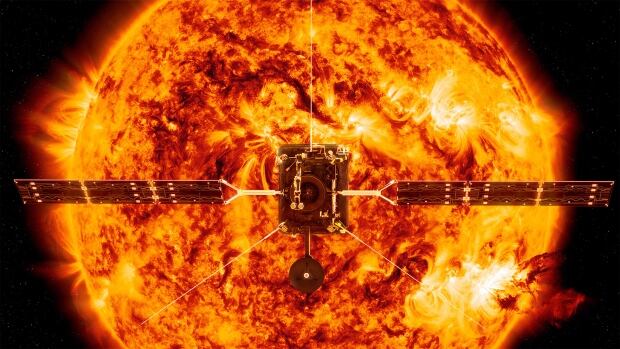
Europe and NASA’s Solar Orbiter rocketed into space Sunday night on an unprecedented mission to capture the first pictures of the sun’s elusive poles.

“We’re on the way to the sun. Go Solar Orbiter!” said Cesar Garcia Marirrodriga, project manager for the European Space Agency. “It’s a fantastic moment … it’s like, well, we’re unstoppable.”

The $2 billion ($1.5 billion US)  spacecraft will join NASA’s Parker Solar Probe, launched 1½ years ago, in coming perilously close to the sun to unveil its secrets.

While Solar Orbiter won’t venture close enough to penetrate the sun’s corona, or crown-like outer atmosphere, like Parker, it will maneuver into a unique out-of-plane orbit that will take it over both poles, never photographed before. Together with powerful ground observatories, the sun-staring space duo will be like an orchestra, according to Gunther Hasinger, the European Space Agency’s science director.

“Every instrument plays a different tune, but together they play the symphony of the sun,” Hasinger said.

Solar Orbiter was made in Europe, along with nine science instruments. NASA provided the 10th instrument and arranged the late-night launch from Cape Canaveral.

Nearly 1,000 scientists and engineers from across Europe gathered with their U.S. colleagues under a full moon as United Launch Alliance’s Atlas V rocket blasted off, illuminating the sky for miles around. Crowds also jammed nearby roads and beaches.

The rocket was visible for four full minutes after liftoff, a brilliant star piercing the night sky. Europe’s project scientist Daniel Mueller was thrilled, calling it “picture perfect.” His NASA counterpart, scientist Holly Gilbert, exclaimed, “One word: Wow.”

NASA declared success 1½ hours later, once the Solar Orbiter’s solar wings were unfurled.

Solar Orbiter — a boxy 1,800-kilogram spacecraft with spindly instrument booms and antennas — will swing past Venus in December and again next year, and then past Earth, using the planets’ gravity to alter its path. Full science operations will begin in late 2021, with the first close solar encounter in 2022 and more every six months.

At its closest approach, Solar Orbiter will come within 42 million kilometres of the sun, well within the orbit of Mercury.

Parker Solar Probe, by contrast, has already passed within 18.6 million kilometres of the sun, an all-time record, and is shooting for a slim gap of 6 million kilometres by 2025. But it’s flying nowhere near the poles. That’s where Solar Orbiter will shine.

The sun’s poles are pockmarked with dark, constantly shifting coronal holes. They’re hubs for the sun’s magnetic field, flipping polarity every 11 years.

Solar Orbiter’s head-on views should finally yield a full 3-D view of the sun, 150 million kilometres from our home planet.

A good look at huge coronal holes

“With Solar Observatory looking right down at the poles, we’ll be able to see these huge coronal hole structures,” said Nicola Fox, director of NASA’s heliophysics division. “That’s where all the fast solar wind comes from … It really is a completely different view.”

To protect the sensitive instruments from the sun’s blistering heat, engineers devised a heat shield with an outer black coating made of burned bone charcoal similar to what was used in prehistoric cave paintings. The 3-metre-by-2.4-metre heat shield is just 38 centimeters thick, and made of titanium foil with gaps in between to shed heat. It can withstand temperatures up to nearly 530 C.

Embedded in the heat shield are five peepholes of varying sizes that will stay open just long enough for the science instruments to take measurements in X-ray, ultraviolet, visible and other wavelengths.

The observations will shed light on other stars, providing clues as to the potential habitability of worlds in other solar systems.

Closer to home, the findings will help scientists better predict space weather, which can disrupt communications.

“We need to know how the sun affects the local environment here on Earth, and also Mars and the moon when we move there,” said Ian Walters, project manager for Airbus Defence and Space, which designed and built the spacecraft. “We’ve been lucky so far the last 150 years,” since a colossal solar storm last hit. “We need to predict that. We just can’t wait for it to happen.”

The U.S.-European Ulysses spacecraft, launched in 1990, flew over the sun’s poles, but from farther afield and with no cameras on board. It’s been silent for more than a decade.

Europe and NASA’s Soho spacecraft, launched in 1995, is still sending back valuable solar data.

Altogether, more than a dozen spacecraft have focused on the sun over the past 30 years. It took until now, however, for technology to allow elaborate spacecraft like Parker and Solar Orbiter to get close without being fried.

Fox considers it “a golden age” for solar physics.

“So much science still yet to do,” she said, “and definitely a great time to be a heliophysicist.”



Source link

Categories
Tech

Saskatoon-based tech team helping people access vital information through cellphone games, hotlines


When Louis Dorval went to Ghana in 2005 as a volunteer, the country was in the midst of a cellphone boom. 

Only one in 10 residents of the west African nation were mobile subscribers, but that was steadily climbing to the two-thirds it’s at today, according to a report by data and analysis firm GSMA Intelligence. 

This piqued the curiosity of Dorval, a 37-year-old who grew up in Montreal and by the time he started at McGill Unversity in 2000 had bought his first cellphone, a Nokia dumb phone. 

“There was very, very little work being done through mobile to help co-ordinate, inform and share information related to development and livelihoods in Ghana despite the fact that over the preceding decades access to mobile phone in Ghana and elsewhere in sub-Saharan Africa had really exploded.”

Seven years later, he would help create Viamo, a social enterprise with Canadian roots based on harnessing that the availability and popularity of cellphones in certain developing countries to disseminate educational, everyday information some people otherwise have little access to.

He wouldn’t do it alone, though.

Mark Boots is Viamo’s co-founder and chief technical officer. He’s a Saskatchewan native who met Louis Dorval through volunteering with Engineers Without Borders Canada. (Chanss Lagaden/CBC)

Mark Boots grew up in Saskatchewan and completed a PhD in physics and engineering at the University of Saskatchewan. He and Dorval had volunteered with Engineers Without Borders Canada in Canada and Ghana respectively. They connected through the organization after Dorval had worked for a global software firm in Silicon Valley and was looking to start his own company. 

Together, they launched Viamo in Kumasi, Ghana, in 2012 along with Ghanaian engineers. They first decided to create software that used SMS messages to send out surveys and share information with people. However, they quickly found that these text messages weren’t engaging or getting responses from rural populations, especially women.

So, the company added a voice interactive response (IVR) channel — the kind of technology that has been around since the 1970s that you might encounter if you call a credit card company and are asked to choose from an automated menu. It was more successful. 

Viamo hosts focus group discussions to understand how women access information through their mobile phones in order to improve user experience on the 3-2-1 Service. This one took place in Mozambique. (Viamo)

One of Viamo’s first partnerships was with a Ghanaian organization trying to improve health for pregnant women in rural areas. They piloted a program where women could receive a weekly call in their own language informing them about their baby’s development and how to take care of them. 

“Here in Canada, for example, when my wife was pregnant, obviously it’s fairly easy for us to get to the doctor’s office and have checkups. It’s also easy to go on websites like www.babycentre.ca and get a whole ton of information that helps you understand what’s going on with your first pregnancy,” said Dorval. “Those kinds of options aren’t available for a young mum in a rural village in Ghana, for example.”

One of Viamo’s largest-scale innovations and a real game-changers came after they repurposed IVR and developed the “3-2-1 Service.” Boots described it as “Wikipedia Lite but for people who have basic cells, and might not even be literate.” Viamo partners with local mobile phone operators to provide on-demand information on a range of topics from farming to trafficking simply by having people call a toll-free hotline.

In some countries like Rwanda, 3-2-1 is reaching more unique users than Facebook. In Mali, there are more than 2,000 people listening to the 3-2-1 content at any given moment, for most of the day. (Chanss Lagaden/CBC)

Wanji Games (“Wanji” means “what” in the Ugandan language Luganda) are delivered through the 3-2-1 Service in partnership with local cell operators. The games are based on a “choose-your-own-adventure” format. Callers dial a number and are presented with a series of scenarios. Using their phone’s buttons, they are forced to make a decision. Any wrong choice can affect their “fate,” ending the game. 

“I saw a message on my phone so I tried it and I had much information about family planning, cervical cancer, weather, agriculture,” said Rachael Kabeene, a 30-year-old Ugandan primary school teacher and mother who recently played the games.

Rachel Kabeene, a primary school teacher and mother from Kampala, Uganda, has used the Wanji Games. (Amy Fallon)

One of Viamo’s most recent projects in Rwanda involved delivering remote training for the country’s health ministry in the form of a four-week curriculum on mental health issues, often a taboo topic in Africa, using IVR technology to send phone calls with interactive training content and quizzes. There are over 55,000 community health workers across the east African country, and to bring them all together physically for the training would have been expensive.

Lauren Frank, an associate professor of communications at Portland State University, has studied the games in Cambodia (preventing domestic violence) and Uganda (farming). She said “in one experiment, callers who played the game one or more times, had more confidence in their abilities and were more likely to plan to change their behaviour than those who did not play the game. Our results suggest the Wanji game can be an effective social and behavioural change intervention.” 

In 2019, Viamo’s 3-2-1 Service reached more than six million people across 16 countries through Wanji Games and the other content on it. 

Viamo conducts an interview with a 3-2-1 user in Nigeria. His input is helping Viamo make improvements to the service’s user experience. (Viamo)

“One thing that’s groundbreaking about the service is that through our partnerships with telecom operators, we’ve been able to find a model where it’s free for people to access the service, at least many times per month, allowing it to reach a major scale,” said Boots. 

In some countries like Rwanda, 3-2-1 is reaching more unique users than Facebook. In Mali, there are more than 2,000 people listening to the 3-2-1 content at any given moment, for most of the day.

That reach means expansion for Viamo, too. It now has a total 140 global employees, with 12 in Saskatoon, and three more on the way to the city from Ghana, Rwanda and Madagascar.

Their future vision is to be serving 100 million people per year. They hope to do this with IVR services that offer interactive games, information as stories, dynamic content, recommendations based on what people previously listened to, and eventually AI experiments to let people browse by asking questions in a natural language.


Source link

Categories
Tech

A trillion trees will not be enough if emissions continue to rise


During his State of the Union Speech, President Donald Trump announced that the U.S. will join the Trillion Tree Initiative to fight climate change. Of course, during the same speech, he boasted how the U.S. has increased production of oil and natural gas.

You might have heard about the idea of a trillion trees. Several groups, including the World Economic Forum, traditional environmental groups and youth activists have jumped on the bandwagon. The idea is a global campaign to encourage governments, businesses, civic organizations and individuals to join together in a massive climate-change focused global reforestation effort.

A study published last summer in the journal Science suggested that the Earth had the potential for reforestation that could absorb more than a third of all the carbon humans have emitted since the industrial revolution. While the study was criticized in the same publication in the fall for significantly overestimating the carbon-sequestering potential of reforestation, there is no doubt that having a trillion extra trees on the planet would be beneficial in many other ways.

Trees provide habitat for animals like insects and birds, encourage forest diversity, prevent erosion, help conserve water, and make for great recreational areas. The shade of a tree canopy can reduce the need for air conditioning in urban areas.

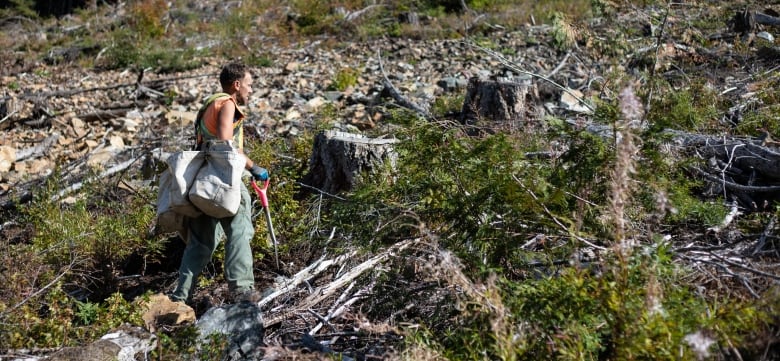
Tree planting on a clearcut in British Columbia. (Tina Lovgreen/CBC)

Unfortunately, one drawback of the tree planting scheme is that it takes 10 or 20 years for trees to grow and absorb enough carbon to make a difference. Meanwhile, worldwide greenhouse gas emissions continue to grow every year. 

President Trump, of course, also pulled the U.S. out of the UN Paris Accord, which is a commitment to reduce emissions. So while announcing the tree planting campaign sounds like the president is going green, his actions speak otherwise. It’s like pouring water onto one side of a fire and adding gasoline to the other.  

And speaking of fire, as we are seeing in Australia, California and Canada’s north, wildfires are bigger than ever thanks to a warmer climate, which means any newly planted forest could be at higher risk of fire in the future, releasing sequestered carbon back into the atmosphere..  

A reforestation assistant measures a newly-planted tree in a field damaged during illegal gold mining in Madre de Dios, Peru, on March 29, 2019. (AP Photo/Rodrigo Abd)

Tree planting seems like an easy solution to climate change, but without a reduction in fossil fuel emissions, the effort is a drop in the bucket. It cannot be used as a licence to continue business as usual, or a cover to make it look like governments are going green while continuing to cultivate the source of the problem.

In Canada we’ve made efforts to reduce greenhouse emissions, largely through phasing out coal fired generating plants. But we are also planning to increase our exports of oil and gas through pipelines, which will ultimately add to global carbon emissions when burned by other countries. 

This conundrum is a demonstration of the long standing conflict between short-term economic gain and long-term environmental sustainability. It is not an easy conflict to resolve because jobs are at stake. However, new jobs are emerging in the rapidly growing clean energy sector, which is one of the fastest growing sectors in the economy.

The transition away from fossil fuels will not be easy, but it won’t be impossible either. If we are going to cultivate new green trees, we have to cultivate green technology at the same time. 


Source link

Categories
Tech

Federal government warning of voter coercion, foreign election interference through private messaging services


The federal government is worried about the risk of voter coercion and foreign election interference through private messaging services — a concern that could pit the right to privacy and free expression against Canada’s election laws.

The warning was tucked into a briefing note prepared for President of the Privy Council Dominic LeBlanc about ongoing issues with social media platforms. Private messaging includes Facebook and Instagram message services, WhatsApp groups and WeChat channels.

“As the platforms move towards private/encrypted conversations as the foundation of how they work, concerns have been raised about the capacity of the tools used for private communications to potentially undermine [Canada Elections Act] provisions, or to facilitate the potential for voter coercion or foreign interference,” says a briefing note, obtained by CBC News through access to information.

“This will introduce difficult considerations, such as the trade-offs between respecting the privacy of private communications and protecting the integrity of the electoral regulatory regime. There will, additionally, be significant challenges for enforcement.”

The briefing note’s sections on recommendations and implementation are blacked-out in the copy obtained by CBC News, since they’re considered advice to a minister.

The note flags questions about “whether and how to intervene in a quickly changing technological environment” and “how to apply timeless democratic principles (e.g., freedom of expression) in this environment” as ongoing issues for LeBlanc, whose role at the cabinet table includes protecting democratic institutions.

A spokesperson for LeBlanc didn’t answer direct questions about what the government plans to do.

“Our government continues to work with social media platforms, including those with messaging systems, and Elections Canada to ensure the integrity of our democratic processes. Canadians have a right to engage in private conversations with their friends and family about politics without limitations or restrictions,” said Brandan Rowe in an email.

“We continue to learn from experiences around the world, where different platforms are being used to influence election outcomes.”

‘Tricky terrain’

Taylor Owen is the chair of media, ethics and communications at McGill University. He said the massively popular chat app Whatsapp is at the centre of this controversy.

“In part because in many countries, particularly emerging economies, WhatsApp is the primary mode of communication,” he said.

“It has been shown to have been abused quite widely in a number of elections and even to incite violence in countries around the world, where messages that were shared through WhatsApp groups spread very quickly and had fairly serious consequences.”

Whatsapp — which is owned by tech giant Facebook — began cracking down after rampant disinformation campaigns in India triggered lynchings and other violent acts. With about 200 million users, India is WhatsApp’s largest market.

President of the Queen’s Privy Council for Canada Dominic LeBlanc responds to a question in the House of Commons February 4, 2020 in Ottawa. (Adrian Wyld/Canadian Press)

Whatsapp users can now only forward a message five times — a change the company said is meant to combat “misinformation and rumours.”

Owen said the Canadian government showed it took disinformation campaigns seriously before the election when it reformed the rules on advertising. Now, he said, it’s confronting “the most difficult challenge in this space.”

“What do you do with information that is made private, either by the choice of the users or by the technology itself?” he said.

“We haven’t had a set of policies that have really gotten that issue yet. Most governments have just dealt with the much easier issues around regulating advertising, better privacy protections, limiting spending in the digital space.

“That is the low-hanging fruit that the Canadian government has already implemented and now, as this document signals, they’re heading into the much more tricky terrain.”

Backdoor debate reignited in the U.S. 

South of the border, U.S. Attorney General William Barr reignited a debate on encryption when he appealed to Apple to help unlock iPhones linked to a December naval base shooting in Pensacola, Fla.

His comments set the stage for another fiery debate between law enforcement and manufacturers over the ethics of installing so-called “back doors” to allow law enforcement agencies to decode encrypted data after obtaining search warrants.

Apple has refused, saying in a media statement that “there is no such thing as a backdoor just for the good guys.”

Asked by CBC News whether it would consider introducing backdoor access through legislation, LeBlanc’s office didn’t reply.

Owen said the things the government would have to do to break into “end-to-end encrypted communication … would be so dangerous to the architecture of the internet that depends on that kind of encryption that it is probably not worth entertaining.

“But some sort of regulation or engagement with content that happens in much wider semi-private channels, even if it’s perhaps auditing content in that, or some degree of oversight, is something that could probably be done.”

Under LeBlanc’s predecessor Karina Gould, the Liberal government amended the Canada Elections Act in 2018 to force digital platforms to maintain a public registry of partisan and election advertising leading up to and during the 2019 election campaign.

In the leadup to the election, the government also unveiled what it called a “Declaration of Electoral Integrity” which asked online platforms to address attempts to disrupt the upcoming federal election.

In the days immediately after the federal election, government officials said they did detect attempts to spread misinformation and disinformation during the election campaign — but not at a level high enough to trigger a public warning.


Source link

Categories
Tech

Wood highrises: 2 environmental benefits for the price of 1


Hello, people! This is our weekly newsletter on all things environmental, where we highlight trends and solutions that are moving us to a more sustainable world. (Sign up here to get it in your inbox every Thursday.)

This week:

  • Wood highrises to shoot up thanks to new building codes
  • One business guru thinks we’re seeing the ‘death knell’ of oil stocks
  • Does Canada have a ‘moral and legal obligation’ to allow climate migrants?

Wood highrises to shoot up thanks to new building codes

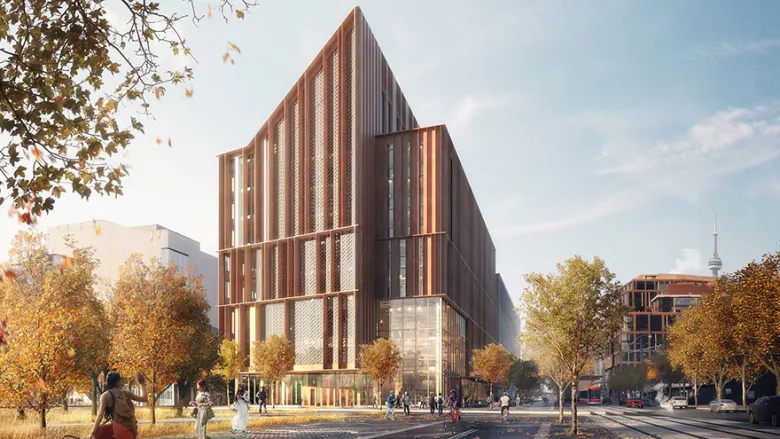
(George Brown College)

Tall towers have defined cities as “jungles” of concrete and glass. But what if we built highrises out of wood instead?

Proponents say that could have two benefits:

A five-storey residential building built with wood can store up to 180 kilograms of carbon per square metre — three times more than a high-density forest with the same footprint, according to a new study from U.S. and German researchers.

Right now, just 0.5 per cent of new buildings are constructed with timber. But if we pushed that up to 10 per cent, those buildings could store 10 million tonnes of carbon per year. And if 50 per cent of buildings were built with wood, they could store up to 700 million tonnes of carbon a year, the researchers estimate. 

Not only that, but building with timber would cut emissions from steel and cement manufacturing by half.

So why haven’t we been doing it?

One problem is that the most common wood product used in modern construction until now — the two-by-four — doesn’t have the strength or versatility needed for constructing tall buildings, said Anne Koven, director of the Mass Timber Institute, which is based at the University of Toronto.

But in the 1990s, researchers in Austria and Germany invented cross-laminated timber (CLT), which uses adhesives to bind smaller pieces of wood into sturdy, fire-resistant panels and beams. “It’s an engineered wood product for building on the scale of cement and steel,” Koven said.

Designers, engineers and architects, including Russell Acton of Acton Ostry Architects in Vancouver, saw that and similar new products as an opportunity. “It was kind of like, now that we have engineered wood and we have an environmental interest, why not explore mass timber to get it back in use?” Acton said.

There was also another barrier: the maximum height for most wood buildings allowed by building codes in Canada was six storeys. Until now.

Acton and his team got a special exemption to build Brock Commons Tallwood House, an 18-storey student residence at the University of British Columbia and the tallest wood building in the world when it opened in 2017.

Since then, some provinces — most recently Alberta — have changed their building codes to allow highrises of up to 12 storeys. When it’s revised later this year, the federal building code will also allow that height.

Across Canada, there are plans to build more wood highrises, from 12-storey condo projects in Victoria and Esquimalt on Vancouver Island to 30-storey wood towers in Toronto proposed by Google as part of its Sidewalk Labs development.

Acton’s firm is working on the Arbour, a 10-storey building slated for George Brown College in downtown Toronto (see photo above).

Despite the budding interest, Acton warns that builders haven’t yet worked out the “most economical” configurations for towers made of wood. For example, Brock Commons in Vancouver cost about seven per cent more than a similar building of steel and concrete.

“Everybody’s doing it for the first time,” Acton said. “It’s in its infancy.”

Emily Chung


Reader feedback

Got something on your mind? Let us know.

Old issues of What on Earth? are right here.


The Big Picture: The fall of oil stocks

Sometimes, a moment of television can seem to crystallize a broader sentiment. Such was the case last Friday, shortly after U.S. oil titans Exxon and Chevron released their fourth-quarter earnings reports. Profits for both companies had dropped from the previous year. This prompted Jim Cramer, a former hedge fund manager and an influential and notoriously plain-spoken CNBC personality, to declare that oil stocks were in the death knell phase.” The quip seemed to catch the segment’s anchor by surprise, but Cramer explained himself. “We’re starting to see divestment all over the world. We’re starting to see big pension funds say, ‘Listen, we’re not going to own them anymore.… The world has turned on [oil stocks]. It’s actually happening kind of quickly.” This came even before news arrived that fears surrounding the coronavirus had dented oil demand in China by three million barrels a day, or 20 per cent.

(CNBC)

Hot and bothered: Provocative ideas from around the web

  • The unveiling of the Tesla Cybertruck in November and an ad for a battery-charged Hummer during Sunday’s Super Bowl suggest that electric vehicles are moving beyond their unassuming, urban-friendly image to “eco-beasts.” This may be a way to convince skeptical Americans between the coasts to consider buying an EV — or at least that’s what this New York Times column argues.
  • Solar panels that work at night? Yes, someone’s developing them. The scientific explanation of “nighttime photovoltaic power” would require significantly more space than we’re allotted here, but this article helps make sense of it.

Does Canada have a ‘moral and legal obligation’ to allow climate migrants?

(Luis Tato/AFP/Getty Images)

A landmark ruling by the United Nations that could pave the way for future climate migrants may force the Canadian government to rethink its conditions around refugees and asylum seekers.

On Jan. 20, the UN Human Rights Committee stated governments must now take into account the climate crisis when considering the deportation of asylum seekers

The non-binding UN ruling involves Ioane Teitiota, from the Pacific country of Kiribati, who brought a case against New Zealand in 2016 after authorities there denied his claim of asylum as a climate refugee.

The UN committee upheld New Zealand’s decision to deport Teitiota, saying he did not face an immediate risk if returned. But committee expert Yuval Shany said “this ruling sets forth new standards that could facilitate the success of future climate change-related asylum claims.”

Currently, there are no specific provisions for people seeking asylum on the grounds of climate change under Canadian immigration and refugee law. 

Mitchell Goldberg, former president of the Canadian Association of Refugee Lawyers, said that if Canada wants to be able to “look itself in the mirror,” the government will need to take urgent policy and legislative action in order to account for the “very threatening new reality” of forced migration as a result of climate change.

Elizabeth May, the former Green Party leader, said, “we are going to have climate refugees” and that it is incumbent on Canada to do something.

According to the Internal Displacement Monitoring Centre, 17.2 million people worldwide had to leave their homes in 2019 because of disasters exacerbated by climate change.

Goldberg said that while the UN ruling was “very encouraging” and “long overdue,” many countries, like Canada, the U.S. and those in the EU, will try and ignore it. It had been “notoriously hard” to update the UN’s refugee convention, given that the “rich countries of the world” have been against any expansion and have tried to limit its provisions, Goldberg said.

In a statement to CBC News, Immigration, Refugees and Citizenship Canada (IRCC) said the Canadian government actively monitors the implications of climate change on migration and displacement of people. 

“Climate change is one of the greatest global challenges of our time…. Developing countries, particularly the poorest and most vulnerable, are the hardest hit,” IRCC spokesperson Shannon Ker said. “In the case of people displaced due to a sudden onset weather event or a natural disaster, IRCC has in the past expedited applications already in the system, and has also extended temporary resident visas for those already in Canada.”

However, IRCC did not state if the ruling would impact Canada’s definition around what constitutes an asylum seeker.

Chiara Liguori, policy adviser for Amnesty International, said governments’ tendency to resist redefining refugee definitions is a result in part of how difficult it is to identify climate change as a specific reason for displacement.

“The reasons why people move are interlinked, and determining this objectively is hard,” Liguori said. “There is also an issue of political will.”

But she said that the climate crisis will trigger more “human rights impacts on the lives of people,” especially those living in developing countries.

May said an increase in climate migrants to Canada could be beneficial to rural areas that have experienced depopulation, and could provide a much-needed economic boost.

“It’s not going to happen all at once, but is going to happen soon enough and governments — both federal and provincial — need to think about how we plan ahead and have adequate infrastructure to make this as positive as possible in unhappy circumstances.”

Adam Jacobson


Stay in touch!

Are there issues you’d like us to cover? Questions you want answered? Do you just want to share a kind word? We’d love to hear from you. Email us at whatonearth@cbc.ca.

Sign up here to get What on Earth? in your inbox every Thursday.

Editor: Andre Mayer | Logo design: Sködt McNalty


Source link

Categories
Tech

Dubious screenshot claims Chinese website published 'real' coronavirus death toll


A screenshot purportedly showing the real death toll of the coronavirus in China — putting it over 80 times higher than the official number — has gone viral. 

However, such screenshots, taken from the social media site QQ, are easily fakeable by anyone using a standard web browser. And, a public health official says, such high numbers at this point are likely a hoax. 

Rumours have been swirling online that the Chinese government is hiding the actual extent of the coronavirus outbreak, which took root there and is now spreading worldwide.

QQ is an instant messenger, owned by the Chinese media company Tencent, that includes a news page. It counts around 900 million active users and has an “epidemic situation tracker” that reports real-time data of known coronavirus cases and deaths across China from over 170 sources, according to Tencent.

On Sunday, a screenshot of the tracker began spreading on Chinese social media. It was said to have captured the accidental release of the “real death toll” — 24,589, far above the roughly 300 then recognized by the Chinese government. 

Likely a hoax

According to Dr. David Fisman, a professor of epidemiology at the University of Toronto and an infectious disease expert at Toronto Western Hospital, those numbers don’t reflect what he and his colleagues are tracking.

“We know enough about this that we can basically call B.S. on some scenarios,” he said.

Because people outside of China are also getting sick, Fisman says public health officials can track how the virus spreads, independently of numbers released by China. 

Fisman and epidemiologist Ashleigh R. Tuite modelled its spread and published their research in the journal Annals of Internal Medicine.

“Based on what we think is going on, it would be very hard to get to 200,000 cases, or whatever is in the Tencent screenshot, and 25,000 deaths,” he said. “There’s really no reason to embellish the seriousness of the situation, unless you have some ulterior motive, which I couldn’t begin to speculate what that could be.” 

He cautions, though, that mathematical models don’t necessarily represent the situation on the ground, and that the number of cases will grow in the future, especially as public health agencies get better at detecting and reporting them.

Easily faked

The screenshot was first picked up by NTDTV, a U.S.-based, Mandarin-language news organization that’s highly critical of the Chinese government. It then made its way onto the Taiwan News website in English — where it was described as the accidental release of the real numbers — before exploding on Western social media. On Thursday morning, British tabloid The Daily Mail ran a story on the screenshot, garnering some 8,000 shares on Facebook in a few hours.

Users and media outlets speculated that a bug or coding error might have accidentally showed the “real figures.” Others said that a whistleblower might have been trying to warn the world. 

However, it’s easy to produce that screenshot using a feature present on most modern web browsers, which lets a user with a bit of know-how change the numbers displayed in the tracker. In a few seconds, CBC News was able to create a near-identical screenshot showing a massive death toll.

In just a few moments, CBC News was able to recreate the screenshot with artificially inflated numbers. It’s almost identical to the version circulating online. (CBC)

This screenshot has not been altered in any way. It is a real screenshot of the site, but the numbers have been manipulated using a browser tool. These numbers did not show up on other users’ computers, only on the computer used to change the figures. That means anyone could alter the tracker to display much lower numbers, higher numbers, or even text instead.

It’s important to note that only one copy of the screenshot with 24,589 deaths exists. If QQ had the higher death toll, even for just a few minutes, to its 899 million users, one would expect many different screenshots of the same figures to exist. 

Screenshots of QQ’s website are therefore not definitive proof that those numbers were ever displayed for all to see on the website. And no archived version of the site exists showing the higher numbers, despite the fact that multiple archived versions of the site are available online. 

In a statement to CBC News, Tencent condemned the screenshots, which it called “unscrupulous behaviour.”

“Unfortunately, several social media sources have circulated doctored images of our ‘Epidemic Situation Tracker’ featuring false information which we never published,” the company said. 

“Tencent does not condone the dissemination of inaccurate information and fake news especially during this sensitive period.”

Using simple tools, CBC News was able to make it seem as if the epidemic tracker was displaying text, without changing what was actually on the site. (CBC)


Source link