Categories
Tech

'First time we've heard of this': Wide fissure opens on Arctic sea ice


In about 24 hours last week a natural phenomenon near Cambridge Bay, Nunavut, developed from a minor inconvenience into a potentially life-threatening hazard.

It’s not unusual for underwater currents in the Queen Maud Gulf, south of Cambridge Bay, to cause small fissures in sea ice. But last week a fissure opened that was large enough to swallow a snowmobile and rider.

Angulalik Pedersen said everyone he’s talked to in Cambridge Bay says they’ve never before seen an opening like this in the sea ice in the area. (Submitted by Angulalik Pedersen)

The fissure was 15 to 20 kilometres long and up to 7.5 metres wide at points, according to Angulalik Pedersen, who works with Cambridge Bay Ground Search and Rescue.

“This is the first time we’ve heard of this,” Pedersen said last Thursday. “There’s usually a lead there but you know, it’s about a foot wide, or two feet wide, and it’s still frozen so you can cross safely. But in the last 24 hours it’s widened out to 20, 25 feet.”

A lead is a channel of water through an ice field or floe.

Pedersen said the ice around the fissure appeared to be as thick as he might have expected.

“From what we saw pushed up on the edges it was four to five feet thick, so normal thickness for that area I guess.”

It’s one of our main snowmobile highways.– Angulalik Pedersen, Cambridge Bay Search and Rescue

Pedersen suspects strong underwater currents in the constriction between the Queen Maud Gulf and the Dease Strait were to blame. It’s a stretch of sea ice used by community members to reach mainland Nunavut from Cambridge Bay, on Victoria Island.

“It’s one of our main snowmobile highways,” Pedersen said. He estimates that up to 50 different parties make return trips every week this time of the year, with some making multiple trips.

Long-time community members surprised

“Our main concern was a lot of the hunters … still down on the mainland,” Pedersen said last week. “They don’t know about this.

“We got the word out as soon as we heard here in the community and we put out the maps … But our concern was those that don’t have contact with the community.”

This satellite image shows open ice near Cambridge Bay in purple. The section outlined in yellow is the new opening that formed last week. (Aivgak Pedersen/Cambridge Bay News/Facebook)

Pedersen said he and others went out onto the ice to set up signs directing unaware travellers away from the open water. He said the detour was about 12 to 15 kilometres long.

Pedersen, who’s lived in Cambridge Bay for about five years and has never seen the ice behave like this before, said he’s since talked to other community members about the opening. Long-time community members were as surprised as Pedersen about the event. 

Calvin Pederson was with Angulalik Pederson when they investigated a large fissure in Arctic sea ice near Cambridge Bay, Nunavut. (Submitted by Angulalik Pedersen)

“Everyone I’ve talked to has said the same thing…. Elders are saying the same thing — they haven’t seen that before in this area.”

On Tuesday Pedersen said the fissure remains, although it moves around a bit depending on the winds.

“Hunters have been using our markers,” Pedersen said. “People are still going down to the mainland and coming back. But the ice is still in the same condition.”

Pedersen said there haven’t been any incidents with travellers, but quick action last week was necessary.

“If somebody didn’t see this, or the signs weren’t there, or somebody didn’t know, they literally could have driven straight into it because with the flat light we have here right now, you can’t tell the difference.

“You jump off of a ledge and into the water … you don’t see it until you’re over it.”



Source link

Categories
Tech

How social media platforms are fighting coronavirus misinformation


The novel coronavirus, COVID-19, has put pressure on social media platforms to try to deal with floods of misinformation.

Even getting a handle on the size of the problem is tricky because while social platforms are publicly keen to tackle the problem, they’re less forthcoming with numbers that might show how much false information is circulating and how they’re working on the problem.

It’s clear that coronavirus is a hot topic. In a blog post on Jan. 29, Twitter revealed it had seen over 15 million tweets on coronavirus over the previous four weeks. A brief look at Google Trends shows that coronavirus searches began to grow in Canada around Jan. 18 and spiked on Jan. 31, though it’s not possible to determine exact numbers. 

One way to get an idea how much false and misleading information is circulating is by looking at what the fact-checkers are facing.

An internal spreadsheet compiled by the International Fact-Checking Network documents over 370 debunks done by fact-checkers and journalists around the world since Jan. 22 on coronavirus alone. The IFCN was started in 2015 by the Poynter Institute, a non-profit journalism training organization, and brings together fact-checkers around the world to share information and establish best practices.

Louis Baudoin-Laarman, a fact-checking journalist with the wire service Agence France-Presse who focuses on Canada and the U.S., says he estimates the wire service has already done between 30 and 40 debunks around the world in just the past two weeks. 

AFP is one of the third-party fact-checkers partnered with Facebook, which means once an AFP journalist has written a story and flagged that a particular piece of information is false to Facebook, the platform will take steps to limit that information’s spread and to surface correct information instead.

Louis Baudoin-Laarman is a fact-checking journalist who works for Agence France-Presse. (CBC)

Baudoin-Laarman says he finds that COVID-19 misinformation comes in four main categories: false information about cures, false information about where new cases are being discovered, images or videos purportedly of people who are sick or even literally falling over from coronavirus, and the origin of the virus.

“But you know compared to the stuff that we see in the U.S. or in France I would say it’s better in Canada,” said Baudoin-Laarman, who noted Canadians might be more likely to stop before sharing something of dubious origin.

Removing content 

In a blog post on Jan. 30, Facebook noted it would begin to remove content containing conspiracies or false claims that had the potential to cause physical harm to users, like incorrect medical information. When contacted by CBC News, a Facebook Canada spokesperson was unable to reveal any figures about how much content may have been removed. 

In Twitter’s Jan. 29 blog post, the service noted it had taken steps to ensure the platform was protected from “malicious behaviours” and that it would remove accounts engaging in those behaviours.  

The most high-profile instance came when Twitter permanently suspended the account of Zero Hedge, a far-right site that purports to share finance and economic information, for circulating a theory blaming one Chinese scientist, without evidence, for creating COVID-19.

Buzzfeed reported that Zero Hedge had posted the personal contact information of the scientist online, a practice known as doxxing, and encouraged others to get in touch.

Twitter hasn’t revealed how many accounts it may have banned. A week after the coronavirus post, Twitter also announced it would remove or label deepfakes — videos altered using AI to make it seem as if someone said or did something they didn’t — and other deceptively altered content that could cause harm. (Facebook announced at the start of January it would ban deepfakes.)

Google and YouTube did not provide information about removing content or altering search results but did provide information about a special search alert set up for the novel coronavirus.

An image from the World Health Organization, debunking claims that eating garlic can protect people from contracting COVID-19. (World Health Organization)

Partnerships with health organizations

Facebook, Twitter and Google have prioritized links, pop-ups or search results directing users to information from official health partners like the World Health Organization and the Public Health Agency of Canada.

The WHO itself has a page dedicated to myth-busting claims about the virus. Some of the claims on the WHO site include whether hand dryers can kill the virus (they can’t), if it’s safe to get a letter or package from China (yes) and if putting sesame oil on your skin will protect you from coronavirus (no). 

When Canadians search Twitter in either official language for coronavirus information, the first result they’ll see is a tweet from Dr. Theresa Tam, Canada’s chief public health officer, directing users to a page with up-to-date health information. 

Anna Maddison, a spokesperson for Public Health, told CBC News that the agency worked with Twitter in May 2019 on a  #KnowTheFacts notification to direct Canadians to factual information on vaccines.

“The government of Canada applauds efforts by social media and technology companies to increase access to evidence-based information on their platforms,” Maddison wrote in an email. 

On YouTube, Instagram, and Facebook, users who search for coronavirus information may see search results or pop-ups directing them to the World Health Organization.

An example of a flag YouTube is attaching to coronavirus videos. The tag gives viewers information about the organization and links to a Wikipedia page with more information. (YouTube)

However, Facebook still may surface information that is less relevant to users. A recent search by CBC News included results from news organizations, but also links to an event listing called ‘Carnaval Coronavirus’  Brazil that appears to be a joke, and a link to a public health event in Sweden.

On Instagram, users may first be directed to accounts that purport to aggregate coronavirus news but aren’t associated with any media organization, or even virus meme accounts, without seeing a pop-up directing them to the WHO.

On Google, users first see recent news related to COVID-19 but are also directed to the World Health Organization for more.

What you see when you search for coronavirus:

On Google:

Google’s search liaison, Danny Sullivan, announced on Twitter on Jan. 30 that the search giant had put in an SOS Alert on coronavirus searches. The alert surfaces the latest news on the topic as well as relevant local news. It will also link to safety tips and health information. 

A look at Google Canada Trends shows searches for coronavirus started around Jan. 18 and spiked at the end of January, though it was not possible to determine exact numbers. 

On YouTube:

Underneath coronavirus videos, YouTube now may include a disclaimer about the media organization and a link to Wikipedia, or a link to the World Health Organization’s information page about coronavirus.

For example, under a CBC News video, there’s a note that the organization is a Canadian public broadcaster, while a CGTN video is accompanied by a note saying it is funded “in whole or in part by the Chinese government.” 

On Facebook:

Facebook says it limits information flagged by third-party fact checkers as false, and instead shows the correct information from the fact-checkers. Facebook also says it sends notifications to users who have shared or are trying to share the content, to let them know it has been fact-checked.


On Instagram:

Facebook says it is blocking or restricting hashtags used to spread misinformation on Instagram. And, when users search for coronavirus, they may see a pop-up directing them back to the World Health Organization. 


On Twitter:

Canadians searching Twitter in both French and English for coronavirus will see is a tweet from Dr. Theresa Tam, Canada’s chief public health officer, directing users to a page with up-to-date health information.


On Reddit: 

A thread started on Jan. 31 from the subreddit Ask Science was featured on the main page of Reddit, helping users find information about the novel coronavirus. The thread has since been moved off the main page but is still available at the top of the Ask Science page.

A spokesperson for Reddit says one subreddit has been quarantined related to coronavirus misinformation. A quarantine means the page won’t show up in search results, and when users to try access it directly, they’ll be shown a warning message.


Source link

Categories
Tech

How Canadian farmers can go from climate change polluters to a key part of the solution


After trudging through the thick layer of snow blanketing his farmland, Brent Preston shovels some aside and begins digging into the soil. 

Under the snow, the ground is unexpectedly green, with a medley of peas, sunflowers, clover and oats alive and thriving in the dead of winter.

“One thing we like to say is: there’s never any bare soil in nature,” Preston said, dusting the snow off a chunk of earth in his hands.

“The more diversity you have, the healthier the soil is going to be.”

While the plants are alive, Preston has no intention of ever harvesting them. When the growing season arrives, he will plow them back into the soil, making way for the salad greens, spinach and cucumbers he produces at his organic farm in Creemore, Ont.

It’s a practice known as cover cropping, an ancient but now uncommon technique in which crops are planted during the off season to keep soil healthy and active.

WATCH: Brent Preston explains how cover crops keeps soil healthy in winter

Brent Preston, a farmer in Creemore, Ont., is calling for major changes to make farming more environmentally friendly and give his colleagues a larger voice in climate policy. 0:42

Critically, cover crops also allow the land to extract harmful carbon from the atmosphere. That ability could be a powerful tool in the fight against climate change, which farmers like Preston call a pressing existential threat to Canada’s agricultural industry and the health of the planet.

“We’ve realized that doing it just on our little farm isn’t going to have enough of an impact,” Preston said. “There are thousands of other farms like ours across the country.”

Preston is now part of a group called Farmers for Climate Solutions, which intends to promote environmental practices while also giving farmers a stronger voice in Canada’s climate change policies. 

Those changes will help Canada reduce emissions while also making farms more resilient to the effects of climate change such as droughts and unpredictable growing seasons, the group says.

The Canada-wide coalition, which includes organizations such as the National Farmers Union and Canadian Organic Growers, launched on Tuesday to mark national Agriculture Day.

Agriculture has ‘huge opportunity’ to capture carbon

As of 2017, Canada’s agriculture industry represents 10 per cent of greenhouse gas emissions. The true contribution is somewhat higher, since that figure only accounts for the production of crops and livestock, and not the use of fossil fuels or fertilizers on farmland.

“When it comes to climate change, people feel like farmers are part of the problem,” said Preston’s partner Gillian Flies.

But unlike other major contributors, such as the oil and gas industry, farming theoretically has the potential to become carbon neutral or even carbon negative, meaning it could one day extract more harmful emissions from the atmosphere than it generates.

“Agriculture is a huge contributor to carbon emissions but it also offers a huge opportunity to reduce carbon emissions and to capture carbon,” said Anja Geitmann, a professor at McGill University’s plant science program.

Healthy farmland, Geitmann explained, can sequester carbon into the soil through the process of photosynthesis, helping reduce the amount of harmful greenhouse gases in the atmosphere.

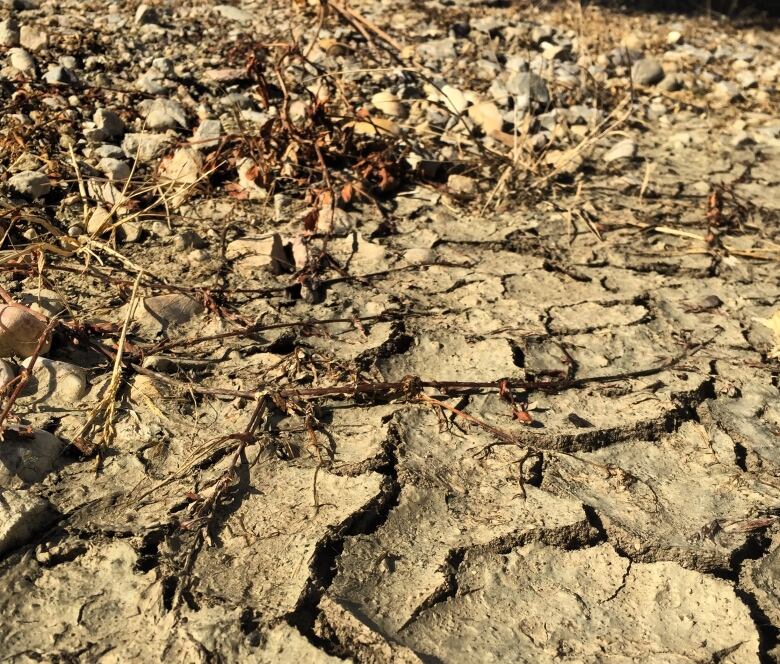
Dry farmland in Leduc, Alta. Farmers for Climate Solutions say droughts are becoming more common as a result of climate change. (Dave Gilson/CBC)

The federal agency Agriculture and Agri-Food Canada notes that earth’s existing farmland could absorb all of the world’s greenhouse gas emissions for the next 100 years at current rates if properly used.

But according to Farmers for Climate Solutions, the existing system of industrial agriculture makes it impossible to realize the carbon fighting potential of Canada’s 160 million acres of farmland.

The group points to soil tilling, chemical products, fossil fuel usage and low biodiversity on farms as key areas that must be improved upon.

Failing to do so, they argue, will prevent the nation’s farmland from reducing carbon and make farms more vulnerable to the effects of climate change.

“It’s really impacting our ability to grow food,” said Flies, pointing to the longer droughts and unpredictable weather making it harder for Canadian farmers to operate.

Costs, established practices are major hurdles

While Geitmann hailed the coalition’s “ambitious” plan to tackle climate change, she noted that several major obstacles could make it hard to achieve its goals.

Chiefly, she pointed to potentially higher costs and the challenges of implementing new practices that have been in place for decades.

Moving away from soil tilling, for example, may require a more laborious system of removing weeds from soil that could be challenging to some farmers.

Anja Geitmann, a professor at McGill University’s plant sciences program, says the plan is ambitious but likely to run into some major hurdles. (McGill )

Bringing those changes to life will likely require new federal incentives to help farmers, Geitmann said.

The Canadian Federation of Agriculture also called the plan to become carbon neutral “prohibitively costly” without policy changes such as exempting farmers from the federal carbon tax.

Farmers for Climate Solutions also acknowledge that the powerful chemical and fertilizer industry will likely resist widespread change that points farmers away from its products.

Much of the information supplied to farmers comes from that industry, Flies said, so her group is also looking for new strategies to educate farmers about environmental practices.

Paul Slomp, who raises beef cattle in Saint-André-Avellin, Que., said his farm has already moved away from chemicals and artificial feeds. His 200 cows now graze exclusively on grass, which he manages with the goal of maximizing the land’s ability to capture carbon.

He questioned the worries around higher costs, and said he’s now making more money than he did before the changes.

“Because we’re reducing the amount of input that we need to purchase, we’re actually able to generate a much better profit margin,” said Slomp, who is not a member of Farmers for Climate Solutions.

“The cows are meant to do this; they thrive in a system like ours, and it can be quite profitable.”


Source link

Categories
Tech

Invasive green crab at Keji seaside could soon become biodegradable plastic


Invasive green crabs that have caused major problems for native species like eelgrass at Nova Scotia’s Kejimkujik National Park Seaside could be the latest solution to reducing plastic pollution in the ocean.

Parks Canada has teamed up with a McGill University professor to find a way to turn the shells of the pesky crabs into a biodegradable plastic that could be used to make cutlery, cups or plates.

Crabs harvested from the park just south of Liverpool, N.S., will be shipped this spring to Montreal, where Audrey Moores has developed a non-toxic way to transform a polymer naturally found in crustacean shells into a hard, opaque plastic-like material.

“What we know is that if we take regular crab shells, shrimp shells, lobster shells, we have very good results, so we’re fairly confident that the green crab should not be different,” said Moores.

Unlike regular plastic, the material that Moores is left with will degrade in the ocean. But more research is needed to find out just how long that process will take, Moores said.

It’s exciting research for Gabrielle Beaulieu, project manager for the eelgrass conservation restoration project at Kejimkujik Seaside. She stumbled across it recently and wondered if it could help in Kejimkujik’s decades-long battle with green crabs.

“Invasive species may be detrimental to the ecosystem, however there’s always surprise solutions that we have to be open to,” Beaulieu said.

Audrey Moores is an associate professor in the chemistry department at McGill University. (Moores Research Group)

European green crabs have been wreaking havoc on eelgrass and soft shell clams at the park since the 1980s. They first arrived in North America in the ballast water of ships from Europe in the 1800s and have been on the move due to warming oceans.

There are now just a handful of spots in Atlantic Canada without green crabs, Beaulieu said.

“If we can make this invasive species come full circle as a solution to the plastic pollution issue that all the oceans are facing today, I really think that’s going to be such a great and innovative way to figure out the invasive species problem,” she said.

Thanks to initiatives like the ecotourism campaign Gone Crabbin’, two million green crabs have been hauled up at Kejimkujik Seaside Park since 2010, said Beaulieu. 

Now, there’s a year-round place for them to go.

“We’re really hoping that this project demonstrates an innovative new way of dealing with invasive species,” she said. “Certainly as climate change is upon us, there may be more introductions of marine species that we still know nothing about.”

The power of chitin

The key to creating biodegradable plastic from green crabs lies in chitin, one of the main components in crustacean and insect shells.

Moores, an associate professor in McGill’s chemistry department, crushes the shells to get to the chitin. She then uses a special method she’s developed to transform the polymer into a material that will withstand water.

“So now you can make a cup out of it that will hold the water because the cup itself is not going to be dissolved by the water,” she said.

Right now, the plastic material that’s created is hard like glass, but Moores said her team is hoping to find a way to make it bendable so it could be formed into disposable cutlery and other single-use items.

How many crabs are needed?

The first batch of crabs will go to Moores’ lab in Montreal this spring, but then the work is moving to Nova Scotia where production of the biodegradable plastics will ramp up.

Moores, who visited Nova Scotia last summer, said it’s unclear exactly how many crabs would be needed for each cup, but estimated that could mean hundreds of crabs for many kilograms of biodegradable plastic.

She’s currently looking for a full-time researcher to help with the work.

Eelgrass making a comeback

Beaulieu said Parks Canada will never be able to eradicate green crabs at Kejimkujik Seaside, but they’ve been able to control the population so native species like the eelgrass can begin to adapt to the intruder.

Eelgrass forms nursery habitat for most of the commercial fish species in Atlantic Canada. (Submitted by Arnault Lebris)

She said green crabs had decimated all but two per cent of the eelgrass that was at the park in 1987, but that thanks to conservation efforts, about 34 per cent has been recovered.

Last summer, when tourists ventured out in boats and hauled up crab traps, Beaulieu was able to tell them that the trouble-making crustaceans could one day be put to good use.

“Most people were a little bit in a state of disbelief that that was even possible,” she said. “But a lot of people were really excited to learn that there are solutions to plastics, as well as invasive species, that we still haven’t even thought about.”

MORE TOP STORIES 


Source link

Categories
Tech

New 'reaper of death' tyrannosaur is the oldest found in Canada


Thanatotheristes degrootorum, seen in this artist’s impression, is the first new tyrannosaur species named in Canada in 50 years. (Submitted by Julius Csotonyi)

A new species of tyrannosaur — the oldest ever found in Canada — has been discovered in Alberta.

Thanatotheristes degrootorum was as long as two cars lined up bumper to bumper and would have towered over an adult human. It stood about 2.4 metres tall at the hips, said Jared Voris, a University of Calgary PhD candidate who led the research identifying it as a new species.

The animal would have been a fearsome predator 79 million years ago during the late Cretaceous period, likely preying on herbivores such as the horned dinosaur Xenoceratops and the dome-headed dinosaur Colepiocephale.

Those are the only two other dinosaur species identified from the same location — a fossil site called the Foremost Formation — and the same period of time. At the time, it was coastal plain with swampy areas near an inland sea called the Western Interior Seaway that extended from the Arctic Ocean to the Gulf of Mexico.

Researchers who discover a new species have the privilege of naming it, so Voris canvassed his colleagues for suggestions. 

The winner for the first part of the new dinosaur’s name translates roughly to “reaper of death” — coming from the Greek god of death Thanatos and the Greek word “theristes,” which means “reaper” or “harvester.” It was suggested by Amanda Hendrix, a master’s student in the same research group, which is led by Prof. Darla Zelenitsky, who co-authored the study.

“This animal would have absolutely been an imposing creature in the ecosystem that it lived in and it would very likely have been the apex predator,” Voris said. “It was really nice to have some sort of name that encapsulated that kind of behaviour.”

Darla Zelenitsky, Jared Voris and Francois Therrien, co-authors of the study, pose with the actual fossils of the species. (Submitted by Royal Tyrrell Museum of Palaeontology)

Found by members of the public

The second part of the animal’s name honours the two ranchers who discovered the fossil, John and Sandra De Groot of Hays, Alta., as they were walking along the shoreline of the Bow River in 2010. They alerted the Royal Tyrell Museum, which labelled the partial jaws and teeth as belonging to a tyrannosaur and filed it to the appropriate drawer in their collection.

About eight years later, Voris came across it while doing research on a different species of tyrannosaur, Gorgosaurus, during his master’s degree.

He noticed that it came from a rock formation where no tyrannosaurs had been positively identified before. On closer examination, he realized it was like no other tyrannosaur he had ever seen.

“I started to realize, ‘Well, this could actually be a new species,'” Voris said. 

An artist’s impression shows how the new species of tyrannosaur discovered in southern Alberta, might have looked. (Submitted by Julius Csotonyi)

It’s the first new tyrannosaur species found in Canada in 50 years.

One of the unique features that helped prove that was some unusual ridges on the specimen’s upper jaw. Those helped identify a second, very broken specimen found by Caleb Brown of the Royal Tyrell Museum, another co-author, in 2018.

The researchers published their description of the new species Monday in the Journal of Cretaceous Research.

Unfortunately, there weren’t a lot of bones to go on — mostly fragments of its jaws with broken teeth. By looking at the impressions on both sides of the rock it came from, it appears the skull was originally intact, Voris said.

Sadly, it appears the entire skull fell out of the riverbank, and most of the bones were washed away before the De Groots stumbled upon what was left.

Rare find

Still, it’s a lucky find, Zelenitsky said. It is only the third dinosaur species identified in southern Alberta from this time period, and the first top predator.

“They were relatively rare in the ecosystems,” she said. In the Cretaceous, as now, there were far more herbivores than predators. “These were probably only a few per cent of the animals.”

Finding one helps build a picture of what the ecosystem was like in southern Alberta at this time, she said.

There wasn’t much fossil material from the new tyrannosaur to study — mostly parts of its jaws and broken teeth. (Submitted by Jared Voris)

Thanatotheristes is most closely related to the other tyrannosaurs found in Alberta and northern Montana about 2.5 million years later, Gorgosaurus and Daspletosaurus, and quite different from tyrannosaurs found in the southern U.S. in the same time period.

The most well-known tyrannosaur, T. rex, lived around 11 million years after Thanatotheristes. At the time that Thanatotheristes roamed, T. rex’s closest relatives were still in Asia.

Voris and Zelenitsky both think there are more Thantotheristes specimens out there, and hope to find more complete specimens.

“One of my goals now is to see if we can find more of another individual and see how to see exactly how different it is from some of the other tyrannosaurs in Alberta,” Voris said. “I have a hunch that it might be pretty different.”

The research team hopes to do some more exploration in the Foremost Formation. 

While only three dinosaur species have been identified there, lots of teeth hint at unidentified species of bird-like and duck-billed dinosaurs, Voris said.

“There’s just a whole bunch of new discoveries waiting to be made.”


Source link

Categories
Tech

Use of facial recognition technology by police growing in Canada, as privacy laws lag


Canadian privacy advocates are calling on all levels of government to create specific regulations around police use of facial recognition technology.

Canada doesn’t have a policy on the collection of biometrics, which are physical and behavioural characteristics that can be used to identify people digitally. Because of that, there are no minimum standards for privacy, mitigation of risk or public transparency, according to the Office of the Privacy Commissioner of Canada’s website. 

In that vacuum, some police departments in Canada have begun to use facial recognition technology.

Calgary police regularly use it, and Toronto police have tested out their own system. Edmonton and Saskatoon are considering it. Montreal police would not confirm whether they use facial recognition systems. Halifax, Winnipeg and Vancouver say they do not. Other police forces contacted did not respond to inquiries.

The RCMP say they are not using facial recognition technology. “However we continue to monitor new and evolving technology,” the force said in an email. 

“I think legislators and policy-makers need to turn their minds to this,” said David Fraser, a privacy lawyer with McInnes Cooper in Halifax. 

“We need to have this discussion, and the police need to be dragged into that discussion, out of the shadows where they’re making decisions about currently deploying this sort of technology.”

Biometrics enable a device to recognize an individual. Facial recognition is a type of biometric system. 

Those systems work by scanning an image of a person’s face to identify unique measurable characteristics, like the distance between someone’s eyes or the width of their nose.

A computer creates a representation of the face and then compares it to the images in a database in an attempt to find a match.

David Fraser, a privacy lawyer with McInnes Cooper in Halifax, says technologies ‘could be horrifically abused, or they could be mildly abused in a widespread sort of way that leads to a significant diminution in our privacy rights.’ (Mark Crosby/CBC)


Fraser and others worry widespread use of this technology without proper oversight could erode individual privacy. 

“Broadly speaking, our office has identified facial recognition as having the potential to be the most highly invasive of the current popular biometric identifying technologies,” Vito Pilieci, a spokesperson for the Office of the Privacy Commissioner of Canada, said in an email. 

Calgary police have been using facial recognition technology since 2014. (Rebecca Kelly/CBC)

Last fall, privacy advocates and commissioners from across Canada urged federal, provincial and territorial governments to modernize privacy laws to better keep pace with technological change.

But Nova Scotia’s Office of the Information and Privacy Commissioner said it isn’t aware of any province with legislation to specifically address facial recognition technology.

Still, some provincial privacy laws may be broad enough to help protect people against the collection and use of their biometric data, according to Janet Burt-Gerrans, the acting director and chief privacy officer with the Nova Scotia office.  

Visitors experience facial recognition technology during the China Public Security Expo in Shenzhen in 2017. (Bobby Yip/Reuters)

The federal Department of Justice said the country’s Privacy Act regulates to what extent federal entities can collect, use, disclose and retain personal information. 

But that legislation does not apply to provincial or municipal police forces. 

The RCMP are subject to the act, the Department of Justice said, meaning the force “can only collect personal information that relates directly to its mandate as Canada’s national police force.”  

The department would not say if there are any plans for more robust regulations to manage the use of facial recognition technology. 

Fraser said all police forces need to be more accountable for how their investigative techniques affect people’s privacy. 

“We’ve consistently seen from the police that their understanding of reasonable expectation of privacy is completely disconnected from what most of us think a reasonable expectation of privacy is, so we can’t have police making those decisions.”     

Toronto police ran a pilot project testing facial recognition technology in 2018. But the force didn’t tell the public they were using the technology, which upset privacy and civil liberty advocates. (Tony Smyth/CBC)

Calgary police say facial recognition technology has worked well for them, cutting down on the time it takes to identify suspects.

Staff Sgt. Gordon MacDonald, of Calgary’s criminal identification unit, said having an officer manually scroll through mug shots on a computer looking for a potential match to a suspect “would be a considerable amount of hours, if not days, trying to find a suitable match.”

The system returns results within two minutes. 

Don Waugh, founder of Applied Recognition, demonstrates the 68 data points that his facial recognition software uses. (Jon Castell/CBC)

MacDonald said there are strict rules about how the system is run and officers only use it to compare images with mug shots. 

“It’s such a valuable technology we wouldn’t want to do anything that would jeopardize our permission to have it,” he said.   

There are about 350,000 mug shots of people who have been charged with various offences in Calgary, but MacDonald said a national database would have to be created to make the system truly effective

“We just have a database that’s just purely for Calgary,” said MacDonald. 

“Canada has such a transient population. People go from province to province and subjects of interest may appear in Calgary and they may be a resident of Edmonton. And of course our system would never find a possible match.” 

A national database would change that. It would allow officers in any part of the country to match images with mug shots from anywhere in Canada.  

Fraser said before there is a national database, law enforcement, privacy regulators and members of the public need to develop regulations on how that system would be used. He said there’s a risk of informal national systems being set up as police departments look at sharing more information. 

“These sorts of initiatives are probably happening outside of view and so we need to put in place regulations before we end up with a de facto national database,” he said. 

In this file photo, Calgary police demonstrate how their facial recognition software works. (CBC)

Michael Arntfield, a Western University criminologist and former police officer, agrees. He said clear regulations would reassure people that police are using facial recognition responsibly. 

He said without rules the door is open to private companies to offer their services to police. 

“I think that would alleviate the concerns that I think people have about using a private-sector third party to compare to wedding photos that were scraped from social media accounts,” said Arntfield.

People walk past a poster simulating facial recognition software at Security China 2018 in Beijing. (Thomas Peter/Reuters)

Fraser said police have access to many technologies that allow them to monitor people and society needs to decide when law enforcement should be allowed to use those tools. 

“They don’t get to use every tool at their disposal,” he said. “They get to use appropriate tools. There are intrusive technologies that need to be regulated, because they could be horrifically abused, or they could be mildly abused in a widespread sort of way that leads to a significant diminution in our privacy rights.”

MORE TOP STORIES


Source link