Categories
Tech

10 years after Deepwater Horizon — what has science learned from the spill?


Ten years after one of the largest environmental disasters in American history, oil spill science is better and stronger — but there are still many unanswered questions about the effects of the Deepwater Horizon disaster.

“It’s a good news story in the sense that 10 years later we know a lot more, we are better prepared for the next eventuality,” marine geochemist Elizabeth Kujawinski told Quirks & Quarks host Bob McDonald. “It’s a bad news story in the sense that we don’t entirely know everything that happened.”

On April 20, 2010, a powerful explosion at an oil rig in the Gulf of Mexico killed 11 workers, and injured 17 others. That explosion also resulted in an oil well blowout more than a kilometre underwater. Crude oil flowed from that well into the ocean for the next 87 days. 

In all, the Deepwater Horizon oil well disaster released an estimated 800 million litres of oil and gas into the Gulf of Mexico, making it the largest accidental marine oil spill in history.

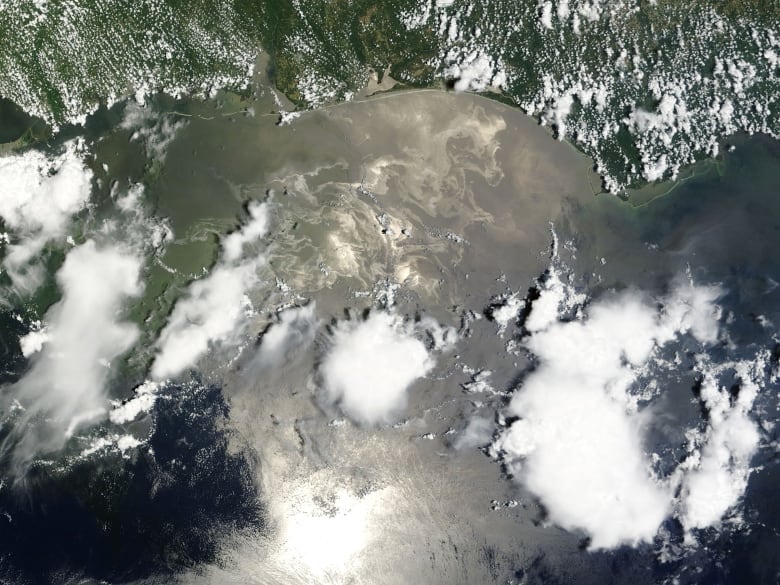
Oil from the Deepwater Horizon rig was visible from NASA’s Terra satellite, on the surface of Gulf of Mexico waters on June 18, 2010. The oil appears as a maze of silvery-gray ribbons in the Gulf of Mexico. (NASA via Getty Images)

Kujawinski is a Senior Scientist in Marine Chemistry & Geochemistry at Woods Hole Oceanographic Institution. She is part of a team behind a review paper, published this week, which surveys what scientists have learned from studying the spill over the past decade.

Deepwater Horizon as one big science experiment

While the oil spill was devastating, it did enable significant scientific discoveries. One such discovery is the greater understanding of how bacteria are involved in degrading oil and gas released into the ocean.

“So who responds first: the organisms that eat oil, or the organisms that eat the gas?” said Kujawinski. 

Another lesson learned was the role of the sun in breaking down the oil. Because the spill took place during the summer months, the strong sunlight acted as a further catalyst to breaking up the oil. 

“That has generated a really interesting body of work that can be used for future spills to understand how to promote that kind of degradation, how to promote sort of the ecosystem cleaning itself,” she said. 

The Transocean Discoverer Enterprise drill ship (with flare) collects oil, alongside support ships and relief wells as workers try to stem the flow of the oil spill in the Gulf of Mexico off the coast of Louisiana, June 12, 2010. (SAUL LOEB/AFP via Getty Images)

As to how the ecosystems are recovering, Kujawinski says some areas are doing better than others. “We were pleasantly surprised… Different Marsh systems and certain aspects of the deep sea all seem to be recovering.”

However, other areas have not bounced back as quickly.

“That seems to be a function of the fact that the Deepwater Horizon was just one of many stressors that were hitting that ecosystem at the time.” 

All of this data goes into creating more accurate models to tell scientists how to deal with oil spills in the future.

Dispersants — did they help, or did they hurt?

There are still many unknowns about the lasting effects of the spill — including the effects of the tools used to stop it.

In an attempt to get the massive spill under control, emergency teams used over 3 million litres of chemical dispersants, which were meant to break up the oil and make it easier to biodegrade. At the time, such widespread use of dispersants was controversial, especially because they were being applied directly to the well head, 1.5 kilometres underwater. 

“The dispersants in my opinion remain one of the most complicated and difficult to understand components of the Deepwater Horizon,” said Kujawinski. “One of the reasons it was a big concern was because there had not been any study of how dispersants would affect organisms, whether they are corals or fish or dolphins or whales in the deep ocean.” 

At the time, Kujawinski studied the chemistry of organic molecules in seawater, and was studying the impact that the dispersants, as well as the oil and gas, would have on the organic molecules in seawater.

“We know that there were dispersants down in the deep ocean for a longer period of time than might have been originally intended,” she said. 

But they don’t know what effects those dispersants are having in the deep ocean. “You have to be able to know what the oil droplets look like coming out of the wellhead before the dispersant, and then during the dispersant application, and those were very challenging data to get,” she said. 

“In the future, it is now clear that that is the critical data to have.” 

A brown pelican coated in heavy oil wallows in the surf June 4, 2010 on East Grand Terre Island, Louisiana. (Win McNamee/Getty Images)

In all, as unfortunate as the disaster was, the science community is now better armed to deal with future oil spills, wherever they may be.

“Our biggest concerns with the Deepwater Horizon results is what will happen if this happens again, but in the Arctic,” she said. “It’s much colder, it’s much more remote, the weather is much more severe.

“In many respects the Deepwater Horizon, as awful as it was, was a way for us to figure out what’s really happening in these systems without the worst case scenario.”


Written and produced by Amanda Buckiewicz


Source link

Categories
Tech

Iconic images from Hubble Space Telescope


Launched on April 24, 1990, the Hubble Space Telescope remains a major symbol for NASA more than 30 years later. Here’s a look at some stellar images from the Hubble.

Pillars of Creation

After the Hubble’s 30 years in space, this image remains one of its most iconic. The Pillars of Creation depicts a jet-like feature that astronomers say has grown by about 96.5 billion kilometres, based on comparisons of pictures taken between 1995 and 2014. 

(Hubble Heritage Team/NASA/ESA/Reuters)

Cosmic Reef

Marking the telescope’s three decades in space, NASA unveiled a new image taken by Hubble’s Wide Field Camera 3. It shows how young, energetic, massive stars illuminate and sculpt their birthplace with powerful winds and searing ultraviolet radiation. The image, nicknamed the Cosmic Reef because it resembles an undersea world, shows a giant red nebula and a smaller blue one that create a huge star-forming region. 

(Space Telescope Science Institute/NASA/ESA)

Hubble Ultra Deep Field

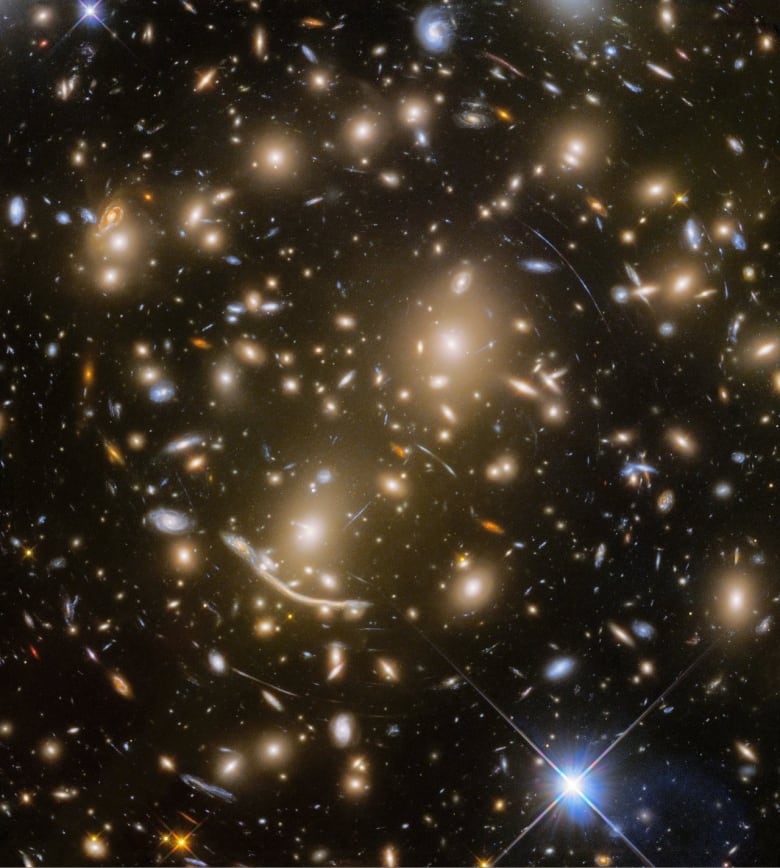
In this 2012 image of hundreds of galaxies, the Hubble provides a display of a phenomenon known as gravitational lensing.

The telescope captured a region six billion light-years away containing the galaxy cluster Abell 370, one of the first galaxy clusters in which astronomers observed gravitational lensing, the warping of space-time by the cluster’s gravitational field that distorts the light from galaxies far behind it.

Arcs and streaks in the picture are the stretched images of background galaxies.

(Hubble, HST Frontier F/NASA/ESA)

Westerlund 2

This 2015 photo features a stellar nursery of about 3,000 stars called Westerlund 2, located about 20,000 light-years from the planet Earth in the constellation Carina.

(NASA/Reuters)

Antennae galaxies

In 2006, this Hubble-captured image of the merging Antennae galaxies offered one of the first high-resolution glimpses of the birth of billions of stars. The brightest and most dense areas of the image show super star clusters representing some of the newest material in space.

 (Hubble/B. Whitmore Space Telescope Science Institute/ESA/Reuters 

Eta Carinae

Images of Eta Carinae, a dying star in our Milky Way galaxy, led scientists to conclude in a 2007 article in the journal Nature that a similarly sized star went supernova some 78 million light-years from Earth and wiped out a star 100 times the size of our sun.

(NASA/Reuters) 

U Camelopardalis

U Camelopardalis, or U Cam for short, is a star nearing the end of its life located in the Giraffe constellation near the celestial North Pole. As it begins to run low on fuel, instability within the star’s core creates coughs of helium gas every few thousand years. This image was captured by Hubble in 2012.

(Hubble/NASA and H. Olofsson/ESA/Reuters)

Jupiter’s polar light

Jupiter, the largest planet in the solar system, is best known for its colourful storms, the most famous being the Great Red Spot. Using the ultraviolet capabilities of Hubble, astronomers have focused on another feature of the planet: auroras — stunning light shows in a planet’s atmosphere — on the poles of the largest planet in the solar system.

(ESA/NASA)

Orion Nebula

This NASA illustration from 2013 shows a closeup of cosmic clouds and stellar winds in the Orion Nebula.

(Hubble Heritage Team/NASA/ESA/Reuters)

Menzel 3

From ground-based telescopes, this cosmic object — the glowing remains of a dying, sun-like star — resembles the head and thorax of an ant.

This image, released in 2003, shows the so-called ant nebula, otherwise known as Menzel 3, and reveals a pair of fiery lobes protruding from the dying star.

(NASA/Reuters)


Source link

Categories
Tech

Hubble Space Telescope celebrates 30 years in space


The Hubble Space Telescope transformed the way we see the universe and our place in it, and on Friday, it celebrated 30 years in space.

To mark the anniversary, NASA released a stunning image of two regions where stars are being born, the giant red nebula, NGC 2014, and its smaller blue neighbour, NGC 2020, in the Large Magellanic Cloud, a neighbouring galaxy to our own Milky Way. 

WATCH | NASA releases video on 30th anniversary of Hubble Space Telescope:

[embedded content]

Hubble — named after astronomer Edwin Hubble who confirmed our universe was expanding, among other findings — was launched into space aboard the space shuttle Discovery on April 24, 1990. 

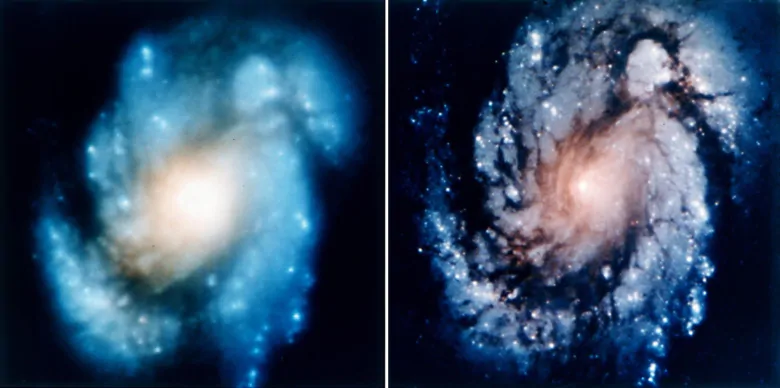
But when Hubble opened its eye and took its first picture, astronomers were horrified to see a blurry and useless image. Further investigation discovered that the telescope’s main mirror had a tiny — about 1/50th the width of a human hair — flaw. 

It would take three more years until another mission could be launched to equip Hubble with a set of “glasses,” the Corrective Optics Space Telescope Axial Replacement that was about the size of a telephone booth.

The result was spectacular.

This comparison image of the core of the galaxy M100 shows the dramatic improvement in the Hubble Space Telescope’s view of the universe after the first servicing mission in December 1993. The original view, taken a few days before the servicing mission, is on the left. ( NASA)


Since then, Hubble has allowed us to peer into the farthest reaches of our 13.8-billion-year-old universe, looking back in time to when it was just 400 million years old, a mere infant in astronomical terms.

While the telescope was launched in 1990, the idea of an orbiting telescope was first conceived in 1946 by Lyman Spitzer. However, it was first seriously considered in 1960, specifically by Nancy Grace Roman, considered the “Mother of Hubble.”

Hubble Space Telescope (NASA)

Why have a telescope in space? Earth’s atmosphere creates turbulence. Placing a telescope above the atmosphere increases the sharpness of images.

And Hubble has had multiple servicing missions upgrading its many cameras and instruments, further sharpening its images.

A Hubble telescope photograph of the iconic Eagle Nebula’s ‘Pillars of Creation’ is seen in this NASA image released Jan. 6, 2015. By comparing an original 1995 photo and a 2014 one, astronomers noticed a lengthening of a narrow jet-like feature that may have been ejected from a newly forming star. (Hubble Heritage Team/NASA/ESA/Reuters)

But it’s not all about beautiful images. Hubble has allowed astronomers to measure the acceleration of our universe; it’s provided evidence of dark matter; it has observed atmospheres around exoplanets; and it has monitored planets in our own solar system.

To date, the workhorse telescope has made 1.4 million observations with data used in more than 17,000 peer-reviewed papers. 

In 1994, Hubble turned its eye on Jupiter, for the first-ever view of a comet breaking apart and hitting a planet. It was this breakup of Comet Shoemaker-Levy 9 that alerted scientists to the potential danger Earth would be in should something similar happen here at home.

Hubble followed unexpected and dramatic changes in Jupiter’s atmosphere caused by collisions with comet fragments. The titanic blasts left Jupiter with a temporarily ‘bruised’ appearance, caused by black debris that was tossed high above the giant planet’s cloud tops. (Hubble Space Telescope comet team, NASA)

And one of its most famous pictures is the Hubble Ultra Deep Field, an image of almost 10,000 galaxies.

This image shows the Hubble Ultra Deep Field in 2012, an improved version of the Hubble Ultra Deep Field image featuring additional observation time. The image reveals nearly 10,000 galaxies, with 800 exposures taken over the course of 400 Hubble orbits around Earth. The total amount of exposure time was 11.3 days, taken between Sept. 24, 2003, and Jan. 16, 2004. (NASA, ESA, R. Ellis (Caltech))

While Hubble is expected to last through the 2020s, a second-generation space telescope, the James Webb Space Telescope, is scheduled to launch in 2021.


Source link

Categories
Tech

1 in 10 Canadians believes a coronavirus conspiracy theory, survey suggests


One in 10 Canadians believes a conspiracy theory about the novel coronavirus, according to preliminary research from the University of Sherbrooke in Quebec. 

The researchers sent surveys to 600 people, half in Quebec and half in the rest of Canada, to ask about the psychological impacts of the pandemic.  

Respondents were presented with six conspiracy theories and asked if they believe any of them. According to Marie-Eve Carignan, an associate professor at the University of Sherbrooke and one of the co-authors of the study, at least one in 10 respondents believed at least one of the six theories.

She cautioned that the findings of the study are preliminary, and that team will have the results of a survey of 1,500 Canadians two weeks from now. Eventually their work will expand to include six countries. 

Carignan said the six theories were:

  • My government is hiding important information about coronavirus.
  • Coronavirus was intentionally made in a lab.
  • Coronavirus was manufactured in a lab by mistake.
  • The pharmaceutical industry is involved in the spread of the coronavirus.
  • Coronavirus medication already exists.
  • There’s a link between 5G technology and the coronavirus.

One of the most popular conspiracy theories of the pandemic is that the coronavirus that causes COVID-19 was genetically engineered in a laboratory, possibly as a biological weapon. While just over half of those surveyed said they believe the virus occurred naturally, nearly a third said they believe it was created in a lab. 

But virologists around the world say they would be able to tell if the virus has been modified in a lab, and there are no signs that is the case. It is possible the virus could have been studied in a lab and then leaked accidentally, but it’s not probable, they say.

The survey also found that around 15 per cent of respondents believe that the pharmaceutical industry is involved in the spread of the coronavirus.

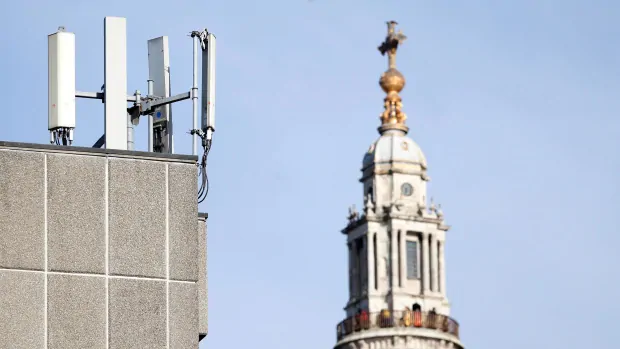
Another popular theory links the virus with 5G wireless network technology. But Quebecers were less inclined to believe it than those outside the province: just 7.8 per cent of Quebec respondents, compared to 15 per cent of respondents in the rest of Canada. 

Carignan says she’s not sure why there’s such a difference but speculated it could be that conspiracy theories that originate in English may not spread as well to French speakers, but she says the issue requires further study.

The 5G conspiracy theory has gained traction this month: Google searches about 5G skyrocketed at the beginning of April, compared to the previous year.

But any perceived link between 5G technology and the coronavirus has been thoroughly debunked.

WATCH | Virologist explains why he is certain the pandemic was not caused by 5G

Kindrachuk explains why he is certain the global pandemic has been caused by a virus and not 5G. 0:42

Roughly 38 per cent of respondents believe their government is hiding important information about the coronavirus. Carignan says that matters because people who are less likely to trust their government may be more likely to believe conspiracy theories. 

Most common myths

Meanwhile, a team at Ryerson University in Toronto has identified the most common types of disinformation related to COVID-19 by creating real-time dashboards that track the work done by fact-checkers around the world.

The group looked at 2,000 debunked claims by fact-checkers and found seven prevalent types of disinformation, which are displayed on two dashboards — a global one and a Canadian one: 

  • Fake tests and cures.

  • Speculation on the origin of the virus.

  • Unproven attributes of the virus.

  • Fake websites purporting to be authorities or government entities.

  • False claims about brands and their involvement with the virus.

  • Rumours about celebrities getting ill or dying from the virus.

  • Blaming certain ethnic groups or religions for spreading the virus.

Philip Mai, co-director of the Ryerson Social Media Lab and one of the researchers behind the dashboard, said that the team’s work on misinformation in the political sphere showed them misinformation follows patterns. Helping people spot the patterns could help them recognize misinformation more easily. 

“We want to educate the public as to what to look for so that they can inoculate themselves against this kind of stuff, because there’s only so many fact-checkers in the world,” said Mai, adding that most people don’t have the time to chase down every claim.

“The idea is you can learn, arm yourself with information, so that next time you see a version of one of these types of misinformation, you can say, ‘Oh, that sounds like something I’ve heard before, and I think that’s not correct,'” Mai said.

“At least it makes you question things as opposed to [hitting] that share button without thinking,” said Mai.


Source link

Categories
Tech

Will COVID-19 change our food habits?


Hello, people! This is our weekly newsletter on all things environmental, where we highlight trends and solutions that are moving us to a more sustainable world. (Sign up here to get it in your inbox every Thursday.)

This week:

  • Will COVID-19 change our food habits?
  • Comparing the current drop in carbon emissions to historical ones
  • How climate change helped uncover a massive cave in B.C.

Will COVID-19 change our food habits?

(Joe Raedle/Getty Images)

On April 20, the Cargill meat-packing plant in High River, Alta., shut its doors after 515 cases of COVID-19 were linked to the plant. It’s just one of the many meat-packing plants closing across Canada and the U.S. in response to the rapid spread of the novel coronavirus. 

These closures have sparked concerns over potential food shortages, although to date none have been reported. But there may be other side-effects to these developments — namely, a change in the way people eat and buy food, which may have knock-on environmental impacts.

Out of concern for the availability of food, for example, some people have turned to creating their own vegetable gardens. But it’s harder to raise a cow or pig in your backyard. 

Chris Ratzlaff, a self-proclaimed meat-lover who lives in Airdrie, Alta., said the pandemic has made him rethink his meat consumption. “It’s very early days for me, but it’s definitely something on my radar,” he said. What worries him isn’t the carbon footprint of meat, which is significantly higher than that of plant-based proteins, but the connection between meat production and infectious diseases.

He said his bigger concern is that a lot of deadly viruses “seem to be connected to our heavy reliance on a mass-production meat industry.” For example, bovine spongiform encephalopathy (BSE), more commonly known as mad cow disease, and the 2009 swine flu have been linked to large-scale farming.

A 2016 report by the UN Environment Program warned that “livestock often serve as an epidemiological bridge between wildlife and human infections,” adding “this is especially the case for intensively reared livestock.” Some argue that farming on a smaller scale does less damage to the environment, and in the wake of COVID-19, reduces the risk of disease outbreaks.

Ratzlaff, who has “taco night” once or twice a week, said he’s starting to research other options to get his protein, though he’s not counting out meat entirely. One of the changes he’s considering is buying meat locally. 

Sylvain Charlebois, director of the Agri-Food Analytics Lab at Dalhousie University in Nova Scotia, said this line of thinking reflects a broader trend. “We are looking at food very differently,” he said.

A recent Angus Reid poll done in conjunction with Dalhousie found that as the pandemic wears on, 50 per cent of respondents intend to buy more local products once things are “back to normal.” The week before, that number was 42 per cent.

Not only that, but even the way we shop is different, particularly when it comes to meal-planning. “Five weeks ago, walking into a grocery store, we were looking for quick fixes,” Charlebois said. “The next day, we’re looking at ingredients for the next couple of weeks.”

While online grocery shopping — which can have a lower carbon footprint than in-store shopping — was something of a novelty before the pandemic, it may become normalized. As a result, local farmers are looking to get into the online food delivery business.

“Right now, my wife and I, we actually buy our fish and seafood from a [delivery] company that didn’t exist two months ago,” Charlebois said.

Buying local may alleviate some concerns over large-scale meat-production farms, but cost can be a holdback, regardless of the environmental benefits.

“People will want to buy local as long as it’s affordable,” Charlebois said. “Governments and politicians and business leaders will always encourage people to buy local. But at the end of the day, the price itself really matters a lot.”

Nicole Mortillaro

How about you? Are you changing the way you eat and shop? Let us know.


Reader feedback

What’s on your mind?

Old issues of What on Earth? are right here.


The Big Picture: The biggest emissions drops in history

Back in January, when China first began to contend with the coronavirus outbreak, it became clear how significant the associated lockdowns would be in reducing carbon emissions as a result of less vehicular traffic, energy-intensive production and overall power use. Since then, much of the world has gone into quarantine to contain the spread of COVID-19, and worldwide emissions have fallen dramatically. The U.K.-based organization Carbon Brief recently estimated that the drop in emissions related to COVID-19 will be the greatest in history — specifically, around 2,000 million fewer tonnes of CO2 than last year. That would mean a decrease of 5.5 per cent. The folks at Carbon Brief caution that this unintended cut still doesn’t get us close to the emissions reductions needed to meet the 1.5 C global limit set by the Paris Accord — to achieve that, we need to cut emissions by more than seven per cent every year for the next decade.

(CBC)

Hot and bothered: Provocative ideas from around the web

  • In another example of how humanity’s retreat during the COVID-19 pandemic is giving nature more breathing room, rare sea turtles have taken advantage of deserted beaches in Thailand to build more nests than they have in two decades.

  • In the interests of physical distancing, cities are examining how best to manage public spaces. These experiments can also have environmental benefits. Milan — which is in Italy’s Lombardy region, the maelstrom of the country’s COVID-19 outbreak — has announced that it will be modifying 35 kilometres of streets to create more cycling and walking space. This will allow people to get much-needed exercise, but will also help maintain clean air in a historically polluted area.

How climate change helped uncover a massive cave in B.C.

(Catherine Hickson/Tuya Terra Geo Corp.)

Researchers have found a large, ancient cave in B.C.’s rugged alpine region that went undetected for hundreds of years largely because it was filled with ice and blanketed by snow until sometime within the last decade. 

A scientific paper published this week said a steadily warming climate ate away at the snow plug until it suddenly collapsed, revealing the black hole in Wells Gray Provincial Park before its discovery in 2018.

Geologist Catherine Hickson co-authored the paper, published online in the Canadian Journal of Earth Sciences, after becoming one of the first people inside the cave entrance. She described the pit as an “amazing, earth-formed natural feature,” but acknowledged it was discovered as a result of climate change, “which is unfortunate.” 

The cave was spotted after a group of government researchers and biologists flew over the area for a mountain caribou census in the spring of 2018.

While Hickson and other geologists say the hidden cave’s exposure is further proof of how climate change is reshaping the planet, they admit the melt has opened up an opportunity to explore what might be the largest cave entrance of its kind in Canada — a rare opening that could lead to a network of smaller caves and resilient life underground.

The opening of the cave is in B.C.’s Cariboo Mountains. Hickson said the cave acts like a drain for the glacier, swallowing a gushing river created by glacial runoff. The mouth of the cave is a dramatic 145-metre vertical drop into the earth — a pit deep enough to fit the Statue of Liberty.

Hickson said the cave is likely hundreds of thousands of years old. The area around the opening was covered by the perennial snowfield for centuries, the paper found, and was likely exposed in the late 1800s as the glacier slowly withdrew after the peak of the last ice age.

The cave was so hidden that one of Hickson’s eventual co-authors, Bert Struik, didn’t realize it was there when he camped nearby during a mapping expedition in the early 1980s.

“At the campsite, we saw the creek disappear at the cave site and marked its location,” said Struik, a scientific researcher with the Geological Survey of Canada. “We did not make a big deal of it at the time.”

Hickson and other researchers used Struik’s notes from that trip, as well as photos taken of the cave site between 1949 and 2018, to determine the ice plug gave way sometime within the past 10 years.

Brent Ward, a glacial geologist at Simon Fraser University, agreed the massive chunk of ice likely would have stayed in place if not for climate change. 

“It’s hard to melt that much material, especially at a high elevation such as this,” said Ward, who did not participate in the research for the paper. “That snow bank and ice would not have melted without the warmer temperatures we’re seeing in the summer.” 

Hickson said the sudden nature of the collapse is unsettling.

“I’ve been very aware of the ebb and flow of great glaciers over millions of years…. We’re in an interglacial period. We know that these things happen,” said Hickson. “It’s the rapidity, how rapidly things are happening, that is very disconcerting.”

The cave will not be officially named without consultation with Indigenous communities. Its precise location is kept secret to deter amateur climbers and Instagram tourists from damaging the environment. Trespassers face a fine of up to $1 million.

Rhianna Schmunk


Stay in touch!

Are there issues you’d like us to cover? Questions you want answered? Do you just want to share a kind word? We’d love to hear from you. Email us at whatonearth@cbc.ca.

Sign up here to get What on Earth? in your inbox every Thursday.

Editor: Andre Mayer | Logo design: Sködt McNalty


Source link

Categories
Tech

Free online 'threat blocker' launched in Canada as successful COVID-19 scams multiply


As the number of successful pandemic-related scams continues to grow online, Canada’s cyber spy agency is helping to launch a new — and free — threat-blocking tool for all Canadians to use.

This first-of-its-kind initiative is getting tentative applause in cyber security circles, but experts caution the initiative needs to be closely watched to make sure it doesn’t cross any red lines.

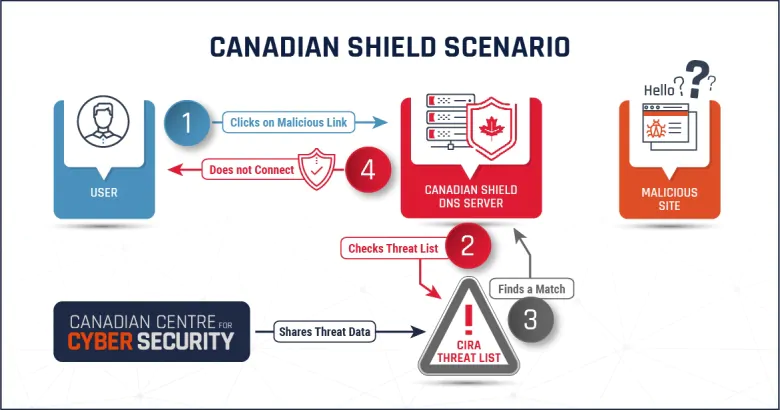
The Canadian Internet Registration Authority (CIRA, the not-for-profit agency that manages the .ca internet domain) and the Communications Security Establishment, Canada’s foreign signals intelligence agency, teamed up on the CIRA Canadian Shield — a protected domain name system (DNS) service that prevents Canadians from connecting to malicious websites that might infect their devices and steal their personal information.

CIRA is providing the threat blocking technology while the CSE’s Canadian Centre for Cyber Security is offering its threat intelligence services — basically a who’s-who list of every bad actor roaming the web.

“For any piece of malicious software to get to you, 90 per cent of it relies on knowing the address book of the internet,” said Scott Jones, head of the cyber security centre.

(Canadian Centre for Cyber Security)

“What we do is when we know it’s malicious, CIRA makes sure that you don’t get told to go to the bad address. It stops you from getting to the bad place.”

The two agencies were working on the project long before the pandemic struck, said Jones, but the current global emergency makes it more relevant because large numbers of Canadians are now working from home, often on unsecured networks or devices.

“We’re not just feeding in information about malicious attacks that are COVID-related. We’re feeding in anything we see from any criminal activity that’s targeting the government, or that we’re getting made aware of. Any state-sponsored type activity as well that we can block, we’re putting it in there,” he said.

“Basically, anything we’re using to defend the government of Canada we’re now making available for all Canadians, so that they can protect themselves.”

Project should be audited for censorship: researcher

Christopher Parsons, a senior research associate at the Citizen Lab through the Munk School of Global Affairs and Public Policy, said the electronic spy agency has made progress in stepping out of the shadows.

“This represents to my eye a continuation of that effort, to take what is often sort of secret or classified information, turn it into a way that could be made publicly available and then trying to make it more useful to Canadians,” he said.

(Canadian Centre for Cyber Security)

Parsons said that even if all those involved in the project are driven by good intentions, it should be audited and tested to make sure it’s not accidentally blocking Canadians from accessing safe sites.

“It’ll be important to assess and evaluate and ensure that the items that are being provided to CIRA from the government are in fact appropriate to block,” he said.

“I don’t think that it’s likely that the cyber centre is, you know, going to secretly use this to build a censorship networking path. I truly cannot see that happening, but mistakes could happen.”

Jones stressed the agency is collecting only anonymized statistics about how frequently the Canadian Shield blocked web addresses on its threat list.

“Nothing about Canadians as individual users. We get nothing about their usage patterns,” he said. 

While the CSE collects a wide array of foreign communications related to Canada’s interests — including phone calls and emails — its mandate restricts its ability to collect data on Canadians. Given the sensitive nature of its activities, it’s monitored by an independent watchdog group — which has reprimanded the agency over its metadata collection practices in the past.

As the Canadian operator of the threat-blocker, CIRA would have to comply with Canadian privacy laws, including the Personal Information Protection and Electronic Documents Act.

Wesley Wark, a University of Ottawa security and intelligence expert, said the project could do a lot of good — but attention should still be paid to the anonymized data it collects.

“The CIRA cyber shield is a new public initiative, so it certainly deserves scrutiny,” he said.

“Anonymization might be the most sensitive issue. [Data] anonymization is a tricky business, as CSE itself knows. It can fail and if it did, it might have impacts on privacy.

“If the Canadian Shield system functions properly, it could make a significant contribution to internet security while at the same time protecting privacy.”

CIRA spokesperson Spencer Callaghan said the authority has committed to a full annual privacy audit by a third-party auditor.

The rollout comes as the cyber agency is reporting more successful attempts at online fraud linked to the pandemic.

Jones said the agency has helped to take down more than 2,000 fraudulent sites and email addresses designed specifically for malicious cyber activity since the crisis began.

Some fraudsters have tried to fool people into clicking on malicious links promising Canada emergency response benefit (CERB) payments, while others have tried to lure Canadians with promises of personal protective equipment, treatments or cures.

“Not necessarily a rise in activity, but certainly a switch to the use of COVID-related themes as lures, which are very enticing for Canadians,” said Jones.

“The same level of activity, but more successful activity because of the nature of the lure.”


Source link