In an effort to better understand the loss of the night sky due to light pollution, astronomers are calling on star-lovers and romantics to enjoy a night under the stars — and give them a helping hand.
Each year, a group of astronomers, headed by Connie Walker at the National Science Foundation’s National Optical-Infrared Astronomy Research Laboratory in Tucson, Az., conduct the Globe at Night project, which asks people around the world to step out and record how many stars they see in a specific constellation.
This, in turn, will allow them to gauge how dark — or bright — the night sky is in a particular location.
This year, the campaign has two runs, the first from Feb. 14 to 23 and the second from March 14 to 24.
“The Globe at Night is a social science program. That means every citizen can be an actual scientist and contribute data. And it’s extremely easy to do,” said Walker. “People can get involved very simply by just going out in the night, then looking up at the stars.”
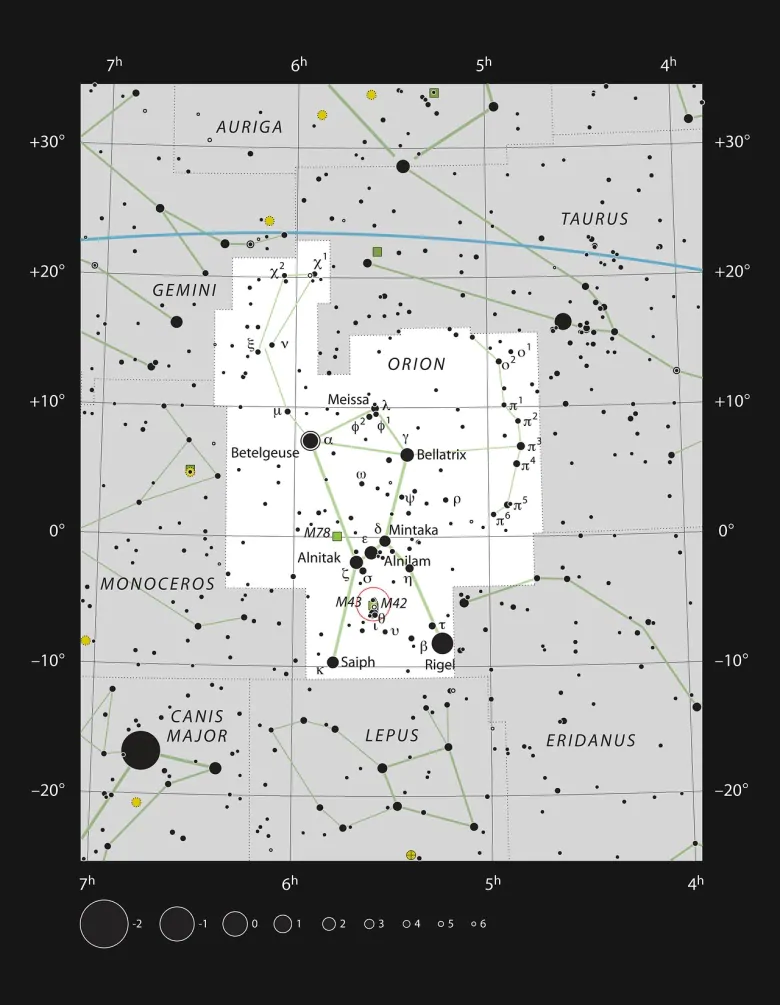
For Valentine’s Day, the particular constellation the project is asking citizen scientists to look at is Orion.
This chart shows Orion as well as the location of the Orion Nebula (Messier 42) in the sword of the famous constellation. It also shows most of the stars visible to the unaided eye under good conditions. (ESO, IAU and Sky & Telescope)
How you can help
Walker said that the whole process is easy, particularly as Orion is one of the most recognizable constellations in the northern hemisphere this time of year.
Participants are asked to visit the Globe at Night’s web app. It asks the time and date and your location (it can also do this automatically). Then there are seven illustrations to choose from, based on how many stars you saw. And finally, it asks you what the sky conditions were at the time of observation, i.e. partly cloudy, etc.
Walker explained the difference between the charts, which measure the magnitudes — or apparent brightness — of the star.
“So, one, it’s like you would see in New York City, where there’s just a couple of stars at best if you see any at all towards Orion,” she said. “And then seven, it’s like you’re in the national parks, where you … see a couple thousand stars.”
Why it matters
Most people probably don’t think of light as a form of pollution, but it’s something that has serious consequences for human health, the environment and wildlife.
For example, light pollution — which is simply defined as the “inappropriate or excessive use of light,” according to the International Dark-Sky Association (IDA) — has affected the nesting habits of sea turtles. There are also estimates that 300,000 to one billion birds die annually from flying into buildings, because they are drawn to the bright lights at night.
This image shows Earth’s lights as seen from space. Many lights — particularly street lights — shine down, out the sides and upward, creating light pollution. (NASA/GSFC)
Though many people and communities have switched to energy-saving LED lights, a 2017 study by Canadian Christopher Kyba, a light pollution researcher at the GFZ German Research Centre for Geosciences, found that these lights might actually be doing more harm than good.
This photograph of Calgary was taken from the International Space Station on November 27, 2015. Many areas on the outskirts are newly lit compared to 2010, and many neighbourhoods have switched from orange sodium lamps to white LED lamps. (Courtesy of the Earth Science and Remote Sensing Unit, NASA Johnson Space Center)
Because the lights cost less, it appears more of them are being used. Kyba, who is involved in the Globe at Night project, is looking to conduct follow-up studies to determine if the night sky brightness is increasing or decreasing.
But why does it matter if we see the stars or not?
“It’s part of our cultural heritage. It has inspired humanity, since the beginning of humanity, for tens of thousands of years. It is an infinite resource for wonder, and it’s where all of our thoughts about science began,” Walker said. “And it’s not just science. It’s the inspiration to be creative in terms of music, like [Gustav] Holst’s The Planets, or literature like Shakespeare …. and then paintings, like Van Gogh.
“If we take away that source of inspiration. What is it going to do to our culture?”
The U.S. Department of Justice hit telecommunications giant Huawei with new charges of stealing trade secrets and breaking sanctions by doing business with North Korea.
A new superseding indictment filed in the Eastern District of New York also adds racketeering conspiracy charges to the allegations already facing the Chinese telecommunications giant.
The 16-count indictment includes the charges of bank fraud, wire fraud, conspiracy to commit bank fraud and conspiracy to commit wire fraud laid last year against the company’s chief financial officer, Meng Wanzhou, who is currently fighting extradition to the U.S. from Vancouver.
Meng, who is the daughter of Huawei founder Ren Zhengfei, faces no new charges in the superseding indictment.
The existing charges allege she lied to banks about Huawei’s control of a subsidiary that was violating U.S. economic sanctions against Iran.
A ‘formal policy’ to steal secrets
The new allegations against Huawei come as the Canadian government is deciding whether to allow the company to be part of Canada’s 5G network.
The U.S. has excluded Huawei from its telecommunications grid and is pressuring its allies to follow suit. Last month, U.K. Prime Minister Boris Johnson announced the Chinese company could play a limited role in Britain’s 5G network.
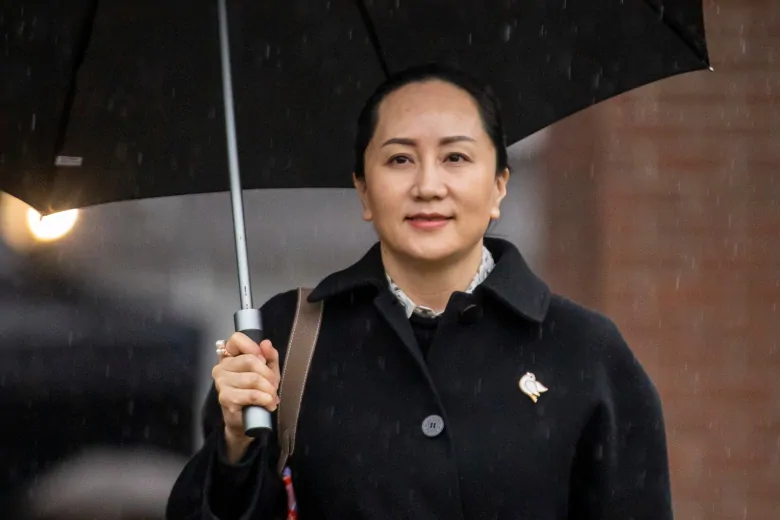
Huawei chief financial officer Meng Wanzhou arrives at B.C. Supreme Court for her extradition hearing. She is currently awaiting a ruling on the issue of ‘double criminality.’ (Ben Nelms/CBC)
The allegations laid out in the superseding indictment build on U.S. fears that Huawei has long engaged in intellectual property theft.
American prosecutors accuse Huawei of entering into confidentiality agreements with the owners of intellectual property and then violating those agreements by misappropriating the information.
They also allege Huawei “launched a formal policy instituting a bonus program to reward employees who obtained confidential information from competitors.”
And they accuse the company of using third-party university professors as proxies to gain access to trade secrets.
None of the allegations has been tested in court.
Involvement in North Korea
In one case outlined in the superseding indictment, a Huawei employee was allegedly “discovered in the middle of the night” after a trade show “removing the cover from a networking device and taking photographs of the circuitry inside.”
The individual allegedly wore a badge listing his employer as “Weihua” — Huawei spelled with its syllables reversed.
Michael Spavor, left, and former Canadian diplomat Michael Kovrig, right, were taken into custody after the arrest of Meng Wanzhou in Vancouver. They have been in Chinese jails for more than a year. (The Associated Press/International Crisis Group/The Canadian Press)
The company allegedly claimed he was a junior engineer. But the superseding indictment claims he was a “senior R&D engineer” who had worked at Huawei for seven years.
The new charges also outline concerns that financial institutions had about Huawei’s presence in North Korea.
The indictment says Huawei representatives and employees repeatedly denied Huawei’s involvement in numerous projects in North Korea.
But U.S. authorities claim Huawei was active in North Korea since at least 2008.
“Internal Huawei documents referred to the geographic locations of projects in North Korea with the code ‘A9,'” the court document says.
“Huawei employees took steps to conceal Huawei’s involvement in projects in North Korea.”
The new indictment says Iran was referred to internally at Huawei by the code A2.
Awaiting ruling on ‘double criminality’
Meng is awaiting a ruling on a key part of her extradition hearing that was held in January in B.C. Supreme Court.
The judge overseeing the case is expected to rule in the coming months on the question of double criminality — whether the offence Meng is accused of committing would be considered a crime if it had occurred in Canada.
She is accused of lying to an HSBC executive in Hong Kong in 2013 about Huawei’s ownership of a Tehran subsidiary that allegedly attempted to sell American computer equipment in violation of U.S. economic sanctions.
The banks allegedly made decisions based on her assertions that put them at risk of violating sanctions.
Meng’s lawyers claim the offence would not amount to a crime in Canada because Canadians did not have the same economic sanctions against Iran at the time the U.S. gave the authority to proceed with the case.
But the Crown alleges Meng’s offence is fraud, plain and simple.
If Meng wins the double criminality argument, the extradition would come to a halt. If not, the case would move to arguments in June over an alleged violation of Meng’s rights at the time of her arrest.
Meng was arrested at Vancouver International Airport in December 2018 on what was supposed to be a stopover on her way from Hong Kong to Mexico City. Her final destination was Argentina.
The 47-year-old has been living under house arrest in one of two multimillion-dollar homes she owns in Vancouver since she was released on $10 million bail a little more than a week after her arrest.
She is forced to wear a GPS monitoring bracelet under the terms of her release and is under the constant guard of a private security firm for which she foots the bill.
Meng says she is innocent of all the charges against her.
The case has sent relations between China and Canada into a tailspin, with the detention of two Canadians within a week of Meng’s arrest.
Entrepreneur Michael Spavor and former diplomat Michael Kovrig were later formally arrested and now face accusations of spying in China, where they are incarcerated without access to lawyers or family.
China also cut off Canadian canola and meat imports in the past year, lifting a ban on pork and beef in November.
Huawei representatives have not responded to a request for comment.
Toronto police confirmed Thursday some of their officers were using Clearview AI, a powerful and controversial artificial intelligence tool that scrapes data from billions of images from the internet.
Police spokesperson Meaghan Gray said in an email that some members began using the technology in October 2019.
Chief Mark Saunders directed those officers to stop using the technology when he became aware of its use on Feb. 5, she said.
Clearview AI has the capacity to turn up search results, including a person’s name and other information such as their phone number, address or occupation, based on nothing more than a photo. The program is not available for public use.
Gray said officers were “informally testing this new and evolving technology.”
In January, police told CBC News they used facial recognition, but denied using Clearview AI. It’s unclear if police purchased the technology — if so, it was never disclosed publicly — or were allowed to demo the app.
Gray said the force has asked Ontario’s Information and Privacy Commissioner and the Crown attorneys’ office to work with the service to review whether Clearview AI is an appropriate investigative tool.
“Until a fulsome review of the product is completed, it will not be used by the Toronto Police Service,” she said.
Police forces across the U.S. have used Clearview AI, but there are growing concerns about how the technology is used and whether it infringes on civil liberties.
It’s unclear if Toronto police have made any arrests based on information generated by the app.
Got a call from Toronto Police today. They tell me that they do use facial recognition technology from Clearview AI and previously “made a mistake” when they said they did not. 1/
As global carbon emissions continue to rise despite warnings from the scientific community, there’s been increased interest in a controversial method to potentially mitigate the rise in Earth’s temperature: Geoengineering.
The conversation around geoengineering — or the deliberate manipulation of our environment — is gaining traction as climate projections remain dire.
Scientists, including the Intergovernmental Panel on Climate Change (IPCC), have repeatedly cautioned that emissions need to be rapidly cut in order to keep the world from warming 1.5 C or 2 C above pre-industrial times — the threshold that would result in widespread damage and suffering.
But with emissions still on the rise, some researchers are now calling for a closer look at more experimental measures, ones that could be pursued alongside emissions cuts.
One of the more popular forms of geoengineering is known as solar radiation management, or SRM.
But SRM is fraught with questions — both ethical and scientific.
“We’re thinking of this as a means to address climate change,” said Anna-Maria Hubert, an international environmental law expert at the University of Calgary. “So you have to situate it within the broader climate debate about what kinds of technologies we want to use. What are their risks? Are they socially acceptable?
“And it’s particularly tricky when you’re talking about something global because these questions are very much socially and culturally embedded.”
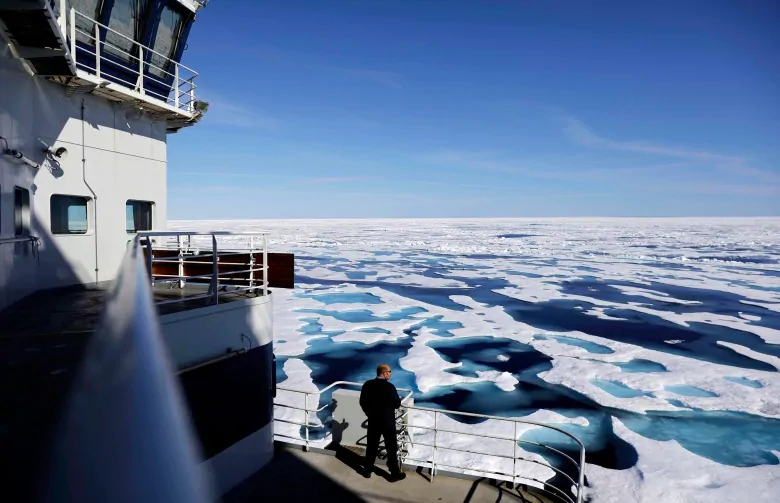
The white snow and ice in the Arctic allows solar radiation to be reflected back out into space. But with accelerated warming in the region, the exposed dark water absorbs that heat, causing more melting. (David Goldman/Associated Press)
In one proposed type of SRM, a material, like sulphur or calcium carbonate, is sprayed into the stratosphere to produce a “global dimming,” or a decline in solar energy reaching Earth’s surface. It’s similar to what occurs after a major volcanic eruption.
Another type is known as marine cloud brightening, where an aerosol of seawater particles would be released in low-lying clouds, increasing cloud cover. It’s an idea born from ship tracks, or the clouds that form in some vessels’ wakes.
With both methods, the concept is that particles in the atmosphere would reflect solar radiation back into space, rather than allowing it to be absorbed by the Earth. (The reflectivity of an object is known as its albedo.)
The overall goal is to create a cooling effect for the planet.
The white snow and ice of the Arctic has done this for thousands of years. But with Earth’s warming temperatures, that snow and ice is melting, increasingly allowing radiation to be absorbed in the now-dark waters at the pole.
Perhaps an even larger issue: How do you get an entire planet to agree on something that knows no borders?
International agreement may be particularly challenging, Hubert noted, at a time when the world’s most powerful nation is retreating from multilateral agreements, including trade agreements and, on the climate change, withdrawing from the Paris Agreement. The U.S. is the world’s second-largest emitter of greenhouse gases.
Scientific challenges
In January, the U.S. National Oceanic and Atmospheric Administration (NOAA) received $4 million from Congress to study geoengineering.
David Fahey, director of the chemical sciences division at NOAA’s Earth System Research Laboratory, said the research is not about whether the government agency will condone geoengineering, but rather that it’s better understood, since most work has been done in labs or using models.
This NASA image from satellite data shows the extent of Arctic sea ice on Sept. 18, 2019. Last year recorded the second lowest levels on record. The orange border indicates the median ice edge from 1981 to 2010. (NSIDC / NASA Earth Observatory.)
NOAA’s mission is to be “stewards of the oceans and atmosphere,” an objective they take very seriously, said Fahey.
And as stewards, he said it’s important that the agency is at least be involved in the planning stages of the discussion, in order to examine the science and feasibility of such a monumental task.
“With geoengineering today, it’s a tangled ball of issues,” he said.
Any tests that can be performed would have to be done on a small, local scale. But the tricky part to testing on a small scale is that you truly don’t know the consequences or repercussions until you do it on a larger scale.
Simply put, the only real way to understand what would happen is to actually do it.
But any deployment of solar geoengineering would be an experiment “in and of itself,” noted Hubert.
“You wouldn’t really know whether or how it’s working, and you’d have to rely on models for quite a long time afterwards to really show what’s going on in the system,” she said. “It would definitely be a leap of faith — no matter how much small-scale research you did in advance.”
Former Japanese environment minister Ryu Matsumoto, centre, front row, delivers the opening speech at the high-level segment of the 10th Conference of the Parties to the Convention on Biological Diversity (COP10) in Nagoya on Oct. 27, 2010. It was during this meeting that delegates put a moratorium on geoengineering. (Yuriko Nakao/Reuters)
Today, some of the most prominent research is currently being done at Harvard, headed in part by Canadian David Keith, a professor of applied physics at the John A. Paulson School of Engineering and Applied Sciences.
One project, known as the Stratospheric Controlled Perturbation Experiment (SCoPEx), plans to use a propeller-driven balloon that would be positioned in front of the sun, some 20 kilometres above the southwest U.S. Once in place, it would release a small amount of material, likely calcium carbonate, and then observe how the particles disperse.
The research is being overseen by an advisory board, created in July 2019, ahead of a planned test.
“I think it’s important for people to discuss these issues more seriously and to do research, so we understand more about the risks and how well these things work and how they might be governed,” Keith said.
There is no confirmed date for the test.
Ethics and governance
Beyond determining whether such geoengineering can be done, the question that’s often raised is should it be done?
It’s clear that not everyone is a fan of changing Earth’s albedo.
“I think albedo modification, by and large, is a terrible idea,” said Emily Cox, an environmental policy researcher at both Cardiff University and the Tyndall Centre for Climate Change Research in the U.K.
“Not necessarily because of the cross-border impacts, but because every time you put it in a model, it changes precipitation patterns — and this is not good.”
“If you’re talking about justice and equity, then the impacts of changing rainfall patterns is going to fall disproportionately on the poorest around the world.”
Women carry diapers as they cross an area flooded by heavy rains in Jakarta in January. Some solar radiation management models show that there could be the unintended consequences of increased precipitation that would require major adaptation. (Willy Kurniawan/Reuters)
And there remains the issue of getting the entire world to agree on using SRM, since any effort will impact everyone. What would its governance look like?
David Cooper, deputy executive secretaryof the UN Convention on Biodiversity, argues that “one could only legitimately proceed on something of scale if you have a multilateral agreement to do so.”
“The central question behind this is: who decides and the power relations behind that,” he said. “It’s important … that any decisions on this need to be taken multilaterally and collectively, and informed by public discussion that involves all groups … particularly Indigenous communities and local communities.”
Another concern relates to something called a “moral hazard,” or the argument that if SRM were deployed, it might be an excuse for some to claim that eliminating CO2 emissions isn’t necessary.
Keith recognizes these concerns and agrees that SRM isn’t a catch-all solution; emissions still need to be cut, he said.
“Do I think … that it might be politically exploited by forces that want to block emissions cuts, like big oil companies who will lie and say that emissions do not need to be cut? Or that it’s an excuse to avoid emissions cuts?” Keith said. “Do I think that is a political risk? Yes, very clearly.”
Cox argues that there’s another way to think about it: Some research into moral hazards has found that they can go both ways. With SRM, for example, it may actually galvanize people who hadn’t realized the climate situation was so dire, into making greener choices.
And no matter whether or not SRM is deployed, experts agree more research needs to be done — even on a small scale.
“Generally, people are favourable toward research under controlled conditions,” said Cox. “The problem is how much you can actually tell from that research.”
One of the largest turtles that ever lived was about the size of a car — and prowled the lakes and rivers of northern South America from about 13 million years ago to 7 million years ago.
Scientists said on Wednesday they have unearthed new fossils of the turtle, called Stupendemys geographicus, in Colombia’s Tatacoa Desert and Venezuela’s Urumaco region that for the first time provide a comprehensive understanding of the big reptile, which got up to four metres long and weighed as much as 1.25 tonnes.
Stupendemys males, unlike the females, boasted sturdy front-facing horns on both sides of the carapace — or shell — very close to the neck. Deep scars detected in the fossils indicated that these horns may have been used like a lance for fighting with other Stupendemys males over mates or territory.
Fighting occurs among certain turtles alive today, particularly between male tortoises, according to paleontologist Edwin Cadena of the Universidad del Rosario in Bogota, who led the research published in the journal Science Advances.
Stupendemys is the second-largest known turtle, behind seagoing Archelon, which lived roughly 70 million years ago at the end of the age of dinosaurs and reached about 4.6 metres in length.
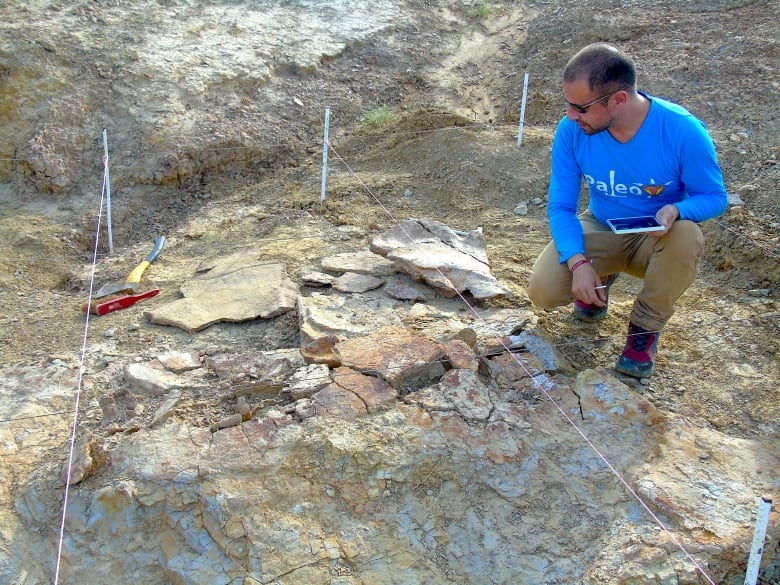
A scientist works at the site of the fossil of one of the male specimens of Stupendemys geographicus during fieldwork in 2016. (Rodolfo Sanchez/Handout via Reuters)
The first Stupendemys fossils were found in the 1970s but many mysteries remained about the animal. The new fossils included the largest-known turtle shell — 2.86 metres long, even larger than Archelon’s shell — and the first lower jaw remains, which gave clues about its diet.
“Stupendemys geographicus was huge and heavy. The largest individuals of this species were about the size and length of a sedan automobile if we take into account the head, neck, shell and limbs,” Cadena said.
“Its diet was diverse including small animals — fishes, caimans, snakes — as well as mollusks and vegetation, particularly fruits and seeds. Putting together all the anatomical features of this species indicates that its lifestyle was mostly in the bottom of large freshwater bodies including lakes and large rivers,” Cadena added.
Stupendemys — meaning “stupendous turtle” — inhabited a colossal wetlands system spanning Colombia, Venezuela, Brazil and Peru before the Amazon and Orinoco rivers were formed.
Its large size may have been crucial in defending against formidable predators. It shared the environment with giant crocodilians including the 11-metre-long caiman Purussaurus and the 10-metre-long gavial relative Gryposuchus. One of the Stupendemys fossils was found with a five centimetre crocodile tooth embedded in it.
Canada will add a huge share of the land that becomes climatically suitable for growing major crops as the world’s temperatures continue to rise, a new study suggests.
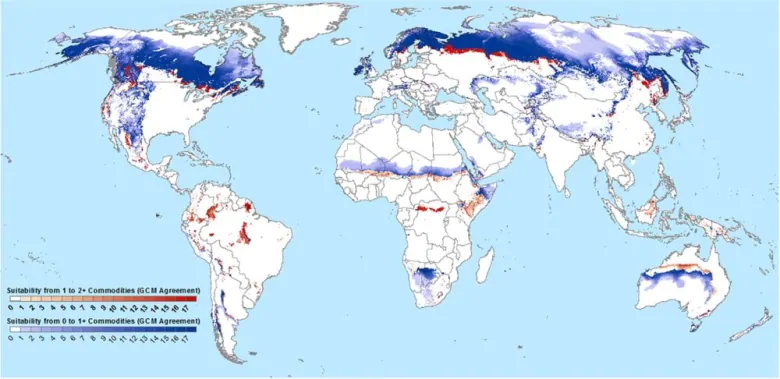
The study, published today in the journal PLOS ONE, predicts about 4.2 million square kilometres of Canada that are currently too cold for farming crops like wheat will be warm enough by 2080 if greenhouse gas emissions continue to climb.
“It may become our bread basket for the future. In that regard, it’s good for Canada,” said co-author Krishna Bahadur KC, an adjunct professor of geography at the University of Guelph.
Currently, only a million square kilometres in Canada are warm enough for growing crops like wheat, corn and potatoes, he said.
“It’s a big, huge difference.”
The research suggests that even much of the Northwest Territories and Yukon could get warm enough to grow wheat and potatoes, while corn and soy could be grown farther north than they are now.
By combining models that predict the future climate with those that show what temperatures are suitable for growing 12 major crops, the researchers showed that around the world, about 15.1 million square kilometres of new land — more than 30 per cent of the land currently being farmed worldwide — could become warm enough for farming corn, sugar, oil palm, cassava, peanuts, cotton, millet, sorghum, rice, potato, wheat and soy.
In this map from the study, areas that transition from no current suitability for major commodity crops to suitability for one or more crops are depicted in blue, while currently uncultivated areas that transition to suitability for multiple major commodity crops are shown in red. (Hannah et al, 2020)
The new farm land wouldn’t just be found in northern areas like Canada and Russia, but also mountainous areas in other parts of the world, including the tropics.
More farming, more warming
But actually farming all of it could have serious environmental impacts, the study says.
Huge amounts of greenhouse gas emissions would be released from the soil — about 177 gigatonnes, or 119 times the current annual emissions of the U.S.
It would destroy important biodiversity hotspots and many of the animals and plants that live there.
It would degrade the drinking water quality for millions of people.
“We need to proceed to expand agriculture very cautiously,” KC warned, “and also [be] very mindful about possible environmental consequences.”
He said the study aims to highlight those concerns for policy-makers.
The idea for the study came from lead authors Lee Hannah and Patrick Roehrdanz of the U.S.-based environmental organization Conservation International. Experts have long predicted that a warmer climate would make new areas of the world suitable for growing crops. Hannah and Roehrdanz wondered what the impact would be on biodiversity and water quality.
Canadian biologist Julian Heavyside helped discover this new bird species — the alto de pisones tapaculo — in the Western Andes region of Colombia in 2017. The Tropical Andes are among the biodiversity hotspots whose climate could become suitable for growing crops by 2080. But actually cultivating the land could put wildlife at risk. (Julian Heavyside)
They approached KC and his colleagues at the University of Guelph, who thought they could use models to answer that question. In the process, they realized the release of carbon from agriculture would also be an issue.
In fact, it would be a major consequence of pushing agriculture into Northern Canada, where boreal forests and peatlands store huge amounts of carbon, the study says.
Cutting down the trees and disturbing the peat would release a lot of that stored carbon, as would tilling the soil to grow crops, KC said.
“The magnitude of the potential release indicates that policies directed at constraining development of these areas are vitally important,” the study says.
Climate isn’t the only factor
KC acknowledged the study looked only at climate as a factor when determining where crops could be grown in the future, and didn’t take into account things like soil quality.
Soil scientist David Burton of Dalhousie University, who wasn’t involved in the study, says that could have a big impact on how much of the potential new farmland is actually arable.
“The soils of Southern Canada have taken 10,000 years to develop,” he said. “Rapid change wouldn’t necessarily make soils in Northern Canada suitable for production.”
A peat plateau on the Dempster Highway in Canada’s North has standing pools with bright green algal mats and a spectacular backdrop featuring the boreal forest. Both peat and boreal forest store huge amounts of carbon that could be released if they are converted to agriculture. (Trevor Porter)
He said he wholeheartedly agrees people should think about the potential environmental consequences before expanding agriculture into new areas, but he said he thinks policy-makers already do.
Johanna Wandel, an associate professor of geography at the University of Waterloo who edited a book called Farming in a Changing Climate, agrees the soil in much of Canada would likely be unsuitable for growing crops, as it’s too rocky or acidic.
Neither Burton nor Wandel think the expansion of agriculture into new areas will necessarily be the solution to a growing world population and increased demand for food in the near future, especially given the study predicts only 0.2 per cent of existing farmland will become unsuitable for growing major crops due to rising temperatures.
They predict the emphasis will instead be on better technology and productivity on the land we already farm and reducing waste to make harvests go further.
Nonetheless, Wandel said she has great respect for the quality of the modelling in the study.
She said even though the benefits of climate change may be small compared to the negative impacts, “it’s absolutely useful to start talking about some of the opportunities.”