Categories
Tech

Dinosaur found with signs of tumour-causing disease that afflicts humans today


Fossils from a hapless hadrosaur from Alberta show telltale signs of a disease that causes tumours in human children, showing the affliction has been around since at least the Age of Dinosaurs, a new study suggests.

Bones from the tail of a truck-sized duck-billed, plant-eating dinosaur that lived about 75 million years ago had some large, unusual holes in them that caught the eye of Darren Tanke of the Royal Tyrrell Museum in Drumheller, Alta.

In a new study published last week in the journal Scientific Reports, Tanke and collaborators in the U.S. and Israel propose that the holes were caused by tumours from Langerhans cell histiocytosis (LCH). The disease affects about one in 200,000 human children and, in rare cases, adults, according to the Histiocytosis Association of Canada.

The disease, which can be painful but usually isn’t fatal in humans, is caused by an overgrowth of immature white blood cells called Langerhans cells, which can accumulate into tumours in parts of the body such as the skin, bones, lymph nodes or liver.

There is some debate whether it is an immune dysfunction or a non-malignant cancer, and the cause is unknown, although it is not contagious and usually not inherited. In humans, aggressive cases are often treated with chemotherapy.

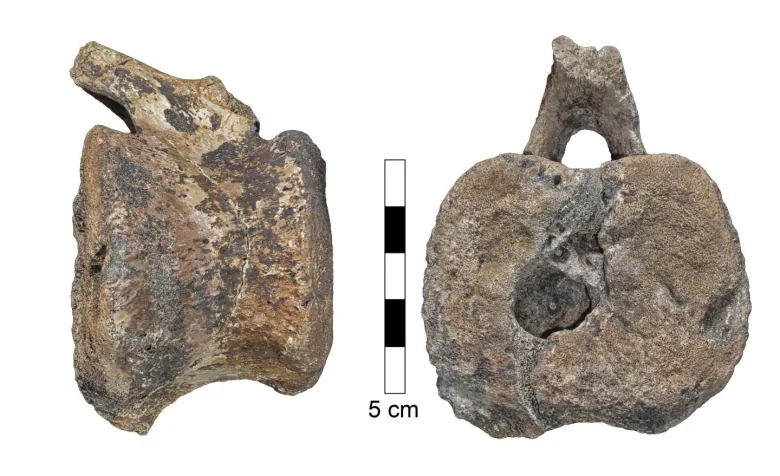
This is one of the diseased hadrosaur tail bones seen from the side, left, and from rear, right. The hole caused by a tumour opens toward the rear. (Assaf Ehrenreich/Sackler Faculty of Medicine/Tel Aviv University)

‘Pathological’ bones tell stories

Tanke, a technician at the museum, has been excavating fossils in Alberta’s Dinosaur Provincial Park for more than 40 years. He’s particularly interested in “pathological” bones showing injuries or diseases that can tell us more about how dinosaurs lived.

One day, he was out fossil hunting when he found a cluster of tail bones from hadrosaurs that roamed the coastal plains of Alberta during the Late Cretaceous.

Tail bones, especially those near the end of the tail, often show injuries — Tanke suggests that many may come from the huge animals, which roamed in herds, stepping on each other’s tails. He took a closer look at this particular cluster and noticed that some were broken through the middle to reveal deep, circular holes.

“It reminded me a lot of when you cut a block of Swiss cheese and encounter a new hole,” he said. “I had never seen anything like it before.”

Darren Tanke of the Royal Tyrrell Museum hunts for fossils at a hadrosaur quarry in Dinosaur Provincial Park. He is particularly on the lookout for bones that are injured or diseased to learn more about dinosaurs’ lives. (© Royal Tyrrell Museum of Palaeontology)

Knowing he had found something very unusual, he sent some photos to Bruce Rothschild, a research associate with the Carnegie Museum and a professor of medicine at Indiana University, who has worked with him on other projects related to diseased and injured dinosaur bones.

Rothschild, who later visited and took a closer look, said there aren’t a lot of things that can create holes in bone, especially holes of this shape, which were smooth with little bulges or “outpockets” visible under a microscope. He had never seen anything like it before in dinosaurs — but he had in some human bones belonging to people with LCH.

“I’d never even heard of it,” Tanke recalled.

To confirm his hypothesis, Rothschild sent the fossils to Hila May, a researcher at Tel Aviv University, for micro-CT scanning. The researchers compared the results to holes in human bones with LCH, and found they shared very similar shapes.

But at least one expert has some doubts. Dr. James Whitlock is a pediatric oncologist at the Hospital For Sick Children in Toronto who has treated and researched LCH in children for over 30 years. He was not involved in the study.

Whitlock says in humans, the disease is diagnosed by looking at tissues under the microscope. He’s not sure a diagnosis can be made by looking at the holes left in the bone.

“As a health scientist, it’s not that convincing to me,” said Whitlock, who is also a director of the Histiocytosis Association of Canada.

That said, he hopes the study raises awareness of the rare disease and helps doctors diagnose it.

This is an illustration of the hadrosaur parasaurolophus. Hadrosaurs were plant-eating, duck-billed dinosaurs that lived in Alberta during the Late Cretaceous. The diseased hadrosaur was an adult about eight metres long. (Daniel Eskridge/Shutterstock)

But how bad is LCH?

Whether the hadrosaur had LCH or not, the researchers don’t know is what impact the holes in its bones would have had on the animal.

In humans, sometimes LCH causes no symptoms. The disease is considered “low-risk” when it affects the bones, though it’s worse if it affects the spleen, liver or bone marrow.

The animal that had the holes in its tail bones was an adult about eight metres long and taller than a human, and looked like it had had the disease for some time, Tanke said.

But he added that hadrosaurs are “very tough” — he’s seen bones from individuals that have survived and healed from “pretty spectacular” injuries, including broken limbs and pelvises.

While this is the first dinosaur ever found with possible signs of LCH, it has been seen in other animals, including tigers and a tree shrew.

Rothschild, who has compared signs of disease in many animals, said many diseases, from gout to psoriatic arthritis, can affect a wide range of animals, and can look quite similar in all of them.

“We’re all God’s children,” he said. “It sounds like a funny way to phrase it, but we all have the same susceptibility.”


Darren Tanke prepares a specimen at the lab at the Royal Tyrrell Museum of Paleontology. (© Royal Tyrrell Museum of Palaeontology)


Source link

Categories
Tech

Jeff Bezos to spend $10B of his money fighting climate change


Amazon founder Jeff Bezos said Monday that he plans to spend $10 billion US of his own fortune to help fight climate change.

Bezos, the world’s richest man, said in an Instagram post that he’ll start giving grants this summer to scientists, activists and non-profits working to protect Earth.

“I want to work alongside others both to amplify known ways and to explore new ways of fighting the devastating impact of climate change,” Bezos said in the post.

Amazon, the company Bezos runs, has an enormous carbon footprint. Last year, Amazon officials said the company would work to have 100 per cent of its energy use come from solar panels and other renewable energy by 2030.

The online retailer relies on fossil fuels to power planes, trucks and vans in order to ship billions of items all around the world. Amazon workers in its Seattle headquarters have been vocal in criticizing some of the company’s practices, pushing it to do more to combat climate change.

Bezos said in the post Monday that he will call his new initiative the Bezos Earth Fund. An Amazon spokesperson confirmed that Bezos will be using his own money for the fund.

Despite being among the richest people in the world, Bezos only recently became active in donating money to causes as other billionaires like Bill Gates and Warren Buffett have done. In 2018, Bezos started another fund, committing $2 billion of his own money to open preschools in low-income neighbourhoods and give money to non-profits that help homeless families.

Bezos, who founded Amazon 25 years ago, has a stake in the company that is worth more than $100 billion.


Source link

Categories
Tech

Astronauts' cravings about to be satisfied with supply run of cheeses, fresh fruit and candies


A cargo ship is rocketing toward the International Space Station, carrying candy and cheese to satisfy the astronauts’ cravings.

Northrop Grumman launched its Cygnus capsule from the Virginia seashore on Saturday. The nearly four-tonne shipment should arrive at the orbiting lab Tuesday. It took three tries over the past week to get the Antares rocket off the pad, with it finally taking flight at 3:21 p.m. — an auspicious 3-2-1.

“Awesome launch,” Joel Montalbano, NASA’s deputy space station program manager, said once the capsule reached orbit.

Besides the usual experiments and gear, the capsule holds cheddar and manchego cheeses, fresh fruit and vegetables, chocolate and three kinds of gummy candy expressly requested by the three station astronauts: Skittles, Hot Tamales, and Mike and Ike jelly candies.

Periodic supply runs by Russia, Japan and NASA’s two private shippers, Northrop Grumman and SpaceX, usually provide more than experiments, equipment, clothes and freeze-dried meals. The capsules also bring family care packages, as well as fresh food to offset the run-of-the-mill station grub.

This latest delivery should have arrived well before Valentine’s Day. But last-minute equipment concerns at the Wallops Island launch pad halted Feb. 9’s countdown for the Antares rocket, then bad weather moved in. Dangerously high wind scuttled Friday’s attempt.

This was the company’s 13th space station delivery for NASA. The Cygnus capsules get their name from the Swan Constellation.

This particular Cygnus has been christened the SS Robert H. Lawrence in honour of America’s first black astronaut. Lawrence, an Air Force major, was chosen in 1967 as an astronaut for a classified military space program known as the Manned Orbiting Laboratory. He was killed five months later in a plane crash and never flew in space.

The space station is now home for Americans Jessica Meir and Andrew Morgan and Russian Oleg Skripochka. Morgan has been up there since July, and the two others since September; they’ll remain on board until April. Three other astronauts returned to Earth earlier this month.

Until astronaut launches resume from Florida — possibly by SpaceX this spring — the station crew will be limited in size to three. NASA astronauts now launch on Russian rockets from Kazakhstan.

Boeing, NASA’s other commercial crew provider, is struggling with software problems in its astronaut capsule. A December test flight was marred by coding errors.


Source link

Categories
Tech

'A great way to wear your activism': Apps are powering a fashion resale revolution


In the market for a vintage blazer or second-hand sneakers? There’s an app for that.

The proliferation of e-commerce tools has propelled the fast fashion industry, giving anyone with an internet connection the ability to put together a new outfit with just a swipe or a click.

But it’s not just new clothes we’re buying. In fact, with the help of apps, the digital thrift market is eclipsing traditional retail in growth, as savvy shoppers hunt for bargains, luxury goods, and a more ecologically conscious way to keep their wardrobes up to date.

Buying and selling second-hand goods online certainly isn’t a new phenomenon. Almost as long as the internet has existed, there have been platforms for shopping. eBay, founded in 1995, has been around for 25 years, spawning a category of online marketplace akin to a flea market, with competitors like Craigslist and Kijiji, where seemingly anything and everything is for sale.

But according to fashion insiders, this new generation of resale platform is different. These new apps are competing not with the likes of eBay, but with the fast fashion brands that dominate social media feeds, offering the convenience of searching by size or brand, linked to the trendy styling of Instagram.

Business is booming

The approach seems to be working: According to a recent ThredUp report, second-hand retail grew 21 times faster than the traditional retail apparel market in the last three years, and is poised to be worth over $50 billion US within the next five years. Luxury resale startups like The RealReal and Poshmark are valued at well over $1 billion each.

Not surprisingly, traditional retailers are taking note.

Last year, Neiman Marcus invested in the luxury reseller Fashionphile, and Foot Locker invested $100 million US in the shoe reseller Goat. Just last week, Nordstrom launched See You Tomorrow, a resale shop in New York, which they started purely based on customer interest.

The Thred Up report found that nearly nine in 10 retail executives want to get into the growing resale market this year.

Better quality, better prices

According to Amanda Cosco, the founder of Electric Runway, there are several reasons for the explosive growth of the second-hand market.

For starters, she says, older clothes are better quality than most of today’s fast fashion. She notes, “Forever 21’s collapse indicated that consumers are moving away from cheap thrills like trend pieces and towards choosing more durable, classic pieces that will stand the test of time.”

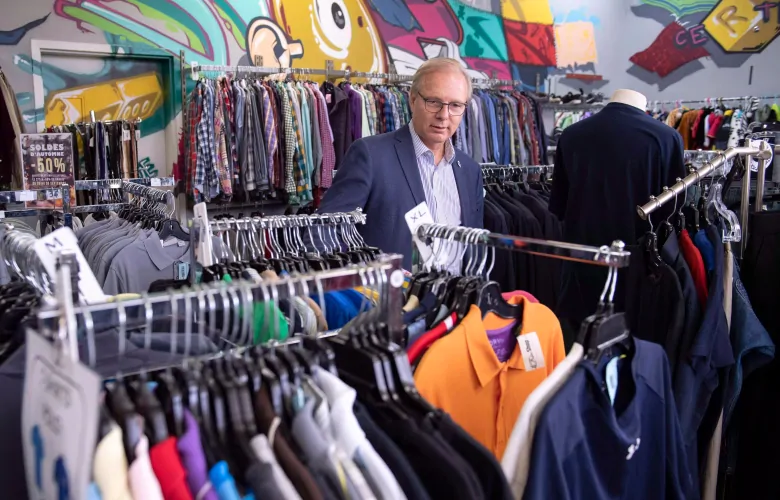
Former Parti Québécois leader Jean-François Lisée walks through a thrift shop in St-Hubert, Que., during the 2018 provincial election. Finding the right size and style at a thrift shop can take time, while apps allow you to follow someone your size with similar tastes, experts say. (Paul Chiasson/The Canadian Press)

Consumers can also get those quality items for less, says Cosco. “Second-hand is more affordable, especially when it comes to luxury items like handbags. Consumers who can’t afford brands like Chanel are just as happy to purchase a gently used Chanel on the second-hand market. It’s their way of buying into a brand that was previously inaccessible.”

Savvy shoppers now have these options, thanks largely to a growing number of apps and online platforms.

“Scouring the racks at Value Village or your local thrift store requires time to sort through and try on items, as well as a good eye for your desired style. On apps and platforms, you can shop via your mobile phone,” says Cosco.

“You can follow people who are your size and who represent the style you’re aspiring to, so finding what you love is a lot easier.”

Peer-to-peer versus consignment

The new generation of online resale can be sorted into two categories: peer-to-peer and consignment services. 

Peer-to-peer platforms are similar to eBay, where sellers create accounts, upload photos and descriptions of goods, and fulfil shipments.

But unlike eBay, Cosco says, new peer-to-peer platforms like Poshmark and Depop operate more like social media in creating communities based on interests and influence. “Where sellers on eBay and Craigslist were fairly anonymous,” she says, sellers on these new apps create profiles that showcase their style, and followers are invited to “shop their closet.”

With consignment apps like The RealReal, the platform itself is more involved in the resale process, photographing and listing items on behalf of sellers, often in order to ensure the quality of brand name luxury goods. That’s especially important when the internet is overflowing with people selling fakes that can sometimes be difficult to distinguish from the real thing.

Brands like The RealReal require all products to be shipped to their warehouses where, once authenticated, they style and photograph the item, explains Andrea Romero, manager of the Fashion Zone at Ryerson University.

“Authentication is a huge thing,” says Romero. “On eBay, we have to trust the seller is acting in good faith, whereas sites like Goat and RealReal take care of this for us, so we can feel confident in making a purchase.”

A more sustainable wardrobe

But the appeal of resale isn’t just about scoring luxury goods, says Romero. As we see the rise in efforts toward sustainability, resale is also an attractive option for consumers who want to make more ecologically conscious decisions.

According to the United Nations, greenhouse gas emissions from textiles production, at 1.2 billion tonnes annually, exceed those of all international flights and maritime shipping combined. Buying an item used reduces its carbon footprint by approximately 82 per cent.

“Buying second-hand is a great way to wear your activism by extending the life of a garment and keeping it out of landfills,” says Cosco.

Romero adds, “The fact that we can do this from the comfort of our own home — that’s a game changer.”


Source link

Categories
Tech

New photo of a star that people hope will explode shows it fading and changing shape


Betelgeuse just keeps getting weirder and weirder.

The massive star has been the subject of much discussion over the past few months after it began to dim in December. The fading hasn’t stopped, and the star that usually lies in the top 10 brightest has fallen to 24th. 

Then, last month, a gravitational wave was detected from the region. These ripples of space-time can occur by massive objects merging, like two black holes or two neutron stars.

Now, astronomers using the European Southern Observatory‘s Very Large Telescope have photographed the massive star and revealed that it appears to have changed shape.

The team has been observing Betelgeuse for some time and, in fact, had taken an image in January 2019 using the Spectro-Polarimetric High-contrast Exoplanet REsearch instrument on the telescope (SPHERE). 

But their followup photograph in December — released today — showed something entirely different.

“We imaged [Betelgeuse] last year … and at that time it wasn’t dimming,” said Emily Cannon, an astronomer at the Institute of Astronomy, KU Leuven in Belgium. “After we got that [new] image we realized that there’s actually quite a large difference between the two of them. So now it’s, ‘What is causing that?'”

Swipe to compare 2019 images from January and December:

For one, the star has changed shape. Also in the image is a bright spot near the top left, and of course, the dimming seen at the lower part of the star.

“It looks like half of the star is hidden behind, in a sense, a sort of curtain,” said Pierre Kervella, an astronomer with LESIA at the Observatoire de Paris — PSL, who was also involved in acquiring the photograph.

Though Kervella said they’re still collecting observations, he said that one hypothesis is that the star has ejected material that has condensed into molecules and dust grains which resemble a “cloud of smoke.”

Seeing as Betelgeuse is 14,000 times more luminous than our sun (it’s also massive: roughly 1,400 times larger than our sun), it would take an immense amount of material for this to occur. But Kervella said that’s another thing they’re trying to determine.

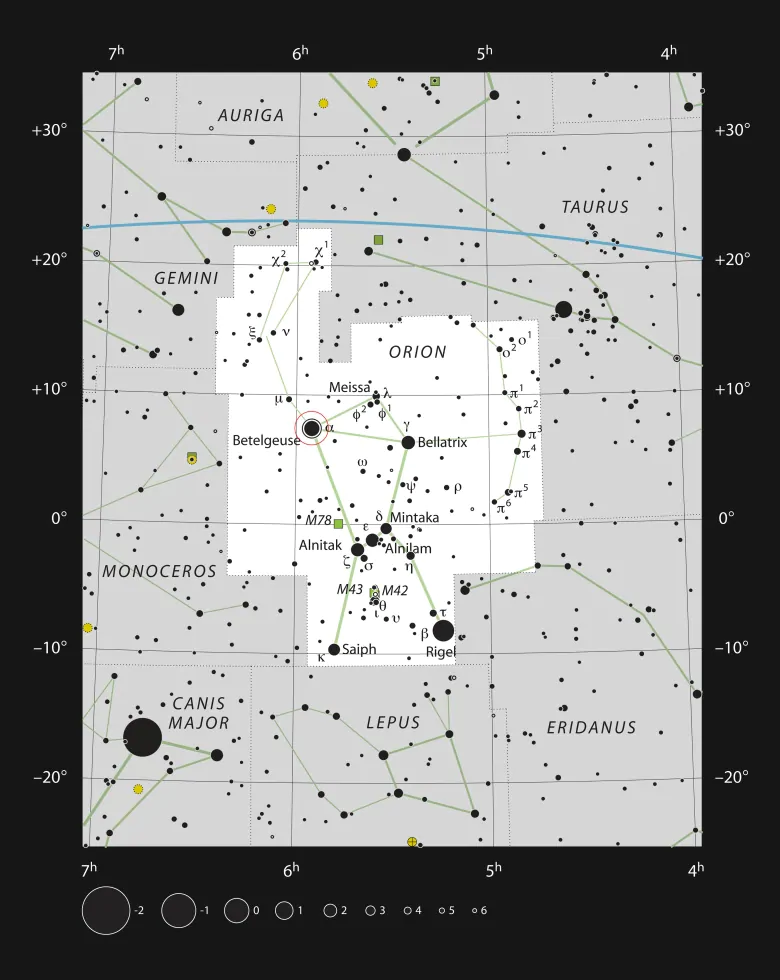
This chart shows the location of Betelgeuse in the famous constellation of Orion. (ESO, IAU and Sky & Telescope)

The bright spot, astronomers believe, is caused by convective cells. These are regions where hotter material is rising to the star’s surface while cooler material goes down. Our sun has millions of these cells, whereas it’s believed that a red supergiant like Betelgeuse likely just has five or 10.

Cannon notes that red supergiants don’t actually appear round, as big bubbles of gas can be bubbling out in various directions, so that could account for the star’s strange appearance.

A big ‘boom’?

Red supergiants are some of the most massive and brightest stars, but they don’t live that long. In human terms, Betelgeuse is a geriatric at 10 million years old. It is nearing the end of its life. By contrast, our smaller sun is roughly 4.5 billion years old, just middle-aged.

Red supergiant stars like Betelgeuse die in a spectacular fashion: after exhausting all their hydrogen and helium they collapse onto themselves, and finally explode in a supernova, one of the most cataclysmic events in the universe. And Betelgeuse is near the end of its life. 

This artist’s impression shows Betelgeuse and its incredible blowing stellar wind of gas. The scale in units of the radius of Betelgeuse as well as a comparison with the Solar System is also provided. (ESO/L. Calçada)

Betelgeuse is a semi-regular variable star, meaning that it dims periodically, with multiple periods. It has cycles of roughly 430 days, but also 100 to 180 days as well as one of about six years.

But this incredible dimming has reduced it by 36 per cent to date. And some people think all this activity — the deep minimum, the potential gravitational wave and now its seemingly misshapen appearance — might mean it’s going to go boom.

Due to its proximity, if it did go supernova, astronomers believe it would be as bright as the full moon and visible during the day.

“This is something everyone would like to see,” said Kervella. “If it would explode, it would be a marvellous show.”

However, he added, “I’d say it’s quite unlikely in terms of pure statistics that we’ll see it in our lifetime.” 

Though Cannon said she doesn’t believe what they’ve observed means that Betelgeuse is necessarily ready to pop now, she added that our knowledge on red supergiants is somewhat limited.

“Never say never, because we don’t really know that much about what’s going on with red supergiants,” she said. “It’s impossible to rule out anything, really.”


Source link

Categories
Tech

How produce stickers contribute to climate change


Hello, people! This is our weekly newsletter on all things environmental, where we highlight trends and solutions that are moving us to a more sustainable world. (Sign up here to get it in your inbox every Thursday.)

This week:

  • How produce stickers contribute to climate change
  • Powering up: The biggest players in battery storage
  • Building a net-zero home doesn’t mean it will sell

How produce stickers contribute to climate change

(Evan Mitsui/CBC)

About three years ago, Susan Antler was at a composting facility in B.C. when a truck full of rotting avocados pulled up.

It was “51 feet, 52 feet [approx. 14 metres] — like, [a] massive truckload,” said Antler, executive director of the Compost Council of Canada. “And the facility just wouldn’t accept it.”

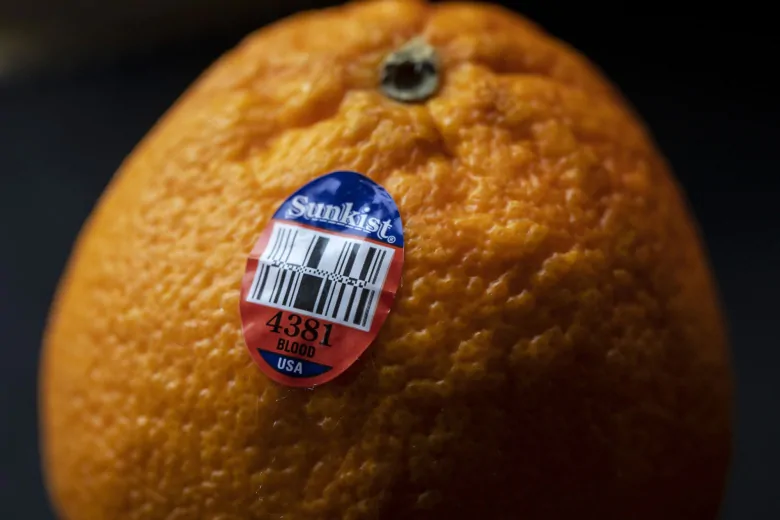
Why? Because each of those thousands of rotting avocados was “contaminated” by a little plastic PLU (or produce look-up) sticker. It carries a number, standardized around the globe, that identifies the type of produce and whether it’s conventionally or organically grown, to help cashiers enter the right price at the supermarket checkout.

Jane Proctor, vice-president of policy and issue management at the Canadian Produce Marketing Association, said while the stickers are voluntary, most chain supermarkets require them. “It is not a regulatory requirement,” she said. “It’s a business requirement.”

The stickers are too small to be screened out in the waste sorting process, but don’t break down during composting. Antler said they end up sprinkled as “foreign matter” through the finished product — compost that’s destined to be used to enrich soils in places such as gardens, farmland and parks. 

The stickers aren’t toxic and don’t harm the compost — although presumably they add microplastics to the environment — so it’s mostly a cosmetic issue, Antler acknowledged. But there are strict guidelines about how much foreign matter is allowed in compost, especially higher grades. And too much can make compost unmarketable.

Mindful of the old adage “garbage in, garbage out,” composting plants that want to produce and sell higher grades of compost need to be careful about what raw materials they take.

In the case of the B.C. facility, Antler offered to remove the stickers from the avocados, but the composting plant manager declined. “He just sent the truck away, so that material went to landfill.” She’s pretty sure it happens all the time. “The scale of waste is massive.”

It’s not just a waste — it could also speed up climate change. 

At a compost plant, organic matter typically decomposes in the presence of oxygen, generating CO2 and compost that can nourish plants. At a landfill, it decomposes without oxygen into methane, a greenhouse gas that has about 30 times the global warming impact of CO2 over a century. (Some organics plants use anaerobic digestion, which also generates methane, but it is captured and burned so it doesn’t go into the atmosphere.)

But there are solutions, including other ways to affix the PLU to bulk fruits and veggies, such as:

Proctor said produce sellers often don’t see the extra investment as worthwhile when many customers don’t have access to municipal composting. She added that the recent introduction of scannable barcodes on PLU stickers — which Canadian stores are expected to adopt soon — requires the labels to show fine detail and maintain durability, which only plastic enables.

In the meantime, you can help by making sure you take the little stickers off your fruit and veggie peels and rinds before tossing them in your green bin at home.

Emily Chung


Reader feedback

Emily Chung’s piece on wood buildings last week garnered a lot of feedback from readers, some of whom were concerned about the safety of the material itself. “I have reservations regarding wooden highrise buildings,” said Bob Miller. “These include: Wood burns. Wood is not recyclable. Wood is subject to rot.”

This article from last year highlights the concerns of some fire chiefs and also includes a comment from a senior researcher at Natural Resources Canada.

Other readers were concerned about where all the wood would come from.

“Are you seriously promoting the denuding of our planet’s trees as a green solution! Methinks this is seriously flawed logic,” wrote Simon Faunt.

We already cut and clear-cut, unfortunately, too many forests,” said Joan Thompson. “Can and will we replant enough trees to maintain the natural wildlife spaces, clean our air and prevent soil erosion… I’m not sure. We build and we build and we build. There are no restrictions. We need to consider each option carefully — pros and cons.”

Old issues of What on Earth? are right here.


The Big Picture: The major players in battery storage

Last week in this space, we discussed the stock market slide for a number of the best-known oil and gas companies. This week, we’re highlighting some of the biggest players in lithium-ion battery storage, which will be a key industry in the global transition away from fossil fuels. All of these companies supply car manufacturers (as well as electric utilities). In addition to upstart Tesla, there are a couple of Chinese newcomers — Contemporary Amperex Technology (CATL) and BYD — as well as more established names like South Korea’s LG Chem and Japan’s Panasonic. The chart below reflects 2018 figures for each company’s total storage capacity.

(CBC)

Hot and bothered: Provocative ideas from around the web

  • Many environmentalists say that making some doubters appreciate the scale of carbon pollution is difficult because CO2 is invisible. This clever video illustrates what it would look like if your tailpipe emissions came out as solid chunks of carbon — or “car turds.”

Building a net-zero home doesn’t mean it will sell

(Roger Cosman/CBC)

Brad McLaughlin says it should be easy for a northern country like Canada to build the kind of home that is so efficient it makes more energy than it uses.

But McLaughlin, the general manager of MCL Construction Ltd. in Quispamsis, N.B., is beginning to wonder if reducing residential greenhouse gases is really a priority in this country.

His certified net-zero home has maxed out energy efficiency. The house has insulated concrete walls, triple glazed windows, 44 solar panels and a backup rechargeable battery system.

On a sub-zero February afternoon, it’s sending excess electricity back to the provincial grid in exchange for NB Power credits to be used on the coldest days, or at night when the sun is down.

But the three-bedroom, two-bath home stubbornly refuses to sell. It has been on and off the real estate market since 2017.

“It hasn’t moved,” McLaughlin said. “We had a lot of people through it.” 

Starting out, McLaughlin’s asking price was $695,000. By May 2019, he had lowered it to $570,000. This week, he put the two-storey house back on the market at $495,000.

McLaughlin points to mortgage “stress tests” and indifference from bank-hired appraisers as obstacles pushing buyers away from these higher-than-average priced homes. McLaughlin feels the federal government could do more to kick-start construction of these kinds of homes.

His first suggestion would be to revamp the mortgage stress test introduced to cool red-hot housing markets in Vancouver and Toronto. McLaughlin said the test lacks flexibility and is locking people out of the net-zero-carbon housing market by denying them mortgages for homes with higher purchase prices, without allowing for the fact the buyer won’t have any heating and electricity costs.

He said appraisers are at a loss when it comes to a sustainable house like this.

“Around here, they just don’t know how to value it.…They just say, ‘Well, there’s a similar house down the street,'” he said. “Well, sure it might look the same, but it’s a lot different.”

McLaughlin isn’t alone in his thinking. The Canadian Home Builders Association and the Canadian Real Estate Association (CREA) are also calling for changes to the system. CREA national president Jason Stephen, who is a Saint John realtor, said the stress test should be adjusted to suit regional markets across the country.

“If this was a system that was brought in to address escalating housing prices, month over month, or year over year, we just don’t have that, which is why we always say there’s not one housing market [across] the whole country,” Stephen said.

During the 2019 election campaign, the federal Liberals promised to introduce a $5,000 grant to buyers of net-zero homes and to offer interest-free loans of up to $40,000 to homeowners and landlords for energy saving retrofits. The program has yet to be introduced.

Other efficiency programs are already available to builders and buyers in New Brunswick. NB Power offers as much as $10,000 in incentives for construction of energy-efficient homes, and Canada Mortgage and Housing Corporation has a 15 to 25 per cent discount on mortgage insurance costs, depending on the level of efficiency of the home. 

Connell Smith


Stay in touch!

Are there issues you’d like us to cover? Questions you want answered? Do you just want to share a kind word? We’d love to hear from you. Email us at whatonearth@cbc.ca.

Sign up here to get What on Earth? in your inbox every Thursday.

Editor: Andre Mayer | Logo design: Sködt McNalty


Source link