Categories
Tech

Neanderthals had funerals with flowers, study suggests


A Neanderthal skeleton unearthed in an Iraqi cave already famous for fossils of these extinct cousins of our species is providing fresh evidence that they buried their dead — and intriguing clues that flowers may have been used in such rituals.

Scientists said on Tuesday they had discovered in Shanidar Cave in the semi-autonomous Kurdistan region of northern Iraq the well-preserved upper body skeleton of an adult Neanderthal who lived about 70,000 years ago. The individual — dubbed Shanidar Z — was perhaps in his or her 40s or 50s. The sex was undetermined.

The cave was a pivotal site for mid-20th century archaeology. Remains of 10 Neanderthals — seven adults and three infants — were dug up there six decades ago, offering insight into the physical characteristics, behaviour and diet of this species.

Clusters of flower pollen were found at that time in soil samples associated with one of the skeletons, a discovery that prompted scientists involved in that research to propose that Neanderthals buried their dead and conducted funerary rites with flowers.

That hypothesis helped change the prevailing popular view at the time of Neanderthals as dimwitted and brutish, a notion increasingly discredited by new discoveries. Critics cast doubt, however, on the “flower burial,” arguing the pollen could have been modern contamination from people working and living in the cave or from burrowing rodents or insects.

A view of the entrance to Shanidar Cave in the foothills of the Baradost Mountains in Iraq’s northern Kurdistan region, the site where fossils of 10 Neanderthals have been unearthed is seen in an undated photo. (Graeme Barker via Reuters)

But Shanidar Z’s bones, which appear to be the top half of a partial skeleton unearthed in 1960, were found in sediment containing ancient pollen and other mineralized plant remains, reviving the possibility of flower burials. The material is being examined to determine its age and the plants represented.

“So from initially being a skeptic based on many of the other published critiques of the flower-burial evidence, I am coming round to think this scenario is much more plausible and I am excited to see the full results of our new analyzes,” said University of Cambridge osteologist and paleoanthropologist Emma Pomeroy, lead author of the research published in the journal Antiquity.

Debate over Neanderthal burials

Scholars have argued for years about whether Neanderthals buried their dead with mortuary rituals much as our species does, part of the larger debate over their levels of cognitive sophistication.

“What is key here is the intentionality behind the burial. You might bury a body for purely practical reasons, in order to avoid attracting dangerous scavengers and/or to reduce the smell. But when this goes beyond practical elements it is important because that indicates more complex, symbolic and abstract thinking, compassion and care for the dead, and perhaps feelings of mourning and loss,” Pomeroy said.

Shanidar Z appears to have been deliberately placed in an intentionally dug depression cut into the subsoil and part of a cluster of four individuals.

The bones of a Neanderthal’s left hand emerge from the sediment in Shanidar Cave. Bodies appear to have been deliberately buried in just one part of the cave. (Graeme Barker via REUTERS)

“Whether the Neanderthal group of dead placed around 70,000 years ago in the cave were a few years, a few decades or centuries — or even millennia — apart, it seems clear that Shanidar was a special place, with bodies being placed just in one part of a large cave,” said University of Cambridge archeologist and study co-author Graeme Barker.

Neanderthals — more robustly built than Homo sapiens and with larger brows — inhabited Eurasia from the Atlantic coast to the Ural Mountains from about 400,000 years ago until a bit after 40,000 years ago, disappearing after our species established itself in the region.

The two species interbred, with modern non-African human populations bearing residual Neanderthal DNA.

Shanidar Z was found to be reclining on his or her back, with the left arm tucked under the head and the right arm bent and sticking out to the side.




Source link

Categories
Tech

Strategy aims to have 80 per cent of Windsor homes retrofitted for energy-efficiency by 2041


With three months having passed since Windsor council declared a “climate emergency,” the question now is — what’s the city going to do about it?

On Wednesday, the city’s Environment, Transportation and Public Safety Standing Committee examined multiple reports, looking at strategies to find the answer to that question.

One outlined a strategy to reduce Windsor’s greenhouse gas emissions by 40 per cent from 2014 levels over the next two decades. The second looked at renovating homes throughout Windsor to reduce the city’s carbon footprint.

Karina Richters, the city’s supervisor for environmental sustainability and climate change, said home retrofits are a key part of the plan, since the average Windsor home was built in 1955, about 20 years before things such as insulation were required.

“So we know that we have an inefficient building stock, especially in those homes that haven’t had any sort of retrofit,” she said, adding many homeowners in Windsor don’t have the capital to do a massive retrofit since “windows and doors are pretty expensive.”

Fabio Costante says the retrofit program would save money for both the city and homeowners in the long run. (Dale Molnar/CBC)

Another reason more homeowners haven’t taken advantage of grants and incentives to make their properties more energy-efficient, Richters said, is that they don’t know if they will remain in their homes long enough to see a return on that investment.

“So one of the things we’re looking at is trying to set up a program that would eliminate those two hurdles to get people to actually be able to retrofit their home.”

Called the Deep Energy Retrofit Program, the strategy would see the city create an entity to administer the program. It would have standardized retrofit packages, which could reduce costs through volume pricing for materials and labour productivity.

It also means contractors would not need to prepare customized quotes. Property owners could then pay for the upgrades through a local improvement charge on their taxes.

“It’s not a tax increase, but it will be attached to the property much like a tax is,” standing committee member Fabio Costante said. “If you bought into this program and you were to sell your property, whatever is left owing on the retrofit will be the obligation of the purchaser of the property — much like property taxes would be.”

Costante added a number of questions were directed to Richters during Wednesday’s meeting about the city’s ability to create a separate entity which would operate this retrofit program.

“There were some questions on risk to the corporation of the City of Windsor and what kind of financial commitments the city would have to make,” said Costante.

According to Costante, only five per cent of homeowners in Windsor take advantage of special grants for retrofitting. The Deep Energy Retrofit Program would aim to have 80 per cent of city homes retrofitted by 2041. (Stacey Janzer/CBC)

“But ultimately, it was seen as a net positive and the rewards that could come from it could in fact outweigh the risks involved.”

Richters believes if about 80 per cent of all homes were retrofitted, that would reduce about 235,000 tons in greenhouse gas emissions every year. 

According to Costante, only five per cent of homeowners in Windsor are currently “taking advantage of special grants for retrofitting.” The Deep Energy program calls for 80 per cent of homes to be retrofitted by 2041.

“When we look at saving on energy as individual homeowners and and as a community as a whole, this is one of those programs that could really move the needle,” said Costante.

One of Costante’s most emphatic points during Wednesday’s meeting, he said, is that the program would serve not just as a means to reduce the amount of energy the city uses — but that it also makes economic sense as well.

City of Windsor councillors declared a climate change emergency on Nov. 18, 2019, joining over 400 communities across Canada. (Katerina Georgieva/CBC)

“The payback that homeowners will receive and the cost savings that they’ll receive within a shorter period of time than originally anticipated is really important. Over the long run, they’re going to see great savings,” said Costante.

“The community as a whole is going to be producing less energy, which is great for the environment. So it’s a really good win on both sides, the environment and the economy.”

Coun. Kieran McKenzie, who also sits on the committee, says it’s the city’s moral duty to help people cut down on greenhouse gas emissions from their homes.

“I truly believe that we can’t afford to not make the investments that are being proposed here, and what we see in front of us is a road map to help us get to where we, as a community, need to be,” McKenzie said.

Richters is also recommending the city begin considering climate change risks in all future reports presented to council. She said the aim is to “bring an awareness” to the city of possible climate risks.

“We want people to consider, for example, if we’re building something, is it going to last the climate future?” she said.

“The marina, it was under water this year. So if we’re building another marina, let’s consider what those water levels are going to be like. Giving it a little bit of forethought, maybe we can reduce those risks in the future.”

Following a unanimous vote from all five committee members, the retrofit program will be presented to council in three weeks for final approval. Even if this strategy is completely successful, there would still be a 29 per cent gap to reach the city’s target, but Richters says she’s not worried about that.

“We need to start where we can and make headway, and I think once the public sees that it’s not necessary a change of the way they live, but just a rethought, I think that we’ll get more buy-in, more acceptance,”

Richters also expects technology to come along that will make greater gains.

“For electric cars, we have a target now 10 per cent, but that could easily go up to 30, 40, if we start getting trucks and SUVs on the road that are EV.”


Source link

Categories
Tech

Tim Hortons changes Roll Up the Rim contest to go greener


Until now, Tim Hortons’ annual Roll Up the Rim contest encouraged customers to consume and throw out millions of disposable coffee cups for a chance to win prizes. But this year it’s rolling out a greener version of the contest.

“We listened to the feedback from our guests, who wanted us to modernize the program,” Hope Bagozzi, the company’s chief marketing officer, said in a statement Wednesday.

This year’s contest, which runs from March 11 to April 7, allows people to play online at rolluptherimtowin.ca or through the Tim Hortons app. In fact, they’ll only be able to get a disposable contest cup for the first two weeks of the contest.

“We will reward guests who make the sustainable choice by using a reusable cup,” Bagozzi said. They’ll get extra chances to win, compared to those who opt for a disposable cup.

However, customers who play digitally will need to provide an email address and register a Tim Rewards card. Previously, all you needed to do to claim a smaller prize was to present a winning cup (or even just the rim).

Tim Hortons will also be giving away 1.8 million free reusable cups starting March 10 ahead of the contest launch.

Traditionally, the contest that began in 1986 has involved rolling up the rim of a disposable plastic-lined paper cup to reveal prizes ranging from a free coffee or doughnut to TVs and cars. Customers who brought their own mugs still had to accept a paper cup to play.

That led to criticism and petitions from Canadian environmental groups and schoolchildren, who said it encouraged people to generate more waste, most of which wasn’t recycled and often ended up as litter.

Millions of cups, most not recycled

According to Greenpeace, the company produced 260 million single-use cups for last year’s contest alone. CBC News has reached out to Tim Hortons to verify that number.

Greenpeace also surveyed 20 major municipalities across Canada and found the combination of cups and lids were not collected for recycling in 15 of them. 

This Tim Hortons cup was found along the St. John River in Fredericton, N.B., during a mini cleanup and brand audit at Morell Park in September 2019. The plastic-lined cups and plastic lids are often found during shoreline cleanups, leading to the company being named by Greenpeace as one of Canada’s top plastic polluters. (Greenpeace)

The cups and lids have been among the top items found in shoreline cleanups across the country. That’s helped earn Tim Hortons a place as one of Canada’s “top plastic polluters” in Greenpeace’s annual audits of branded plastic litter.

Sarah King, the head of Greenpeace Canada’s oceans and plastics campaign, said in a statement she’s pleased that the company is committing to going beyond the disposable cup by incentivizing its customers to use resusables during the contest.

“Tim Hortons’ vow to change consumer habits towards using reusable cups is the right direction for the coffee sector who has based its business model on the throwaway culture,” she added.  “We are hopeful that Tim Hortons will lead the fast-food industry into a new era of replacing all disposables with reusables.”

However, Mark Gordon, a Toronto-based customer experience expert, told CBC Calgary he thinks the changes will inconvenience customers and have a negative impact on a popular, long-running campaign.

“[Customers] just can’t wait to finish it and do that little ritual of rolling up the edge. People love doing it, and they’ve been doing it for 30 years and it’s part of the fun and the unique character of this promotion.”

He said he doesn’t think this year’s contest will go well for Tim Hortons and doesn’t think this format will continue next year.


Source link

Categories
Tech

Oilsands on 'collision course' with Canada's climate goals, global market changes: report


The oilsands have reduced the amount of greenhouse gas they emit per barrel of oil produced but remain more carbon-intensive than the average barrel worldwide and are the fastest-growing source of emissions in Canada, according to a new report from the Pembina Institute.

That puts the sector in a risky position as the world looks to shift toward lower-carbon energy sources, the report says, and creates a challenge for Canada in meeting its climate commitments.

“We urgently need to work together to prepare Canada to compete in a low-carbon economy,” the institute’s executive director, Simon Dyer, said in a release.

“That includes a fact-based discussion about the role of the oilsands, which is the fastest-growing source of emissions in Canada. We need a constructive and thoughtful conversation — let’s not shy away from it.”

The report aims to “depolarize the conversation about continued production of oil from the oilsands,” highlighting the success the industry has had in reducing emissions intensity over past decades while also warning of “unprecedented pressures” that lie ahead.

Despite those improvements in carbon intensity, total emissions from the oilsands have more than doubled since 2005 due to increased production and “are projected to keep growing at a similar pace through to 2030,” the report says. That puts the industry on a “collision course” with Canada’s commitment to achieve “deep decarbonization” as part of a global effort to stave off the most devastating effects of climate change.

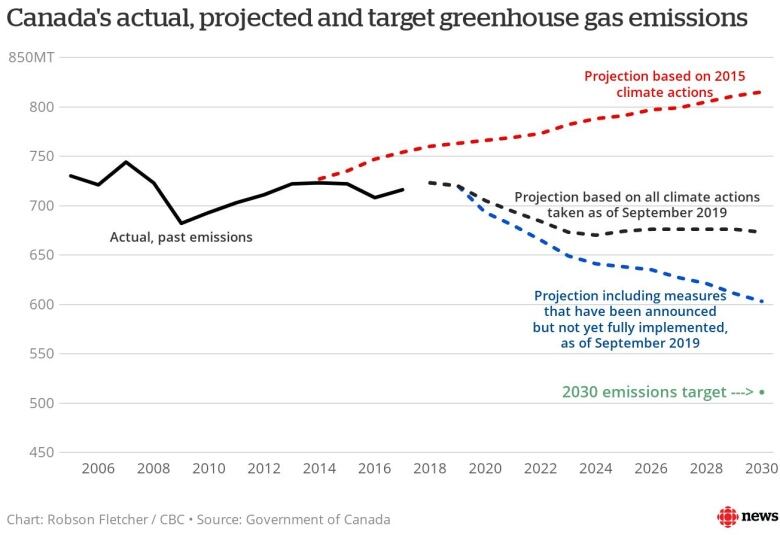
Canada’s annual emissions totalled 716 megatonnes in 2017. Under the Paris Agreement, it has pledged to reduce that amount to 511 megatonnes by 2030, but at its current rate is set to miss that target by nearly 100 megatonnes.

Even more challenging will be Canada’s plan to become carbon-neutral — that is, to have zero net emissions when including carbon offsets — by 2050.

“Business-as-usual no longer applies — significant changes are necessary,” the report reads.

Those changes will be particularly needed in Alberta, which accounts for more than a third of Canada’s total greenhouse gas emissions, the report adds.

It notes the province’s oil and gas sector is “the largest single source of emissions across Canada,” making up 19 per cent of the country’s total greenhouse-gas output in 2017.

Greenhouse gas emissions by province and sector in 2017. (Chart: Pembina Institute / Data: 2019 National Inventory Report)

“The pathway to make Canada’s oilsands carbon-neutral will not be easy, and will only be more difficult if the discussion is not grounded in fact,” Chris Severson-Baker, the Pembina Institute’s Alberta regional director, said in a release.

“This report answers some of the key questions around oilsands and describes the challenge to go well beyond the incremental gains that have been made to date to reduce total emissions for the sector by 2030 and ultimately achieve net-zero emissions by 2050.”

Several major oil-and-gas companies, including Cenovus, Canadian Natural Resources and MEG Energy have announced long-term plans to make their operations carbon-neutral in the coming decades, although exactly how to achieve that remains an open question.

The Pembina report makes several recommendations it says would help toward that goal, including a return to an industry-wide standard in Alberta’s carbon pricing policy for large emitters.

Effective Jan. 1, the provincial government changed that policy, creating different benchmarks for different facilities, a move the report describes as “a step backward in climate policy.”

“In contrast, the previous provincial regulations were meant to accelerate the adoption of lower-carbon technologies through an industry-wide benchmark that created both a level playing field and a race to the top,” the report reads.

It also recommends improved emissions monitoring, the creation of sector-by-sector emissions targets for 2030 and 2050 made enforceable in five-year increments and the establishment of more “credible and effective” energy regulators at both the provincial and federal levels that have “the capacity to follow through on that enforcement.”

Finally, it calls for a a “robust ecosystem to support innovation, research and development” of new technologies that go “beyond incremental improvements” in reducing oilsands emissions.

Such rapid changes will be necessary not only to meet Canada’s climate commitments, the report says, but also to keep the industry competitive as “global shifts toward lower-intensity energy options are likely to put more carbon-intense crudes — such as the bulk of oilsands products — at risk over the next decade.”

The Pembina Institute is a non-profit organization that produces research, analysis and recommendations on policies related to Canadian energy and climate change.


Source link

Categories
Tech

Cleanup of Cameron Hills project hangs in balance as Strategic Oil and Gas in receivership


A troubled oil and gas company that has wells in the Northwest Territories has gone into receivership, and the territory’s oil and gas regulator is worried that taxpayers will be left to clean up the property.

Strategic Oil and Gas Ltd. has been under creditor protection for 10 months, but it’s efforts to restructure have failed, it’s directors have resigned and it is now winding down and selling off all of its assets.

But the Office of the Regulator of Oil and Gas Operations for the territory has grave concerns about the company’s plan to transition from creditor protection to receivership. Those concerns are laid out in a Jan. 28 affidavit submitted by OROGO’s chief conservation officer to the Alberta Court handling Strategic’s dissolution.

“Of particular concern to OROGO is the suggestion … that all of the Cameron Hills Wells can safely be left in their current condition for an indefinite period of time, as the transition plan provides that Strategic’s intention to ‘defer previously scheduled suspension and abandonment work,'” Pauline de Jong says in her affidavit.

Another worry is that Strategic’s plan makes no mention of its obligation to comply with an order issued by the N.W.T. regulator late last year.

Outstanding orders

In the Oct. 14, 2019 order from then-regulator Louis Sebert, he told Strategic to repair and test an old well that was leaking deadly hydrogen sulfide gas. 

“As the Cameron Hills Field is a sour gas (hydrogen sulfide) field, an uncontrolled release from the I-73 Well, or any other well in the Cameron Hills Field may include the release of H2s (hydrogen sulfide), which is toxic to humans and poses a risk to flora and fauna in the area,” he wrote.

Shortly after, as a temporary measure, Strategic installed a sour gas scrubber, which uses chemicals to remove hydrogen sulfide from the gas escaping the well. Sebert set April 1, 2020 as the deadline for permanently fixing the problem. According to the KPMG monitor handling Strategic’s dissolution, the company is on track to meet that deadline.

In his report, however, the monitor says nothing about Strategic’s ability to meet deadlines Sebert set for final closure of 40 other wells and the pipeline gathering system at Cameron Hills.

H2s (hydrogen sulfide) … is toxic to humans and poses a risk to flora and fauna in the area.– Louis Sebert

Last summer, an MLA raised concerns about taxpayers being saddled with the cost of doing that work.

Frame Lake MLA Kevin O’Reilly pointed out that KPMG, the accounting firm handling the restructuring of Strategic, estimated that the company owed the N.W.T. government $12.4 million in “end of life” obligations associated with the Cameron Hills project. In regulatory filings, Strategic says it has posted $3.9 million in security for the project.

In an email to CBC, the territorial government said it does not know how KPMG came up with the $12.4 million figure.

Restructuring plan rejected

In a restructuring plan Strategic proposed late last year, it said it had reached a proposed deal to sell the Cameron Hills property. But the Office of the Regulator of Oil and Gas Operations identified problems with that plan.

Sebert pointed out that his office was not given a copy of the terms of the purchase and was worried it would relieve Strategic of its obligations to clean up its Cameron Hills operation.

Sebert wrote that his office had reviewed the financial information provided by the prospective purchaser, Tallahassee Resources Inc., and had concerns that it “is not in a financial position to be able to complete the necessary suspension and abandonment of wells and decommissioning of infrastructure.”

The Alberta Energy Regulator also had problems with Strategic’s restructuring plan. According to a report from the monitor overseeing the restructuring, it also issued an order to Strategic. On Jan. 20, it ordered Strategic to post a $48.7 million security deposit for liabilities in that province.

The monitor said he understood that Alberta had no realistic expectation of Strategic paying up and that the step was necessary to engage a program the province has for dealing with so-called “orphan wells” — those owned by companies that do not have the financial resources to decommission them.


Source link

Categories
Tech

Astronomers look to preserve the night sky as thousands of satellites set to launch


The potential launch of tens of thousands of satellites is a serious threat to astronomy, according to the International Astronomical Union (IAU). Now, it’s trying to find solutions.

The announcement came just days before SpaceX launched an additional 60 of its Starlink satellites

Such “constellations” — any collection of artificial satellites —  are already in wide use, powering the GPS in our cars and cellphones, for instance. But it’s the massive number yet to come that has astronomers around the world deeply concerned.

Seen here is a trail of almost 60 satellites recorded by Marco Langbroek. The Starlink satellites were launch atop a Space X Falcon 9 rocket on May 23, 2019. (Marco Langbroek)


“We are used to some satellites crossing the night sky, but now we’re talking about thousands, some that would be bright enough to see with the human eye,” said Piero Benvenuti, an adviser at the executive committee of the IAU, which has more than 13,000 members worldwide.

In all, SpaceX plans to launch as many as 42,000 satellites, and it’s not the only one. Amazon plans to launch roughly 3,200 satellites, and OneWeb’s 650 satellites. Canada also plans to launch 300 Telesat satellites.

The goal of Starlink is to bring internet connectivity to every part of the world, a goal similar to OneWeb’s.

And while astronomers agree that goal is a practical one, they are concerned over not only the loss of the night sky, which is already under threat due to light pollution, but also to large-scale and very expensive observatories, like the $1 billion US, 8.4-metre, ground-based Large Synoptic Survey Telescope

There are more and more of these all-sky surveys being put into place. Instead of looking at a small patch of sky, they scan large swaths. But moving satellites create long streaks of light in the images collected.

Around 19 Starlink satellites were imaged by DECam on the Blanco 4-metre telescope at the Cerro Tololo Inter-American Observatory (CTIO) shortly after launch in November 2019. The gaps in the satellite tracks are due to the gaps between the DECam CCD chips. (NSF’s National Optical-Infrared)

“Apart from their naked-eye visibility, it is estimated that the trails of the constellation satellites will be bright enough to saturate modern detectors on large telescopes,” the IAU statement said. “Wide-field scientific astronomical observations will therefore be severely affected.”

‘Pristine’ night sky

Reports of the visibility of a “train” of Starlink satellites began last May, shortly after the first batch of 60 were launched. Astronomers, both professional and amateur, posted videos and photos of the long streak of satellites dotting the night sky.

Then, in December, more satellites were launched. 


But while the threat may be most felt by professionals, the IAU statement noted, “The appearance of the pristine night sky, particularly when observed from dark sites, will nevertheless be altered, because the new satellites could be significantly brighter than existing orbiting man-made objects.”

As a result, the IAU, as well as other organizations like the American Astronomical Society, sought out professional astronomers to run simulations showing what would happen with tens of thousands of satellites in orbit around Earth. The hope was to not only better understand the consequences but also head toward some solutions.

Preliminary findings

They found that, using an example of 25,000 satellites in low-Earth orbit — which ranges from 160 to 2,000 kilometres above Earth and with orbits between 84 and 127 minutes — at any given point, satellites above the horizon could number from 1,500 to a few thousand. 

Some other notable findings:

  • While most would lie near the horizon, roughly 250 to 300 of those would appear in a part of the sky where most of astronomical observations are conducted (roughly 30 degrees above the horizon).
  • When the night sky is darkest, there could be 1,000 satellites visible at once, until they enter Earth’s shadow and become less visible. 
  • The trains of satellites are most visible shortly after initial launch. 
  • While the IAU’s focus is on optical telescopes, radio telescopes are also in jeopardy.

Benvenuti is keen for more research in order to better understand what the effects of tens of thousands of satellites could be. Right now, he said, astronomers are working with SpaceX in an effort to reduce their reflectivity — called albedo — and trying to work with other companies as well. 

Connie Walker, an astronomer and president of the Commission B7, which is involved in the IAU constellation analysis, said the idea is to find a solution suitable for everyone.

“It’s going to be a long process, and I think to some extent, the various companies producing these satellite constellations are willing to try to come up with some solutions,” she said. Some of the ideas being examined, she said, are changes to the coatings of the satellites and changes to software to help observatories avoid, or compensate for, albedo.

But, she said, there is unlikely to be one quick-fix that will check off all the boxes.

Moving forward

The launch of satellite constellations and their consequences have largely taken the astronomical community by surprise. One of the problems is that there is no regulation surrounding the albedo of an object in orbit.

But that might change.

The IAU plans to bring the issue to the UN Committee on the Peaceful Uses of Outer Space (COPUOS) in the coming months. They also plan to include the issue of constellations and their threat to science in the program of the Conference on Dark and Quiet Skies for Science and Society, held by the IAU, the United Nations Office for Outer Space Affairs and the Government of Spain in October.

“We don’t want to stop the progress of having this G5 interconnectivity,” Benvenuti said. “But one has to consider the implications that you’re creating on the environment, and in particular the night sky.” 

And, he added, “We don’t want to cry wolf and say it’s a disaster and you can’t do astronomy anymore.”

But astronomy is more than just looking up at the night sky, admiring the stars or photographing them. It’s about advancing knowledge and even technologies. 

“The progress that we’ve made in the last 100 years … It’s absolutely astonishing how much we’ve learned because of astronomical observations,” he said. “When you use your GPS, you apply Einstein’s relativity, otherwise you wouldn’t know where you are. People tend to forget about this.”


Source link